Part 2: A Biker Found Me Begging For Change — Five Years Later, I Set A Table For Three
I remember the diner better than I remember the ambulance.
That sounds wrong, but hunger makes its own memories.
The place was called Blue Ridge Diner, one of those old roadside spots outside Asheville with red vinyl booths, chrome napkin holders, and coffee that smelled burned but warm. The waitress looked at Grizzly first, then at me, then back at Grizzly like she was deciding whether to call somebody.
He noticed.
He always noticed things.
“She’s eating,” he said.
The waitress blinked. “Okay.”
“Pancakes. Eggs. Milk. And bring toast while she waits.”
He did not ask me what I wanted. I was too hungry to choose. When the toast came, I grabbed it with both hands and ate too fast. Crumbs stuck to my sleeves. My stomach hurt immediately, but I kept eating because kids who have gone hungry do not trust full plates to stay full.
Grizzly watched with one hand wrapped around a black coffee mug. His fingers were thick and scarred. There was a tattoo across his knuckles, but it had blurred so much I could not read it. On the inside of his left wrist, half hidden by his sleeve, was a tiny tattoo of a bluebird.
That did not match him.
Everything else about him looked like danger. The black vest. The skull patch. The beard. The chain hanging from his belt. The smell of gasoline, leather, sweat, and cold wind. But that little bluebird looked like something from a baby blanket.
I stared at it.
He caught me looking and pulled his sleeve down.
“What’s your name?” he asked.
“Grace.”
“Grace what?”
“Miller.”
“Your mama’s name?”
“Rachel.”
He nodded once, like he was filing facts in a place where they would not get lost.
Then he asked, “You got anybody else?”
I shook my head.
He did not say sorry. I learned later bikers do not say sorry when sorry is too small. They do something with their hands instead. Fix a car. Buy a meal. Make a call. Sit where someone needs sitting.
While I ate, he stepped outside the diner and used his phone. I watched him through the window. He stood beside his Harley, shoulders hunched against the wind, one hand in his beard, his face turned away from me. A truck passed on Tunnel Road and threw dirty spray across his boots. He did not move.
I did not know he was calling a social worker.
I did not know my mother was being taken to Mission Hospital, alive but in bad shape. I did not know words like ICU or withdrawal or temporary custody. I only knew the pancakes were warm, and the scary biker had ordered a second plate because I finished the first one too fast.
When he came back, he slid a small biscuit wrapped in a napkin across the table.
“For later,” he said.
That was the first gift.
Not the biggest. Not the most important.
Just the first.
Grizzly was part of a motorcycle club called the Ridgeback Riders. They were not fancy. They met in the back of a repair garage off Swannanoa River Road, drank bad coffee, raised money for veterans, and argued about chili like it was a legal matter. Grizzly was not the president. He was not even the loudest. But when he spoke, the room got quieter.
He had a past people whispered around.
Thirty years before he found me, he had been a young man with fists faster than his brain. He drank hard, fought harder, and spent eleven months in county jail after a bar fight that almost ruined another man’s life. When he got out, his wife was gone. His little daughter was gone with her. Not dead. Just gone from him. Court papers. Moved address. No forwarding number.
Her name was Birdie.
That was the bluebird tattoo.
I did not know any of that then.
All I knew was that when the social worker arrived at the diner, Grizzly stood up between me and the world.
Not blocking her.
Just standing there.
Like a wall with a beard.
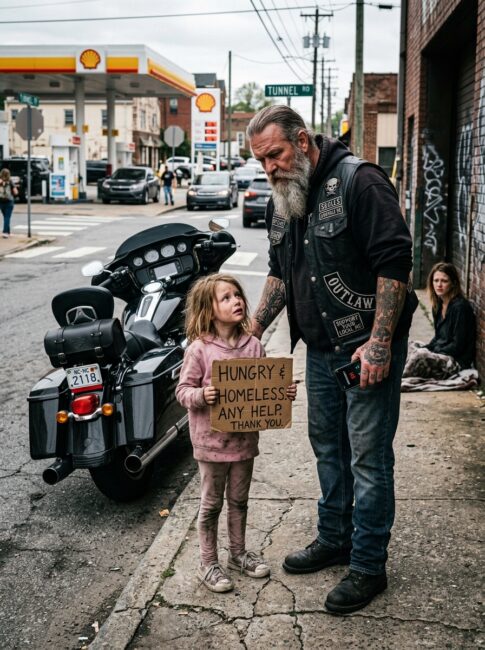
The social worker’s name was Denise Carter, and she smelled like peppermint gum and rain.
She knelt beside the booth, not too close, and told me my mother was at the hospital. She said doctors were helping her. She said I was going to stay somewhere safe for a little while. She said “foster home” carefully, like the words might bite me.
I looked at Grizzly.
He looked at the coffee cup.
“Am I in trouble?” I asked.
Denise shook her head. “No, sweetheart.”
“Is Mama?”
No one answered fast enough.
That was how I knew.
Children hear truth in pauses.
My mother had struggled with pills after a car wreck when I was four. That is how she explained it later. Pain first. Medicine next. Then needing the medicine after the pain should have been gone. Then needing other things when the medicine stopped coming. Adults like clean timelines, but addiction is not clean. It leaks under doors. It takes the grocery money. It makes a mother promise breakfast while her hands shake too badly to open a jar.
But she loved me.
Both things were true.
That is another thing people have trouble holding.
Denise drove me to a foster home near Black Mountain. A woman named Mrs. Alvarez opened the door wearing slippers and a worried face. Her house smelled like laundry soap and chicken soup. There was a little bedroom with a yellow quilt and a lamp shaped like a moon.
Before I got out of the car, I grabbed Grizzly’s sleeve.
He had followed us on his Harley.
“Will I see you again?” I asked.
He looked surprised. Like nobody had expected him to matter.
Then he squatted down on the sidewalk. His knees cracked. His leather cut creaked. The moonlight made his beard look silver.
“Every week,” he said.
“Promise?”
He looked me right in the eyes.
“Thursday.”
That was all.
I thought adults lied when they were trying to leave gently. I had heard too many promises made in parking lots, clinics, shelters, and church basements. “Tomorrow.” “Soon.” “When things get better.” “I’ll be right back.”
But the next Thursday, at 4:07 p.m., I heard a Harley engine outside Mrs. Alvarez’s house.
Not loud for showing off.
Low. Careful. Like even the motorcycle knew it was near children.
Grizzly came up the walkway holding a brown paper bag.
Inside were two biscuits, a pack of crayons, and a used copy of Charlotte’s Web with somebody else’s name crossed out inside the cover.
“You read?” he asked.
“A little.”
“You’ll read more.”
That was week one.
Week two, he brought a stuffed bear missing one eye. He had sewn a black button in its place with thread so thick it looked like rope.
Week three, he brought hair ties because Mrs. Alvarez told him I kept losing mine.
Week four, he came during a storm, soaked through, water dripping from his beard onto the porch. Mrs. Alvarez told him he could have called.
He said, “Thursday.”
That was it.
Meanwhile, my mother was fighting for her life in a hospital bed.
Then rehab.
Then a program.
Then relapse.
Then back.
Nobody tells the truth about recovery in neat stories. It is not one straight road with sunlight at the end. It is a road with ditches. My mother fell into some. Climbed out of others. Sometimes she called and sounded like herself. Sometimes she did not call at all.
For six months, Grizzly came every Thursday.
He never said bad things about my mother. Not once.
When I got angry, he let me be angry. When I cried, he sat on the porch steps and looked at the yard until I stopped. When I asked if Mama loved the pills more than me, his hands tightened on his knees until his knuckles went white.
Then he said, “Sickness ain’t love. Don’t confuse the two.”
I thought that was the lesson.
I thought the story was about a biker keeping a promise to a lonely kid until her mother got better.
It was not.
The real twist was why he chose me in the first place.
Six months after the day at the gas station, my mother walked into Mrs. Alvarez’s living room wearing jeans that hung loose on her hips and a sweater from the rehab donation closet.
She looked smaller.
But her eyes were clear.
I did not run to her at first. I wanted to. My body did. My feet almost did. But my heart had learned caution before it learned multiplication. So I stood by the couch, holding the one-eyed bear Grizzly had fixed.
Mama saw that.
It hurt her.
Good. Not because I wanted revenge. Because truth should hurt when it needs to.
She knelt down and said, “Hi, baby.”
I said, “Hi.”
Grizzly was outside on the porch when it happened. I could see him through the curtain, sitting on the steps with his elbows on his knees, pretending to examine a loose buckle on his boot. He had brought biscuits that day too. Three of them. One for me. One for Mrs. Alvarez. One he said was extra.
It was for my mother.
Denise explained the plan. Supervised visits first. Then weekends. Then home, if Mama stayed in treatment, stayed clean, kept appointments, and kept a job. There were so many rules they made my head hurt.
Mama said yes to every one.
Then she asked if she could thank the man who had called 911.
Grizzly came inside and stood near the door like he was ready to leave if anyone asked him to. He had faced bar fights, courtrooms, storms on mountain roads, and men twice as mean as him. But a sober young mother saying thank you made him look scared.
Mama walked up to him.
“You saved my life,” she said.
He shook his head. “Paramedics did.”
“You saved my daughter.”
“Food did.”
“You kept coming back.”
He had no answer for that.
So she hugged him.
Grizzly froze. Both arms at his sides. Eyes wide. Like a tree being hugged by a bird.
Then his right hand rose slowly and patted her shoulder once.
Not soft. Not graceful.
But real.
That was when I saw the bluebird tattoo again.
Mama saw it too.
She touched her own wrist.
I had never noticed the tiny scar there, shaped like a thin white comma.
“You lost someone,” she said.
Grizzly looked away.
Mrs. Alvarez took me to the kitchen then, but adults forget that kitchens have doorways and children have ears.
I heard pieces.
Daughter.
Birdie.
Three years old when his wife left.
He was drunk too often, angry too often, absent even when he was home. One night, after he punched a wall beside the crib and scared his own child awake, his wife packed two bags and disappeared while he was sleeping it off.
He never saw Birdie again.
Not because she died.
Because he had become the kind of man a child needed saving from.
That was the twist.
Grizzly did not stop for me because he was naturally good. He stopped because, thirty years earlier, nobody had stopped him before he lost his little girl. He had spent three decades trying to become the kind of man who would have deserved one more visit.
When he saw me on that corner, hungry and still standing, he did not see a stranger.
He saw the last chance he never got with Birdie.
And he did not waste it.
After that day, the pieces started fitting together.
The bluebird tattoo was not decoration. It was a name he could not say easily.
The way he never stood too close to me until I moved first was not coldness. It was discipline. He had learned that big men scare small children even when they mean well.
The biscuits were not random. Birdie used to love biscuits from a diner near Knoxville. He had taken her there twice before everything broke. In his mind, food meant apology. Food meant I am here. Food meant no kid should sit in a room wondering if adults forgot dinner.
Even the Thursday promise had a reason.
Thursday was the day the court papers came thirty years earlier, telling him his wife had filed for full custody and left the county. He got drunk that night. Then the next Thursday. Then many Thursdays after that. For years, Thursday was the day he destroyed himself a little more.
Then I asked him to come back.
So he changed what Thursday meant.
Bikers do not always talk about healing. They act like that word belongs to counselors and church ladies. But I watched a rough old man rebuild a day of the week with biscuits, library books, and porch visits.
The Ridgeback Riders noticed too.
At first, they teased him.
“Grizzly got a kindergarten route now?”
“Don’t forget story time, old man.”
He would glare, and they would shut up because nobody really wanted him mad. Then one Thursday, a prospect named Eli rode with him and waited outside Mrs. Alvarez’s house. The next week, Eli brought sidewalk chalk. A month later, two more club members donated winter coats to my foster home. By Christmas, the whole club had adopted Mrs. Alvarez’s house without saying the word adopted.
They fixed the porch rail. Changed the oil in her minivan. Put new tires on Denise’s county car after they found out she was driving on bald ones because the department budget was frozen.
Brotherhood, I learned, is not always men calling each other brother in loud rooms.
Sometimes it is a bunch of bikers pretending they just happened to have extra groceries.
My mother worked her program like someone climbing a mountain with bleeding hands. She went to meetings. She cleaned motel rooms. She took a bus to appointments. She called me every Tuesday and Saturday. If she missed a call, she had to explain why to Denise, Mrs. Alvarez, and me.
Grizzly never let her use shame as an excuse to quit.
Once, after a hard visit where I refused to hug her goodbye, Mama sat on the curb outside the foster home and cried into her hands.
Grizzly stood beside her.
She said, “Maybe she’s better without me.”
He said, “Don’t flatter your guilt.”
She looked up.
He said, “Kid needs her mama clean. Not gone.”
That was all.
No sermon.
Just a road sign.
A year after the overdose, Mama got her one-year chip. I went back home two months later to a small apartment above a florist shop on Haywood Road. The place smelled like lilies from downstairs and old radiator heat. My room was tiny. The window stuck. The carpet had a burn mark shaped like Florida.
It was home.
On the kitchen table that first night sat three things.
A plate of biscuits.
My one-eyed bear.
And a folded note from Grizzly.
Kid, home is a thing you keep doing.
He still came Thursdays.
Mama did not mind.
She said, “He came when nobody else did.”
Five years later, she would say it again.
Only this time, at our table.
Thanksgiving came on a cold evening with rain tapping the windows and the smell of roasted chicken filling our apartment because Mama said turkey was too much bird for three people.
I was twelve by then.
Taller. Louder. Less afraid of full plates disappearing.
Mama had been clean five years and had just graduated from her recovery counselor training program. She worked at a women’s center outside Asheville, helping mothers who came in with shaking hands and eyes that would not meet anybody’s face. She did not pretend to be better than them. That was why they trusted her.
I set the table for three.
Not two.
Three.
That was important.
I used the blue plates because they had no chips. I folded paper napkins into triangles because I had seen it in a video. I put the biscuits in the middle, covered with a towel to keep them warm.
At 6:02 p.m., the Harley rolled into the parking lot.
Even after five years, I knew his engine from any other. Low. Uneven. Like an old dog clearing its throat.
Grizzly came up the stairs carrying a pie from the grocery store and wearing the same black leather cut, though the seams looked tighter around his shoulders now. His beard was whiter. His tattoos had faded more. His boots were still heavy enough to announce him before he knocked.
Mama opened the door.
For a second, he stood there looking like he did not know what to do with being invited instead of needed.
Then Mama said, “Come in, Thomas.”
She almost never used his real name.
He stepped inside and wiped his boots on the mat twice.
Dinner was awkward for the first ten minutes because love can be awkward when nobody knows the rules. Grizzly sat too straight. Mama passed chicken. I talked too fast. Rain hissed against the window. Downstairs, the florist’s cooler hummed through the floor.
Then Mama raised her glass of sweet tea.
“I need to say something.”
Grizzly looked like he wanted to jump out the window.
Mama continued anyway.
“You have a role in my daughter’s family. You didn’t replace her father. You didn’t replace me. But you are the one who came when nobody else came.”
Grizzly stared at his plate.
His eyes went wet, but nothing fell.
Bikers do not cry easy.
They carry it in their jaw first.
I reached under the table and handed him something wrapped in notebook paper.
He opened it slowly.
It was a keychain I made at school. Crooked beads. Plastic letters. Too childish for a grown man with skulls on his vest.
UNCLE HERO.
He held it like it weighed fifty pounds.
Then he clipped it to the ring with his Harley key.
“Guess I got a title,” he said.
Mama smiled.
“You earned it.”
When Grizzly left that night, I followed him downstairs.
The rain had stopped, but the pavement still shone under the apartment lights. His Harley sat near the curb, black and silver and huge, with drops of water clinging to the seat. He put on his gloves slowly, buying time without admitting it.
I hugged him before he could escape.
At twelve, I was too tall to fit under his arm the same way. But he still smelled like leather, gasoline, diner coffee, and cold air. That smell meant safe to me now.
“You’re my Uncle Hero,” I said into his vest.
His chest moved once.
Hard.
He patted the back of my head with one scarred hand.
“Don’t go making me famous, kid.”
Too late.
He climbed onto the Harley, turned the key, and the engine woke up low enough to shake the puddles beside the curb. The new keychain swung below the handlebar. Crooked beads. Plastic letters. UNCLE HERO catching the apartment light every time it moved.
He pulled away slow.
At the corner, he stopped under a red light.
Later, Mama told me she saw him from the window. Saw his shoulders drop. Saw one gloved hand rise to his face before he turned onto Haywood Road.
He cried on that ride home.
First time in thirty years.
He told me that himself much later, in the usual Grizzly way, pretending it was about the cold.
“Eyes leaked,” he said. “Damn November air.”
Every Thursday after that, I still listened for the engine.
Low. Rough. Coming closer.
Then boots on stairs.
Then a knock.
Then home.
Follow the page for more biker stories about the rough-looking people who show up when the world looks away.