Part 2: A Biker Stopped Traffic for One Tiny Shoe — Then My Daughter Called Him Dad
My name is Rachel Monroe, and before that afternoon, I thought I knew what grief looked like.
I thought grief was folded flags and casseroles in foil pans. I thought it was a uniformed officer standing on my porch with another man beside him who would not meet my eyes. I thought it was the sound my mother made when she slid down my kitchen cabinets after I told her David was gone.
But grief changes shape.
Sometimes it is a toddler asking why every other kid at daycare made a Father’s Day card except her.
Sometimes it is a little girl pressing her palm to a framed photo and saying, “Night-night, Daddy,” to a man whose voice she never heard outside my phone recordings.
Sometimes it is a single pink shoe in the middle of a road.
David Monroe was not famous. Not rich. Not the kind of man people write songs about. He was a White American Army medic from Prescott with a crooked smile, too many opinions about diner coffee, and a soft spot for old motorcycles. He rode a Harley before he ever owned a decent couch. When we met, he smelled like gasoline, cheap soap, and spearmint gum. He kept a tiny wrench on his keychain and said a man should always be able to fix at least one thing he broke.
He found out I was pregnant two weeks before his last deployment.
He cried in the garage, not in front of me. I heard him anyway.
Men think garage doors hide everything.
His brothers rode with him the Sunday before he shipped out. Not a club exactly. More like veterans and mechanics and men who had pulled each other out of bad nights. They called themselves the mile markers, because none of them believed they were destinations. Just points along the road keeping each other from disappearing.
I met a few of them.
Not him.
Not the biker from the crosswalk.
At least, not that I remembered.
After David died, the motorcycles stopped coming around. I did not ask why. Maybe they thought the sound would hurt me. Maybe it hurt them. Maybe men are worse than women at standing in doorways with grief in their hands.
For three years, I raised Emma with pictures and stories.
“Your daddy liked pancakes burned at the edge.”
“Your daddy sang off-key.”
“Your daddy rode a big motorcycle.”
That last part stuck.
Emma called every motorcycle “Daddy bike” before she could say “motorcycle.” When a Harley passed our apartment, she would stop whatever she was doing and stare until the sound faded. I tried not to make too much of it. Children grab the pieces we leave within reach.
The day of the shoe, I had taken her to a thrift store off Route 66 because money was tight and she had outgrown nearly everything at once, as children do just to humble you. She found the princess shoes in a bin under a rack of Halloween costumes.
They were ridiculous.
Pink plastic. Glitter flaking off. Silver stars on the toes. One heel slightly bent. She held them to her chest like treasure.
“Daddy shoes,” she said.
“No, baby,” I told her. “Princess shoes.”
She shook her head. “Daddy find me.”
I almost put them back.
Not because of the money. They were three dollars.
Because some sentences land wrong when you are tired.
But she loved them, so I bought them. Then we walked to the diner for grilled cheese because some days a child needs something golden and simple and you need to sit somewhere nobody asks if you are doing okay.
I did not know a Harley would follow us to the light.
I did not know the man riding it had a folded photo in his vest.
And I did not know the tiny star on Emma’s shoe would pull an old promise out of him.
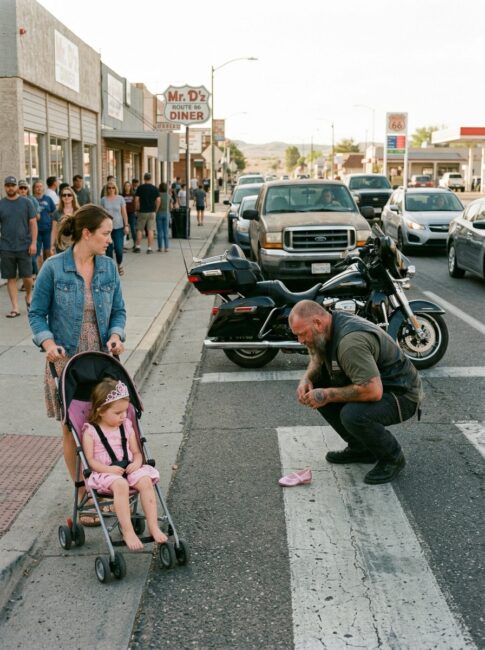
It was 4:17 in the afternoon when the light changed.
I know because the video showed the bank clock behind us.
The heat was coming off the asphalt in waves. A diesel truck idled near the gas station. Somewhere, a loose sign clanged against a pole. The world smelled like hot rubber, fryer oil, and dust.
Emma was tired. The kind of tired that makes toddlers heavy even when they are sitting down. Her tiara had slipped sideways. Her cheeks were sticky from apple juice. She had one foot kicked up on the stroller tray and the other dangling.
I remember looking at the walk signal and thinking, hurry.
That thought still makes me angry.
Mothers hurry all the time. Hurry through crosswalks. Hurry through grocery stores. Hurry through grief because bills do not pause and children still need baths.
Halfway across, Emma leaned to point at a mural painted on the side of an old brick building. It had a red car, a desert sunset, and the words “Historic Route 66” curling like smoke. Her little leg bumped the side of the stroller.
The shoe fell.
I did not hear it.
A pink princess shoe does not make much sound when it hits a white stripe.
The Harley behind us did.
That engine had been part of the traffic noise until it suddenly wasn’t. It cut clean off, leaving only horns and heat and a few people yelling from windows.
I turned because I thought something bad had happened.
A big man was already off the bike.
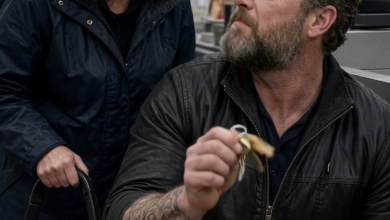
He had stopped right behind the crosswalk, one boot down, one hand still near the handlebar. His motorcycle sat angled across part of the lane, blocking the impatient SUV behind him. The driver of the SUV, a White American woman in her 40s with sunglasses pushed into her hair, threw both hands up. A Black American man in a delivery van leaned out and shouted, “Come on, man!”
Then they all saw what he saw.
The shoe.
Small. Pink. Alone.
He stepped into the crosswalk.
That is when the truck driver started yelling.
“Move that bike!”
The biker bent anyway.
His leather cut shifted, and I saw the patch on his chest. Not a gang symbol. Not anything flashy. Just a worn rectangle with three letters: DOC.
I knew that patch.
David’s Army friends used to call medics that.
The biker picked up the shoe.
His hand shook once.
Not much. Just a quick tremor in the fingers before he closed them around the little thing. His jaw tightened under his beard. His eyes stayed on the shoe longer than made sense.
Then he looked at Emma.
I should have smiled. I should have understood.
Instead, fear got there first.
He was too big. Too rough. Too sudden. A stranger stepping out of traffic with scarred hands and tattoos up both arms. I pulled the stroller back toward the curb and put myself between him and my daughter.
He noticed.
Of course he did.
Men like him notice when rooms turn cold. When strangers measure them. When mothers decide whether they are safe.
He slowed.
He held the shoe out where I could see it.
“Ma’am,” he said, voice low and gravelly, “this belonged to your little girl.”
His voice was not gentle exactly. It had too much road in it. But he tried.
Emma leaned around me.
Her eyes locked on him.
Not on the shoe.
On him.
The horns quieted one by one, as if the street had started listening.
The biker crouched.
His knees cracked. Leather creaked. His shadow fell across the sidewalk, wide and dark. He held the shoe with both hands now, careful as communion.
“Princess lost her slipper,” he said.
Emma’s mouth opened.
Her lower lip trembled.
Then she reached for his beard, the way she reached for David’s photo on my nightstand.
“Daddy?”
The word hit me in the chest so hard I could not breathe.
The biker went still.
Everything did.
The SUV. The delivery van. The truck driver. The people at the diner window. Me.
His eyes lifted to mine.
I saw it then.
Not confusion.
Recognition.
And grief.
My husband died before our daughter took her first breath.
That is the part strangers did not know when the video went viral.
They saw a little girl mistake a biker for her father and thought it was sweet, heartbreaking, maybe just one of those moments children create because they do not understand death yet.
But Emma had never called any man Daddy.
Not my brother. Not my father. Not the kind neighbor who fixed our sink. Not the young mailman who always waved at her.
Never.
She had saved that word for a photograph and a folded flag.
So when she said it to the biker, I almost dropped to my knees right there on the sidewalk.
The biker did not reach for her.
That mattered.
A lesser man might have leaned into the moment. Might have smiled for the cameras already pointed our way. Might have said something big and warm and made himself the center of a wound that did not belong to him.
He did not.
He stayed crouched where he was.
Close enough to return the shoe.
Far enough to let me decide.
His face worked once, like he was swallowing broken glass. His tattooed thumb rubbed the little silver star on the toe of the shoe. Then he looked at Emma and spoke in the softest voice I had ever heard come out of a man that size.
“No, sweetheart.”
Two words.
They hurt.
Emma blinked.
He took a breath.
“I’m not your daddy.”
Her little face folded.
I hated him for one second. Not because he was wrong. Because he was right.
Then he added, “I’m just the man bringing the shoe back to the right princess.”
The whole sidewalk broke open.
Not loudly. Not all at once. But you could feel people change. The woman in the SUV covered her mouth. The delivery driver looked down at his steering wheel. A waitress from the diner wiped her eyes with the corner of her apron. The man who had yelled from the truck leaned back inside like shame had pulled him by the collar.
I crouched beside Emma.
“He brought your shoe back, baby,” I whispered.
The biker held it out.
Emma took it with both hands, still staring at him.
“You ride Daddy bike,” she said.
His eyes moved to me again.
I do not know what he saw on my face. Maybe panic. Maybe apology. Maybe the kind of grief only another grieving person can read at a glance.
He reached slowly into the inside pocket of his leather cut.
I tensed before I could stop myself.
He saw that too.
“Just a picture,” he said.
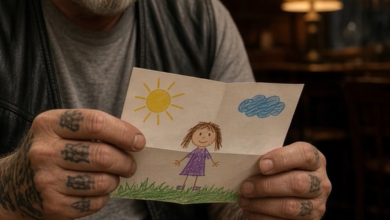
He pulled out an old photograph, folded at the corners, softened by years of being carried close to a body.
Three soldiers stood beside a dusty ambulance overseas.
One of them was the biker, younger, darker beard, same hard eyes.
One of them was my husband.
David had his arm around the biker’s shoulders.
On the back, in David’s handwriting, were four words.
“Get home, brother. — D.”
My hand went to my mouth.
The biker looked at the photo, then at Emma.
“He talked about you,” he said.
I shook my head. “He didn’t know her.”
The biker’s voice cracked, but only barely.
“He knew enough.”
His name was Cal Mercer.
White American. Fifty-one years old. Former Army medic. Mechanic. Rider. A man with a face that made strangers nervous and a habit of stopping for things other people drove around.
He told me almost nothing on that sidewalk.
That came later.
At first, all he did was help Emma put her shoe back on.
He did not touch her foot until she pushed it toward him. Even then, he looked at me first. I nodded because I had no words left.
His hands were enormous around that little shoe. Scarred. Oil-dark in the creases. Tattooed across the knuckles with letters too faded to read clearly. But he fastened the tiny strap like he was disarming a bomb.
“Too tight?” he asked.
Emma shook her head.
“Good.”
That was all.
A police cruiser rolled slowly past, then kept going once the officer saw traffic moving again. The light changed twice before anyone remembered they had somewhere to be.
Cal stood.
He was taller than I had realized. Or maybe grief made me feel small.
“Your husband was a good man,” he said.
People say that after funerals. Most of the time, they mean it politely. Cal did not sound polite. He sounded like the sentence had weight.
“You knew David?” I asked.
He looked toward his Harley.
“I knew Doc Monroe.”
My husband had been a medic, but he hated being called hero. He said hero was a word people used when they did not want to talk about fear, dirt, bad luck, and the men who did not come back.
Cal folded the photo and put it away.
“Last night over there,” he said, nodding toward a place I could not see, “your husband shoved me into a ditch before the blast hit.”
I stopped breathing.
“He saved you?”
Cal’s mouth tightened.
“He saved a lot of us.”
There are moments when a dead man becomes larger and smaller at the same time. Larger because you learn another piece of what he gave. Smaller because you remember he was flesh. Afraid. Young. Someone who wanted pancakes and a daughter and a garage full of unfinished projects.
Cal looked at Emma.
“She got his eyes.”
I had heard that before. From family. From friends. From women at church who meant well.
But from him, it felt different.
Because he had seen those eyes in a place I never would. Under dust. Under fear. Under a helmet. Looking at another man and deciding to push him out of death’s way.
The video people later shared did not catch most of this.
It caught the shoe. The kneel. The “Daddy?” The answer that broke everyone. Then it cut off when the driver recording it started crying.
So the internet made Cal into a perfect stranger who appeared from nowhere.
But he was not nowhere.
He was one of the mile markers.
He had been at David’s memorial, he told me later, standing outside the chapel because he could not make himself go in. He had seen me from across the parking lot, pregnant, wearing David’s jacket over my black dress. He had heard the bugle and walked away before the folding of the flag because he said if he stayed, he might not stop shaking.
He had carried David’s photo in his vest for three years.
The little silver star on Emma’s shoe got him. That was another seed I understood too late.
David used to draw stars on letters he sent me. Not hearts. Stars. He said hearts were too obvious.
On the last letter he mailed before he died, he wrote: “Tell the kid I’ll bring her the moon if she asks, but I’m starting with stars.”
Cal had seen one of those letters. David showed it to him overseas, laughing like a fool, proud before fatherhood had even reached his arms.
So when Cal saw a little pink shoe with a silver star lying in the road, he stopped.
Not because he knew it was ours.
Because once, a dead man had promised stars to a daughter he never got to hold.
Cal did not tell me all that like a speech. Bikers don’t usually hand you their wounds tied up in ribbon.
He gave it in pieces.
A sentence in the diner.
A name in the parking lot.
A photo across a Formica table.
And when I thanked him too many times, he shook his head.
“No debt,” he said.
“Then why did you stop?”
He looked outside at the Harley, at the traffic moving again, at the white crosswalk stripe where the shoe had been.
“Somebody should.”
The driver who recorded the video was named Marcus Hill, a Black American father of two who drove a delivery route through Kingman every weekday.
He posted it that night with the caption:
“Not every hero comes to stay. Some just stop at the right second.”
By morning, people had shared it from Arizona to Ohio. By lunch, strangers were arguing in the comments about bikers, soldiers, fathers, grief, and whether men with tattooed arms should be judged before they open their mouths.
Cal hated it.
I know because Marcus found him two days later at a gas station on Andy Devine Avenue and tried to apologize for posting without asking. Cal was checking tire pressure beside the air pump, boots dusty, coffee balanced on the curb.
“You made me look soft,” Cal said.
Marcus did not know whether to laugh.
Then Cal added, “Kid get her shoe?”
That was all he cared about.
After that, he started showing up sometimes.
Not often.
Never announced.
A little pack of sidewalk chalk left on our porch. A used children’s book about motorcycles tucked into the screen door. Once, a tiny helmet charm for Emma’s backpack. He never knocked if he could avoid it.
The first time Emma saw his Harley outside our apartment, she ran to the window.
“Mr. Shoe,” she shouted.
Cal stood beside the bike, looking like he had faced easier things than a three-year-old with a juice stain on her shirt.
“Mr. Shoe?” I asked.
He shrugged. “Been called worse.”
Every year now, on David’s birthday, Cal rides through Kingman before sunrise. He stops at the same crosswalk. Not long. Just enough to put one boot down and look at the white stripes.
Then he rides to the veterans memorial near the park and leaves a silver paper star under David’s name.
No note.
No speech.
Just a star.
Emma is six now.
She knows Cal is not her father. She knows David was. She knows one man gave her life, and another brought back a shoe when the road tried to keep it.
Sometimes children can hold truths adults make too heavy.
Cal still carries David’s photo.
The corners are worse now. Softer. More worn. He says he should put it in plastic. He never does. Some things are meant to be touched.
Last week, Emma lost another shoe.
Not in traffic this time. In our hallway, under a pile of laundry she swore was “a castle.”
She came running out with one foot bare and one foot wearing a purple sneaker, yelling, “Mommy, Mr. Shoe would find it.”
I laughed before I cried.
That is how grief works now. It mixes.
That afternoon, we walked to the diner on Route 66. Cal was there, sitting alone at the counter, black coffee in front of him, leather cut hanging off the chair, tattoos showing under rolled sleeves. People still glanced at him when they came in. Some old habits take longer to die.
Emma climbed onto the stool beside him.
“I lost a shoe,” she announced.
Cal looked down at her purple sneaker.
“Again?”
She nodded seriously.
He reached into his vest pocket and pulled out David’s old photo, just far enough for her to see.
“Your daddy ever tell you something?”
She leaned close.
Cal tapped the picture once.
“Princesses keep walking.”
Emma smiled.
Outside, the Harley waited in the sun, metal ticking softly, one boot print near the curb, Route 66 humming like it always had.
Cal finished his coffee.
Emma swung one purple sneaker under the stool.
Some men come into a story like thunder.
Some leave like mercy.
Follow the page for more biker stories about strangers who stop when the world keeps moving.