Part 2: A Biker Took My Son at a Bus Stop — Then the Bus Hit Where He Stood
My name is Claire Bennett.
Before that morning, I did not have a strong opinion about bikers. I had the usual kind of opinion people pretend is not prejudice.
I did not hate them.
I just watched my purse when they walked into the same gas station.
I moved Noah to the other side of me when a group of them came through a restaurant.
I thought I was being careful.
That day taught me the difference between careful and blind.
The biker’s name was Jonah Briggs, though most people in his club called him “Bear.” That fit him. He was enormous, heavy-shouldered, with hands like work gloves and a beard that covered half his chest. He wore a black leather cut from a club called Road Mercy MC. The back patch was a worn-out desert raven. The front had old pins, a faded veteran patch, and one small square of cloth sewn badly near his heart.
A yellow school bus.
I did not notice that patch at the bus stop.
I noticed everything else.
The scar on his cheek. The tattoos wrapping his arms. The way his boots hit the pavement. The chain on his wallet. The hard look in his eyes when he crossed the street toward my child.
Later, I learned that Jonah had been a school bus mechanic for twenty-two years before he ever joined a motorcycle club.
He knew the sound of failing brakes.
Not guessed.
Knew.
He could hear air pressure drop wrong. He could hear a brake chamber fail. He could hear the panic in a driver’s horn the way a mother hears fever in a child’s cry.
But that was not the whole reason he moved.
The whole reason was buried ten years earlier on a rainy road outside Santa Rosa.
Jonah’s wife, Marlene, had driven a school bus. She loved kids more than adults, which Jonah said made her smarter than most people. One winter morning, a truck crossed the center line. Marlene swerved the bus away from it, put herself into a ditch, and saved twenty-three children.
She died before Jonah got there.
After that, he stopped fixing buses.
Stopped sleeping well.
Started riding.
Not because motorcycles made him free. He hated that word when people used it too easily.
He rode because the engine was loud enough to keep the memory from talking all the time.
Road Mercy MC found him at a diner outside Tucumcari three years later, drinking coffee with both hands wrapped around the cup like it was holding him up. Their president, a black American man in his early 60s named Curtis “Deacon” Hale, sat beside him and said, “Brother, grief will eat alone if you let it.”
Jonah did not answer.
Deacon left a card anyway.
The club was rough around the edges. Some veterans. Some ex-cons. Some men who had buried wives, children, brothers, and better versions of themselves. They did charity rides, escorted funeral processions, fixed vehicles for single parents who could not afford repairs, and showed up for people who had nobody else to call.
Jonah fit them because he did not talk much.
He worked.
That was his language.
If a widow needed her radiator fixed, Jonah fixed it. If a kid’s bike chain broke outside the garage, Jonah knelt down and fixed that too. If someone cried, he usually left the room and came back with coffee.
The yellow bus patch was for Marlene.
His hands had sewn it himself.
Badly.
Crooked.
With thread too thick.
He never let anyone fix it.
“Looks like she made it,” he told Deacon once. “She couldn’t sew worth a damn either.”
That little patch sat near his heart the day he crossed Central Avenue and took my son from my hand.
I wish I had seen it first.
But fear does not look for details.
Fear writes its own story.
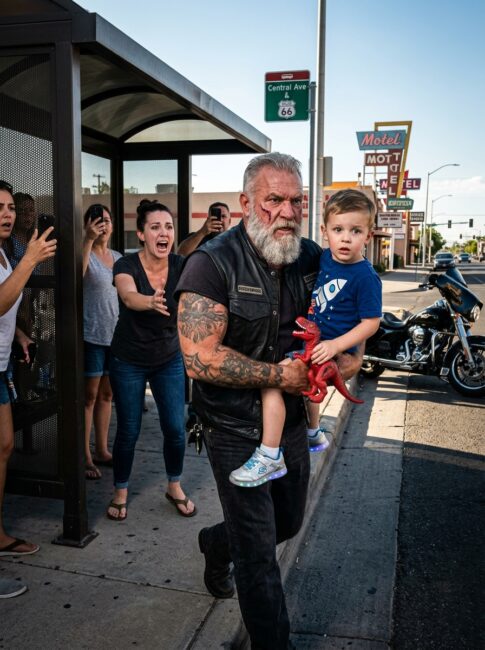
It was 9:17 in the morning.
I know because I checked my phone while Noah asked if buses had belly buttons.
We were going to the library.
My car was in the shop. My husband was working a double shift. Noah had been bouncing around the apartment since 6 a.m., so I decided we would take the bus downtown, get picture books, maybe split a cinnamon roll if he behaved like a civilized human for more than ten consecutive minutes.
The bus stop was busy.
An older Hispanic American woman with grocery bags. A college kid with headphones. A white American man in a construction vest drinking burnt gas station coffee. Two teenagers sharing earbuds. A nurse in purple scrubs. Me and Noah.
Across the street, Jonah waited at the light on his Harley-Davidson Road King.
He had just left a parts store.
His club brother Manny “Socket” Alvarez was behind him on another Harley, and Deacon was in a pickup across the intersection hauling donated tires to the club garage.
That mattered later.
Three witnesses who saw the same thing from three different angles.
I did not know any of them then.
The city bus came down Central from the east.
Route 766.
Blue and white.
Normal.
For two seconds, nothing about it looked dangerous.
Then Jonah’s head turned.
He heard something.
Manny heard it too, but later he said Jonah moved before his own brain found the words.
The bus was slowing for the stop, but not enough. Its front end dipped, then jerked. The driver hit the horn. Once. Then held it.
That sound changed everything.
It was not traffic anger.
It was fear.
Jonah looked from the bus to the shelter.
To Noah.
My son had stepped half a foot forward because he loved buses. He always wanted to see the doors open. He was standing near the exact edge of the metal shelter, one little shoe on a crack in the sidewalk.
Jonah had four seconds.
That was what the police report said later.
Four seconds between the bus horn and the impact.
Four seconds to choose whether to shout, point, run, or watch.
He ran.
He killed the Harley’s engine so hard the bike rocked under him. His boots hit the pavement. Leather snapped. He crossed the road against traffic with his arms pumping, beard flying, face set like violence.
That is why we misunderstood.
Good men do not always look gentle when they are racing death.
He hit the curb in one stride.
I looked up and saw him coming at my child.
Not at the bus.
Not at danger.
At Noah.
I pulled Noah closer, but Jonah was faster.
His big hands went under Noah’s arms.
Noah’s dinosaur fell.
I screamed.
The old woman screamed.
The construction worker yelled and threw his coffee down.
Jonah carried Noah away from the shelter and set him on the sidewalk near a newspaper box. He did not throw him. Did not drop him. Set him down like something holy.
Then he turned back.
I slapped him before he could speak.
The sound cracked across the bus stop.
His cheek reddened under his beard.
He did not flinch much.
That made me angrier. I wanted him to react. I wanted him to be the monster I had already decided he was.
“What did you do?” I screamed.
Noah was crying behind him.
The crowd was closing in.
Phones were out.
The construction worker stepped toward Jonah with both fists tight.
Manny was running from the other side of the road now, shouting, “Back up! Back up!”
Nobody listened.
Then Jonah looked past my shoulder.
His eyes widened.
He raised one hand, not to stop me from hitting him again, but to stop me from stepping backward.
“Don’t move.”
His voice was low.
Terrible.
The bus horn swallowed the street.
I turned.
The bus jumped the curb.
Metal screamed.
Glass burst.
The shelter folded inward like it was made of foil.
The bench where Noah had been standing disappeared under the front corner of the bus.
There is a silence after a crash that is not really silence.
It is full of ringing.
Full of dust.
Full of people trying to understand why the world has changed shape.
The bus had slammed into the shelter, crushed the bench, tore down the route sign, and shattered the glass panels into thousands of greenish pieces. One metal support bent exactly where Noah’s head would have been.
I saw his red dinosaur under the bus tire.
That was the moment my knees failed.
I turned and saw Noah standing five yards away, crying but alive, clutching the newspaper box with both hands.
Jonah was already moving again.
Not toward praise.
Toward the bus.
The driver was slumped over the wheel, awake but stunned, a white American man in his 50s with shaking hands and a face the color of paper. Jonah climbed onto the first step through the broken doorway and put one hand on the driver’s shoulder.
“You breathing?”
The driver nodded, gasping.
“Stay still.”
Manny called 911. Deacon pulled his pickup sideways to block traffic. Jonah checked the passengers one by one with the calm of a man who had seen metal bend before.
No one at the stop had serious injuries.
A miracle.
That word gets overused, but I do not know what else to call it.
A piece of shelter glass had cut the construction worker’s arm. The nurse in purple scrubs was already helping him. The older woman was praying in Spanish. The college kid stood frozen with his headphones still on, tears running down his face.
And me?
I crawled to my son.
Crawled.
I could not stand.
I grabbed Noah so hard he cried louder. I checked his face, arms, chest, legs. I kept saying his name like a broken machine.
“Noah. Noah. Noah. Noah.”
He sobbed, “Mommy, my dinosaur.”
That nearly destroyed me.
Because the dinosaur was gone.
Because he was not.
I looked back at Jonah.
He was stepping off the bus now, one hand bleeding from broken glass, his leather vest dusted white, the yellow bus patch near his heart dark with sweat.
That was when I saw it.
The crooked little school bus stitched into the leather.
My handprint was still red on his cheek.
I tried to speak.
Nothing came out.
So I did the only thing my body knew to do.
I reached for him.
He saw me coming and stiffened, like he expected another hit.
Instead, I wrapped one arm around Noah and the other around Jonah’s waist because he was too big to reach properly, and I broke open right there on the sidewalk.
“I’m sorry,” I kept saying.
Over and over.
“I’m sorry. I’m sorry. I’m sorry.”
Jonah did not hug me back at first.
His arms hung at his sides.
Then one huge hand settled lightly on my shoulder.
Not claiming forgiveness.
Just keeping me upright.
He said, “Kid’s okay?”
I nodded into his vest.
He looked down at Noah.
“You okay, little man?”
Noah sniffed.
“My dinosaur died.”
Jonah’s face changed.
Just a little.
He looked toward the crushed toy under the bus tire.
Then he said, “He went down brave.”
Noah stopped crying for half a breath.
That was the twist inside the twist.
The man I thought had stolen my son was the only one there who knew how to speak to him after saving his life.
Police arrived. Firefighters arrived. Ambulances. Transit supervisors. News vans.
The story became public before my heartbeat slowed down.
At first, witnesses said a biker grabbed a child.
Then the crash footage came out.
A traffic camera across Central Avenue showed everything.
Jonah at the red light.
The bus approaching.
His head turning before anyone else reacted.
His bike shutting down.
His body moving.
Four seconds.
That was the number everyone repeated.
Four seconds to hear the wrong sound.
Four seconds to see the wrong future.
Four seconds to decide that a stranger’s child mattered more than being misunderstood.
The bus driver’s brakes had failed suddenly. Investigators later said he had done everything he could. He was not drunk. Not distracted. Not reckless. Just unlucky in a machine that betrayed him.
That mattered to Jonah.
When people started blaming the driver online, Jonah hated it.
He refused interviews until one local reporter caught him outside Road Mercy Garage two days later. His hand was bandaged. His cheek still had a faint mark from my slap. He looked miserable in front of the camera.
The reporter asked, “Do you blame the driver?”
Jonah’s answer was six words.
“No. Metal fails. People panic.”
Then he walked back inside.
That clip went viral.
So did mine.
I posted the first Facebook message that night because I had no other way to find him. He had left before I got his number. Before I got his last name. Before I could thank him without sobbing.
The post read:
“To the biker who grabbed my son at the Central Avenue bus stop today: I thought you were hurting him. I hit you. You saved him. Please let me apologize properly.”
I included a photo of Noah holding a new red dinosaur in the emergency room, his cheeks still blotchy from crying.
The internet found the club before I did.
Road Mercy MC.
Albuquerque.
Jonah “Bear” Briggs.
People called him a hero.
He ignored most of it.
His club did not.
Deacon called me three days later.
His voice was deep and careful.
“Ma’am, Bear isn’t much for attention.”
“I don’t want attention,” I said. “I just want to say thank you.”
There was a pause.
“He knows.”
“That’s not enough.”
“For him, it might be.”
I did not understand then.
Later, Manny told me about Marlene.
About the wife who drove a school bus.
About the crash.
About the patch.
About Jonah leaving bus work because every hiss of brakes made him hear the phone call again.
Suddenly every seed made sense.
He did not just hear a bus losing control.
He heard the past coming back with my son standing in front of it.
He ran at Noah like he was running at the day he could not change.
And this time, he made it.
That knowledge did something to me.
It changed the shape of gratitude.
I had thought I owed him thanks for saving my son.
I did.
But I also owed him something heavier.
I owed him the truth that his worst memory had not only hurt him.
It had trained him.
That is a terrible kind of gift.
A gift nobody would ask for.
A gift that saved my child anyway.
For months, I tried to reach him.
Road Mercy protected him like family. They were polite, but firm.
“He’s not ready.”
“He got your card.”
“He says the boy’s smile in the photo is enough.”
That sounded noble.
It also made me mad.
Because gratitude needs somewhere to go.
So I sent photos.
Noah at the library.
Noah starting preschool.
Noah asleep with his new dinosaur.
Noah standing beside a toy bus, grinning.
I never knew if Jonah saw them.
But one year later, at a charity event outside a community center on Route 66, I found out.
Road Mercy MC hosted the event every spring.
Free oil changes for single parents. Car seat checks. Hot dogs. Bottled water. A raffle for grocery cards. Nothing fancy. Just useful.
I went because Deacon invited me.
Noah was five by then, taller, louder, missing no opportunity to tell strangers he liked volcanoes more than buses now. He wore a red dinosaur shirt on purpose. I carried the old broken dinosaur’s replacement in my purse like a weird little holy object.
The parking lot was full of Harleys.
The sound rolled between the buildings, engines starting and stopping, pipes thumping, boots scraping gravel, men laughing too loud because quiet made them uncomfortable. The air smelled like grilled onions, motor oil, sun-warmed leather, and cheap coffee.
Then I saw him.
Jonah stood near the car seat inspection table, arms crossed, watching a young mother struggle with a buckle. He looked exactly the same and somehow older. Big gray beard. Tattooed arms. Black cut. Heavy boots. Yellow bus patch still crooked near his heart.
He stepped forward, adjusted the car seat strap with two fingers, then backed away before the mother could fuss over him.
I could not move.
For a full minute, I just watched him.
Noah tugged my hand.
“Mommy?”
Jonah heard that.
His head turned.
Our eyes met.
He recognized me immediately.
Not with surprise.
With something softer.
Like he had been expecting this road to circle back one day.
I walked toward him.
I had practiced words in my head for a year.
Thank you.
I’m sorry.
You saved my son.
Your wife would be proud.
None of them came.
When I reached him, I just hugged him.
Both arms around that huge leather vest.
Face against the yellow bus patch.
I held on for five minutes.
Maybe less.
Maybe more.
Time gets strange around the things that almost took everything.
Jonah did not pull away.
After a moment, one big hand came to rest between my shoulders.
Noah stood beside us, looking up at the biker like he was trying to remember a dream.
Finally Jonah said, “I recognize you.”
His voice was rough.
Then he looked down at Noah.
“Kid doing okay?”
I nodded because I could not speak.
Noah lifted the red dinosaur.
“This one didn’t die.”
Jonah looked at it.
Then at him.
“Good. Brave ones deserve backup.”
Noah smiled.
That was when Jonah’s eyes filled.
He turned his head before anyone could see too much.
Biker culture, I had learned, gives men a thousand ways to bleed and almost no safe way to cry.
So Deacon, standing ten feet away, saved him.
“Bear,” he called. “Need help with a minivan.”
Jonah cleared his throat.
“Yeah.”
But before he walked away, he tapped the dinosaur gently with one finger.
Then he tapped the crooked yellow bus patch.
Noah watched him go.
“Mommy,” he whispered, “is he our friend?”
I looked at Jonah’s broad back, the leather creaking as he bent to help another stranger’s child sit safer in another stranger’s car.
“Yes,” I said.
“Our friend.”
Every April, we go back.
Noah calls it “the motorcycle picnic.”
He is seven now. He knows the story, but only in pieces. He knows a biker moved him before a bus crash. He knows Mommy cried. He knows the red dinosaur was replaced.
He does not know how close the world came to ending under a bus shelter on Central Avenue.
Not yet.
One day I will tell him more.
I will tell him that heroes do not always arrive looking gentle.
Sometimes they arrive smelling like gasoline and road dust.
Sometimes they have scarred hands and skulls on their vest.
Sometimes they save your life so fast your own mother mistakes them for danger.
Jonah never lets us make a big deal of him.
At the charity event, he kneels when Noah talks. Always kneels. A man that large choosing to be small still gets me.
His Harley waits nearby, black paint dusty, engine ticking as it cools. The yellow bus patch sits crooked over his heart. He still refuses to fix the stitching.
Last time we left, Noah ran back and hugged his leg.
Jonah froze, then rested one hand on his head.
“Ride safe, little man,” he said.
“We’re in a car,” Noah told him.
Jonah nodded.
“Still counts.”
Then he started the Harley.
The V-twin shook the parking lot, deep and steady. Noah covered his ears and laughed. Jonah lifted two fingers from the handlebar and rolled toward Central Avenue, past the new bus shelter, past the place where the old one folded around empty air.
The taillight faded into traffic.
My son held my hand.
The bus arrived.
And this time, we stepped back.
Follow the page for more biker stories where the man people fear most may be the one who sees danger first.