Part 2: Everyone Thought the Biker Was Attacking a Mother on I-40 — Until Police Looked Into the Back Seat
My name is Caleb Morris, and I drive appliance delivery between Phoenix, Flagstaff, and half the small towns people only know because they pass them hungry and low on gas.
I am not a biker.
Before that day, I was the kind of man who moved my wallet to the front pocket when a motorcycle club walked into a diner.
I knew enough to be nervous and not enough to be fair.
The biker’s name was Raymond Pike, but nobody called him Raymond except court papers and one nurse in Phoenix who had known him before his beard went white.
Everybody else called him Pike.
I learned that later.
At the moment, he was just the big man in the black leather cut beside the silver Toyota, and every frightened part of me believed the worst thing I could imagine.
That is the ugly truth.
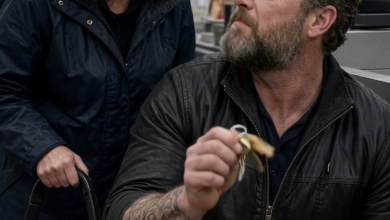
Pike looked like the warning posters your mother makes up in her head. He had prison-blue tattoos down both forearms, a broken nose that had healed crooked, and a scar under his left eye that pulled his face into a permanent glare. His beard was salted with gray. His knuckles were thick. His riding gloves hung from his belt, and when he moved, the chain on his wallet clicked against his leg.
His Harley was an old black Road King with scratches on the tank and a brown leather seat polished by years of weight and miles. It was not pretty. It looked like a tool that had outlived better men.
But there were things I missed.
Everybody missed them.
The little blue ribbon patch on the inside edge of his cut.
The clean fingernails.
The folded baby blanket strapped under the cargo net behind his seat.
The way he kept one ear uncovered, even with the helmet dangling from his handlebar, like he was always listening for something small.
Pike had been an Iron Saint for seventeen years. Before that, he had been Army. Before that, foster care. Before that, a boy who learned early that doors slam harder when nobody wants you inside.
He had done two years in Florence for aggravated assault when he was twenty-seven. He never lied about it. He also never told the story unless asked by somebody who had earned the answer.
“Worst thing I ever did,” he told me months later, sitting outside a diner in Winslow with a coffee going cold in his hand, “was think hurting a man could fix what he did to a kid.”
That was all he said.
The Iron Saints were not angels. Pike would have laughed if anyone called them that. Some had records. Some had tempers. Some had old sins tattooed deeper than ink. But their club had one rule written on the wall of their shop in Bellemont, Arizona, over the smell of oil and burnt coffee:
Kids don’t pay for grown folks’ damage.
They fixed bikes. They ran charity rides. They showed up at hospitals when families had no family. They stood outside courtrooms when abused kids had to testify and needed a row of scary men between them and the people who scared them.
That sounded like a myth to me until I saw it happen.
Pike was the club’s road captain. That meant he chose routes, watched mirrors, kept riders alive. He noticed things others missed because missing things had cost him before.
The blue patch said Maddie because Maddie had been his daughter.
Eight months old.
Dead before her first word.
Not from a crash. Not from cancer. Not from anything dramatic enough to make sense.
She stopped breathing in her crib while Pike was outside arguing with his wife on the phone from a motel parking lot outside Kingman. He had been on a run with the club. He had ignored two calls because he was angry. He came home to a tiny white hospital bracelet, a wife who would not look at him, and a crib that never sounded right again.
That was twenty-one years before the Toyota.
Since then, Pike could not hear a baby cry without turning his head.
And he could not hear a baby stop crying without moving.
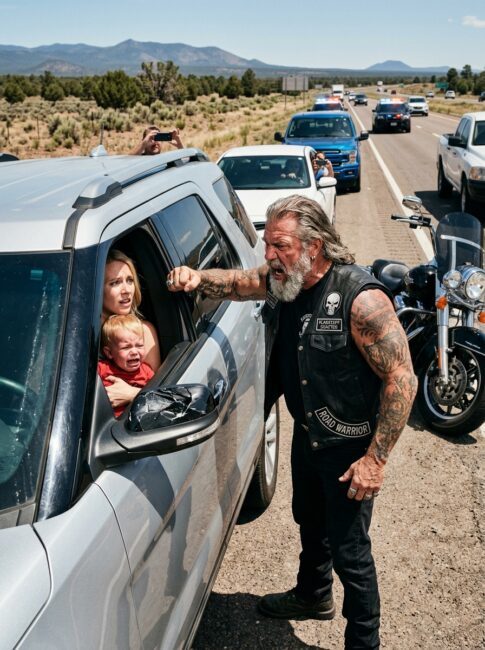
That day was a Thursday.
Hot enough for tar to shine.
Traffic had backed up near the I-40 and Country Club Drive exit because of roadwork. Orange cones pinched three lanes into two. Semis grumbled. Pickup trucks idled. Heat rolled off hoods in waves.
I was behind the Toyota.
Pike was in the lane beside it, left boot planted on the pavement, one hand resting on the chrome of his handlebar. His Harley gave off that low, uneven thump that you feel in your ribs before you hear with your ears. Then the light turned red, and he cut the engine.
That mattered.
Later, he told the police he cut it because the baby in the back seat had been crying.
He heard her over traffic.
Over horns.
Over the woman yelling into her phone.
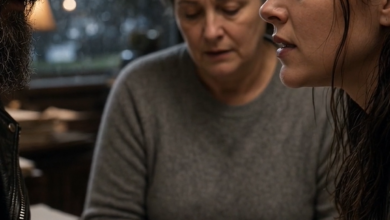
The mother’s name was Jenna Whitaker. Thirty-one. Pediatric dental assistant. Two kids. A husband who had moved out the week before. A phone call that should have waited until she was parked.
Her two-year-old son, Mason, had climbed out of his booster at the last light. When traffic stopped, Jenna pulled him onto her lap because he was screaming and kicking and she was trying to keep him from opening the door.
Her eight-month-old daughter, Lily, was in the rear passenger-side car seat.
Rear-facing.
Small.
Hot.
Crying hard.
Then not crying.
That is the part nobody in traffic noticed.
Pike did.
He turned his head because of the silence.
He looked through the Toyota’s rear window and saw the baby’s head tilted back wrong. Not asleep. Not resting. Wrong. Her mouth was open, but there was no sound. Her hands were limp. Her skin had gone a color no baby should ever be.
Pike slapped the Toyota window with an open palm.
Jenna did not see him.
She was still yelling into the phone, one hand around Mason, the other gripping the steering wheel. Mason was screaming in her face. The phone speaker was loud enough that Pike heard a man’s voice barking through it.
He pulled forward a few feet and pointed at the back seat.
Jenna glanced over once.
Imagine what she saw.
A giant biker.
Tattooed arms.
Skull vest.
Face twisted with urgency.
Pointing at her child.
She thought he was threatening her.
She locked the doors.
Pike shouted, “Your baby!”
But the windows were up.
Traffic horns covered him.
The light changed.
Cars began to move.
Jenna lurched forward.
Pike moved with her.
That is when everyone started filming.
The Toyota rolled half a car length and Pike kicked his Harley into gear just enough to block her from merging. He did not ram her at first. He bumped the side panel with his crash bar. Metal groaned. Jenna screamed. Mason screamed harder.
People saw a biker attacking a mother.
Pike saw a baby dying six feet away.
He swung off the Harley so fast it tipped against his leg. His boots hit the pavement. His leather vest creaked as he lunged for the rear door.
Locked.
He hammered the glass with the heel of his hand.
“OPEN IT!”
Jenna pressed herself back in the seat, clutching Mason. The phone fell somewhere near her feet. Her husband’s voice kept yelling from the floor.
Pike grabbed the side mirror and ripped it down, not because it helped, but because fear does stupid things even in good men. The mirror cracked. Plastic snapped. People gasped like that was the crime of the century.
He kicked the door.
Once.
Twice.
A pickup driver jumped out, pointing a tire iron.
“Get away from her!”
Pike never turned around.
He put both hands on the rear door frame and roared, “THE BABY IS BLUE!”
That stopped one person.
A woman in a Subaru ahead of them. She looked back. She lowered her phone. She tried to see through the rear window.
By then, the first police cruiser was coming up the shoulder, siren yelping.
Officer Daniel Ruiz stepped out with his hand on his weapon and yelled, “Step away from the vehicle!”
Pike did not.
That was the false ending.
The one we all thought we understood.
Big dangerous biker loses his mind in traffic. Attacks terrified mother. Police arrive. Biker gets arrested. Video goes viral. Everyone gets to be angry and certain by dinner.
But Pike did not raise his hands.
He pointed at the back seat and said, in a voice that broke just once:
“Eight months old. Not breathing.”
Officer Ruiz later admitted he almost tackled him anyway.
He had his command voice ready. His cuffs ready. His report half-written in his head.
Then he looked.
Not at Pike.
At where Pike was pointing.
The rear window was tinted, but the sun hit it just right, and for one second the inside of that Toyota became visible like a room with the lights turned on.
Lily Whitaker was slumped in her car seat.
Her lips were blue.
Her head had fallen back at an angle that made my stomach turn even from two cars away.
Ruiz shouted, “Unlock the door!”
Jenna froze.
She did not understand.
That may be the cruelest part of panic. It makes language useless.
Pike moved around to the driver’s side, grabbed the door handle, and yanked. Still locked. He slapped the glass once with his palm, not angry now, just desperate.
“Ma’am. Back door. Now.”
Jenna looked over her shoulder for the first time.
The sound she made did not sound human.
She dropped Mason onto the passenger seat and scrambled for the unlock button. The locks clicked.
Pike had the rear door open before the sound finished.
He did not wait for permission.
He reached in with those huge tattooed arms, unbuckled the chest clip with fingers that suddenly moved like a nurse’s, not a fighter’s, and lifted Lily from the car seat.
Her body hung too loose.
That image is still inside me.
A big biker holding a baby who looked like a doll someone had forgotten to wind.
He laid her on the asphalt beside the Toyota, right there between spilled fast-food wrappers and broken mirror glass. The pavement was hot. Pike ripped off his leather vest and shoved it under her body without thinking. The skull patch disappeared beneath an eight-month-old girl in a yellow onesie.
Then he put two fingers on her chest.
Not both hands.
Not like movies.
Two fingers.
Small compressions.
Counted under his breath.
“Come on, little bird. Come on.”
Officer Ruiz called it in. The Subaru woman was crying into 911. Jenna was on her knees, both hands over her mouth, making that same broken sound. Mason was sobbing inside the car.
Pike breathed into Lily’s mouth, tiny breaths. Then compressions again.
His hands were shaking, but his rhythm was steady.
Thirty seconds.
That is what the EMTs estimated later.
Thirty seconds with no breathing before Pike got her out.
Maybe longer.
Long enough for every person who had called him a monster to go silent.
Then Lily coughed.
It was small.
Wet.
Angry.
The whole highway exhaled.
Pike sat back on his heels and covered his face with one hand. Not crying. Not exactly. His shoulders moved once, hard, like he had taken a punch.
Then he looked at Officer Ruiz and said, “Now cuff me if you need to.”
Ruiz didn’t.
He picked up Pike’s vest from under the baby and saw the blue patch.
Maddie.
His face changed.
The second twist came from a Tesla parked two lanes over.
Its camera had recorded everything.
Not the dramatic part people filmed with phones.
The eight seconds before.
That video showed Pike at the red light beside Jenna’s Toyota. It showed him looking at the rear window. It showed him tapping his horn once, then twice. It showed him pointing. It showed Jenna glancing over, afraid, and looking away.
It showed Lily’s crying stop.
You could not hear it in the video, but you could see Pike react to the silence.
His head snapped toward the car seat.
His whole body changed.
That was the moment.
Eight seconds.
That was all he had between noticing and choosing.
Eight seconds to decide whether to be polite or be useful.
Eight seconds to wonder if a terrified mother would misunderstand him.
Eight seconds to know that every phone in traffic might turn him into a villain before anyone knew why he moved.
He moved anyway.
The dashcam became the only witness with no fear and no opinion.
It showed Pike trying the window.
Pointing.
Shouting.
Blocking the Toyota so Jenna could not drive away with a dying baby in the back seat.
It showed him breaking the mirror after he failed to get her attention.
It showed something else too.
Something small.
When he pulled Lily from the car, his thumb brushed the side of her face the way people do when they have held babies before. Not awkward. Not performative. Familiar. Devastated.
That was when Jenna stopped defending herself.
She had been in shock at first. Then denial. Then horror. Then shame so deep she could barely stand under it.
Nobody needed to punish her more than her own mind already had.
She had not been drunk.
She had not been cruel.
She had been exhausted, distracted, angry, scared, trying to hold one child while missing the crisis of another.
That is not an excuse.
It is a human tragedy with a steering wheel.
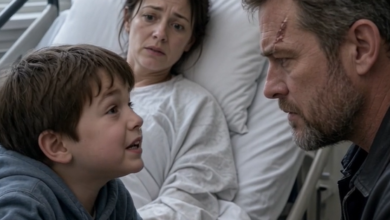
At the hospital in Flagstaff, Lily was treated for an airway obstruction and heat stress. A small piece of softened snack had lodged wrong. The pediatric doctor told Jenna that if another minute had passed, the outcome could have been very different.
Pike did not come into the room.
He stayed in the hallway with the Iron Saints.
They had arrived one by one after somebody in traffic posted the first video online. At first, the comments called him an animal. A criminal. A thug. A biker who finally showed his true colors.
Then the second video appeared.
The one from the Tesla.
The internet turned around so fast it made you dizzy.
Hero.
Angel.
Saint.
Pike hated both versions.
He sat on a plastic hospital chair, elbows on knees, staring at his boots. His club brothers stood around him like a wall. Big men with gray beards, sunburned necks, and hands blackened from shop work. No speeches. No chest-thumping. Just presence.
A younger rider named Cole, still a prospect then, tried to say, “You saved her, brother.”
Pike shook his head.
“Don’t make it pretty.”
That was all.
Jenna came out around midnight.
Her eyes were swollen. Her hair was half fallen from its clip. There was dried baby formula on her shirt. Mason slept against her shoulder, thumb in his mouth.
She walked up to Pike and stopped three feet away.
For a second, I thought she might apologize.
But apology was too small.
She looked at the broken skin across his knuckles from the glass, the bruising already rising on his hand, the black vest folded beside him with Lily’s hospital sticker stuck to the leather.
Then she said, “You scared me.”
Pike nodded.
“I know.”
“You broke my car.”
“I know.”
“You saved my daughter.”
He did not answer.
Jenna tried to keep her voice steady, but it snapped in half.
“I don’t know how to hold all three of those things at once.”
Pike looked up then.
His eyes were pale blue and tired in a way I had never seen on a man his size.
“You don’t have to,” he said. “Just hold her.”
That was the third twist.
The thing I learned about men like Pike.
Some of them are not trying to be forgiven by the world.
They are trying to make sure somebody else gets another morning.
Officer Ruiz later asked him where he learned infant CPR.
Pike rubbed his thumb over the blue patch on his vest.
“After my girl died,” he said. “Too late for her. Not for everybody.”
No monologue.
No tears for cameras.
Just that.
Maddie.
The name we had all missed.
The seed stitched inside the monster costume.
The news ran the story for three days.
The first headline was ugly.
“Biker Attacks Mother’s Vehicle on I-40.”
Then the video changed.
So did the headline.
“Biker Saves Infant After Highway Rescue.”
Pike refused interviews twice. On the third day, Jenna agreed to speak outside the hospital because people online had started tearing her apart, and somehow Pike found that worse than being called a criminal.
He stood off-camera.
You could see one boot in the corner of the frame if you knew to look.
Jenna held Lily against her chest. Mason clung to her leg. She looked smaller than she had on the highway, but steadier too.
A reporter asked if she was angry about the damage to her car.
Jenna looked down at her daughter’s breathing body, then toward the shadow where Pike stood.
“He smashed my mirror,” she said. “He dented my door. He terrified me.”
The reporter waited.
Jenna swallowed.
“He also saved my baby. I don’t have the right to be angry. I only have the right to be grateful.”
That line followed Pike everywhere.
He hated it.
At the Iron Saints clubhouse, the guys printed it and taped it above the coffee maker. Pike tore it down. They taped it up again. He tore it down again. Finally the club president, a man named Rooster with two missing fingers and a laugh like gravel in a bucket, wrote underneath it:
Kids don’t pay for grown folks’ damage.
Pike left that one up.
Every Thursday after that, he rode the same stretch of I-40.
Not for attention.
Not with a camera.
He would leave the shop around 5:00 p.m., when the sun was low and the trucks were heavy, and he would take the Road King past Country Club Drive, past the shoulder where the mirror glass had scattered, past the place where a baby coughed herself back into the world.
Sometimes one brother rode behind him.
Sometimes twelve.
Sometimes none.
The Harley’s engine would drop to a low thump at that red light, and Pike would turn his head toward the cars beside him.
Always looking.
Always listening.
Not because he wanted to find trouble.
Because once, trouble came wrapped in silence.
A month after the rescue, Jenna brought Lily to the Iron Saints charity breakfast in Bellemont. She was nervous walking into that clubhouse. Anyone would be. The place smelled like leather, coffee, oil, pancakes, and old smoke trapped in wood. Men with tattoos up their necks went quiet when she stepped inside.
Then Pike saw the baby.
He backed away like she was fire.
Jenna walked toward him anyway.
Lily was healthy by then. Round cheeks. Bright eyes. A little pink bow clipped to soft hair.
Jenna held her out.
Pike shook his head once.
“No, ma’am.”
Jenna said, “Her doctor says she’s here because of you.”
Pike looked at the floor.
Rooster muttered, “Take the kid, you stubborn old mule.”
So Pike took Lily.
Carefully.
Like his hands were too rough for anything that small.
The entire clubhouse pretended not to watch.
Lily grabbed his beard with one tiny fist.
Pike froze.
Then he laughed.
One sound.
Short.
Rusty.
Like something in him had not opened in twenty-one years and did not know how to move.
I still think about that first video.
The one everybody shared before they knew.
The one where Pike looked like the villain.
I think about how easy it was for me to believe it.
A leather vest. Tattoos. A loud bike. A broken mirror. A woman screaming.
That was enough for my mind to build a whole man and convict him.
But the truth was in the quiet place the camera did not understand.
A baby not breathing.
A biker who had already buried one daughter.
A decision made in eight seconds.
Last winter, I saw Pike again outside the same diner in Winslow. His Road King was parked near the window, dust on the tires, helmet on the seat. The blue Maddie patch had been restitched. Cleaner now. Brighter.
Beside it was a new patch.
Small yellow thread.
Lily.
I asked him if he ever got tired of being misunderstood.
He took a sip of black coffee and looked out at the highway.
“Brother,” he said, “I ain’t built for pretty.”
Then a family minivan pulled into the lot. A baby started crying inside.
Pike turned his head before anyone else did.
The Harley waited.
The road hummed.
And the big man listened.
Follow the page for more biker stories that look one way at first — and hit different by the end.