A Boy Was Bullied Every Day for His Torn Shoes — When His Veteran Neighbor Found Out, What He Did Changed the Entire Neighborhood
Part 2
Walter Briggs had lived across from the Turner family for almost six years, yet nobody on Maple Avenue could remember seeing him attend a neighborhood barbecue, holiday gathering, or school fundraiser.
He mowed his lawn every Thursday at exactly four. He carried groceries for Mrs. Collins when her arthritis worsened, but left the bags outside without waiting for thanks. He repaired loose porch rails after dark and denied doing it when homeowners asked.
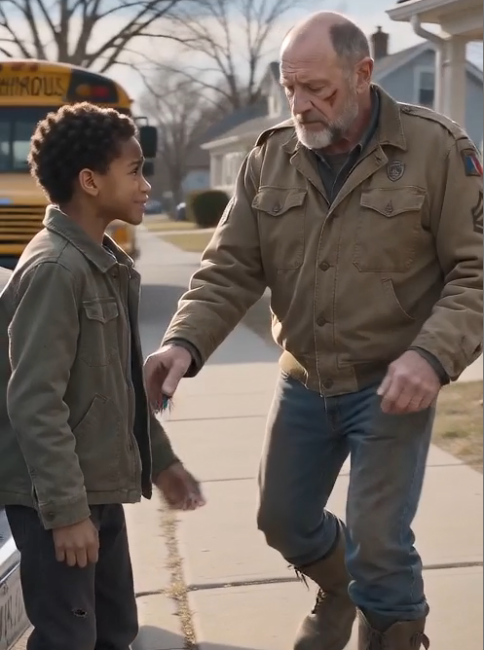
People described him as unfriendly because quiet men are often assigned the emotions others find easiest to understand.
The children called him Sergeant Stone, though nobody knew his actual rank.
Caleb knew only that Walter sat on his porch before sunrise, drinking black coffee from a dented metal cup. Some mornings, when Caleb left for school, Walter raised two fingers in greeting. Caleb returned the gesture.
They had never exchanged more than six words at once.
That changed after Walter cut open the sneaker.
The school bus driver, Denise Porter, shut the door but did not pull away immediately. She was a fifty-year-old Black American woman who had watched Caleb board with wet socks for weeks. She had offered to call the school counselor twice. Caleb always said his mother had ordered new shoes.
At the bus stop, the parents formed a half-circle around Walter.
“What gives you the right to destroy a child’s property?” asked Allison Grant, whose son Mason had been one of the boys laughing.
Walter folded his pocketknife and placed it on the truck hood, far from Caleb.
“He said the sole was cutting his foot.”
“That doesn’t make those shoes yours.”
“No.”
Walter did not argue.
He looked at Caleb.
“I should have asked before cutting them.”
Caleb stood in wet socks, staring at the contents Walter had removed.
The pharmacy receipt was dated three days earlier. It listed insulin needles, glucose strips, and a partial prescription payment under the name Renee Turner.
Caleb’s mother.
The handwritten list contained household expenses:
Electricity — $62 short.
Medicine — $38.
Bus pass — $25.
Rent — don’t know.
The seventeen dollars had been collected from lunch money Caleb saved by telling teachers he ate breakfast at home and telling his mother he received free lunch at school.
He did receive reduced-cost meals.
Not free ones.
Walter looked at him.
“Does your mother know you’re skipping lunch?”
Caleb shook his head.
Allison’s anger softened slightly, but she crossed her arms again.
“That still doesn’t explain the shoes.”
The pawn ticket did.
Two months earlier, Renee had bought Caleb a pair of nearly new black basketball sneakers from a church resale room. They cost forty-five dollars, more than she could spare. Caleb wore them home, placed the box beside his bed, and listened through the wall as his mother called the pharmacy.
Her insurance had stopped covering one of her diabetes supplies after a paperwork error. She needed sixty-eight dollars by Friday.
The next afternoon, Caleb pawned the sneakers for thirty dollars.
He told Renee someone stole them from his gym locker.
He put his old taped shoes back on.
That was the first reveal.
The torn sneakers did not show that Caleb’s mother had neglected him.
They showed what a thirteen-year-old had secretly sold to keep medicine in her refrigerator.
Walter studied the pawn ticket.
“You planned to buy them back?”
Caleb nodded.
“That’s why the money was in your shoe?”
“If Mom found cash in my room, she’d ask where it came from.”
“How were you earning it?”
Caleb looked away.
After school, he collected aluminum cans from public trash bins, returned shopping carts at a grocery store for small tips, and carried bags for elderly customers. He told Renee he stayed late for science tutoring.
The blue thread in his socks came from a sewing kit belonging to his late father.
Marcus Turner had repaired uniforms at a commercial laundry. He died in a warehouse accident when Caleb was eight. The legal settlement paid funeral expenses and part of the mortgage, but not enough to preserve the life he left behind.
Renee sold the house and moved to Maple Avenue.
The faded green jacket had belonged to Marcus too.
Walter noticed the name written inside the collar.
He became still.
“Your father was Marcus Turner?”
Caleb looked surprised.
“You knew him?”
Walter did not answer immediately.
He picked up the ruined sneaker and examined the layers Caleb had placed inside it: cardboard from a cereal box, a folded grocery bag, duct tape, and part of an old foam insole.
The repairs were careful.
Too careful for a boy learning by accident.
“Who taught you to patch shoes like this?”
“My dad.”
Walter’s fingers tightened around the sole.
Years earlier, Marcus Turner had worked nights at the laundry facility that cleaned uniforms for a veterans’ transitional housing program. Walter had been living there after returning from his final deployment and losing both his marriage and his sense of where ordinary life was supposed to begin.
Walter owned one pair of military boots and no proper shoes for job interviews.
One evening, Marcus found him in the laundry loading area trying to glue a separated boot sole.
Marcus sat beside him.
He did not ask why Walter, a decorated soldier, could not afford shoes. He did not praise his service. He simply took the boot, cleaned the rubber, and repaired it with industrial adhesive and heavy thread.
The next week, Marcus left a pair of brown dress shoes in Walter’s locker.
There was no note.
Walter wore those shoes to the interview that became his first civilian maintenance job.
That was the second reveal.
The veteran had not crossed the street because he pitied a poor child.
He had recognized the stitching of the man who once helped him without turning his need into a performance.
Walter looked toward Caleb’s house.
“Where is your mother?”
“At work.”
Renee cleaned rooms at a rehabilitation center from six in the morning until two in the afternoon. She also delivered groceries three evenings a week.
She believed Caleb ate at school, attended tutoring, and lost the new shoes through ordinary carelessness.
Caleb preferred her disappointment to her guilt.
That was another truth nobody at the bus stop had expected.
The child being mocked for poverty had spent months protecting his mother from knowing how closely he watched her struggle.
Walter lifted the pharmacy receipt.
“You can’t carry this alone.”
Caleb’s voice hardened.
“I’m not asking anyone for anything.”
The sentence sounded practiced.
Walter recognized it.
He had spoken it in shelters, clinics, and employment offices where asking for help felt like surrendering the final piece of dignity he still controlled.
“I didn’t say you were asking,” Walter replied.
A mother at the back of the group whispered, “He still destroyed the boy’s shoes.”
She was right.
Good intentions had not returned the sneaker to Caleb’s foot.
Walter took responsibility without trying to decorate the mistake.
“I’ll replace what I damaged.”
Caleb shook his head.
“I don’t want charity shoes.”
“Neither did I.”
For the first time, Caleb looked directly at him.
The bus driver opened the door again.
“I can still take him,” Denise said.
Walter studied Caleb’s wet socks.
“No.”
Several parents bristled.
Then Walter removed his own heavy leather boots.
He placed them beside Caleb.
They were much too large.
“I’m not making him walk into school like this.”
Walter turned to Denise.
“Tell the office he’ll be late.”
Then he faced Caleb.
“We’re getting your shoes back.”
Part 3
The pawnshop opened at nine.
Walter drove Caleb in an old dark-green pickup that smelled of motor oil, coffee, and cedar shavings. Caleb sat silently with his ruined sneakers in a grocery bag on his lap.
He did not trust the plan.
Adults often offered help in ways that made children surrender ownership of the problem. They called reporters, took photographs, or bought something expensive enough that gratitude became a debt.
Walter made no promises.
At the pawnshop, the owner searched the ticket number and brought out the black basketball sneakers.
Caleb stared at them.
The shoes had been placed on a metal shelf between a power drill and a guitar amplifier. One lace was missing.
The owner wanted forty-two dollars to release them.
Caleb counted his seventeen.
Walter added twenty-five.
Caleb pushed his money away.
“No. I’ll pay you back.”
Walter placed the bills on the counter.
“You already paid thirty when you sold them.”
“That money bought medicine.”
“Then these shoes were never unpaid for.”
Caleb frowned.
“That doesn’t make sense.”
“It doesn’t have to today.”
Walter bought replacement laces but nothing else.
No second pair.
No expensive shopping trip.
No dramatic stack of shoeboxes.
Outside, he handed the sneakers to Caleb.
The boy did not put them on.
“My mom will know I lied.”
“Yes.”
“She’ll feel terrible.”
“Yes.”
“Can’t I say you found them?”
Walter opened the truck door.
“You can. But then the shoes go home and the truth stays outside.”
Caleb hated the answer.
He also understood it.
They drove first to school.
Walter entered the office carrying the ruined sneakers in a bag. Caleb wore the black basketball shoes but kept his eyes on the floor.
The assistant principal, Helen Price, asked why he was late. Walter told her only that a footwear problem had been resolved and that Caleb wished to report ongoing harassment.
Caleb looked at him, surprised.
Walter did not describe the pharmacy receipt, the pawn ticket, or Renee’s illness.
That story belonged to Caleb.
At the meeting, Mason Grant and the other boys admitted mocking the torn shoes. They denied pushing Caleb’s backpack into a puddle until the bus driver confirmed what she had seen.
The school proposed detention.
Caleb expected Walter to demand harsher punishment.
Instead, Walter asked one question.
“What did the boys think they knew about Caleb because of his shoes?”
The room became uncomfortable.
Mason looked at the carpet.
“That he was poor.”
“And what did that permit you to do?”
“Nothing.”
“Then why did you do it?”
Mason had no answer.
Neither did the adults.
The bullying had not begun because three children invented cruelty from nothing. They had heard parents laugh about discount clothing, welfare cards, old cars, and families who “should not have kids they cannot afford.”
Children rarely create the first hierarchy.
They repeat the one adults use casually.
That afternoon, Renee arrived at school believing Caleb had been injured.
She was a thirty-eight-year-old Black American woman with warm brown skin, tired dark eyes, and short natural curls tucked beneath a rehabilitation-center cap. Her pale blue work uniform carried faint bleach marks along one sleeve.
When she saw the recovered shoes, relief crossed her face.
Then she saw the pawn ticket.
Caleb began explaining too quickly.
“I was going to buy them back. I only needed a little more. The pharmacy said you had to pay, and I heard you crying—”
Renee sat down.
“You sold your shoes for my medicine?”
Caleb stopped.
His mother covered her mouth.
“You thought I needed you to do that?”
“You did need it.”
“I needed the medicine. I did not need my child skipping lunch and walking through rain with cardboard under his feet.”
Caleb’s eyes filled.
“You always say we’ll manage.”
“We do manage.”
“No, you manage. I watch.”
The sentence exposed a gap many parents mistake for protection.
Renee believed she had hidden the worst of their hardship. Caleb had seen nearly everything: the bills turned facedown, the meals she claimed to eat at work, the way she stretched insulin supplies longer than prescribed, the car she stopped repairing because bus fare was cheaper than brakes.
Children notice what adults conceal.
They simply create explanations alone.
Renee turned toward Walter.
“Why were you involved?”
Walter placed Marcus’s old green jacket on the chair between them and touched the stitched name inside the collar.
“Your husband helped me once.”
Renee looked closer.
Recognition arrived slowly.
“You were the veteran from the laundry.”
Walter nodded.
Marcus had mentioned him only once. He said a man at the housing program needed interview shoes and would never accept them if Marcus made a speech.
Renee began crying.
“He took money from our grocery jar for those shoes.”
Walter looked down.
“I didn’t know.”
“He told me he bought work gloves.”
“I’m sorry.”
Renee shook her head.
“Don’t be. I was angry about the missing money for a week. Then he got paid overtime and filled the jar again.”
That was the third major twist.
Walter had believed Marcus’s help cost nothing but an old pair of shoes.
It had cost the Turner family food money during a difficult month.
Marcus gave anyway, then quietly worked extra hours to repair the gap.
Walter stood as if the chair could no longer hold him.
“I owe your family more than twenty-five dollars.”
Renee’s expression changed immediately.
“No.”
“I have savings.”
“No.”
“I could cover the pharmacy balance.”
“No.”
“You don’t know what I was going to offer.”
“I know the look.”
Her voice remained calm.
“My husband helped you because he wanted you to stand on your own feet. If you turn that into a lifetime debt, you change what he did.”
Walter looked toward Caleb.
The boy had said almost the same thing at the bus stop.
He did not want charity shoes because gifts often arrived carrying someone else’s story about who he was.
Walter sat down again.
“What would help without making it a debt?”
Renee wiped her face.
“Fix the system that lets a thirteen-year-old think selling his shoes is the fastest way to get medicine.”
No one in the room expected the answer.
Renee’s insurance problem had begun when the rehabilitation center reduced her hours by forty minutes per week, moving her below an eligibility threshold for one employer assistance program while still leaving her income slightly above the limit for another.
The pharmacy had offered a discount application, but the forms required online documents Renee did not know how to retrieve. She kept returning with the wrong paperwork.
Walter was not a benefits specialist.
But Mrs. Alvarez’s daughter was.
Denise Porter’s sister worked for a community health nonprofit.
The school counselor knew a local food cooperative.
The help had existed within five blocks, scattered among people who had never asked the right question.
That evening, Walter called a meeting in his garage.
Not a fundraiser.
Not a ceremony.
He placed Caleb’s destroyed sneakers on a workbench and invited neighbors to bring one pair of shoes they no longer wore.
When Allison Grant arrived with three boxes, Walter stopped her.
“One pair.”
She looked confused.
“I thought we were collecting donations.”
“We’re finding out what people actually need.”
He explained that piles of unwanted objects often made donors feel generous while leaving recipients to sort through sizes, damage, and embarrassment.
Every donated pair would be cleaned, repaired, measured, and offered privately through the school counselor or community center. No photographs. No public handoffs. No signs with names. No child required to stand in line beneath the gaze of neighbors.
Walter called it the Ordinary Steps Shelf.
Caleb disliked the name.
“It sounds like a shoe store run by a librarian.”
Walter considered this.
“Good. We’ll keep it.”
The first night, twelve neighbors came.
By the end of the week, forty-two pairs sat on labeled shelves. Walter repaired soles. Renee washed laces. Mrs. Alvarez organized sizes. Denise arranged discreet requests through the bus district’s family liaison.
Even Patricia Reed, who often complained about “people expecting handouts,” brought two nearly new pairs of work boots.
She left them outside Walter’s garage after dark.
The neighborhood began changing, but not through a sudden wave of goodness.
People argued.
Some wanted donor names attached.
Walter refused.
One local business offered fifty pairs if its logo appeared on the shelves.
Renee declined.
A parent posted a photograph of the garage online and described Caleb as “the brave poor boy who inspired everyone.”
Caleb saw it at school.
He came home furious.
“I didn’t inspire them. They laughed at me.”
Renee asked the parent to remove the post.
Walter went further.
He closed the garage for two days.
Neighbors complained that families needed the shoes.
Walter said, “Then we learn to protect the people receiving them before we congratulate ourselves for giving.”
The photograph disappeared.
When the shelf reopened, every volunteer signed a simple privacy agreement.
No names.
No stories.
No images without consent.
That was the redemption Walter could offer.
Not rescuing one child publicly.
Changing how help moved through the neighborhood so no child had to become a display before receiving it.
Mason Grant arrived at the garage on Saturday with his father.
Allison had made him apologize at school, but the apology sounded memorized. Walter handed Mason a cleaning brush and placed Caleb’s old torn shoes in front of him.
Caleb stiffened.
“I don’t want him touching them.”
Walter stopped.
“They’re yours.”
The decision belonged to Caleb.
After a moment, Caleb placed the shoes on the table himself.
“Clean them,” he said. “Don’t throw them away.”
Mason worked for an hour.
As mud lifted from the rubber, the repairs became visible: Marcus’s blue stitching, Caleb’s cardboard insert, duct tape darkened by rain.
Mason whispered, “I thought you wore them because you didn’t care.”
Caleb looked at him.
“I wore them because I cared about something you couldn’t see.”
No adult added a lesson.
None was needed.
Part 4
Renee’s insurance problem was corrected within three weeks.
The community health advocate helped her submit the missing documents, obtain temporary manufacturer assistance, and enroll in a plan that covered the diabetes supplies consistently. Walter drove her to two appointments but waited outside unless she asked him to enter.
Caleb stopped hiding lunch money in his shoes.
It took longer for him to stop checking the refrigerator each morning to make sure his mother’s medicine remained there.
Fear often continues performing its old job after the emergency has changed.
At school, the harassment did not disappear instantly. Some students found new things to say. Caleb’s jacket was too old. His phone screen was cracked. His lunch came from home.
But the three boys who had targeted his shoes no longer had the easy protection of adult silence.
The bus driver watched.
The school counselor checked in.
Other students began sitting near Caleb.
Not because he became popular through suffering, but because once someone challenged the public story, quieter children admitted they had been uncomfortable all along.
Mason joined Walter’s garage project every second Saturday.
At first, Caleb avoided him.
Later, they worked at opposite ends of the same table. Then at adjacent stations. Eventually Mason asked Caleb to teach him the stitch used along the old sneaker’s side.
“My dad taught me,” Caleb said.
“Can you teach me?”
Caleb considered.
“Yes.”
The friendship that formed was cautious and imperfect. Mason occasionally said something careless. Caleb did not become responsible for educating him without limit. When patience ran out, he went home.
Walter respected that.
He had once believed reconciliation meant standing together for a photograph. He learned it could look like two boys repairing different shoes without demanding that the past become beautiful.
The Ordinary Steps Shelf expanded into a narrow storefront donated by a retired dentist. It included shoes, winter coats, backpacks, and basic repair supplies. Families requested what they needed through private appointment slots.
Nothing was called free.
Nothing had a price.
A sign near the entrance said:
Take what fits. Leave what may fit someone else.
Walter paid the first year’s utilities from his savings. He refused to put his name on the building.
When the city council offered him a community service award, he declined the ceremony.
Caleb asked why.
“You did something good.”
Walter tightened a clamp around a loose sole.
“Your father did something good without putting me on a stage.”
“That doesn’t mean nobody should thank you.”
“No.”
Walter looked at him.
“It means I get to choose where thanks belongs.”
He accepted a handwritten card from the neighborhood children instead.
Inside, each child had drawn a shoe.
Some were bright. Some crooked. One looked like a potato with laces.
Walter framed it in the repair room.
Years passed.
Caleb grew taller. The green jacket became too small, but he refused to discard it. Renee folded it inside a cedar box with Marcus’s work gloves and photographs.
At sixteen, Caleb worked part time at the Ordinary Steps storefront. He measured children’s feet and never asked why they needed shoes.
One afternoon, a nine-year-old girl arrived wearing sandals in January. Her grandmother began apologizing.
“Our heat bill—”
Caleb gently interrupted.
“What colors does she like?”
The girl chose purple sneakers.
Caleb brought three pairs so she could decide.
Afterward, he sat in the storage room longer than necessary. Walter found him there.
“You all right?”
“She kept saying thank you.”
“That bothered you?”
“She looked scared she wasn’t saying it enough.”
Walter sat beside him.
Caleb remembered the black basketball shoes recovered from the pawnshop, the twenty-five dollars Walter added, and the confusion of feeling grateful and exposed at once.
“How do we stop that?”
“We can’t always.”
Walter rubbed his scarred hands together.
“But we can stop waiting for gratitude before we treat someone with dignity.”
Caleb nodded.
At eighteen, he graduated as valedictorian of his class.
Renee sat in the front row wearing a dark blue dress and the black shoes Walter had repaired for her after the soles separated. Walter sat at the edge of the auditorium, uncomfortable in crowds, wearing the brown interview shoes Marcus had given him decades earlier.
They had been resoled twice.
The leather was cracked.
Walter could afford better.
He chose them that day.
During his speech, Caleb did not tell the entire shoe story. The neighborhood already knew too much of it, and he had learned that hardship did not become public property merely because it produced a hopeful ending.
He spoke instead about invisible calculations.
How a child might look careless while protecting an adult.
How a quiet neighbor might look angry while deciding whether to interfere.
How a repaired object could contain more history than a new one.
He did not name Walter until the final paragraph.
“Someone once cut open my only shoes,” Caleb said, and laughter moved gently through the audience. “He apologized for doing it without asking. Then he spent years showing me that helping people should not require cutting their dignity open too.”
Walter lowered his head.
Renee reached across the empty seat and squeezed his hand.
Caleb received a scholarship to study industrial design, focusing on affordable adaptive footwear. The decision surprised people who assumed he would become a doctor, social worker, or motivational speaker because those careers fit the story they preferred.
He liked building things.
He liked materials.
He liked solving the problem of shoes that wore out before children outgrew them.
That was enough.
Before leaving for college, Caleb returned to Walter’s garage. The original torn sneakers remained on the top shelf inside a clear storage box.
Mason had cleaned them years earlier.
The duct tape had hardened. The blue stitching remained visible. The sole Walter cut open never fully closed again.
Caleb lifted the box.
“I think I should take these.”
“They’re yours.”
“You kept them.”
“You asked me not to throw them away.”
Caleb opened the lid.
Inside one shoe remained the flattened cardboard from the cereal box.
The pharmacy receipt had faded almost blank.
The seventeen dollars had long since returned to Caleb, though he spent part of it buying Renee a birthday breakfast during his first year of high school.
Walter reached into a drawer and removed a small folded piece of paper.
It was a note Marcus had placed inside the brown interview shoes.
Walter had discovered it years after receiving them, hidden beneath the insole.
A man should not have to explain every hard season before someone helps him stand through it. — Marcus
Caleb read the sentence twice.
“My dad wrote this?”
Walter nodded.
“Why didn’t you show me before?”
“I wasn’t sure whether it belonged to me or you.”
“What did you decide?”
“That it got me through one door. Maybe it can go through the next one with you.”
Caleb placed the note inside his father’s green jacket before packing for college.
Walter drove him to campus.
Renee followed in a borrowed car loaded with bedding, boxes, and too many snacks. At the dorm entrance, she checked Caleb’s shoes three times.
“They fit?”
“Yes, Mom.”
“Any rubbing?”
“No.”
“You brought the second pair?”
“Yes.”
Walter leaned against the truck, hiding a smile.
Caleb looked down.
He wore simple black sneakers from a design company that offered replaceable soles. He had purchased them with his own summer wages.
Before entering the dorm, he turned toward Walter.
“You know the neighborhood still tells the story wrong.”
“How?”
“They say you bought me shoes and changed everyone.”
Walter nodded.
“People like short stories.”
“You didn’t just buy shoes.”
“No.”
“You cut mine apart.”
“That part they remember.”
Caleb smiled.
Then his expression softened.
“You noticed.”
Walter looked toward the moving boxes stacked along the sidewalk.
“Your father noticed me first.”
Caleb hugged him.
Walter remained stiff for half a second, then folded his arms around the boy whose life had once fit inside taped sneakers and a grocery bag.
During Caleb’s second year of college, Walter suffered a mild stroke.
He recovered much of his movement, but the fine control in his right hand weakened. Repairing delicate stitching became difficult.
Caleb returned during winter break and found him struggling with a child’s boot.
Without comment, he took the needle.
Walter watched.
“You’re pulling too tight.”
“I know.”
“You’re twisting the thread.”
“I know.”
“You don’t sound grateful for instruction.”
Caleb laughed.
The roles had shifted without ceremony.
Caleb repaired the boot while Walter steadied the leather.
Outside, snow covered Maple Avenue. On several porches sat weatherproof collection boxes for the Ordinary Steps Shelf. Neighbors placed clean shoes inside without photographing themselves.
Allison Grant managed appointment schedules.
Patricia Reed handled utility grants.
Mason studied education and volunteered with the middle-school anti-bullying program, though Caleb had warned him never to use their story without permission.
Renee became the storefront coordinator after the rehabilitation center promoted her to a full-time supervisory position with benefits.
The neighborhood had not become perfect.
People still judged.
Children still noticed differences.
Families still hid hardship.
But the street had learned to pause before turning visible wear into a complete story about the person wearing it.
Walter’s brown interview shoes remained beneath his workbench until he died at seventy-one.
At the small funeral, Caleb wore them.
They were slightly large, even with thick socks. The leather creased differently around his feet.
Afterward, Renee asked whether he planned to keep them.
Caleb looked down.
“No.”
She seemed surprised.
He brought the shoes to the Ordinary Steps workshop and placed them on a shelf above the repair table beside his torn childhood sneakers.
Between them, he framed Marcus’s note.
The three objects formed no polished memorial.
One pair had helped a veteran enter civilian life.
One pair had carried a child through rain while medicine stayed cold in a refrigerator.
One sentence connected two men who understood that help could be offered quietly, without requiring anyone to perform their pain.
Years later, Caleb returned to Dayton as a footwear designer. He developed an inexpensive school shoe with replaceable toes and soles, allowing families to repair high-wear areas without buying a full new pair.
The first test batch went to the Ordinary Steps Shelf.
No cameras attended.
No children’s names appeared.
Caleb placed one pair in the smallest size on the front shelf, then adjusted the laces.
A boy waiting with his mother looked at the shoes.
“Are those for poor kids?”
Caleb crouched until they were eye level.
“They’re for feet that need them.”
The boy considered the answer, then tried them on.
They fit.
Across the room, Renee was showing a grandmother how to request a winter coat. Mason carried boxes through the back door. Mrs. Alvarez, now moving slowly with a cane, sat near the register pretending she was not supervising everyone.
The neighborhood had grown older.
Its memory had changed too.
People no longer told the story only as the day a veteran rescued a bullied boy.
They remembered the mother working while ill, the father whose quiet gift returned decades later, the child who hid medicine money inside torn shoes, the neighbors who had laughed too easily, and the uncomfortable work required after everyone understood they had been looking at the wrong thing.
Before closing the storefront that evening, Caleb walked into the repair room.
He touched the blue thread along his old sneaker.
The stitch remained uneven but strong.
Walter had once told him it was the first thing he recognized.
Caleb smiled.
Then he turned off the light, leaving the torn shoes beside the brown dress shoes in the quiet room—not as symbols of shame, but as evidence that people sometimes carry one another farther than they ever live long enough to see.
Follow this page for more heartfelt stories about quiet kindness, misunderstood people, and the ordinary objects that carry extraordinary sacrifices. 🌷