A Mother Tore Up Her Daughter’s College Acceptance Letter Before the Whole Family — Minutes Later, Police Revealed Who Had Written It and Why
The moment seventeen-year-old Natalie Brooks lifted her college acceptance letter for the family photograph, her mother snatched it away, tore it through the gold seal, and let the pieces fall across the birthday cake.
No one moved.
Natalie stood beside the dining table in her blue graduation dress, her honey-brown hair pinned behind one ear and the silver locket that had belonged to her late father resting against her throat. Around her, twelve relatives stared at Helen Brooks as if they had just watched a mother destroy her daughter’s future.
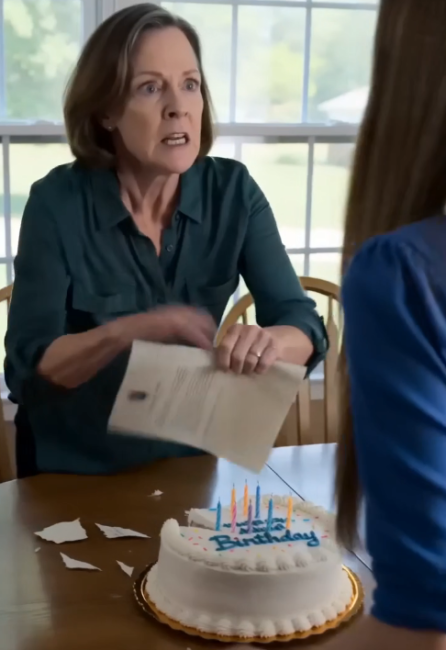
“You couldn’t let me have one good thing?” Natalie whispered.
Helen’s hands shook, but she did not answer.
Aunt Diane grabbed her phone from the counter. Natalie’s grandmother began gathering the torn pieces, muttering that some things could never be repaired. Even Helen’s sixteen-year-old son, Caleb, stepped between his mother and sister.
The letter had offered Natalie a full scholarship to Alder Ridge University, a private school three states away. It promised housing, books, and a place in its nursing program—the dream Natalie had carried since her father died.
Helen picked up one torn page.
Her eyes stopped at the bottom, where Natalie had already written the first three letters of her signature.
Then someone knocked hard on the front door.
Two Dayton police officers stood on the porch. Behind them waited a woman in a gray suit, holding a photograph of the man Natalie had introduced to the family as her college admissions adviser.
“Mrs. Brooks,” the woman said, “Alder Ridge University did not send that letter.”
Natalie’s face emptied of color.
The officer turned the photograph toward her.
“And before you sign anything else, we need to know where this man is.”
Part 2
Aunt Diane had already raised her phone to capture Natalie opening the envelope when Helen crossed the dining room, ripped the letter from her daughter’s hands, and tore the page carrying the scholarship offer in half.
The camera caught Natalie’s smile disappearing.
It caught the cream paper falling beside eighteen unlit candles and Helen crushing the gold seal beneath her shoe. What it did not catch was the tiny line of print on the second page—the line Helen had noticed while everyone else was cheering.
“Eighty-six thousand dollars,” Helen said.
Natalie recoiled. “It’s a full scholarship.”
“No. It isn’t.”
Grandma Rose pushed herself up from her chair, one hand braced against her cane. “Your daughter worked for this.”
Helen looked at Natalie, but her eyes dropped to the silver locket at the girl’s throat. The locket was open. Inside it should have been a photograph of Natalie’s father.
Tonight, the photograph was missing.
Caleb stepped closer to his sister. Diane accused Helen of jealousy. Someone said she had never recovered after losing her husband. Someone else said a mother who loved her child would have asked questions before humiliating her.
Helen bent down and collected one piece of the envelope. A blue thread had been pressed beneath its false gold seal.
She had seen that thread three weeks earlier inside an envelope hidden beneath Natalie’s mattress.
Before Helen could explain, red and blue light moved across the dining room wall.
Detective Lena Ortiz entered carrying a folder. She was forty-six, with dark hair threaded in silver and rain beading on the shoulders of her gray jacket.
She placed a photograph on the table.
Natalie stared at the smiling young man in the picture—the man who had called himself Aaron Vale.
“That isn’t his name,” Detective Ortiz said. “And he isn’t an admissions adviser.”
Then she opened the folder to a page bearing Natalie’s Social Security number.
Part 3
Natalie grabbed the document before anyone could stop her.
Her name appeared at the top. Beneath it were her address, birth date, projected nursing-school expenses, and a loan request for $86,400. The lender was not Alder Ridge University. It was a private financing company registered to a rented mailbox outside Columbus.
The repayment section listed Natalie as the sole borrower.
The disbursement instructions sent the money somewhere else.
“This isn’t mine,” Natalie said. “I’ve never seen it.”
Detective Ortiz pointed to the last page. “You saw part of it. It was attached to the acceptance packet.”
Helen unfolded one of the torn pieces. Along the bottom, beneath a paragraph about reserving dormitory housing, was a sentence printed in pale gray type:
By signing, the applicant authorizes educational financing through the institution’s approved funding partner.
Natalie looked at the unfinished signature.
Her knees struck the chair behind her.
Caleb caught her elbow, but she pulled away from everyone except the table. “Aaron said it was just to hold my room.”
“What else did he ask you for?” Detective Ortiz asked.
“Transcripts. A photo of my driver’s license. Tax information for financial aid.” Natalie swallowed. “He said Dad had told him about me before he died.”
Helen finally closed her eyes.
That sentence changed the room.
Mark Brooks had been a guidance counselor at Roosevelt Technical High School until a heart attack killed him four years earlier. He had kept notebooks filled with students’ names, scholarship deadlines, and small details other adults overlooked—which teenager lived in a motel, whose mother worked nights, who needed bus fare without being asked why.
Natalie had trusted Aaron because he knew those details.
He knew Mark called her “Nat-bird.” He knew Mark had wanted her to become a nurse. He knew about the silver locket.
“How?” Grandma Rose asked.
Natalie’s fingers went to her throat. “Aaron said Dad gave him the photograph inside it years ago. He said Dad wanted him to return it when I got into nursing school.”
Helen looked at the empty locket again.
Three weeks earlier, she had found the first cream envelope beneath Natalie’s mattress. It contained a checklist requesting bank statements, identification, and her deceased husband’s employment records. Natalie had said it belonged to a friend.
Helen had not believed her.
She had called Alder Ridge. The registrar found no application under Natalie’s name. The nursing program listed in the letter had closed two years earlier. When Helen mentioned the adviser, the woman on the phone transferred her to campus security.
Instead of confronting Natalie, Helen had copied the documents and contacted police. She feared that if she moved too soon, Natalie would warn Aaron—the charming young man who had spent three months convincing her that her family wanted to control her.
“You searched my room,” Natalie said.
“I did.”
“You followed me?”
“Twice.”
The admission landed almost as badly as the torn letter.
Helen did not defend herself. She had read private messages. She had placed a location tracker in Natalie’s car after seeing her meet Aaron outside a check-cashing office. She had crossed a boundary because fear had made every boundary look smaller than the danger behind it.
“You could have talked to me,” Natalie said.
“I tried.”
“No. You questioned me. There’s a difference.”
Detective Ortiz watched both women without taking sides. “Natalie is right about that. And your mother was right about the document. Both things can be true.”
Diane slowly lowered her phone. The video was still recording.
Helen reached over and pressed stop.
Then Detective Ortiz removed another item from her folder: a photograph taken from a security camera that afternoon. It showed Aaron entering a coffee shop near the Brooks home.
He carried a black canvas bag.
Stitched across its side were the faded words M. Brooks—Second Chances Program.
Helen stared at the bag.
It had belonged to her husband.
And it had disappeared from their garage the week after his funeral.
Part 4
The police found Aaron two blocks away, sitting in his car where he could see the Brooks family’s front porch.
Inside the vehicle were six cream envelopes, three prepaid phones, a portable printer, and copies of financial documents belonging to young women between seventeen and twenty-one. Each had recently lost a parent, aged out of foster care, or become estranged from family.
Each had been promised a scholarship.
Natalie was not the first.
She was simply the closest he had come to receiving the money.
His real name was Andrew Keller. He was twenty-six and had once attended Roosevelt Technical High School, where Mark Brooks had counseled him during his senior year. Mark had helped Andrew apply for community college, found him a weekend job, and allowed him into the Second Chances Program—a quiet fund built from teacher donations for students who needed fees, work boots, or transportation.
Andrew had dropped out after one semester.
Years later, he returned to Roosevelt as a temporary records contractor. That gave him access to archived student files and several boxes of Mark’s old counseling materials waiting to be returned to the family.
The stolen canvas bag came from one of those boxes.
So did Mark’s notebooks.
Andrew had not merely invented a connection to Natalie’s father. He had built his deception from a dead man’s handwriting.
The full scholarship was the first lie. The private loan was hidden behind it. Once approved, most of the money would have been sent to an “approved housing provider”—a shell company Andrew controlled. Natalie would have received a small deposit, enough to make everything appear legitimate until the first payment notice arrived.
By then, Andrew planned to be gone.
“He said he loved me,” Natalie whispered.
No one answered because there was no answer that would not deepen the wound.
Andrew had started carefully. He corrected an essay online. He mailed Natalie a copy of one of her father’s old scholarship lists. He remembered her birthday. When she became suspicious, he did not threaten her. He told her that doubt was normal when a person had grown up with a controlling mother.
Then he encouraged secrecy and called it independence.
Helen had noticed the change before anyone else. Natalie began carrying her phone into the shower. She stopped talking about local colleges. She withdrew $1,200 from the savings account Mark had opened for textbooks.
Natalie had told Andrew the money was all she had.
He took it anyway, calling it a refundable housing deposit.
Helen pressed a hand against the edge of the table. That money had come from eighteen months of evening payroll work after her regular shift at a dental-supply company. She had skipped replacing the leaking roof over her bedroom and slept with a bucket beside the dresser whenever it rained.
But she did not mention any of that.
Instead, she said, “I’m sorry I tore it in front of everyone.”
Natalie looked up.
“I am not sorry I stopped you from signing. But I should have taken you into another room. I should have told you what I knew. I made your fear public because I let mine take over.”
Diane deleted the video without being asked.
Grandma Rose gathered the pieces of the letter and placed them inside a clear food-storage bag, as if preserving evidence could also preserve whatever remained between mother and daughter.
Detective Ortiz turned over the canvas bag. Near one handle, someone had repaired a tear with crooked red stitches.
Helen touched them with one finger.
“My husband didn’t sew like that.”
Natalie looked at the stitches. “Then who did?”
Detective Ortiz’s expression changed.
“I did,” she said.
Part 5
Before she became Detective Lena Ortiz, she had been Lena Morales, a seventeen-year-old senior who carried her schoolbooks in a grocery bag because her backpack had split along the bottom.
Her father had left. Her mother cleaned hotel rooms and spoke limited English. Lena had missed so many mornings while caring for her younger brothers that the school had begun preparing withdrawal papers.
Mark Brooks found her sleeping behind the auditorium during lunch.
He did not give her a speech. He gave her the black canvas bag.
It was the first item purchased through the Second Chances Program.
Lena had torn one handle two months later and repaired it with red thread from her mother’s sewing tin. On graduation day, she tried to return the bag so another student could use it. Mark refused.
“Second chances aren’t borrowed,” he told her. “They’re carried forward.”
Lena used that bag through community college and police academy. Years later, when she bought a proper briefcase, she returned it to Mark with a note asking him to pass it to someone else.
She had assumed he did.
“When your call came in,” Lena told Helen, “I recognized his name. That’s why I checked the university before the report reached the financial-crimes queue.”
She had made four calls from her kitchen after midnight. She traced the phone number, found the rented mailbox, and discovered two recent loan applications with matching language. She had quietly carried Mark’s favor for twenty-nine years, never expecting it to lead back to his dining room.
Natalie removed her father’s locket and placed it on the table.
“Andrew still has the picture,” she said.
Detective Ortiz shook her head. “We found it in his wallet.”
The photograph showed Mark kneeling beside six-year-old Natalie as she planted a tomato seedling. On the back, in his handwriting, were four words:
Help her grow brave.
Andrew had used the sentence as proof that Mark had chosen him to guide her.
What Natalie did not know was that Mark had written those words to Helen.
The picture had once been tucked inside a card he gave his wife after she agreed to leave nursing school and take a full-time payroll job when his health began failing. Helen had told everyone she no longer wanted to become a nurse.
The truth was quieter.
Mark’s medical insurance would not cover an experimental cardiac procedure unless the family paid a large portion upfront. Helen abandoned her final year of training, worked days and nights, and bought Mark three additional years with his children.
She had never told Natalie because she did not want the girl’s nursing dream to feel like a debt.
“You gave it up because of Dad?” Natalie asked.
“I made a choice for our family.”
“And then I accused you of hating that I got into nursing school.”
Helen folded the photograph once along its old crease. “You were deceived. I was frightened. Neither of us gets to use that as an excuse for every hurtful thing we did.”
Natalie began to cry without covering her face.
Helen did not rush around the table. She waited.
After several seconds, Natalie held out her hand.
Her mother took it.
The next morning, a bank representative offered to reimburse Helen for the stolen deposit if she signed a confidentiality agreement. Helen refused. She did not want a settlement that buried a system allowing an eighteen-year-old to request nearly ninety thousand dollars through an unverified school packet.
Grandma Rose offered to sell her wedding brooch to replace Natalie’s college savings.
Natalie refused that too.
“I don’t need everyone rescuing me with money,” she said. “I need help finding out what’s still real.”
So Helen brought out a yellow legal pad.
Detective Ortiz called the three legitimate colleges Natalie had applied to before Andrew persuaded her to withdraw. Caleb searched nursing programs. Diane, who had spent the previous night condemning Helen, contacted a lawyer who specialized in identity theft.
At the bottom of the page, Natalie wrote one request:
No decisions about me without me in the room.
Helen read it twice.
Then she initialed beside it.
Part 6
The first real acceptance arrived nine days later.
It came by email from Sinclair Community College, twenty minutes from home. There was no gold seal, no cream paper, and no promise that every problem would disappear. The financial-aid package included a modest grant, a work-study position in the campus library, and a gap Natalie would still need to cover.
She read it at the same dining table.
This time, Helen sat beside her and kept both hands in her lap.
“Will you check it with me?” Natalie asked.
They called the number listed on the college’s official website, not the number in the email. Natalie spoke while Helen took notes. When the admissions officer verified every detail, Natalie let out a breath that seemed to have been trapped inside her for weeks.
The family did not clap.
Caleb opened the bakery box he had hidden beneath his chair. Grandma Rose lit one candle. Diane left her phone inside her purse.
The repair extended beyond the Brooks home.
Police identified eleven potential victims from Andrew’s phones. Four had already signed financing agreements. One young woman had stopped speaking to her mother because Andrew told her family members often sabotaged scholarships to keep daughters dependent. Another had moved into an apartment owned by his shell company and handed over her passport as “enrollment security.”
Not every loss could be reversed.
The bank canceled the pending loans but initially described the victims as careless applicants. Helen attended the review meeting carrying the torn letter in Grandma Rose’s plastic bag. She placed the false gold seal, the misleading signature line, and the copied university language in front of six executives.
“They weren’t careless,” she said. “You built a process that rewarded urgency and punished questions.”
Detective Ortiz provided evidence, but she did not make a heroic speech. Natalie explained how Andrew had isolated her one reasonable step at a time. Diane admitted that she had nearly posted the family confrontation online without knowing the truth. Her voice trembled when she described how quickly public outrage could have turned both Helen and Natalie into entertainment.
The bank changed its verification procedure. Private education loans now required direct confirmation from an accredited institution before disbursement. Applicants under twenty-one received a plain-language page identifying the lender, total debt, destination of funds, and cancellation period.
The local school district created monthly financial-aid clinics staffed by counselors, credit-union volunteers, and former students. No student had to publicly explain a family hardship to attend. Parents were welcome, but students had to remain part of every conversation.
Helen volunteered twice a month.
She did not lead the sessions. She checked forms at a side table and circled sentences that tried to hide large obligations behind small print.
Natalie volunteered too, though not beside her mother at first.
Some damage did not vanish because good work began.
Natalie still flinched when Helen asked where she was going. Helen sometimes fought the impulse to inspect every envelope in the mailbox. They started meeting with a family counselor on Thursday evenings, where apologies could not be used as shortcuts.
Caleb remained angry with Andrew and occasionally with Natalie. Grandma Rose kept offering money no one had requested. Diane was helpful in a way that sometimes felt like punishment she had assigned herself.
They were improving without becoming suddenly wise.
Andrew eventually pleaded guilty to identity theft, fraud, and unlawful use of personal information. At sentencing, Natalie declined to speak in the courtroom. Instead, she submitted a written statement describing the difference between trust and consent.
She did not forgive him.
She also refused to let him remain the author of what came next.
Detective Ortiz returned Mark’s canvas bag to the Brooks family after the case closed. The fabric was stained, the zipper stuck, and evidence tape had left a pale stripe along one side.
Helen offered it to Lena.
Lena shook her head. “Mr. Brooks told me to carry it forward.”
Natalie repaired the zipper at the kitchen table. She preserved the crooked red stitches and added one small blue stitch beside them, taken from the thread beneath the fake letter’s seal.
Months later, the bag hung inside the financial-aid clinic. It held blank notebooks, bus passes, loan checklists, and stamped envelopes for students who did not want forms mailed to unsafe homes.
Beside it sat a small sign written by Natalie:
Take what helps. You owe no explanation.
The torn acceptance letter remained sealed in its clear bag inside Helen’s desk.
Not as proof that she had been right.
As proof that being right had not excused the way she had broken something in front of everyone.
Part 7
Three years later, Natalie graduated from nursing school in white shoes that pinched her heels and a plain blue dress that Helen had altered twice at the waist.
Helen was fifty-five now. Gray had spread through her short brown hair, and arthritis made the smallest buttons difficult. She had lost her payroll job when the dental-supply company moved its accounting department out of state, then found part-time work at the same financial-aid clinic she had helped change.
Natalie had not become fearless.
She checked every contract twice and sometimes a third time. She distrusted compliments from strangers. When someone said they knew her father, she asked for details no notebook could provide.
But she had not become closed either.
During her final clinical rotation, she met an eighteen-year-old patient named Mariah who planned to leave school and sign a private training contract for a medical-assistant program advertised online. The brochure promised immediate placement and “guaranteed funding.”
Natalie recognized the pale signature line.
She did not tear the brochure.
She pulled a chair beside the bed and said, “Let’s check it together.”
The program existed, but its job-placement numbers were false and its interest rate would have doubled the original cost. Mariah chose a community-college program instead. She never learned why Natalie’s hands had trembled while dialing the registrar.
On graduation morning, Helen brought Natalie the preserved pieces of the fake Alder Ridge letter.
“I thought you might want to throw this away,” she said.
Natalie studied the broken gold seal. “No.”
She carried the bag to the financial-aid clinic and placed it beneath the old canvas satchel. The staff mounted the pieces between two sheets of clear glass, leaving every torn edge visible. There was no name attached and no dramatic explanation—only the loan amount printed in pale gray beneath the false scholarship.
A week later, Helen slipped on the clinic steps.
The fall was minor, but the arthritis in her hands had worsened, and for several weeks she could not drive or fasten her coat. Natalie moved home temporarily to help.
One rainy morning, Helen stood at the dining table struggling with an envelope from her retirement account. Natalie reached for it, then stopped.
“Would you like me to open it?”
Helen smiled at the question.
“Yes.”
Natalie sat beside her, slit the envelope neatly, and read every page aloud. When she reached the signature line, she placed the pen in her mother’s hand but kept her own fingers beneath Helen’s wrist to steady it.
They checked the company name.
They called the official number.
Then Helen signed for herself.
The fake letter had once divided that dining table into people who believed Natalie and people who believed Helen. Years later, the same table held medication bottles, nursing schedules, college-loan checklists, and the old silver locket with Mark’s photograph restored inside.
Natalie eventually moved into her own apartment, but she returned every Thursday with groceries. Sometimes she and Helen spoke about Andrew. More often, they did not. Healing had become less like a revelation and more like laundry—ordinary, repeated, and never completely finished.
On the fifth anniversary of the birthday dinner, they visited the clinic together. A teenage boy stood beneath the framed letter, reading the hidden loan terms while his grandmother waited beside him.
“Can somebody help us verify this school?” he asked.
Natalie walked toward them carrying her father’s canvas bag.
Helen remained by the doorway, one hand resting against the frame. For once, she did not follow, interrupt, or reach for the papers.
She simply watched her daughter pull up a chair.
The torn letter was still there, its broken edges plainly visible.
But no one was asking Natalie to put it back together.
Follow this page for more heartfelt stories about imperfect families, misunderstood choices, and the quiet ways trust can be rebuilt after it breaks.