A Little Girl Ran Two Blocks to Return a Rich Stranger’s Hundred-Dollar Bill—Then He Opened the Locket Around Her Neck and Saw the Nickname Only His Missing Daughter Knew
Part 2
Vivian Calloway stepped out of the Mercedes in cream slacks and pearl earrings, and for one half second, when her eyes landed on the locket, her smile stopped moving.
Then it came back, bigger than before.
“Lord, Tom, you scared me half to death. You know Dr. Patel said no long walks after your heart thing.” She bent down to Lucy, red nails resting on her knees. “Well, aren’t you a sweet thing. What a pretty necklace, sugar. They sell those dogwoods in every gift shop in Williamsburg.”
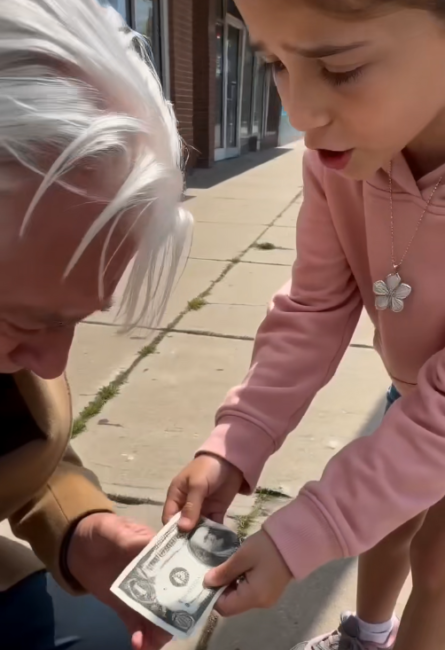
Lucy didn’t answer. She pushed the hundred-dollar bill into Tom’s hand, turned, and ran.
“Wait!” Tom called after her. “Sweetheart, wait—what’s your mama’s name?”
She was already gone around the corner, past the laundromat.
“Tom.” Vivian took his arm firmly. “Get in the car.”
He got in. His hands wouldn’t stop shaking.
“It said Honeybee, Viv,” he said as they pulled away from the curb. “Inside the locket. It’s Emily’s. I had it engraved myself.”
Vivian drove for a full block before answering. When she did, her voice was soft with pity.
“Then she sold it, honey. Like she sold everything else.” She reached over and squeezed his knee. “Or think about it, Tom. A lemonade stand three blocks from your very first store. On the street you drive down every single Saturday morning. A little girl with a sob-story sign and your daughter’s locket around her neck.” She sighed. “Somebody wanted you to see that child.”
Tom stared out the window at the shabby storefronts of Hull Street.
The first Calloway Hardware had opened on this street in 1976. One room, two employees, and Margaret doing the books at the kitchen table. Now there were thirty-eight stores across Virginia, and he hadn’t walked into the old one in years.
That night, in the big house in Windsor Farms, he couldn’t sleep.
He sat in his study with the lights off and tried to remember March 2014.
He couldn’t.
That was the truth he’d never said out loud. Margaret had died in the fall of 2011, and for the next three years Tom Calloway had drunk himself through every evening. He married Vivian in 2012 because she was kind to him and organized and there, and because the house was so quiet it hurt. By 2014, there were whole weeks he’d lost.
The week Emily left was one of them.
He remembered waking up on the leather couch in this study. Vivian standing over him with coffee. She’s gone, Tom. She took Margaret’s diamonds. You called the police yourself last night. Don’t you remember?
He hadn’t remembered. He’d believed her anyway. Because who else was there to believe?
He got up, turned on the desk lamp, and opened the bottom drawer of the old oak file cabinet, the one labeled 2014.
It was right at the front.
A carbon copy of a Richmond Police Department larceny complaint. His daughter’s name. His address. And at the bottom, his signature.
Tom sat down slowly on the floor.
Had he really sent the police after his own child, and drunk the memory away?
Part 3
March 14, 2014. Emily’s twenty-third birthday.
Tom was sober that day. He’d made sure. He’d even shaved.
Emily sat at the big kitchen island in Windsor Farms in a yellow sundress, laughing at something Rosa the housekeeper had said, and when Tom slid the small velvet box in front of her, she went quiet.
Inside was a silver locket shaped like a dogwood blossom, Virginia’s flower, Margaret’s favorite. Tom pressed the hidden latch on the side and it clicked open. On one side, a tiny photo of Margaret. On the other, engraved in letters so small you needed good eyes: HONEYBEE.
“Daddy.” Emily’s eyes filled.
“Your mama called you that from the day you were born,” Tom said gruffly. “Listen to me. If you ever need me, wherever you are, whatever you’ve done, you write ‘Honeybee’ on anything and send it to me. I’ll come running. No questions.”
“No questions?”
“Not one.”
After cake, he took her into the study and opened the safe so she could wear her mother’s diamond necklace for a birthday photograph. It had a platinum clasp, and on the back of that clasp, Tom had engraved M+T 1979 for Margaret’s thirtieth birthday.
Emily fastened it carefully around her neck.
Vivian appeared in the study doorway, red nails curled around a wine glass. “Well,” she said lightly. “Diamonds always look better on a woman who’s earned them.”
Everybody laughed. Tom laughed too.
He would remember that laugh for the rest of his life.
Twelve hours later, Emily was gone.
Part 4
Vivian brought him coffee in the study the next morning and set a slim folder on the desk beside the cup.
“I never wanted you to see this,” she said quietly. “I’ve kept it for twelve years so you wouldn’t have to.”
The first page was a grainy black-and-white still from the house security camera. Timestamp: 3/15/2014, 2:13 a.m. Emily, in a dark hoodie, crouched in front of the open safe in this very room.
The second was a pawn ticket from Broad Street Gold & Loan. One diamond necklace. Signed E. Calloway.
The third was a mug shot of a skinny young man with hollow eyes. Jake Rourke. Arrested for heroin possession in Henrico County, February 2014.
“Her boyfriend,” Vivian said. “She took the diamonds for him. Thirty thousand dollars in cash from the safe too. You were so torn up about Margaret that I couldn’t bear to tell you the details. So I handled it.” Her eyes glistened. “Maybe I should have told you. Maybe I protected you too much.”
Tom stared at the photo of his daughter crouched at the safe.
He’d been so ready to believe Vivian was hiding something. And she’d been carrying this for him the whole time.
But he still went back to Hull Street.
The lemonade stand was gone. An older woman sweeping the steps of the Baptist church pointed him toward a brick apartment building on Bainbridge Street. “Lucy’s mama? Second floor, 2B. Bless her heart. She’s real sick.”
He climbed the stairs with his heart pounding.
The door opened on a chain. A thin woman with dark circles under her eyes and a dialysis port taped below her collarbone looked out at him.
She looked like Margaret at the end.
“Em,” he said.
Emily looked at him for a long time. Something moved across her face, hope maybe, and then it closed like a door.
“Twelve years,” she said.
“I need to ask you something. And I need you to tell me the truth.” His voice cracked. “Did you take your mother’s diamonds?”
Her face went perfectly still.
“Is that why you came? Not to see if I was alive. Not to meet your granddaughter. To ask me that?”
She shut the door.
Through it, muffled, he heard her say one more thing.
“Ask Rosa.”
Tom stood on the landing.
Rosa Martinez had kept house for his family for twenty-two years. Vivian fired her the same week Emily disappeared.
Why?
Part 5
Rosa lived with her daughter in a small ranch house in Petersburg. She was sixty-six now, gray-haired, and when she opened the door and saw who was standing there, she put her hand over her mouth and started to cry.
“I been waiting twelve years for you to knock, Mr. Tom.”
She sat him at her kitchen table and went to a closet. She came back with a shoebox.
Inside was a cheap USB drive, a sheet of paper in a plastic sleeve, and an old flip phone.
“The night Miss Emily left,” Rosa said, “I copied the security recorder. All of it. Before Mrs. Vivian could erase it. I knew she would.” She pushed the drive across the table. “Then she fired me for ‘stealing groceries.'”
Rosa’s grandson plugged the drive into his laptop.
2:13 a.m. Emily at the open safe, exactly like Vivian’s photo.
But Rosa let it play.
Emily wasn’t taking anything out. She was putting the diamond necklace back in its velvet case, closing the safe, and spinning the dial. Then she looked up at the camera, a little guiltily, and went to Tom’s oak desk. She opened the top drawer and took out an envelope.
“That’s the only thing she took,” Rosa said quietly. “Your desk cash. I’ll let her tell you why.”
At 3:41 a.m., the study door opened again.
Vivian came in first, in a silk robe, holding a flashlight and a small slip of paper. Behind her was her son, Bradley Sloane. Vivian read numbers off the paper. Bradley turned the dial. The safe swung open.
Bradley took out the diamond necklace and a thick envelope of cash. He put both in his jacket.
Vivian closed the safe and looked straight up at the camera. Then she reached up and switched it off.
Tom couldn’t breathe.
Rosa slid the plastic sleeve across the table. Inside was a page of lined notebook paper covered in signatures. Thomas R. Calloway. Thomas R. Calloway. Thomas R. Calloway. Dozens of them. Each one a little better than the last.
“I found it in the kitchen trash a week before Miss Emily left,” Rosa said. “Mrs. Vivian practiced your name at that island for days.”
It took Tom two more phone calls to finish the picture. Sol Weiss, the retired owner of Broad Street Gold & Loan, still had his old ledgers in a storage unit. Ticket 40117, March 2014, wasn’t a diamond necklace at all. It was a ten-karat gold chain, pawned for a hundred and eighty dollars, and the ID on file was a Virginia driver’s license belonging to Bradley Sloane. Somebody had altered the ticket afterward.
His insurance agent at Chubb confirmed the rest. In April 2014, Vivian Calloway had filed a claim for the theft of Margaret Calloway’s diamond necklace. The company paid three hundred and ten thousand dollars.
And in June 2014, Tom had signed a new will, a will he didn’t remember signing either, disinheriting his daughter entirely. Calloway Hardware, a hundred and twenty million dollars, would go to Vivian and Bradley.
It had never been about a necklace.
As Tom stood to leave, Rosa caught his sleeve.
“Mr. Tom. One more thing.” She hesitated. “Miss Emily called me last spring. She needs a kidney. And she said a woman phoned the transplant center at VCU, saying she was Emily’s stepmother, asking whether any family members had been tested as donors.”
Tom went cold.
Why would Vivian care whether he was a match?
Part 6
He planned to call a lawyer on Monday.
On Sunday night, Vivian made him chamomile tea, the way she always did, and sat with him on the back porch watching the fireflies over the boxwoods. She held his hand. She talked about Bradley’s big day coming up, the company’s fiftieth anniversary gala at the Jefferson Hotel, where the board would finally name Bradley CEO.
Tom drank the tea. He was so tired he could barely lift the cup.
He woke up on Tuesday in a bed at VCU Medical Center with a monitor beeping beside him and a cardiologist frowning at a chart.
“Digoxin toxicity, Mr. Calloway,” the doctor said. “Your heart medication. Your level was nearly three times the safe range. Have you been taking extra pills?”
“No,” Tom rasped. “Never.”
“Your wife says you’ve been confused lately. That you’ve been mixing up your medications.” The doctor’s voice was kind. “And that you’ve been talking about a granddaughter who doesn’t exist.”
Tom tried to sit up. The room spun.
Vivian came in an hour later with flowers and Bradley at her elbow. She kissed Tom’s forehead.
“I’ve talked to the nurses,” she said softly. “Family only, honey. No more upsetting visitors. You need to rest.” She patted his hand. “Bradley’s going to take good care of everything on Saturday.”
His phone was “lost.” When Rosa came to the front desk on Wednesday, security walked her out. Emily wasn’t on the visitor list. Tom asked a nurse to call his attorney. She smiled patiently and wrote it down, and he watched her glance at the note on his chart that said patient may be disoriented.
He was seventy-one years old, in a hospital bed, with his heart fluttering like a trapped bird. Nobody believed a word he said.
Two floors below him, in the Hume-Lee Transplant Center, his daughter sat in a dialysis chair four hours a day, three days a week, with her kidneys at eight percent.
On Thursday night, a little after nine, the door to his room creaked open.
Lucy slipped in wearing a pink hoodie, holding a construction-paper card. She’d come to the hospital with her mama for dialysis, she whispered, and she’d ridden the elevator upstairs by herself, because Rosa told her Grandpa was here.
The card had a drawing of a bee on the front.
Tom grabbed her small hand.
“Lucy. Tell your mama something for me. Tell her… Honeybee.”
Lucy nodded seriously. “Mama already told me what that means. It means you’ll come running.”
Down the hallway, sharp and steady, came the click of high heels.
Part 7
Lucy dove under the bed. The heels passed the door and kept going.
At three in the morning, the door opened again.
A night nurse named Keisha, who had overheard Rosa crying in the parking garage and decided she didn’t care whose name was on the visitor list, wheeled Emily into the room in a hospital wheelchair. Rosa was behind them.
Emily stopped beside the bed. Father and daughter looked at each other for a long time.
“You got old, Daddy,” she said.
“You got thin, Honeybee.”
She laughed, and it broke in the middle.
He told her everything. The video. Bradley at the safe. The practice signatures. The insurance money. The will. The tea.
Emily listened without a word. When he finished, she was quiet for so long he thought she might leave.
“I did take something that night,” she said finally. “Not Mama’s diamonds. The cash in your desk. Eight thousand dollars.” She stared at her hands. “Jake owed money to some very bad people. He said they’d hurt him. I was going to pay you back. I was twenty-three and stupid and in love with an addict.”
Tom said nothing.
“Vivian saw me on the camera before I ever got back to my room. She was waiting in the hallway. She said, ‘Leave tonight, or I’ll tell your father his daughter is a thief and a junkie’s girlfriend, and I’ll call the police myself.'” Emily’s voice shook. “And I believed her. Because I was a thief. Just not the one she said.”
“So you left.”
“So I left. I found out I was pregnant two months later. Jake overdosed when Lucy was two.” She wiped her face with the heel of her hand. “I wrote you, Daddy. Eleven letters in seven years. I wrote Honeybee on every single envelope. You never answered.”
Tom closed his eyes. He had never seen a single one.
“And there’s one more thing you should know,” Emily whispered. “The lemonade stand on Hull Street. I picked that corner. I knew you drove past your old store every Saturday. I put my locket on her on purpose and sent her out there for a month of Saturdays, hoping you’d see it.” Her voice cracked. “The hundred dollars was real. Lucy chasing you down was all her. But the rest? I used my own child as bait, Daddy. Because I was dying, and I was too proud to just knock on your door.”
Tom reached out and took her hand.
“I believed a woman I’d known for two years over a daughter I’d raised for twenty-three,” he said. “I never asked you one question. Not one. Don’t you dare tell me you’re the one who should be ashamed.”
Rosa cleared her throat by the door.
“Mr. Tom. They’re discharging you Friday. Mrs. Vivian’s already arranged a bed for you at a memory-care home in Chesterfield. She’s signing the papers Saturday morning, right before the gala.”
“Then I’m going to that gala,” Tom said.
“You can barely stand,” Emily said.
He looked at her, and then at the little sneaker sticking out from under the bed, where Lucy had fallen asleep.
“I’ll stand long enough.”
Part 8
The Rotunda of the Jefferson Hotel glittered under its stained-glass skylight. Three hundred guests in black tie gathered around the grand marble staircase: bankers, vendors, store managers from thirty-eight towns across Virginia, and the Richmond Times-Dispatch photographer. A banner read CALLOWAY HARDWARE — 50 YEARS.
Bradley Sloane stood at the top of the staircase with a microphone. Vivian stood beside him in black velvet, and around her throat glittered a necklace of graduated diamonds.
“My stepfather couldn’t be here tonight,” Bradley said gravely. “As many of you know, he’s very ill. But I promise you, I’ll honor everything he built.”
“I’m right here, son.”
Heads turned.
Tom Calloway came through the Rotunda doors in a wheelchair, pushed by Rosa Martinez, in the same good wool coat he’d worn on Hull Street. Beside him, Emily walked slowly with Keisha’s hand on her elbow. Lucy held her mother’s other hand, wearing the dogwood locket outside her dress.
Behind them, quietly, came two more people: a Richmond Police detective named Carla Simmons and a fraud investigator from Chubb Insurance.
Vivian’s face went white, then composed. She came down three steps, smiling at the crowd.
“Oh, Tom. Honey, you shouldn’t be out of the hospital.” She turned to the guests. “I’m so sorry, everyone. He’s been very confused with his medications—”
Tom put both hands on the arms of the wheelchair and stood up. It took a long time. Nobody in the Rotunda breathed.
“That’s a beautiful necklace, Viv,” he said. “Where’d you get it?”
Vivian’s hand went to her throat. “You bought it for me, Tom. Harry Winston. New York. 2016. You don’t remember?”
“Turn the clasp around.”
She laughed lightly. “Oh, for heaven’s sake. There’s nothing on the clasp. The jeweler polished the engraving off when he reset the—”
She stopped.
The silence spread across the Rotunda like spilled ink.
“M plus T, 1979,” Tom said. His voice carried all the way up the marble stairs. “I had it engraved for my first wife’s thirtieth birthday. You told the police my daughter stole it. You told my insurance company it was gone forever, and they paid you three hundred and ten thousand dollars.” He looked at Bradley. “And your son pawned a ten-karat gold chain to make the ticket look real.”
Bradley set down the microphone very carefully, as if it might explode.
Detective Simmons stepped forward. “Mrs. Calloway, we have a security recording from March 15, 2014, showing you and your son opening Mr. Calloway’s safe. We have handwriting samples. We also have the hospital’s toxicology report.” She paused. “And we have a search warrant for your house that was executed two hours ago.”
She held up a clear evidence bag.
Inside was a bundle of envelopes tied with a rubber band. Eleven of them. Every single one addressed in a young woman’s handwriting to Thomas Calloway, and every single one marked on the back with one word.
Honeybee.
Vivian’s knees gave out. She sat down on the marble staircase in her black velvet, the stolen diamonds glittering at her throat, while three hundred people stared.
Bradley tried to slip out by the service door. A uniformed officer was already standing there.
Tom sank back into the wheelchair, shaking.
A small hand tugged on his coat sleeve.
Lucy was looking up at him with enormous eyes.
“Grandpa,” she whispered. “Now can you give Mama your kidney?”
Part 9
Vivian Calloway was convicted the following spring of insurance fraud, forgery, obtaining money by false pretenses, and attempted malicious wounding by poisoning. She was sentenced to eighteen years. Bradley Sloane pleaded guilty to grand larceny and conspiracy and received five. The 2014 will was voided. The diamond necklace, with its polished clasp, went back to Chubb, and Tom wrote the insurance company a check for three hundred and ten thousand dollars himself.
He read all eleven letters in one night, sitting on the floor of his study. The last one was from 2021. It had a crayon drawing of a bee inside, signed Lucy, age 4.
Tom was tested at Hume-Lee in July. He was a match.
The transplant team turned him down anyway. Seventy-one years old, a heart that had nearly stopped from digoxin poisoning. They were kind about it. Tom cried in the parking garage like a child.
But something else had happened by then.
Someone at the Jefferson Hotel had filmed Lucy asking that question. Forty million people watched it. Within three weeks, more than eleven hundred strangers had registered to be tested as living kidney donors at VCU, people from Richmond and Roanoke and as far away as Ohio. One of them was a Chesterfield County firefighter named Marcus Bell, who’d never met Emily in his life.
He was a match.
Emily got her new kidney in October. Marcus visited her the next day with a teddy bear wearing a tiny fire helmet. The other eleven hundred stayed on the registry. Forty-three of them have donated to strangers since.
Rosa came back to the Windsor Farms house. Not as a housekeeper. Tom put her name on the deed of the garden cottage out back and dared her to argue. She argued for about a week.
* * *
The next summer, on a hot Saturday morning, a lemonade stand appeared again on the corner of Hull Street, three blocks from the very first Calloway Hardware.
This time there were two folding chairs behind it. One for a nine-year-old girl in a pink hoodie. One for a seventy-two-year-old man in a straw hat who insisted on pouring.
Emily sat on the church steps across the street in the sun, healthy and laughing, watching them.
The sign on the stand had a new label in Lucy’s best handwriting:
FOR SOMEBODY ELSE’S MAMA.
Around noon, Tom stood up, stretched, and started walking down the sidewalk. As he went, a hundred-dollar bill slipped out of his pocket and floated down onto the concrete.
Lucy saw it and grinned.
She grabbed it and ran after him, the dogwood locket bouncing against her chest.
“Grandpa! You dropped your money!”
Tom turned around, smiling.
“I know, Little Bee,” he said. “I just wanted to see you run after me.”