See more: My Daughter-in-Law Left Me at a Desert Gas Station in Arizona With One Bottle of Water “to Learn Not to Be a Burden”—She Had No Idea the Kid Who Took Me Home Was About to Inherit Her House
Part 2 — The Guardian
The deputy came twenty minutes after Mateo read my son’s text out loud.
His name was Luis Ortega. He was polite and sunburned, and he was very uncomfortable. He knelt in front of my chair in the Chevron break room and spoke to me slowly, the way people speak to old women they’ve already decided about.
“Mrs. Ellison, I’m going to be honest with you. Your son filed for emergency guardianship in Maricopa County Superior Court three weeks ago. The judge granted it. There’s a neurologist’s report saying you have moderate Alzheimer’s and a history of wandering.”
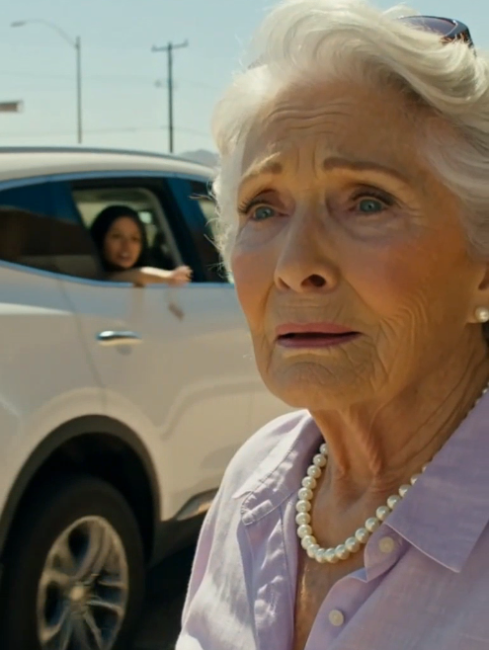
“I have never been to a neurologist.”
He looked at his phone. “The referring doctor is listed as Vanessa Ellison.”
“My daughter-in-law. A dermatologist. She does Botox in Scottsdale.”
Deputy Ortega didn’t laugh, but his mouth twitched.
“Ma’am, I believe you’re upset. But a court order is a court order. Your son says Mrs. Vanessa Ellison stopped for gas and you got out of the car and refused to get back in. He says they’ve been frantic.”
“She left me here with a bottle of water and told me to learn not to be a burden.”
“Yes, ma’am,” he said. He wrote it down, but he wasn’t going to do anything about it.
Mateo stood by the door with his arms crossed. He was twenty-two, lean, dark-haired, and wore a Chevron polo with a name tag. His eyes were the gray-green of my late husband’s eyes. I couldn’t stop looking at them.
“She’s not confused,” Mateo said. “She’s been sharper than me all afternoon.”
“Son, I’ve got an order.”
Then the ugly part came, the part I haven’t told anyone until now.
Sitting in that plastic chair, I tried to remember signing guardianship papers, and I couldn’t. I tried to remember the last time I’d seen my own checkbook. It had been months. Vanessa had “helped” me with the bills since spring. I remembered finding my car keys in the freezer in April. I remembered standing in my own kitchen in June, not knowing why I’d walked in. I remembered Vanessa’s patient voice. It’s okay, Mom. It happens.
What if it was happening?
What if the woman who drove away was right, and I was the last person in the world who knew?
Mateo knelt next to me.
“Ma’am,” he said quietly, “what’s today’s date?”
“July 14th,” I said. “Bastille Day. And your dog has a torn left ear, you have a nursing textbook under the register, and you’ve been rereading the same page for an hour because you’re worried about me.”
He smiled a little.
“You’re not crazy,” he said.
At 6:40 p.m., a black Tesla pulled up to pump four. My son Richard got out in a golf shirt, fifty-two years old, looking exactly like his father at that age. He hugged me hard in front of the deputy.
“Mom. Thank God. We’ve been out of our minds.”
He smelled like whiskey and Vanessa’s perfume.
Mateo walked us to the car. Just before Richard closed my door, I saw my son glance down at the silver bracelet on the boy’s wrist.
His face went white. Then he shut the door.
As we pulled onto Pima Street, I turned to him.
“You’re going the wrong way, Richard. Home is north.”
He kept his eyes on the road.
“We’re not going home, Mom,” he said gently. “We’re going somewhere safe.”
Where exactly did my son think was safer than my own house?
Part 3 — Owl
Forty-one years ago, the house on Mummy Mountain in Paradise Valley was brand new, and it smelled like fresh adobe and orange blossoms.
Walt and I had built it with our own real estate money, one deal at a time. It had a pool shaped like a kidney bean and a patio facing Camelback Mountain, where the sunsets went pink and gold.
Our daughter, Caroline, was the night owl of the family, like me. When everyone else went to bed, she and I sat on that patio reading with our feet in the pool until two in the morning.
“You’re an owl, Mama,” she told me when she was nine. “Owls stay up and keep watch.”
From then on, she called me Owl. Only she did. Not Walt. Not Richard. Just Caroline. On birthday cards, on notes stuck to the fridge, on the chalkboard by the phone. Dear Owl.
On her sixteenth birthday, I gave her a silver bracelet with a tiny saguaro charm. I had it engraved on the back, C.E. 16, at a little jewelry shop on Fifth Avenue in Old Town.
“So you always know where you came from,” I said.
She wore it every day.
Richard was the careful one. He was the accountant, always doing sums in his head, always a little jealous of how easily Caroline laughed. At twenty-one, he noticed how much the house was worth. At thirty, he noticed it out loud.
Walt and I put the house in the Ellison Family Trust in 2004, with me as trustee. Our lawyer and old friend, Harold Beck, drafted it. Walt wanted to leave everything to Richard.
I made Harold add one clause anyway, in my own words.
I never told Richard what it said.
Did I ever imagine that clause would one day save my life?
Part 4 — The Camera
The place Richard called “safe” was Desert Bloom Memory Care, a locked facility in Mesa with keypad doors, pastel walls, and a courtyard nobody could leave.
“It’s temporary, Mom,” Richard said, holding my hand at the intake desk. His eyes were wet. “Just until the doctors adjust your medications. I promise.”
He looked devastated. That was the terrible part.
The next morning, he came back alone, and he was crying before he even sat down.
“Mom, I need to tell you something. Vanessa and I are separating.” He wiped his eyes. “When she told me you’d ‘wandered off’ at that gas station, I believed her. Then that kid from the Chevron sent me something.”
He turned his phone toward me.
It was security-camera footage from the Chevron, timestamped July 14th, 2:17 p.m. It showed the white Range Rover at pump four. I was getting out to use the restroom. Vanessa leaned across, said something through the window, tossed a water bottle onto the concrete, and drove away while I stood there in the heat.
Richard’s hand was shaking.
“She told me you refused to get back in the car.” He covered his face. “Mom, I texted the family chat, ‘Is she gone?’ because Vanessa said you’d run off and the police were handling it. I meant is she gone with the police. I didn’t know. I swear on Dad’s grave I didn’t know she left you.”
He showed me the whole thread. It was ambiguous enough. Just.
“Then why am I in a locked building, Richard?”
“Because the neurologist—”
“I’ve never met a neurologist.”
“Mom, you have,” he said gently. “Dr. Pressman, at Banner. In May. Vanessa took you. You don’t remember because…” He trailed off and squeezed my hand. “That’s part of the disease.”
He showed me a medical report with a real letterhead from Banner Alzheimer’s Institute, signed by a real doctor’s name. Moderate Alzheimer’s-type dementia. Recommend supervised living.
I stared at it.
I didn’t remember any Dr. Pressman.
Was that because it never happened, or because it had happened and I’d lost it?
“I’m filing for divorce, Mom,” Richard said. “I’m going to make this right. The guardianship is just to protect you from her. Okay?”
He kissed my forehead and left.
I sat in that pastel room for a long time, thinking maybe I’d been wrong about my son. Maybe the villain was the woman who drove away, and Richard was just a weak man who had married badly.
That evening, a night aide named Rosa came in with my pills. Two white ones, one yellow, and a new small blue capsule I’d never seen before.
“What’s the blue one, honey?”
Rosa checked the chart. “New order from your guardian’s physician. Started yesterday. It’s a sleep aid.”
“Who’s the physician?”
Rosa looked at the chart again. Then she looked at me with something new in her face.
“Dr. Vanessa Ellison,” she said.
If Richard was divorcing her, why was his wife still writing my prescriptions?
Part 5 — Harold’s Files
I didn’t take the blue pill. I held it under my tongue and spat it into a tissue when Rosa turned away. She saw me do it, and she said nothing.
The next night, she said something.
“There’s a young man in the parking lot every evening,” she whispered as she tucked in my blanket. “Chevron shirt. With a dog. He brought this for you.”
It was a cheap prepaid flip phone, with one number saved: MATEO.
I called at two in the morning, because owls keep watch.
“Mrs. Ellison? Are you okay?”
“Mateo, I need you to find a man named Harold Beck. He’s eighty-two and he’ll be furious about being woken up. Tell him the Owl needs her file.”
Harold Beck showed up at Desert Bloom three days later in a seersucker suit, with a cane, a briefcase, and a court order he’d bullied a probate commissioner into signing. It allowed attorney-client visitation.
“Maggie,” he said, kissing my cheek, “you look terrible and completely sane.”
Mateo was with him. So was Mateo’s father, Daniel Navarro, a quiet man in a dairy-farm cap who shook my hand and wouldn’t quite look at me.
Harold spread his files across my bed.
“First,” he said, “Richard’s finances. Your son personally guaranteed a $1.4 million SBA loan for his restaurant, the Ellison Chop House in Old Town. It closed in March. The bank starts foreclosing on his own house in September. Vanessa’s practice is leveraged to the ceiling. They’re drowning.”
He laid down another page.
“Second. A mail forwarding order with the Postal Service. Every piece of mail addressed to you at Mummy Mountain has been forwarded to a P.O. box in Richard’s name since 2019.”
“Seven years,” I whispered.
“Third.” He laid down a thin stapled document. “The Banner neurology report. I called Banner. There’s a Dr. Alan Pressman, but he retired in 2023. He’s never seen you. The letterhead is copied from an old public brochure. The signature was lifted from an online article.” He tapped it. “Forged.”
“And fourth.” He produced a single sheet printed from a phone backup. “Vanessa’s clinic manager quit last week and brought these to the Sheriff’s Office.”
They were text messages between Richard and Vanessa, from June.
RICHARD: Keep her foggy. Double the Benadryl in her evening tea. By the hearing she won’t know what year it is.
VANESSA: And after the hearing?
RICHARD: Memory care. We list the house. $2.1M. Pays the SBA, pays our mortgage, done.
VANESSA: What if she “remembers” the trust?
RICHARD: There’s nothing to remember. She signed the amendment in 2024. Everything goes to me. You drove her.
I put the paper down.
I did remember that amendment. Vanessa drove me to Harold’s office two years ago, sweet as pie, and I signed where Harold pointed.
Harold smiled like a shark.
“Maggie told me that afternoon, privately, not to have it witnessed or file it,” he said. “She said she’d think about it. Under Arizona law, an unwitnessed trust amendment in this form is worth exactly the paper it’s printed on.”
“Then who inherits?” Mateo asked.
Harold looked at me. I nodded.
“The 2004 trust stands,” he said. “With the clause Maggie wrote herself. The house goes to her daughter, Caroline Ellison. And if Caroline has passed…” He turned to the young man in the Chevron polo. “…to Caroline’s descendants.”
Mateo went completely still.
Then my flip phone buzzed in my pocket.
It was Rosa, whispering. “Mrs. Ellison. Your son just called the front desk. He’s revoking all visitors. Starting now.”
Could they lock the door any tighter?
Part 6 — Locked Doors
They could.
By the next morning, Richard had filed a report with Arizona Adult Protective Services. He named Mateo Navarro, twenty-two, a gas station clerk from Gila Bend, as a suspected financial predator “targeting a vulnerable elderly woman with dementia.”
He attached the Chevron footage and cut it so it showed only Mateo helping me inside. He attached a photo of the silver bracelet and claimed it had been stolen from my jewelry box. He noted that Mateo had a juvenile record. Mateo had once been caught shoplifting formula for a neighbor’s baby when he was fifteen.
An APS investigator named Carla Huff came to Desert Bloom and interviewed me for twenty minutes.
“Has this young man asked you for money, Mrs. Ellison?”
“He gave me a cup of water and his chair.”
She wrote something down that I couldn’t see.
The facility banned all visitors except my guardian. They took the flip phone when an orderly found it under my mattress. They reassigned Rosa to the day shift across the building.
Harold filed an emergency motion. The probate court scheduled a hearing for two weeks out.
Two weeks is a long time when you’re eighty and someone is putting something in your tea.
On the third night, the evening pills came with a new aide I didn’t know. He watched me until I swallowed. I tried to hold the blue one under my tongue, and he said, very kindly, “Open, please, Mrs. Ellison.”
I slept for fourteen hours.
When I woke up, I didn’t know what day it was.
I lay there staring at the pastel ceiling with my heart pounding, trying to find the date the way you feel for a light switch in the dark.
Nothing.
It came back an hour later. Tuesday, July 29th. But for that hour, I understood exactly what my son was doing. He wasn’t waiting for me to lose my mind. He was taking it from me, one blue pill at a time.
That afternoon, Richard came to visit with a legal pad and a pen.
“Mom, there’s just one form. So we can sell the house and pay for your care here. It’s the right thing.” He put the pen in my hand. “You trust me, right?”
I looked at my son’s face, the face I’d kissed goodnight for eighteen years.
“Where are Caroline’s letters, Richard?”
He blinked.
“What letters?”
“Your P.O. box. Seven years of my mail. Where are they?”
His face shut like a door.
“You’re confused, Mom,” he said softly. He took the pen back. “I’ll come back when you’re having a better day.”
After he left, I pressed my forehead against the locked window and cried for the first time since the gas station.
But I wasn’t only crying because of Richard.
I was crying because I knew why Caroline had stopped writing to me. And I had never told a soul.
Part 7 — What the Owl Said
Rosa found a way.
Three days before the hearing, she swapped shifts with a friend and walked into my room at 2 a.m. with Mateo behind her in a pair of borrowed scrubs.
“Ten minutes,” she whispered. “I didn’t see anything.”
Mateo sat on the edge of my bed. He looked exhausted. APS had called his community college. His Chevron manager had let him go “until things blow over.” Pancho was staying with a neighbor.
“Mrs. Ellison,” he said, “there’s something I need to ask you before the hearing. And I need the truth.”
“Ask.”
“My mom told me you didn’t want us.” His jaw tightened. “She told me that when she was dying. She wrote you a letter when she got diagnosed, three years ago. She got one back from you. It said, Do not contact me again. You made your choice.”
He held out his phone. It showed a photo of an envelope and a single typed page. It was signed with my name, in a signature that wasn’t mine.
“She cried for a week,” Mateo said. “Then she stopped talking about you.”
I took the phone with shaking hands.
“I never saw her letter,” I said. “I never wrote this. Richard did. It came to his P.O. box.”
Mateo nodded slowly. He believed me. I could see that.
Then I told him the part I’d kept locked away for twenty-three years.
“But the reason your mother had to write that letter to begin with was me.”
He waited.
“When Caroline was nineteen, she came home from Arizona State and told us she was pregnant. By a boy named Daniel Navarro, whose father worked on the cattle ranch next to our friends’ place in Wickenburg.” I made myself say it. “Walt was furious. And I stood in my kitchen, in that beautiful house, and I said, ‘Don’t you dare bring that baby into this house.’ I said worse than that. Things about Daniel’s family that I’m ashamed to repeat in front of his son.”
Mateo’s face didn’t change. His eyes did.
“She left that night,” I said. “I told myself she’d come back when she came to her senses. She didn’t. I was too proud to go after her. I sent one letter, a year later. It came back unopened. I thought she’d refused it.” I looked at my hands. “Now I wonder whose P.O. box it went through.”
“So you knew about me,” he said quietly. “The whole time.”
“I knew a baby existed somewhere. I didn’t know your name. I didn’t let myself know.” My voice broke. “I wrote that clause into the trust in 2004, when you were a baby, because I was a coward. I couldn’t face her. But I could make sure the house went to her and to you. That was the only brave thing I did. And it was on paper, where nobody could see it.”
Mateo stood up and walked to the window.
“She kept the bracelet,” he said finally, without turning around. “Her whole life. Even after all that. She never took it off. She gave it to me in the hospital.” He turned around. “She said, So you always know where you came from.”
I pressed my hand to my mouth.
That was what I’d said to her when I gave it to her at sixteen.
Rosa tapped on the door. Time was up.
Mateo went to leave. Then he stopped.
“Mrs. Ellison, the hearing is public. Harold says Richard’s lawyer will argue you’re too confused to testify. That the bracelet was stolen. That I’m a scammer. And nobody has ever proved my mom was your daughter.”
“Then we’ll prove it,” I said.
“How? Richard shredded seven years of mail.”
I thought about a nine-year-old girl in pajamas on a patio, calling me by a name nobody else ever used.
“Richard read every letter before he shredded it,” I said. “He’s a careful man. He always reads everything.”
“So?”
“So he knows something about your mother’s letters that only a person who read them could know.”
Could I make my son say it out loud?
Part 8 — Dear Owl
Courtroom 5B of the Maricopa County Superior Court on Jefferson Street in Phoenix was built for thirty people. That morning, more than a hundred squeezed in.
A clip of Pancho lying across my feet at pump four had gone viral. A trucker had filmed it from his cab. Twelve million people had watched an old red heeler shade a stranger in pearls from the Arizona sun. Channel 15 had a camera outside. Half of Gila Bend had driven up. The Chevron manager sat in the third row with his arms crossed. Pancho was allowed to stay in the hallway on a leash with Daniel Navarro.
Richard sat at the petitioner’s table in a navy suit. Vanessa wasn’t with him. Her lawyer had advised her not to attend.
I sat beside Harold in my own clothes, finally. Rosa had smuggled in my good lavender blouse. I’d skipped every evening pill for four days.
The commissioner was a brisk woman with reading glasses named Judith Kaplan. She let Richard’s lawyer go first.
He talked about my “tragic decline,” the wandering, the keys in the freezer, and the gas station. He called Mateo “a young man with a record who saw an opportunity.” He held up a photograph of the silver bracelet.
“Stolen from Mrs. Ellison’s jewelry box,” he said, “by someone who’s now claiming to be a long-lost grandson.”
Then Harold called Richard to the stand.
My son was calm and sad, a loving son worn thin. For twenty minutes he said everything right.
Then Harold leaned on his cane.
“Mr. Ellison, did your sister Caroline ever try to contact your mother?”
“Not in twenty-three years,” Richard said. “She cut us off.”
“No letters?”
“None.”
“Not even three years ago? When she was diagnosed with ovarian cancer?”
Richard’s jaw worked.
“If she’d written, Mom would have told me.”
“Your mother’s mail has been forwarded to your P.O. box since 2019, Mr. Ellison.”
“For her protection. She was getting scam letters.”
“So if Caroline had written, you’d have seen it.”
“There was nothing from Caroline,” Richard snapped. “The only thing that ever came was some sob story begging for money, from a woman in Gila Bend addressed to ‘Dear Owl’ like a greeting card, and I wasn’t about to—”
He stopped.
The courtroom went silent. Even the air conditioning seemed to stop.
Harold let the silence sit for a long moment.
“‘Dear Owl,'” he repeated softly. “Mr. Ellison, who in your family called your mother Owl?”
Richard didn’t answer.
“Your Honor,” Harold said, turning to Commissioner Kaplan, “only one person on this earth ever called Margaret Ellison ‘Owl.’ Her daughter, Caroline. Mr. Ellison has just told this court under oath that he received a letter from Caroline, read it, and kept it from his mother. Three years ago. While his sister was dying.”
He placed a stack of paper on the bench.
“Here are twenty-three birthday cards and notes in Caroline’s handwriting, saved by Mrs. Ellison since 1983, every one of them addressed to Owl. Here are Richard and Vanessa’s text messages about doubling Benadryl in an eighty-year-old woman’s tea. Here’s a forged neurology report. Here’s the letter Caroline received, signed with a name that isn’t her mother’s. And here is the 2004 Ellison Family Trust, which leaves the Mummy Mountain house to Caroline’s descendants.”
He turned and looked at the young man in the second row.
“Mateo Navarro is Caroline’s only child. Mr. Navarro and his father consented to a DNA test last week. We have the results.”
Richard stood up at the witness stand, gripping the rail.
“Mom—”
For the first time that day, I stood up too.
“Don’t,” I said. My voice was steady. “You don’t get to call me that in here.”
He looked at me, then at Mateo, then at the bracelet photograph still propped on his lawyer’s easel.
And my son said the last thing I ever expected him to say.
“Caroline got everything,” he whispered. “Even after she left. She got you.”
Commissioner Kaplan took off her reading glasses.
“Mr. Ellison,” she said quietly, “before I rule, I need to ask you one question, and I’d advise you to think very carefully before you answer.”
What would he say?
Part 9 — So You Always Know
Richard took the Fifth.
His lawyer asked for a recess and never came back. By the end of that week, Richard Ellison had been arrested by the Maricopa County Sheriff’s Office on charges of elder abuse, fraudulent schemes, forgery, and theft of mail. Vanessa was arrested at her clinic in Scottsdale two days later. The Arizona Medical Board suspended her license the same afternoon. They both took plea deals. Richard got four years in state prison. Vanessa got two years and permanently surrendered her medical license.
The guardianship was dissolved. Commissioner Kaplan wrote one sentence in her order that Harold framed and sent to me:
This Court finds Mrs. Margaret Ellison to be of entirely sound mind, and considerably sharper than most of the people who have appeared before it.
APS closed its investigation of Mateo with a written apology. His community college reinstated him. The Chevron manager gave him his job back with a raise, and Mateo turned it down, very politely. He had nursing clinicals at Banner in the fall.
I didn’t move back to Mummy Mountain.
Two million dollars’ worth of adobe and orange trees, and it was the loneliest house in Arizona. I signed it over to the trust’s rightful heir the same month. Mateo tried to refuse. Harold explained, very slowly, that you cannot refuse a dead woman’s gift to her son.
Mateo sold it in November. He paid off his father’s truck and his student loans, and he set up a scholarship at Central Arizona College in his mother’s name for first-generation nursing students. With the rest, over my objections, he bought a small stucco house in Gila Bend with a porch, a mesquite tree, and a spare bedroom.
“For the Owl,” he said. “If she wants it.”
She did.
Daniel and I are still careful with each other. I apologized to him on his own front porch, in plain words, for what I said about his family twenty-three years ago. He listened to all of it. Then he said, “Caroline forgave you a long time ago, ma’am. She just didn’t know how to tell you.” He’s been teaching me to make tamales ever since. I’m terrible at it.
Pancho lives with us now. He sleeps across my feet every night, like he’s still shading me from something.
Last Sunday, the three of us sat on the porch at sunset while the sky over the Maricopa Mountains went pink and gold, the same colors it used to go over Camelback.
Mateo was studying pharmacology flashcards. I was reading. It was past midnight, and neither of us had gone to bed.
“You’re a night owl too,” I said.
He glanced up and smiled.
“Mom always said I got it from somebody.”
He reached over, unclasped the silver bracelet from his wrist, and held it out to me in his palm. The tiny saguaro was worn smooth from forty years of two people who never took it off.
“I think this belongs back with you,” he said.
I closed his fingers gently over it.
“No, sweetheart,” I said. “I gave it to her so she’d always know where she came from.”
I pushed his hand back toward him.
“Now you do too.”
He put it back on. Pancho sighed across my feet. Somewhere out in the dark desert, a real owl called once, low and patient, keeping watch.
For the first time in twenty-three years, so was I.