A POLICE OFFICER RAMMED A BIKER AT A RED LIGHT—THEN A WITNESS LOWERED HIS PHONE AND THE OFFICER TOLD HIM TO SAVE THE VIDEO
Part 1
A POLICE CRUISER RAMMED A BIKER WAITING AT A RED LIGHT, AND THE OFFICER TOLD THE MAN WHO FILMED IT TO KEEP THE RECORDING.
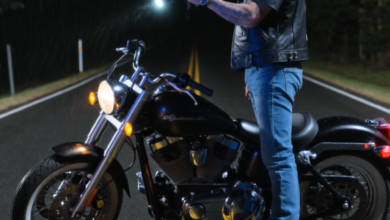
Just after midnight on Saturday in Mill Creek, Indiana, Tess Lawson stood outside the diner holding a paper bag with her father’s reading glasses inside. Ray had left them by the register again. He’d already gone the length of the diner parking lot and stopped at the red light on Foundry Avenue. Tess could see his left boot on the pavement. She thought she might still catch him before the light changed.
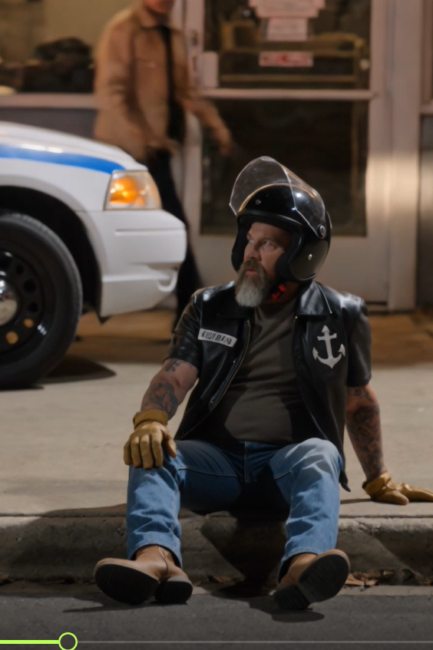
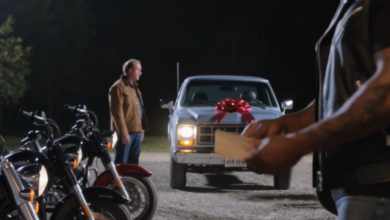
A police cruiser was stopped to his left. Tess noticed it because its headlights lit up the heel of his boot. She started to lift the bag. The front of the cruiser swung right and struck the back half of Ray’s motorcycle.
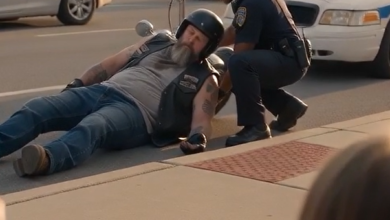
The sound was short and ugly. His bike went sideways onto the apron by the curb, and Ray went down with it.
“He hit him on purpose!” Jonah called from the diner steps. He still had his phone up. A woman beside him said, “Was he trying to get away?”
“He was stopped,” Tess said.
Ray was sitting on the apron when she reached him, one knee bent, his right glove flat against the concrete. His left hand lay across his stomach. His visor had come up partway. Beneath it Tess could see his long gray beard and a little piece of gravel caught in it.
“Dad?”
He looked at her. For a second that was all he did.
The officer got out. His door was still open when Jonah called down to him.
“I got all of that.”
“Give him room,” the officer said.
Tess heard it as an order to back off. So did the woman from the steps, who put a hand on Jonah’s arm and whispered that he’d better put the phone away. Jonah lowered it far enough that Tess could see the screen still glowing.
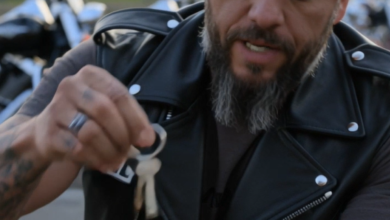
The officer came around the front of his cruiser. The beam from one headlight hit Ray in the chest. His short-sleeved black leather jacket had twisted at the shoulder, showing half the white anchor patch on his back. Tess reached to straighten it, then stopped. She didn’t know what would hurt him.
The officer went down on one knee a few feet away. He set his radio on the concrete and opened his hand beside it. Tess had been watching his face for some sign he was angry. It was his fingers that gave her pause. They were trembling so hard that he pressed them flat against his thigh.
Ray had come by the diner after his Friday night meeting to wait for her shift to end. They usually drove home separately. If it got late, he sometimes followed her as far as the turn for her apartment. Tonight she’d told him to go ahead because she had a drawer to count. He’d gone as far as the light.
Tess still had the paper bag. She’d crushed it around the glasses without feeling the frames through the paper. She lowered it to the concrete beside her father. The officer lifted his hand from his thigh and pointed toward the phone Jonah was about to slip into his pocket.
“Keep that recording.”
Part 2
Jonah brought the phone back up. The officer reached for his radio.
“Send a second ambulance. Pickup into a light pole east of the intersection. Driver still inside.”
Tess turned. Past the crosswalk, about fifty yards down Foundry, a pickup sat with its hood folded against a light pole. The lamp above it had gone dark. She’d heard two sounds, she realized. She’d been so sure the second one was her father’s motorcycle hitting the curb that she hadn’t even looked down the street.
“How did that get there?” she asked.
The officer gave dispatch the nearest cross street and put his radio down again. Then he asked Ray if he could feel the fingers on his left hand.
“Can feel them,” Ray said.
“Any pain in your neck?”
“No.”
“Stay where you are till they get here.”
Ray watched the officer for another second. Then he turned to Tess. “Did you get my glasses?”
She laughed once, loudly enough that Jonah looked down from the steps. Tess had spent years trying to get her father to carry a glasses case. Now she wanted to tell him she’d buy him a case for every room in his house if he would just keep asking her ordinary questions.
“Right here,” she said.
Another cruiser pulled up beyond the diner. The officer who’d hit Ray stood and flagged it toward the pickup. Tess caught his name when he checked in over the radio. Walker. She kept repeating it in her head so she could tell somebody later.
“Did he say anything to you before he did it?” she asked her father.
Ray shook his head.
“Did you see him coming over?”
“Saw the car when I stopped. Then I was sitting here.”
Tess looked at the scuff on Walker’s front bumper. It was about the height of Ray’s rear saddlebag. She wanted to ask him why he’d done it. He was standing a few yards away, close enough to hear her, with one hand cupped over his radio to hear the dispatcher. She decided she wanted somebody else in the room when she asked.
The first ambulance crew checked Ray on the apron and took him to the hospital. Tess followed in her car. In the waiting room she picked gravel out of the cuff of her jeans and sent a message to her aunt saying Ray was awake and talking. She deleted okay before she sent it. She didn’t know that yet.
The doctor found a fracture in Ray’s left wrist and cleaned up the scrapes on his forearm. Tess watched him try to get the paper band off his coffee cup with the fingers that stuck out of his splint.
“Give it here,” she said.
“I can do it.”
“I know. Give it here anyway.”
He handed her the cup. By then her aunt had texted back twice, the second time with a video Tess had never seen.
The clip lasted four seconds. It showed the cruiser angling into Ray’s bike and cut as the bike slid out of the frame. The title read Police Officer Deliberately Rams Biker at Red Light. Someone had added a circle around Ray’s boot to show he was stopped. Tess watched it three times before she noticed a reflection at the edge of the diner window.
There was a phone in the reflection. The person holding it was still filming when the clip ended.
Part 3
Tess called Jonah from the hospital vending alcove. He picked up on the second ring.
“Did you post it?”
“I sent a short piece to my brother.”
“How short?”
“Just the hit. He asked why I was late. I didn’t think he’d send it anywhere.”
“Do you still have the whole thing?”
“Yes. Why?”
“Because I’d like to know what we missed.”
Jonah went quiet. Tess could hear the diner refrigerator kick on behind him. He was still there. The night manager had let him sit in a booth while he waited for someone to pick him up.
“I thought I was going to get in trouble for filming,” he said. “That woman told me to put it away.”
“I heard her.”
“Then he told me to keep it. That’s what I don’t get.”
Jonah sent the original. He’d been outside recording a voice message for his brother when Ray rode to the light, and he’d switched to video because he wanted to show him the old V-twin. He’d kept the phone pointed at the bike even after the cruiser came into frame. From the steps, the cruiser’s side blocked most of the lane behind it. On the original, Tess heard a rising engine note, a scrape, then a second crash with a gap between the two. For two frames there was a flash in the diner glass. It could have been a headlight. There wasn’t enough to tell.
By morning, strangers had decided Walker had targeted a biker for fun. Other strangers had found Ray’s shop page and decided anybody who dressed like him had probably given an officer a reason. The diner took three calls before breakfast from people who wanted Tess to come to the phone. She was at Ray’s kitchen table, helping him pry the foil off a container of oatmeal.
“Can I tell them you were sober?” she asked.
Ray looked up. “Who’s asking?”
“People who saw the clip.”
“You tell the person taking my statement. That’s who needs it.”
Tess set the phone down. At twenty-one she’d answered a call from Ray after his arrest for drunk driving. He’d asked if she could feed the dog. She remembered waiting for him to say there’d been a mix-up, then going to the house and finding half a sandwich on the counter with the knife still lying in the mustard. He’d been on his way back from a short errand. He could have walked it.
Ten years later, she’d gotten used to him ordering coffee at places where the waitress already knew his order. She still remembered how much she’d wanted a simple explanation that first morning. Hearing him tell her to stick to what she knew made her put her hands flat on the table.
“Did you know Walker?” she asked.
Ray picked up the oatmeal with his good hand. “I thought I might.”
She waited.
“He looked different kneeling down.”
“Different from when?”
He took a bite and worked at swallowing it. Then Tess’s phone rang. It was the investigator handling the collision. She asked Tess to preserve Jonah’s original file and said the patrol car had recorded two angles.
“One pointed forward,” the investigator said. “The other looked back.”
Part 4
It took eight days for the department to release the two camera views. Tess had already given her statement and had hated how often she needed to say she couldn’t be sure. She was sure Ray had been stopped. She was sure the cruiser had steered toward him. She could remember exactly how the paper bag felt in her fist. Beyond that, the investigator could ask the same question six ways and Tess still couldn’t put a pickup in a lane she’d never seen.
She watched the release at Ray’s kitchen table. He sat across from her with his splinted arm on a dish towel so the edge of the table wouldn’t catch it. He’d asked her to play it once without stopping.
The rear camera showed a pair of headlights coming up behind them. At first Tess thought the truck was several blocks back. Then it passed the edge of the diner lot and she understood how quickly it was closing. It was in Ray’s lane. The signal ahead of it had been red long enough for the cruiser to stop, for Ray to put his foot down and for Tess to decide she might catch him with his glasses.
The front view showed the cruiser lurch right. Its bumper caught the left rear of the motorcycle and shoved it toward the apron. The pickup came through the space Ray had occupied about a second later. The forward camera caught it crossing the intersection, veering right and hitting the light pole. The red signal stayed red through all of it.
Tess looked across the table. Her father was watching the screen with his good hand curled around the rim of his coffee mug.
“Again?” she asked.
“Go back to where my foot’s down.”
She did. They watched the boot. Neither one said anything for a while.
In the investigator’s account released with the footage, Walker said he’d seen the truck in his passenger-side mirror. The driver was closing too fast and hadn’t begun to slow. The review team estimated the pickup had approached at around seventy-five miles an hour from the available footage and distance markers. Walker said by the time he understood what he was seeing, he had seconds at most. A horn would have had to make Ray hear, look, understand which lane the danger was in, and get several feet out of it. He’d moved the one thing he could reach.
Tess didn’t remember deciding to pause the video. The picture stopped on the back of the motorcycle, close enough for her to see the bent tip of the saddlebag latch. Ray had fixed that latch at her apartment the summer before. He’d used a butter knife because she didn’t own a screwdriver. She’d told him she knew what she was getting him for Christmas.
“Would you have gone if he’d honked?” she asked.
Ray looked at the frozen picture. “I’d have looked left.”
The diner called to ask whether it could share the full release. Jonah texted an apology and then another one because the first didn’t sound right to him. Tess called him back.
“You kept the file,” she said. “I’m glad you did.”
After they hung up, she opened the investigator’s email again. Walker’s full name was listed beside his statement. She read it aloud this time.
“Benjamin Walker.”
Ray moved his coffee mug off the towel. “Get me the gray envelope in the second drawer.”
Part 5
The envelope was under a stack of takeout menus and a warranty for a toaster Ray no longer owned. Tess recognized her own handwriting across the front. Court stuff. She’d written it at twenty-one, when she was angry that he kept leaving papers where she would see them. She hadn’t opened it in ten years.
Ray worked the flap with one thumb. Inside was a citation, a receipt for a fine, and a piece of lined paper folded in thirds. He slid the citation toward her.
The arresting officer’s name was halfway down the page.
“You knew when I said Walker at the hospital?”
“Thought it might be him.”
“Why didn’t you tell me?”
“Because I needed to see what happened this time.”
Tess set the citation down. Her father pressed one finger along the fold in the lined paper, working it flat. It was a copy of what he’d said at his sentencing. Some of it was crossed out. One line had been written in the margin after he’d run out of room.
Officer Walker, you saved my life.
“You said this to him in court?”
“After the judge was done with me. He was by the door.”
“What did he say?”
“He said, ‘Make it count.’”
Ray’s first arrest had begun with Walker finding him stopped at an angle beside a drainage ditch. Ray had insisted he’d pulled over on his own. Walker had walked him back to the curve later, once the tow truck came, and shown him the tire marks. Ray had crossed the opposite lane before he stopped. He could still remember arguing that the road was usually empty at that hour. He told Tess that was the part he’d had the hardest time admitting to the men at his first meeting. He’d been trying to claim credit for having missed whoever might have been there.
“Were you scared?” she asked.
“Afterward. At first I was mad about the truck getting towed.”
Tess had been mad about feeding the dog. She hadn’t cared that the dog needed feeding. She’d cared that Ray had asked it like she was covering for him while he worked a late shift. She told him that, for the first time. He kept his hand on the folded statement while she talked.
“I should’ve called you back that night,” he said.
“I would’ve answered.”
“I know.”
She’d assumed his Friday meetings were the same ones he’d started attending after court. He told her he’d started a small group of his own a few years later. Mostly riders. A couple of guys who’d sold their bikes and still came. He unlocked a room behind a tire shop on Fridays, put on a pot of coffee and kept a ride list. If someone called from a parking lot, a person on the list came to get them. They could go back for the bike in the morning.
“That’s where you’d been Friday?”
He nodded. “I was last out. That’s why I came for coffee so late.”
Tess thought about all the times he’d walked in at closing and set his gloves on the counter so she could fill a mug around them. She’d thought he liked coming when the diner was quiet. Now she wondered how many Fridays he’d been waiting for somebody to call.
“Are you going to talk to Walker?” she asked.
Ray reached for his phone. Before he could pick it up, it lit against the table. The investigator had forwarded a request from Walker. He wanted to come by the shop, if Ray was willing.
“He wants to bring somebody,” Ray said.
Part 6
Walker brought his wife. Tess had spent a full day guessing who might come with him, and had never once thought of her.
Her name was Denise. She carried a flat bakery box through the shop door and asked where she could set it. Walker stood behind her in jeans and a plain dark jacket. With his hands out of his pockets and his radio gone, he looked to Tess like a man waiting to hear how much his car repair would cost.
“I asked if I could come,” Denise said. “He said he’d check. Then I figured the least I could do was bring something people could eat.”
“Put it on the bench,” Ray said. “The clean end.”
Denise went straight to the dirty end. Tess moved an oily rag before she could set the box down. Denise took one look at the rag and laughed. The small sound did more to settle Tess than anything anybody had said in the week since the crash.
Ray’s motorcycle stood behind them on a stand. The rear saddlebag had cracked around the latch and the bars had twisted. Walker looked at it. Then he looked at Ray’s splint.
“I’m sorry about your wrist,” he said.
“Me too.”
“I’ve gone through what else I could’ve done.”
Ray waited.
“I keep getting to the same second,” Walker said.
Tess asked what he’d seen immediately afterward. She’d watched both camera views until she knew the points where the sound changed. She still wanted his answer.
“I saw your dad get as far as the curb,” he said. “Then the truck went through. I couldn’t see his left hand from where I was. I could see him moving his right one.”
“Why did you tell Jonah to keep recording?”
“His camera was looking straight at what I did. I wanted him to keep it, whatever it showed.”
Denise had opened the bakery box, but she hadn’t reached inside. She told Tess that when Walker came home that night, he put his keys in a bowl by the door and missed. He left them on the floor. She’d asked what happened and he’d said he’d hit somebody on purpose. She’d made him sit down before he tried to explain the rest.
Tess had heard those same words from Jonah. They still described what happened. She could see now how much room there’d been after them for somebody to supply the reason.
Ray took the old citation out of his shirt pocket and unfolded it on the workbench. Walker leaned over it.
“I figured it was you when I saw the name,” Ray said. “Took me longer with the face.”
“You had a shorter beard,” Walker said.
“I was trying to look respectable for court.”
“Did you shave it for court?”
“Trimmed the ends.”
Walker smiled, and Ray did too, briefly. Then Walker told him the pickup driver’s attorney had contacted the investigators. The driver was claiming he’d swerved because of the cruiser. Tess thought of the lane in the rear camera and the place the pickup was already headed. Walker said both original files had been preserved. The crash report had also been updated with the driver’s lab result.
“What’d it say?” Ray asked.
“Point three two.”
Ray put the citation back in his pocket with his good hand. Then he asked Tess to get his helmet camera from the shelf.
Part 7
The helmet camera hadn’t been running at the intersection. Tess told Ray so while she was still reaching for it. She thought he’d remembered a piece of evidence nobody had asked for.
“I know,” he said. “See if it’s got a charge.”
She turned it on. The battery icon showed one bar. Ray asked her to frame him and Walker in front of the damaged motorcycle. Walker looked down at his jacket, then over at Denise. She reached for a paper towel and brushed a few crumbs off his sleeve. That was all the preparation either of them got.
“Do you know what you’re going to say?” Tess asked.
“Most of it.”
She pressed record.
“My name’s Ray Lawson,” he said. “That’s my bike. Ben Walker hit it on Friday night. I’ve seen the whole recording. I’m glad he hit it.”
He looked at Walker, who was looking at the floor.
“Ten years ago, he arrested me for drunk driving. I told him at court he’d saved my life. I hadn’t gone long enough without a drink to know how true that was.”
Ray paused. The sound from the camera later picked up the fan running in the shop and a car pulling away from the light at the end of the block. Tess left those seconds in when she uploaded it. She’d watched her father take time before saying something hard many times. There was no reason to cut around it.
“This was the second time he saved my life,” Ray said.
He asked Tess to use that sentence as the caption. He also asked her to put the full footage first in the post so people would have somewhere to look besides his face. When she showed him the finished draft, he checked the caption, then made her play the opening to see whether the first second made Walker look as if he were waiting for praise. She showed him that Walker was looking at a crack in the shop floor.
“That’s fine,” Ray said.
By the end of the first week the video had been viewed millions of times. The copies kept spreading, and over the following weeks the combined view counts climbed into the tens of millions. Most people Tess talked to in town had seen at least one of the videos. The ones she was grateful to hear from were people who’d watched the short clip first and could say exactly where their understanding had changed.
The driver’s case took months. In court, the reconstruction showed that the pickup was already on course to enter the intersection in Ray’s lane before Walker’s cruiser moved. The lab result of .32 was four times the .08 threshold cited in the case. The driver ultimately pleaded guilty to charges tied to the crash and received a sentence that included jail time, a license suspension and a treatment requirement. The separate review of Walker’s actions found his response justified under the circumstances. Tess read both results at Ray’s kitchen table. The towel that had propped up his splint was back on the oven handle.
Ray was sitting beside her, testing how far his wrist would turn. The doctor had cleared him to do more with it. He still had trouble opening a pickle jar.
“Think that settles it?” Tess asked.
“For court.”
He slid a printout across the table. It was a still of his motorcycle on the apron, with Walker’s cruiser angled behind it. On the back he’d drawn two parking spaces and written a question.
Think they’ll let us bring both?
Part 8
The first event Ray and Walker held together was in a school parking lot on a Saturday morning. They called the campaign Leave It Parked. Tess printed the name on a sign along with a number people could use to ask for a ride through Ray’s group on weekend nights. Ray asked her to make the number bigger. From the road, he said, a person ought to be able to read it without getting out of the car.
The department brought Walker’s cruiser with the scrape still on the front bumper. Ray had his motorcycle brought on a trailer. He’d left the damaged saddlebag attached. Standing between the two vehicles, Tess could see where a small strip of paint from the cruiser had transferred to the latch. It was the most ordinary mark in the world. In the parking lot a person could put a finger on it.
A little girl in a yellow sweatshirt walked up with her grandfather. She went straight to Ray and asked if his tattoos had hurt.
“Some of them,” he said.
“Did that hurt worse?” She pointed to the saddlebag.
“My wrist did.”
She thought it over. “Did you yell?”
“I was too surprised.”
“Grandpa yells at jars,” she said.
Ray looked over at the grandfather. “I got one at home I can’t open either.”
The man laughed, then looked down at the sign. He took a card with the ride number and put it inside his wallet. Tess saw Ray notice. He stayed where he was and showed the girl how the broken latch used to work.
They’d agreed to use the two vehicles in campaign photos. When the photographer asked them to shake hands in front of the cruiser, Walker held out his right hand. Ray did the same. They stayed there long enough for one picture before a volunteer called Walker away to help move a table. Tess liked the photo the photographer took after that. Her father was rubbing his wrist with his thumb. Walker was turning to see who needed him. The scrape and the broken latch were both in focus.
That evening Tess closed the diner alone. A man in a rain jacket came in just before she locked the door. He asked if she could call the number on the sign because his own phone was dead. He had a motorcycle outside and a folded card in his pocket. He took his keys out while Tess was dialing and set them on the counter between them.
Ray answered. Tess told him where they were. She put the man on the phone, then got down two mugs because she knew how long it took her father to drive there from home.
When Ray came through the door, he had the same short-sleeved jacket on. The man at the counter glanced at the anchor patch and pulled out the stool next to him.
“I can leave it here overnight?” he asked.
Tess reached under the register for an envelope. “Put your name on this. I’ll be here at six.”
Ray waited while the man wrote his name. Then he picked up his coffee and sat down beside him. Tess slid the keys into the envelope and set it in the drawer with her father’s reading glasses.