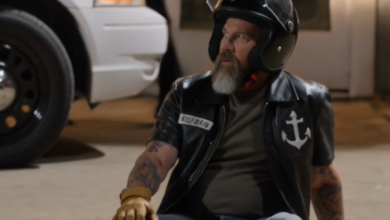
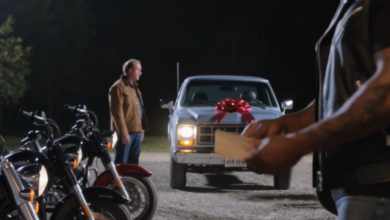
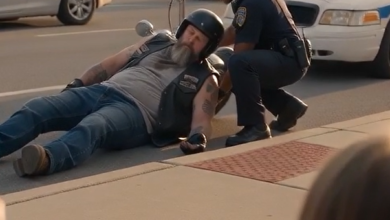
THE PARK SUPERVISOR ORDERED AN OLD MAN OFF HIS BENCH—THEN TWENTY BIKERS PULLED UP AND THE MAN IN FRONT WENT DOWN ON ONE KNEE
Part 1
THE PARK SUPERVISOR TOLD FRANK TO CLEAR HIS BENCH. THEN TWENTY BIKERS PULLED UP, AND ONE KNELT WITH A SET OF KEYS.
Three nights earlier, Frank Miller had been sitting under the bus shelter at the end of Water Street in Bellwether, Pennsylvania, counting the change in the bottom of his bag. He found a dime and a washer. He put both back. The buses had quit running, but the bakery two blocks up kept its window open for the night shift. He could smell bread when the wind came off the river.
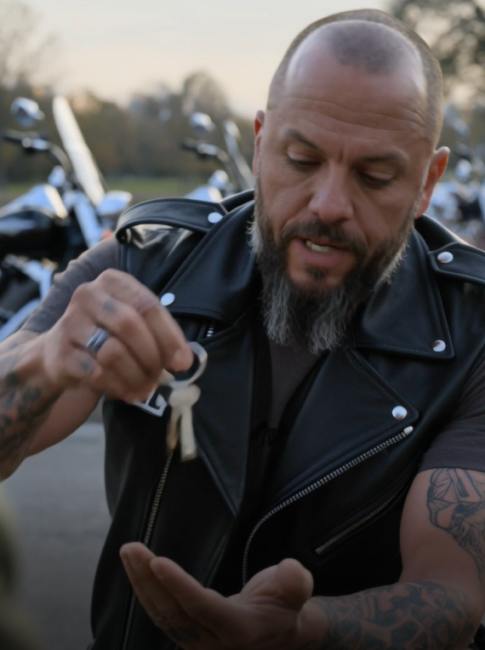
A man in a short-sleeved leather jacket came up the sidewalk and sat at the other end of the bench. He was big enough to make the bench creak. His hands were empty. When Frank asked if he was waiting on a bus, he said someone had taken his wallet. He’d been trying to get home since his bike quit. Frank heard him swallow halfway through the sentence.
“When’d you eat?”
The man had to think about it.
Frank took a folded five out of the inside pocket of his coat. The man pushed Frank’s hand away gently. Frank tucked the bill into the open pocket of his jacket.
“I’m used to being hungry,” he said. “You aren’t.”
On Sunday morning, Don Mercer was standing by Frank’s park bench with a roll of orange tape. The maintenance crew needed the path clear. Frank moved his bag under the bench. Don pointed at it again.
“All of it, Frank. You can’t make a home out of a bench.”
Lila Pierce was emptying the trash can by the path. At the sound of engines, she stopped with the new liner half open. Don looked toward the parking area and told Frank that if he’d called people to argue for him, it was only going to make things worse. Frank hadn’t called anybody. For a few seconds he wondered if the riders had come for somebody else entirely.
They parked in an arc along the paved pullout. When the engines shut off, Frank heard the latch on Lila’s trash can fall into place. The man from the bus shelter swung off the bike in the middle. He walked straight past Don. At the edge of the path he pulled off a worn glove and held it in his left hand. Frank could see the ends of his fingers were red from the cold.
“You still owe me a piece of bread?” Frank asked.
The biker smiled a little. He’d looked down at the five that night before walking away. In the shelter light Frank had seen him run his thumb over the faint writing along one edge. He’d asked who Annie was. Frank hadn’t answered right away.
Now the biker stopped in front of the bench. He lowered himself onto one knee. Lila took a step closer. Frank could hear something small click against the biker’s ring finger as he reached into his jacket and drew out a set of keys. A little metal house hung from the ring.
“Start with this,” the biker said, and laid the keys in Frank’s open palm.
Part 2
Frank kept his fingers open.
“Does it open a locker?”
The biker looked at the keys. “Big one opens a front door. Little one’s for the mailbox.”
“Whose mailbox?”
“Could be yours.”
Frank let the ring slide down to the fold of his fingers. He’d had three lockers in five years. One at a shelter where he kept an extra shirt rolled tight around a bar of soap. One at the bus depot before they took the lockers out. One that belonged to a man who’d let him use the lower half until somebody complained. A mailbox hadn’t occurred to him.
Don set the orange tape on the back of the bench. “Are these men here because I told you to move?”
The biker stood up slowly. “We were coming anyway.”
“Who are you?”
“Caleb Brooks.”
One of the riders called from the parking area, “You want me to leave room by the van, Level?”
Caleb turned. “Give her the whole space.”
Frank watched a rider walk his motorcycle back a few feet. The man wore the same white symbol on his jacket as Caleb, a short carpenter’s level with a little bubble in the middle. Frank knew how to read a level. He’d hung a kitchen shelf once with a glass of water because the man next door had borrowed his. The shelf had been right. The man had never brought back the level.
“You got your bike running,” Frank said.
“Fellow from the club hauled it in that night. Got it sorted the next day.”
“Where’s your bread?”
Caleb tipped his head toward the bikes. A brown paper bag sat on his seat. The top was folded over and stapled.
“Figured I’d bring some.”
A woman in a dark green coat stepped out of the van. Frank knew her by the shoes before he saw her face. Grace Kim wore white sneakers to work even in the rain. For most of the fall she’d met him at the library on Wednesdays with a folder under one arm. She was the first person he’d trusted to keep a copy of his discharge papers somewhere dry.
“Did they send you after me?” Frank asked.
“I was supposed to get here first,” Grace said. “They beat me by a minute.”
She sat next to him and put the folder between them. Frank shifted to give her room. For a moment the bench held the three things he knew he had to keep track of, his bag, the keys, and the woman who’d been calling him about housing since the first cold week in September.
“Did you get what we talked about?” he asked.
“Yes. You can see it today.”
“Is it one of those places where my bag has to stay in the office?”
“You bring it inside.”
“And if I go out after dinner?”
“You take your key and come back whenever you want.”
Don picked up the tape again. He had a crew coming to patch a section of path that roots had pushed up. Frank knew it was a real job. A man had caught a walker wheel there the previous week. He’d helped lift it while Don went for cones.
“Frank can get up when he’s ready,” Lila said. “I’ll show the crew where to start.”
Don looked down the path, then took his tape and went with her.
Frank closed his hand at last. The little metal house pressed into his palm.
“I only gave you five dollars,” he told Caleb.
Caleb looked at the pocket inside Frank’s coat, the one the money had come from.
“I know what was written on it,” he said.
Part 3
It had been three words and a year, if a year counted as a word.
For Annie — 1975.
Frank knew where each letter sat against the fold. Ellen had used a ballpoint that skipped unless you held it straight up. The first n was darker than the second. When the bill was new, the writing was almost the same blue as the dress she’d been wearing.
Caleb had asked about it under the bus shelter light. He’d already gotten to his feet. Frank remembered seeing him read it and thinking he might fold the money back up and push it into Frank’s pocket the way Frank had done to him.
“Annie was my daughter,” Frank had said.
“Did she write it?”
“Her mother did. Annie hadn’t been born yet.”
Ellen had given him the bill the morning he started at the paper mill. It was bus fare and lunch money if the foreman kept him past the end of his shift. She’d written Annie’s name because they’d just agreed on it the night before. Frank had tried to argue that they ought to meet the baby before naming her. Ellen had said he’d had seven months to make that argument and picked a poor time to start.
A man on the mill crew gave Frank half an egg sandwich that first day, and somebody driving past his street took him home. He still had the five when he walked in. Ellen told him to put it in the jar for the baby. He put it in his wallet and carried it to work again the next morning. Having Annie’s name on him turned out to feel better than having it in a jar on the kitchen counter.
“Where is she now?” Caleb asked that night.
Frank looked through the bus shelter glass. A car went past with the inside light on. There were two people in the front seat. He watched until it turned.
“She and her mom died in a house fire. Ninety-eight.”
Caleb sat back down.
“Annie was twenty-three,” Frank said. “She’d come over to fix the hem on some pants for work. The good machine was still at our house.”
He usually stopped there if he got that far. People wanted to know where he’d been, and the answer was the late shift, which sounded like an explanation for something he had spent years failing to explain to himself. Caleb didn’t ask. He sat with the bill unfolded on his knee.
“How long have you had this?”
“Fifty years.”
“And you’re giving it to me for bread?”
“You’re here,” Frank said. “Aren’t you?”
After the fire, he’d carried it through a rented room, then an apartment with yellow tile, then the years when his knees made the mill stairs a problem. There had been a long stretch when he could keep a place if he worked. Later there had been a shorter stretch when he could keep it if nothing else went wrong. He could put dates on some of it. The part he remembered clearest was starting to carry everything he might need to prove who he was.
That night Caleb had asked to borrow the time off Frank’s watch. Frank pushed his sleeve back to look. Caleb’s eyes settled on the faded tattoo under the watchband. The numbers were blurry now. The crossed tools underneath still showed.
“Engineer company?” Caleb asked.
Frank pulled the sleeve down halfway. “Army. Long time ago.”
Caleb looked at him for a second. Then he asked a question Frank hadn’t heard in years.
“Has anybody ever helped you get a copy of your discharge papers?”
Part 4
“Grace got them,” Frank had told him. “I know where they are.”
At the bench on Sunday, Grace opened her folder and showed him the page with his name at the top. It was the housing application they’d filled out at the library. He could recognize his own handwriting where he’d put a seven through the wrong box for his age. Seventy-eight. Grace had let him cross it out himself.
Caleb sat on the other end of the bench. His knee made a small crack as he bent it. Frank was privately pleased that a man that size made the same sound he did.
“How’d you know what the tattoo meant?” Frank asked.
“My uncle had one with the same tools. Different numbers.” Caleb rubbed the back of his bare hand. “He used to tell me they taught him to build a bridge faster than I could put up a shelf.”
“Could he?”
“Probably. I was twelve.”
On Thursday, after Caleb had left the shelter, he’d gone up to the bakery and asked to use the phone. The baker knew one of the club riders and called him. She brought Caleb bread and a cup of soup while he waited. When she came back to take his cup, he asked if he could take a second piece of bread down to the shelter. She wrapped half a loaf for him. By the time he got back, Frank had gone to find somewhere out of the wind.
“You didn’t spend it?” Frank asked.
“No.”
Caleb left the answer there. Frank wanted to ask where the bill was. He let Grace finish turning to the page she wanted first.
She told him Caleb’s motorcycle club had been working with the local veterans housing nonprofit for years. They had a crew that could patch roofs and fit doors on weekends. Caleb did carpentry for a living. He’d put in the last handrail at a small house across town the week before.
“Wasn’t there somebody waiting for it?” Frank asked.
“The man we thought would move in took a place near his daughter instead,” Grace said. “He called Wednesday.”
Frank remembered the apartment she’d offered him in September. It had been above a former drugstore with sixteen steps and a landing. He’d tried the steps twice. The second time he’d made it far enough to look down and realize he couldn’t trust his knee to get him out carrying a bag. He’d told Grace he’d wait. He’d gone back to the park thinking she’d take him off the list.
“You already had his papers?” Caleb asked her.
“Verified weeks ago. We needed a place he could get into.”
When Caleb found Frank again on Friday, he’d asked whether he could speak to Grace about the cottage. Frank remembered saying yes and asking if it was another upstairs place. Caleb had said it had two steps at the front and a level entrance in back. Grace had called later to ask whether he’d be willing to tour it on Sunday. He’d said he would. He’d pictured a clipboard and one person waiting beside a car.
“Did all twenty of them work on it?” Frank asked.
“Some did. A few brought meals. One put new lining in all the drawers. Took her longer than the plumbing took me.”
Frank looked out at the riders. They were talking in little groups now. A man had opened the paper bag and started tearing the loaf into pieces to hand around.
“Want to go see it?” Grace asked.
Frank glanced down at his bag, then up at Caleb. “You got somewhere I can wash my hands first?”
Caleb picked up the bag only after Frank nodded.
“There’s a sink two feet inside the door,” he said.
Part 5
Grace drove. Caleb followed on his motorcycle. Frank sat with his bag between his feet, holding it upright at every stop. He had a clean shirt in it, two pairs of socks, and a photograph he kept inside an envelope from the mill. Every time he took a ride somewhere, he made sure the bag was where he could feel it.
The house stood on a narrow lot between a brick duplex and an alley. Its porch had two steps, just as Caleb had said. Grace walked him around the side to the level entrance. He tried the big key there. It turned more easily than he’d expected, and he had to remind himself to take it out before he went inside.
A dish towel hung by the sink. Frank washed his hands. He couldn’t remember the last time he’d washed them in warm water without keeping an eye on the door. He dried them slowly, down between the fingers. When he turned around, Caleb had set the bag by the kitchen table.
“You want to see the rest?” Caleb asked.
“In a minute.”
Frank went to the window. It looked onto a patch of bare dirt with two broken stakes sticking up. A shed roof showed over the fence. He could see a neighbor’s dog turning in a circle before it lay down.
“Can I do anything out there?”
“Talk to Grace about the fence,” Caleb said. “The dirt’s yours to dig in.”
Frank looked at Grace. “What does this cost me?”
She took him through the agreement at the kitchen table. The nonprofit owned the house. His monthly share was based on his income, and the number was written on the page in front of him. She showed him who to call if the furnace went out and which utilities he would pay. She told him where the spare key would be kept and who could use it. He asked if he could have company on Sundays. She said he could have company on a Tuesday if he liked.
“How long is it for?” he asked.
“You can stay as long as the place works for you and you meet the terms we just went over. We can talk through any of them again.”
Frank asked her to read the repair number a second time. He wrote it on the back of an envelope in his own hand. Then he signed. Caleb stood by the window until Grace had put the papers away.
“Do I take the keys with me when we leave?” Frank asked.
Grace looked at him. “You can stay. I can go.”
He sat with that for a bit. He was still sitting when the van pulled out. Caleb went to the porch, came back with the bread bag and put it on the counter. Frank had expected a fresh loaf. There was about a quarter of it left, with the end crust intact.
“Everybody took a piece?” he asked.
“Most of them.”
“You save me the end on purpose?”
“Lila said you liked it.”
Frank put his hand on the bag. He didn’t know when Lila had noticed that. He could remember telling her once that somebody ought to leave the ends on a loaf of sandwich bread because they were the only pieces that held up in soup. She’d been emptying a trash can at the time.
Caleb took one step toward the door. “You got a knife in the top drawer. There’s something else in there, too.”
Part 6
The drawer stuck for the first inch. Frank put a little more weight on the handle and it came loose all at once.
There was a bread knife in a cardboard sleeve. Beside it lay a small wooden frame with glass on both sides. The bill inside was creased in the same three places it had been creased when he’d handed it over. He could see the dark first n and the faint second one.
He set the frame on the counter. Then he pulled the chair out and sat down because the room had gone blurry and he wanted to be able to put both hands somewhere steady.
Caleb stayed by the door.
“I thought you might have given it to the baker,” Frank said.
“She gave me soup. Wouldn’t let me pay.”
“You could’ve kept it.”
“I figured Annie belonged here.”
Frank put one finger against the glass over her name. He cried without having to turn his face toward the window. Caleb took the bread out of the bag and put it on the cutting board. By the time Frank could see well enough to cut it, Caleb had found two plates.
“Can you come back Sunday?” Frank asked him.
“Sure.”
“Bring eggs if you do.”
Caleb brought eggs, and three other riders brought things to go with them. Lila came after work, when the first pot of coffee was gone. Frank made a second pot. He set a towel under the cups because the table wobbled and everybody kept trying to take the blame for spilling. The carpenter in the room spent half of breakfast sitting on a chair with a folded napkin under its leg. He came back that afternoon with a shim.
The Sunday breakfasts kept going. Some weeks there were two people. Some weeks there were eight and somebody ate standing up. Frank learned that one rider couldn’t come before nine because his daughter needed the car for work, and another took his coffee half cold because he’d once burned his tongue so badly he’d spent the rest of the day unable to taste bacon. Frank always poured that man’s cup first.
Don came to the house near the end of the first winter. He held his hat in both hands on the porch. He told Frank that Lila had challenged the way he’d handled the work order, and his manager had gone over it with him. The crew had needed the damaged stretch of path clear. There had been room to leave Frank’s bench alone until they actually got to it.
“I was embarrassed when all those motorcycles showed up,” Don said. “I thought everybody was going to see me lose control of the job.”
Frank waited.
“So I talked to you like you’d done something wrong.”
“You did,” Frank said.
Don nodded. “I’m sorry.”
They stood there a little longer. Then Frank asked whether the town had any spare bags of soil. Don thought the nursery might give them one with a torn corner if he offered to sweep up what came out. By spring, Frank had a bed of yellow chrysanthemums under the front window. Ellen had liked the plain yellow kind. He bought the first two plants himself so he could choose the right shade.
Lila came by when they were blooming and found Frank turning the frame over in his hands. The club was collecting pictures for a display about its repair work. She asked whether he’d like them to include one of the bill.
Frank looked at Ellen’s writing.
“I’d rather give you a picture of the flowers,” he said. “There’s something else I want done with this.”
Part 7
He told Caleb the following Sunday, while the two of them were peeling the paper off a new stick of butter. Frank could have done it himself, but the corner kept tearing and Caleb had already seen him try twice.
“I want it with me when they bury me,” Frank said.
Caleb looked down at the butter dish.
“The frame, too?”
“Just the five. You can use the frame.”
Caleb got the butter onto the dish. “Okay.”
Frank had expected the usual response, some remark about being a long way from needing to decide. He had an answer ready for that. He let it go. Caleb sat down and asked whether there was somebody he ought to tell. Frank said Grace had helped him put his wishes in writing and Lila knew where he kept the envelope. He wanted Caleb to be the one who took the bill out of the frame.
“You want me to do it now?”
“No. I still like seeing it.”
By the sixth year, Frank had switched chairs at the kitchen table so he could get up by pushing on the wall. The Sunday riders had learned to leave that chair empty. When his health declined enough that he started receiving hospice care at home, a few of them asked if they should stop coming for breakfast. Frank told Lila to tell them they could come as long as they cooked. He was tired of pretending he wanted to stand over a frying pan.
On one of the last mornings he made it to the table, Don came in with the bakery bag. He put it down gently, then went outside to take his boots off because he saw the mud he’d left on the mat. Frank heard him say something to Caleb on the porch about starting over. Caleb told him there was a brush by the door. A little later, Don came back in with clean boots and gave Frank the end of the bread without asking.
Grace had joined them that morning. She’d brought a letter from the nonprofit confirming that after Frank was gone the house would remain part of the veterans program. He’d asked her to check. He’d been worrying about the flowers as well, which was a harder thing to put in a letter.
“Whoever’s here next might want tomatoes,” Caleb said.
“Give them the sunny side.”
“The mums are on the sunny side.”
“There’s room.”
Caleb looked out the window as though he might go measure it. Frank liked that about him. You could tell him what you wanted and see him thinking about where it would fit.
After breakfast, Lila showed him the club’s display photo. It was the one he’d chosen. Yellow flowers below the window. The edge of the porch. A small piece of his sleeve at the corner where he’d been reaching in to take a dead blossom off before she snapped the picture. She asked if he wanted her to crop it.
“Leave my arm in,” he said.
Later, when there was only Caleb in the kitchen, Frank asked him to get the frame from the windowsill. Caleb brought it over. Frank could read For Annie without his glasses by then. He rested the frame flat on his lap and tapped the wood twice.
“You ever wonder why I gave it away after carrying it that long?” he asked.
Caleb pulled out the chair beside him. “I figured you were going to tell me.”
Part 8
“I used to think I’d buy her something with it,” Frank said. “Before she was born. Couldn’t think what. Five dollars wasn’t much even then.”
“What’d you settle on?”
“Never did.”
Frank turned the frame to catch the light. He’d looked at it so often since Caleb brought it back that the bill seemed larger to him now than it had felt under the shelter light. At the shelter he’d only had to make up his mind about a man who was hungry. Annie had been good at that kind of thing. When she was twelve, she’d started taking an extra sandwich to school because a girl in her class kept saying she’d forgotten hers. Ellen had figured it out when the bread started running short on Thursdays.
“I think she’d have told me to give you the five,” Frank said. “Her mom would’ve told me to go get bread with you so I’d eat some, too.”
Caleb rested his forearms on the table. “We could’ve split it.”
“That’s what she’d have said.”
They sat for a while. Frank could hear Lila on the porch saying she was leaving the empty cake pan on the step and would collect it next week. He didn’t have enough breath to call to her. Caleb went out and told her he could take it to her car. Frank heard her say she meant to bring something in it next Sunday. He was glad she’d said that. He wanted there to be a next Sunday in the way the two of them talked at his door.
He died at home later that week. At the funeral home, Lila brought yellow chrysanthemums cut from the bed under his window. Don stood by the entrance handing out programs. When he reached Caleb, he held the last one out with both hands and went back to get another stack.
Caleb had brought the frame wrapped in a kitchen towel. He sat in the front row and worked the backing loose with his thumbnail. The bill came free without tearing. He folded it along the old creases and waited until the room thinned out. Then he went up to the casket and placed it in Frank’s hand, with the blue writing facing up.
The following Sunday, Lila carried the empty frame into the kitchen while the riders finished clearing Frank’s things. She had a spare print of the photograph from the display. Caleb put it behind the glass. Frank’s sleeve still showed at the edge.
A few months later, a new tenant moved in. He put tomatoes along the fence where they got sun in the afternoon. When Lila brought a loaf over, he asked whether the yellow flowers needed cutting back. She told him she’d bring shears and show him what Frank used to do. He said he’d put coffee on.
On the way out, she saw the photograph propped on the kitchen windowsill. The flowers in the picture had been a little brighter than the ones outside. Frank’s arm was reaching into the frame, almost close enough to touch them.
Follow the page for more stories about the people who make room for somebody else.