Part 2: A Poor Father Was Asked to Stay Out of the School Promotional Video — His Son’s Decision Left the Administration Speechless
The auditorium fell quiet.
The communications director, Lauren Mills, lowered the clipboard she had been holding against her chest.
“We can pause for a minute,” she said.
Caleb remained beneath the stage lights.
His borrowed blazer fit across the shoulders but pinched slightly at the sleeves. The school had chosen it from the drama department wardrobe because his own jacket had been damaged during his shift at the grocery store.
Thomas stopped near the hallway door.
He did not turn around immediately.
The principal, Dr. Evelyn Carter, stepped toward the stage with the careful expression she used during difficult meetings.
“Caleb,” she said, “nobody is trying to hide anyone.”
Caleb looked at Lauren.
“She told my dad to wait outside.”
Lauren’s face reddened.
“I asked him to wait near the hallway. We are trying to keep the frame consistent.”
Thomas finally turned.
“It is fine,” he said. “She did not mean anything by it.”
His instinct was familiar.
Make the moment smaller.
Give people an easy way out.
Caleb had watched him do it for years.
When a landlord spoke slowly to Thomas because his boots were muddy, he smiled and thanked the man for his time.
When another parent asked whether Thomas was “helping with cleanup” at an awards banquet, he carried the empty trays to the kitchen before answering.
When Caleb’s guidance counselor suggested college applications might be unrealistic without savings, Thomas only asked which forms needed signatures.
Dr. Carter looked toward the garment bag in Thomas’s hand.
“You brought something for Caleb?”
Thomas lifted it slightly.
“His mother’s brother gave him a jacket for graduation. Caleb forgot it at home.”
Caleb stepped down from the stage.
“You drove all the way here for that?”
“I was nearby.”
Caleb looked at the grease on his father’s sleeve.
“You were not nearby.”
Thomas glanced toward the side exit.
The silence answered for him.
He had left work early again.
Thomas repaired commercial kitchen equipment for a small company across town. The job paid hourly. There was no paid leave for forgotten jackets or promotional videos.
He had already lost two hours the previous week when the school asked him to sign scholarship paperwork in person.
Caleb took the garment bag gently.
“You should go back,” he said.
Thomas smiled.
“I can stay if you want.”
Before Caleb could answer, a sharp buzzing sound came from above the stage.
One of the lights flickered twice and went dark.
The film crew looked upward.
“Can somebody call maintenance?” the camera operator asked.
Thomas placed the garment bag across a chair.
“May I take a look?”
Lauren hesitated.
“We probably should not touch anything.”
Thomas studied the fixture.
“It is not the light. The cable is loose near the dimmer rack.”
He walked toward the side wall, crouched beside a panel, and secured a connection with a small screwdriver from his pocket.
The light returned.
“Thank you,” the camera operator said.
Thomas nodded and stepped away before anyone could make a fuss.
Caleb watched him return to the aisle.
His father had fixed problems in almost every building he entered.
He repaired broken cafeteria refrigerators after hours. He patched neighbors’ heaters before winter storms. He carried spare tools because someone always needed something tightened, reset, or held together.
Most people noticed the work only after it was finished.
Lauren cleared her throat.
“Perhaps we can reset and continue.”
She looked toward Thomas.
“There is coffee in the hallway, Mr. Reed.”
Thomas nodded.
Caleb did not move.
Behind the camera, a student assistant held up a printed script.
The final line had been highlighted in yellow:
AT WESTFIELD HIGH, MY FUTURE BEGAN WITH PEOPLE WHO BELIEVED IN ME.
Caleb read the sentence again.
Then he looked toward the garment bag.
“Dad,” he said, “what is inside the front pocket?”
Thomas stiffened.
“Nothing important.”
Caleb unzipped the pocket.
Inside was a folded envelope with his name written in Thomas’s careful block letters.
The paper was worn at the corners.
Caleb recognized it immediately.
His father had carried that envelope for nearly four years.
It contained a letter Thomas never planned to show him until graduation day.
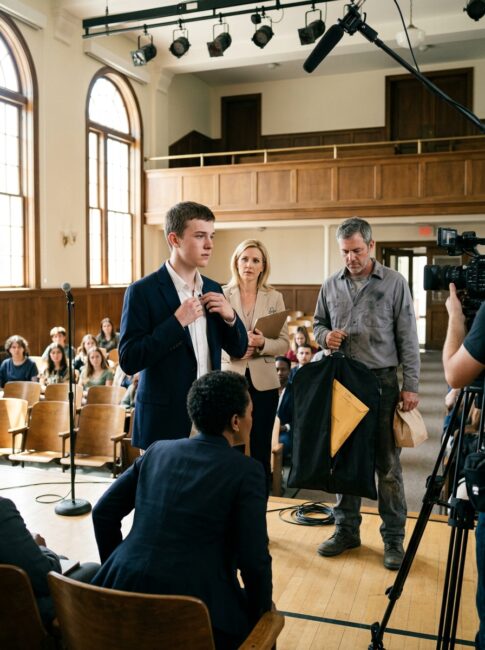
Caleb held the envelope but did not open it.
Not yet.
Thomas looked uncomfortable beneath the auditorium lights.
“That is for later,” he said.
“You kept it in the jacket?”
“I thought you might wear it today.”
Lauren glanced toward the camera operator.
“We should probably take five minutes.”
“No,” Caleb said.
His voice was calm.
“Please keep the camera where it is.”
Dr. Carter studied him.
“This does not have to become part of the video.”
Caleb looked toward his father.
“I think it already is.”
Thomas shook his head slightly.
“Caleb, finish what they asked you to do. This is a good opportunity.”
That sentence carried years inside it.
Finish the assignment.
Do not make trouble.
Be grateful for the opportunity.
Thomas had raised Caleb alone since his wife, Amy, died when Caleb was twelve.
Before her illness, Thomas owned a small appliance repair business with two employees and a white van bearing his name.
When medical bills grew heavier, he sold the van.
Then he sold the tools he did not absolutely need.
Then he closed the business and accepted an hourly job with longer shifts because the company offered health insurance.
The insurance did not save Amy.
It did, however, keep the family from losing their small house.
After her death, Thomas never reopened the business.
He worked mornings repairing restaurant equipment and evenings fixing whatever neighbors could not afford to replace.
Caleb knew most of that.
He did not know everything.
The auditorium doors opened quietly.
Ms. Harper, Caleb’s guidance counselor, entered carrying a folder.
“I heard there was a delay,” she said.
Her eyes moved from Caleb to Thomas, then to the envelope.
Thomas looked down.
Ms. Harper understood immediately.
“You were saving that for graduation,” she said.
Thomas rubbed one hand against the side of his work pants.
“That was the plan.”
Caleb turned toward her.
“You know what is in here?”
Ms. Harper hesitated.
“Part of it.”
Thomas sat in the front row.
For the first time that afternoon, he looked tired rather than merely embarrassed.
“Open it,” he said.
Caleb unfolded the letter.
The first page was written in his mother’s handwriting.
The ink had faded slightly.
Dear Caleb,
Your father will tell you that he is not brave. He will say he simply does what needs doing. Do not believe him when he makes his sacrifices sound ordinary.
Caleb stopped reading.
Thomas stared toward the stage floor.
The next paragraph was shorter.
There may be days when you wish our family looked like other families. There may be rooms where people notice his work clothes before they notice him. Remember that those clothes paid for medicine, groceries, books, and time. Time was the most expensive thing he ever bought for us.
Caleb swallowed hard.
Nobody in the auditorium moved.
The camera remained pointed toward the stage, but the operator lowered his hands from the controls.
Caleb continued silently.
The second page was written by Thomas.
His handwriting was more uneven.
Your mother wrote the first part during one of her better weeks. I never knew when to give it to you. I thought graduation might be right.
Below that was a list.
Caleb recognized the dates.
They were the dates of every major school event his father had missed.
Freshman orientation.
The regional science fair.
The sophomore awards breakfast.
The engineering club showcase.
Beside each date, Thomas had written where he had been working.
Emergency freezer repair — hospital cafeteria.
Overnight boiler call — Brookside Apartments.
Restaurant ventilation failure — double shift.
School kitchen compressor — no charge.
Caleb looked up.
“School kitchen?”
Thomas shifted in his seat.
Dr. Carter turned toward him.
“The cafeteria compressor failed two winters ago,” she said slowly. “A contractor repaired it overnight before classes resumed.”
Thomas remained quiet.
Ms. Harper answered for him.
“He repaired it.”
Dr. Carter stared at Thomas.
“We received an invoice marked paid.”
Thomas looked toward the empty stage.
“The company donated the part after I asked. I covered the hours.”
“Why?”
Thomas gave the smallest shrug.
“The breakfast program needed the refrigerator.”
Westfield served breakfast to more than two hundred students each morning.
Caleb knew his father repaired equipment.
He had not known his father spent an unpaid night inside his school cafeteria so children would have milk before class.
The letter contained another page.
It was a copy of Caleb’s scholarship essay.
He had submitted it months earlier for the state engineering award that brought the film crew to Westfield.
The title read:
The Things That Hold
Caleb had written about bridges, bolts, pressure points, and structures people trusted without seeing.
His final paragraph was about Thomas.
My father repairs machines after restaurants close and before schools open. Most people never see him work. They only notice that the lights turn on, the freezer stays cold, and the doors open in the morning. He taught me that the strongest parts of any structure are often hidden behind walls.
Lauren looked toward the printed promotional script in the student assistant’s hands.
Her expression changed.
The video was supposed to celebrate Caleb as a scholarship student whose success reflected well on the school.
The script mentioned advanced classes, mentorship, and academic opportunities.
It did not mention the father asked to wait off-camera.
Caleb stepped onto the stage again.
He placed his mother’s letter inside the garment bag and picked up the microphone.
Lauren exhaled with relief.
“Thank you,” she said. “We can start from the final question.”
Caleb clipped the microphone back onto his shirt.
The camera operator raised his hand.
“Rolling.”
Lauren stood beside the lens.
“Caleb, tell us where your future began.”
The approved answer waited on the teleprompter.
Caleb looked at the words.
Then he looked toward Thomas.
“My future did not begin on this stage,” he said.
Lauren froze.
Caleb continued.
“It began in a repair van my dad had to sell. It continued in hospital cafeterias, restaurant kitchens, and apartment basements where he worked while I slept.”
Thomas lowered his eyes.
“It began with somebody who missed my awards because he was paying for the shoes I wore to them.”
Dr. Carter stood completely still.
Caleb removed the borrowed navy blazer.
Underneath, he wore a simple white shirt.
He stepped off the stage, carried the microphone toward his father, and held out one hand.
“Dad, will you stand with me?”
Thomas shook his head immediately.
“This is your video.”
“That is my decision.”
For several seconds, nobody spoke.
Then Thomas stood.
His boots were scuffed. His work shirt remained stained. Grease still marked one sleeve.
Caleb guided him toward the stage.
Lauren glanced toward Dr. Carter, waiting for instruction.
The principal looked at the father and son standing beneath the lights.
“Keep filming,” she said.
Caleb faced the camera again.
“This school taught me a lot,” he said. “But my father taught me what education is for.”
He placed one hand on Thomas’s shoulder.
“It is supposed to help us see the people who were already holding everything together.”
No one in the administration moved.
The camera continued recording.
The school did not release the original promotional script.
Instead, the final video opened with an unplanned moment.
Thomas Reed stood near the auditorium aisle holding an old garment bag. His gray work shirt was wrinkled. His boots left faint marks on the polished floor.
For several seconds, he appeared uncertain about where he belonged.
Then Caleb walked toward him and held out his hand.
The school kept the silence between them.
It kept Thomas’s hesitant expression.
It kept the grease stain on his sleeve.
The video ended with Caleb’s unscripted sentence:
“My father taught me to see the people who were already holding everything together.”
Within days, parents began sharing the video.
Some wrote about their own fathers who drove trucks, cleaned offices, repaired roofs, or worked night shifts inside buildings their children entered each morning.
Others wrote about mothers whose uniforms smelled like diner grease, hospital disinfectant, laundry soap, or factory floors.
Thomas did not read most of the messages.
He returned to work the following morning at 6:30.
A restaurant refrigerator had stopped cooling overnight.
Before leaving the house, he found Caleb sitting at the kitchen table with the garment bag draped across the empty chair beside him.
The graduation jacket remained inside.
His mother’s letter lay folded carefully near his cereal bowl.
“You are up early,” Thomas said.
“So are you.”
Thomas poured coffee into a scratched travel mug.
Caleb looked toward the work boots near the back door.
“Ms. Harper called last night.”
Thomas paused.
“She said the school wants to create a fund for students whose parents cannot leave hourly jobs for school events.”
Thomas nodded slowly.
“That sounds useful.”
“They want to name it after you.”
Thomas looked almost alarmed.
“Absolutely not.”
Caleb smiled.
“I told her you would say that.”
“Good.”
“I suggested a different name.”
Thomas waited.
“Open Door Fund,” Caleb said. “For parents who are working behind the scenes.”
Thomas considered it.
“That is better.”
At school, the auditorium floor still carried one faint dark mark from Thomas’s boot near the front aisle.
A custodian tried to remove it after the filming.
The principal stopped him.
“Leave it for now,” Dr. Carter said.
The mark remained there through graduation rehearsal.
On commencement night, Caleb wore the jacket Thomas had carried inside the old garment bag.
When his name was called, he crossed the stage, accepted his diploma, and looked toward the back row.
Thomas sat near the aisle in a clean button-down shirt.
He had arrived late after an emergency call at an assisted-living facility, but he had arrived.
Caleb lifted the diploma slightly.
Thomas smiled and tapped his wristwatch, reminding his son that photographs could wait until after the ceremony.
Outside, families gathered beneath strings of lights.
Thomas tried to remain near the edge of the crowd.
Caleb found him anyway.
They took one photograph together beside the school entrance.
Thomas’s shirt was clean, but a narrow line of grease remained beneath one fingernail.
Caleb noticed it when his father placed an arm around his shoulder.
He did not ask him to hide his hand.
Months later, the photograph appeared beside the Open Door Fund announcement on the school website.
There was no dramatic caption.
Only a single sentence beneath it:
For the families whose work is not always visible, but whose love is present in every opportunity.
Thomas never became comfortable with recognition.
He still entered buildings through service doors. He still carried a screwdriver in his pocket. He still repaired small things before anyone noticed they were broken.
But whenever he walked into Westfield High after that day, nobody asked him to wait in the hallway.
Follow our page for more heartfelt stories about the quiet people whose sacrifices deserve a place inside the frame.