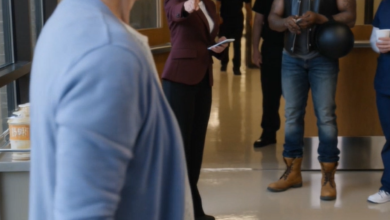
A PROPERTY MANAGER COVERED A CHILD’S DRAWING WITH A NOTICE—THEN SHE POINTED AT A BIKER’S HAND AND SAID, “THAT’S MOM’S WRITING.”
Part 1
THE PROPERTY MANAGER TAPED A MOVE-OUT NOTICE OVER A LITTLE GIRL’S DRAWING, THEN ORDERED THE BIKER ON HER MOTHER’S STEPS TO LEAVE.
Rachel Adams stood in the doorway of apartment 1B with breakfast dishes still in the sink and three children behind her. It was a Friday morning in the Ohio town of Millhaven. Her oldest, Luke, had been about to leave for school. The two girls were waiting for him by the shoe rack. Outside, neighbors had gathered along the cracked walkway, each holding a copy of the same paper.
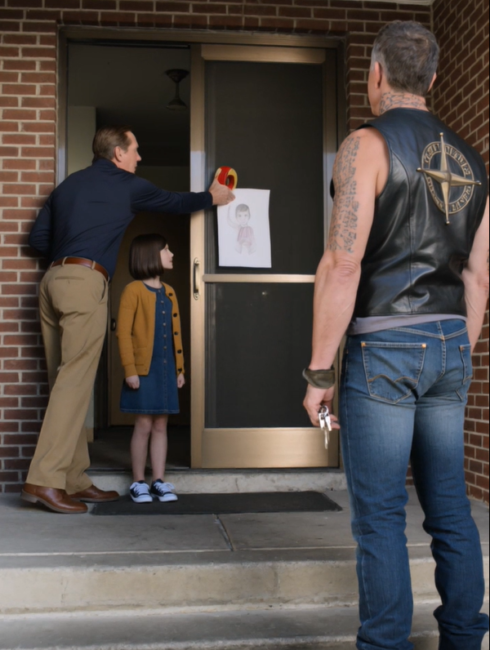
Grant Ellis pulled a strip of tape from his dispenser with his teeth. He fastened Rachel’s notice directly over Anna’s drawing of their front window. “Friday is the deadline for the relocation payment,” he said. “Start packing if you want it.” Rachel asked whether that meant next Friday or the Friday printed at the bottom. He tapped the paper instead of answering. When a broad man in a black leather vest stepped closer with a key ring in one hand, Grant turned on him. “This is private property. Get your motorcycle club off the steps.”
The stranger stopped below the top step. He had closely cropped gray hair and a clean-shaven jaw, with a pale strip of skin where a beard might once have been. Tattoos ran down both arms and across his knuckles. A small brass-colored compass was stitched on the back of his vest. His cruiser stood at the curb behind two others, engines off.
Grant looked past him at the neighbors. “I’ve been trying to arrange help all morning. Now we have people showing up with keys and promises.” Someone at the far end of the walkway asked if the locks were being changed. Rachel pulled her children closer without looking away from the key ring. At sixteen, Luke barely fit beneath her arm anymore. Anna pressed against the back of her cardigan.
The man lowered the keys until they rested against his thigh. Beside his boot lay a long signboard wrapped in brown paper. He left it there. Instead, he took off his right glove and opened the inside pocket of his vest. Rachel saw him work a scrap of paper free from a clear sleeve. It was folded into a square smaller than a grocery receipt. The creases had darkened enough to divide it into four uneven sections. He opened one fold, then the other. Grant’s next sentence trailed off when the man held the paper toward Rachel, keeping his hand below her eye level.
“I came to give this back,” he said. His voice was low. Up close, Rachel could smell sawdust in the leather and see pale paint caught beside one thumbnail. He looked at Luke for a second, then back at her. She searched his face, trying to remember a repair call or a parent from school.
Rachel leaned forward. There was a phone number on the paper, and beneath it a name written so small that the last letters curled up the edge. Anna came around her mother’s hip and pointed without touching it. “That’s Mom’s writing.” Rachel’s hand stopped halfway between the notice on her door and the scrap in the stranger’s palm.
Part 2
“I did write that,” Rachel said. “Who gave it to you?”
The man glanced down at the paper. “You did.”
Luke shifted beside her. The zipper on his backpack caught the screen door, making the spring stretch and release. Rachel took the paper before it could blow out of the man’s palm.
The phone number had an eight squeezed above a crossed-out three. Underneath she’d written, Ask for Denise. Call after eight.
She remembered the pen first. It had come from the diner, a cheap blue one that leaked if she kept it in her apron too long. Then she remembered where she’d found the paper.
A pizza box.
“You had a beard,” she said.
“All the way down to here.” He put his hand below his collarbone. “Frank Hale.”
Rachel looked at Luke. He was staring at the paper now.
“Your cheek was wet,” Luke said. “I thought the pizza was too hot.”
Frank dropped his eyes for a second. “It wasn’t the pizza.”
Grant stepped closer. “Whatever this is, we have forty units to process. People are waiting for instructions.”
Rachel folded the scrap along its old crease. She had spent the week filling boxes with things she couldn’t bear to pack and taking them back out again. She’d called four apartments during her lunch breaks. Three required more money at signing than she had. The fourth wouldn’t take a family of four in the unit they had available.
“Who are you here with?” she asked Frank.
“People who asked me to find you before we held the meeting.”
He took a folder from beneath the wrapped signboard. Inside was a letter naming the building’s new ownership company and its authorized representatives. Rachel saw his name in the second paragraph.
Grant reached for it. Frank let him read without letting go of the folder.
“This closed yesterday,” Grant said.
“Yes.”
“I was told I’d be coordinating the vacancy schedule.”
“With the other buyer.”
A woman at the curb came up the walkway carrying a canvas case. Rachel recognized Marlene Price from the housing clinic at the library. Marlene had helped her read the first notice three weeks earlier. At that meeting she’d asked Rachel’s permission to share her contact information with a group trying to preserve the apartments.
“I couldn’t talk about the buyer until the purchase was complete,” Marlene said. “I asked Frank to wait for me before anyone discussed the leases.”
Grant looked at the key ring, then the wrapped board. “You can’t promise everyone they can stay just because you’ve brought a sign.”
Rachel agreed with that much. She handed Anna’s drawing to Sophie after carefully peeling it loose from the tape.
“No speeches,” she told Frank. “I need someone to explain what happens to our homes.”
“That’s fair.”
He stood aside so Marlene could get up the steps. Beyond him, the other riders remained by their bikes. Nobody came forward until Rachel asked whether they were waiting for the same meeting.
Frank nodded.
“Why are all of you doing this?” she asked.
He looked at the scrap she was still holding.
“Because I made that call the next morning. You ought to know what happened after someone answered.”
Part 3
Six years earlier, Rachel had been washing every sheet they owned because Anna had been sick and the building’s shared washer was broken again. Luke was ten. Sophie was six and could fall asleep sitting up if she had something solid to lean on. Anna, three, had spent the last hour asking when they could go home.
They’d walked to the laundromat after Rachel’s dinner shift. It was nearly midnight by the time the dryers stopped.
The pizza was small. Rachel had ordered it on the way because she couldn’t picture getting three tired children upstairs, feeding them and then finding a place to lay damp blankets. Luke had counted the slices before taking one. He always counted when he thought she wasn’t looking.
Across the room, a bearded man sat beneath a television with no sound. He wore a faded work jacket. His hands lay flat on his knees, and every time Rachel opened the box, his eyes moved toward it.
She didn’t like that at first. She moved Anna to the chair on the other side of her. Then the man looked away with a speed that made Rachel feel she’d caught him doing something shameful.
She asked Luke to take him two slices.
“Both?” he whispered.
Rachel nodded.
“On a plate?”
She tore the lid off the box. “Use this.”
She watched the whole walk. Luke held the cardboard with both hands, concentrating hard enough that his tongue showed at the side of his mouth. The man looked at the slices, then at Rachel. He took one with his fingertips and put it back down.
Luke came halfway back before turning around.
“Are you okay?” he asked.
The man’s cheek was wet beneath the beard.
“Yes,” he said. Then he shook his head. “I’m trying to be.”
Rachel brought him the stack of napkins. He told her he’d been released from prison that morning. The address he’d expected to stay at hadn’t worked out. He’d spent the day walking between places that were closed or couldn’t help until someone else had spoken to him.
“What kind of work did you do?” she asked.
“Repairs. Mostly wood. I could hang a door if someone would let me near the building.”
Rachel had a cousin who’d gone through a county employment program. She knew the woman who answered the intake calls because she’d helped her cousin write down appointment times. She found the pen in her purse and wrote the number on a clean corner of the pizza box lid.
“Ask for Denise. If you call before eight, you’ll get a recording.”
Frank read it carefully. “They take people with a record?”
“Tell her what you told me. She’ll tell you what she can do.”
He asked Rachel’s name. She gave him her first name and, when he asked where the washer was broken, the address of the apartments.
She remembered putting Anna’s shoes back on while Frank finished the second slice. Luke carried the clean towels to the door. Frank held it open with his shoulder, staying clear of the children.
Present-day Rachel looked at the paper again. Someone had trimmed away the greasy edge without cutting off a single digit.
“Did Denise remember the number?” she asked.
Frank smiled a little. “She remembered you correcting your cousin’s times on the appointment cards.”
“And she found you work?”
“Eventually. First she asked where I was going to sleep that night.”
Part 4
Denise put Frank in touch with a transitional housing program and gave him a bus pass for an intake appointment. He showed up forty minutes early because he was afraid of missing the transfer. At first the repair crew let him clean up and carry materials. He had to demonstrate the things he’d said he could do, one task at a time.
“She told me to keep a notebook,” Frank said. “Write down who I called and when they said to come back.”
Rachel looked at his folder. Each sheet had a date penciled in the corner.
“You kept doing it.”
“Still lose things if I don’t.”
He worked for a small remodeling contractor for almost three years. When the owner cut back, Frank bought a used van and took the jobs too small for the remaining crew. He hired a second worker after a long kitchen repair, then a third. By the time he joined the Compass Stone Riders, he had a business that could cover payroll without waiting for the next customer’s deposit.
“The guy who inspected my van rode with them,” he said. “I kept fixing things at their meeting place. After a while, someone told me I could come on a day nothing was broken.”
Rachel would have smiled if Grant hadn’t been checking his phone beside the railing.
“The redevelopment group asked your company to bid?” Marlene prompted.
Frank nodded. “They wanted estimates for stripping the apartments.”
His estimator photographed the property. In one picture Rachel stood beside the mailboxes, trying to balance a laundry basket on her hip while she opened a letter. Frank recognized the address first. Then he enlarged the picture until the screen blurred.
“I wasn’t sure it was you,” he said. “I asked the housing clinic if any of the residents were looking for help.”
Marlene had already heard from twelve households. She asked the tenants whether she could put them in touch with a possible preservation buyer. Rachel signed because she was signing anything that might give them another option. She’d expected someone to buy time, perhaps negotiate another month.
Frank had asked for a different estimate. What would the repairs cost if the apartments stayed apartments? The club had members who knew plumbing, roofing, bookkeeping and rental maintenance. They helped him identify what he still needed professionals to inspect and price.
“That doesn’t buy a building,” Rachel said.
“No,” Frank agreed. “I couldn’t buy it myself.”
The club helped him find investors willing to accept a modest return from keeping the rentals occupied. A local housing organization joined the purchase, and a lender reviewed the rents and repair plan. Frank put in money from his business savings. Other members invested what they could afford after seeing the risks in writing.
The previous buyer’s deal fell through while the seller was still considering offers. The preservation group already had its inspections and financing lined up. They negotiated, signed and spent weeks getting to yesterday’s closing.
Rachel glanced at the signboard. “You bought that before you knew?”
“I ordered a blank board. The paint had to wait.”
Grant put his phone away. “People still signed relocation agreements.”
“How many?” Marlene asked.
“Enough that we need to follow through.”
A neighbor came forward holding a folded receipt. “He told me my utilities would be shut off if I waited past Friday.”
Marlene turned toward Grant.
“Which Friday,” Rachel asked again, “and who authorized you to say that?”
Part 5
The neighbor was Mrs. Ortiz from upstairs. Rachel had carried groceries for her twice that week without knowing she’d already paid a deposit on another place. Mrs. Ortiz unfolded the receipt against the railing. Her hand shook enough that Sophie offered to hold the corner.
“He said I could lose the moving money if I asked the clinic to look at it.”
Grant took a breath. “I said the offer had an expiration.”
“That isn’t what you said in my kitchen,” Mrs. Ortiz replied.
Rachel had thought everybody else understood the notices better than she did. She’d been embarrassed to ask why the dates didn’t match. Around her, people began pulling out texts and showing them to Marlene.
The original notices gave a later date for ending the leases. Grant had been urging tenants to sign earlier move-out agreements in exchange for small relocation payments. Marlene had told Rachel that the notice she received was no court order directing her family out that week. Now she read through the agreements and messages one by one.
Frank moved the signboard off the walkway. One of the riders brought a folding table from a van, and the neighbors set their papers on it. The new owner’s property representative arrived with copies of the ownership notice and contact information. She had spent the morning at the other entrance answering the same questions.
“Why was he still putting notices up?” Rachel asked her.
“We told the management office yesterday afternoon to stop distributing the old materials.”
Grant said he hadn’t opened that message until this morning. The representative held out a printed reply from his account, sent the previous evening. It acknowledged the change of ownership and asked about payment for his work obtaining early vacancies.
The sentence about payment made the walkway go quiet.
“You were getting paid when people left?” Rachel asked.
“The old management agreement included a vacancy incentive.”
“Even if we had nowhere to go?”
Grant looked toward the street. “I was carrying out the redevelopment plan.”
Frank spoke from the end of the table. “And you told a mother to pack before anyone answered her question.”
Grant’s assignment ended that morning. The representative collected his building keys and delivery records while Marlene arranged private appointments for the tenants who’d signed anything. The new owners issued written withdrawals of the pending move-out demands and gave each household a number to confirm their status. They also paid for independent help reviewing the early agreements, including Mrs. Ortiz’s deposit problem.
Rachel read her own letter twice.
Her family could stay. All forty households would be offered continued tenancy under the preservation plan. Existing rents were being maintained while residents met with management about renewals and the long-term affordability restrictions recorded as part of the purchase.
“What about repairs?” Luke asked.
“Scheduled,” Frank said. “You get a notice before we come into your home. You get someone to call if the work isn’t done.”
Rachel wanted to believe him. She wanted to believe him so badly that she made herself ask where those promises were written. Marlene showed her. Frank waited while she read, without trying to hurry her past a paragraph.
Only then did Rachel pick up the scrap again.
“Two pieces of pizza,” she said. “You went through all this because I gave you two pieces of pizza?”
Frank rested both hands on the empty folder.
“I haven’t told you what I was going to do before Luke walked over.”
Part 6
Rachel looked back at the children. Anna and Sophie were comparing the marks the tape had left on the drawing. Luke stood beside her, old enough now that she couldn’t send him out of every difficult conversation.
“Do you want to come inside?” she asked Frank.
He nodded. They sat at the kitchen table. Frank chose the chair that let him see the door. Rachel recognized the habit from the laundromat, although she hadn’t understood it then.
“I was hungry,” he said. “I was also scared to spend another night outside. I knew what time I’d get fed if somebody took me back to jail.”
Rachel sat down slowly.
“Were you going to hurt someone?”
“No. I’d been thinking about breaking a store window and waiting there.” He rubbed his bare thumb across a knuckle. “I kept telling myself it was a plan.”
Luke set his backpack on the floor.
“I thought you were looking at us.”
“I was looking at your food.”
Rachel remembered moving Anna to the other chair. “I almost asked you to stop staring.”
“You would’ve had a reason.”
She let that sit. The kitchen clock clicked, and from the hallway she heard Marlene answering another resident’s question. Frank’s place in the chair seemed to shift when Rachel pictured him on the plastic laundromat seat, trying to calculate how to get arrested for a meal.
“What changed?” Luke asked.
“You put the pizza down and didn’t run back to your mom. You asked if I was okay.”
“I didn’t know what else to say.”
“I didn’t either.”
Frank told them he spent the rest of that night waiting for morning. He read Rachel’s note often enough to memorize the number, but when he reached the phone at a drop-in center, he still held the paper beside the receiver. Denise asked whether he had a pen. He told her he had something better and turned the paper over.
Rachel took it from the table. On the back were a bus route and a time written in a different hand.
“I didn’t know any of this.”
“I didn’t want to find you until I could say things were going all right. Then I kept thinking they ought to be going better first.”
“You could’ve come back without buying the building.”
Frank nodded. “I know that now.”
He hadn’t asked for credit in the notice announcing the purchase. The investors had approved the name of the ownership company; residents would get the people, phone numbers and responsibilities behind it. He said he wanted Rachel to know why he’d kept asking the group to make the deal work when the roof report arrived and the seller changed the terms.
“They could’ve told you it cost too much,” she said.
“They almost did. We changed the repair schedule. Took a smaller return. Everybody had to agree.”
Rachel looked through the screen door at the wrapped board.
“What did you paint on that?”
“Something I should ask you about first.”
He brought it in and peeled back the paper. Rachel read Rachel Court in dark blue paint.
Anna leaned over the table. “Does that mean we have to write Mom’s name on all our letters?”
Rachel laughed with a hand over her mouth. Then she looked at Frank.
“Before you hang that,” she said, “there’s something I want on the other side.”
Part 7
“A maintenance number,” Rachel said. “One somebody answers.”
Frank laughed, then reached for his notebook.
“And the office hours,” she added. “People downstairs work nights. They need to know when they can get a real person.”
Marlene helped arrange a residents’ meeting the following week. The sign stayed wrapped until then. Frank wanted Rachel to see it first, but she wanted the people who lived there to choose whether it went up. At the meeting Mrs. Ortiz said she’d rather see Rachel’s name than the name of another company nobody could find. A man from the third floor asked whether the mail carrier would still know where to go.
They kept the street address and approved the new name. The maintenance number went on the noticeboard beside the entrance, large enough for Mrs. Ortiz to read without taking a picture and enlarging it.
The change took longer to feel real than it took to hang the board. Rachel still checked the lock twice each night. She kept the letter withdrawing the move-out demand in the pocket of her work bag. Once, when a repair van parked outside, Anna asked if the family needed to bring their shoes to the door.
Frank heard her ask. He set his toolbox down on the walkway and explained which apartment he was going into, what he was fixing and when he’d leave. He did it again the next time she asked.
Grant’s employer completed a review of the messages Marlene had collected. The new owners made the vacancy incentives and misleading deadlines part of their formal complaint to the old management company. Grant was removed from its resident-facing work. Mrs. Ortiz recovered the deposit she would otherwise have lost, and residents who’d paid moving costs received help documenting reimbursement requests. Rachel’s family stayed in 1B.
Luke began stopping by when Frank’s crew worked in common areas. He asked why one door always scraped even after it had been painted twice. Frank showed him the worn hinge holes and had him hold a flashlight while a worker repaired them.
“Could I do some work after school?” Luke asked.
Frank looked at Rachel before answering. “We can talk about it.”
They agreed on a paid part-time job that fit his school schedule and the tasks he could safely do at sixteen. He counted supplies, labeled bins, cleaned the office and helped measure materials with an adult. He stayed off roofs and away from powered cutting equipment. Rachel asked for the hours and pay in writing. Frank brought a copy for Luke to keep.
On his first payday, Luke came home with a small pizza and put it on the counter.
“Don’t divide it yet,” he said.
Anna looked offended. “Why?”
“There’s another one coming.”
Frank arrived ten minutes later carrying the second box. He’d asked Luke if the family would help with an idea at the old laundromat. The owner had agreed to let them use folding tables in a clear space by the front windows one evening a month. They’d keep the machines accessible and clean up afterward.
Rachel counted the plates Frank had brought.
“How many people are you expecting?”
“I don’t know.”
“Then we need more napkins.”
Frank handed her a pen. The cheap blue barrel was already cracked near the clip.
She tried it on the corner of a box lid. It worked.
Part 8
The first pizza night started with six customers, three club members and a man who came in only to ask whether the dryers still took quarters. Sophie showed him which machine ate them. Anna stood by the plates until Rachel reminded her that people could take their own.
Frank put the boxes within easy reach. He’d asked the riders to leave room around the tables and take turns parking so the laundromat’s customers could still get in. Their leather vests hung over chair backs or moved between the folding tables as they carried drinks and trash bags.
A woman with a baby looked at the food for a long time before asking the price.
“It’s covered tonight,” Rachel said.
“All of it?”
“Yes.”
The woman took one slice. When she came back for a second, Rachel was helping Anna wipe sauce off a table. Nobody counted. Frank sat near the window with a man who’d been waiting for the bus, comparing the routes printed on a creased schedule.
Rachel watched them from the dryers. Six years earlier, she’d thought she was making a small choice about dinner. She could still remember how carefully Luke had carried the cardboard and how close she’d stayed to the children. Now Frank’s helmet sat on the same kind of plastic seat where he’d once held his hands flat against his knees.
The prison record hadn’t vanished when he learned to keep payroll or bought into a building. He had told the investors about it during their review. A few had asked hard questions. Rachel had questions, too, and she’d been glad he’d answered them at her kitchen table. What changed her mind about the man at the door was how he waited while she read every paper before accepting his word.
At home, the building settled into the noisy business of being lived in. Someone complained about music. Someone reported a leak before it spread through the ceiling. The new manager returned calls, including one from Rachel about an appointment she’d missed because a shift ran late. Nobody told her that keeping her home depended on being grateful enough.
The first time Luke made an error counting supplies, he called Frank from the office instead of trying to hide it. He had missed a box on the bottom shelf. Frank drove back, showed him how to check the delivery against the invoice and left him to correct the sheet.
That evening Luke told Rachel, “He said calling was the right part.”
“Was he mad?”
“A little. He’d already gone home.”
Rachel smiled. “That sounds about right.”
At the next pizza night, Frank brought the old scrap in its clear sleeve. He’d copied Denise’s number onto a current resource sheet, checking first that the center still used it. The original stayed in his inside pocket.
“You’re keeping it?” Rachel asked.
“Unless you need it.”
“I know my handwriting now.”
He looked toward Luke, who was holding the door for an older man carrying a laundry bag.
“She told her boy to bring me two slices,” Frank said. “Then she wrote me a number. I’d been trying to find a way back to jail. I kept that paper six years.”
Rachel set another stack of plates on the table.
Follow this page for more stories about the people who remember a small kindness.
Luke opened the next box. “Who hasn’t eaten yet?”