THE THEATER MANAGER ORDERED A BIKER TO SURRENDER AN EMPTY SEAT—THEN HIS LITTLE GIRL LAID HER DEAD MOTHER’S SCARF ACROSS IT.
Part 2
Nobody in the row spoke.
The screen continued playing advertisements while the yellow scarf rested across the empty seat. Cartoon music bounced off the walls, too cheerful for the silence around Ellie.
Daniel Price lowered his phone.
Owen Carter looked at Marcus. “I didn’t know.”
“That was my point,” Marcus said.
The manager glanced toward the family waiting in the aisle. Two different patrons had already offered to separate so the father and son could sit together. There was no longer any reason to take Ellie’s seat.
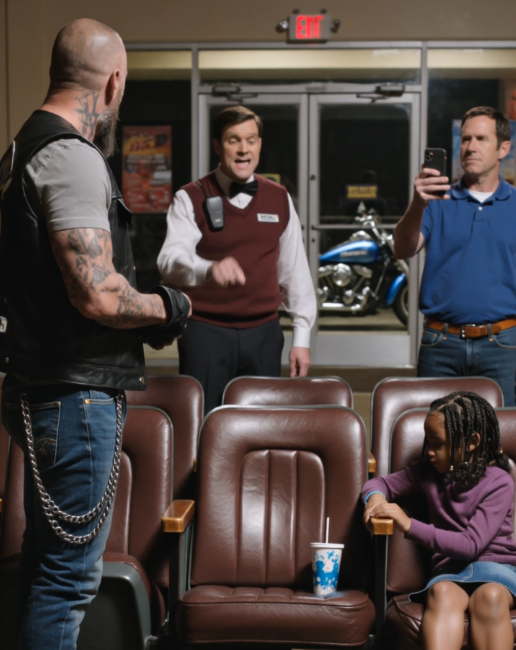
Owen bent toward her.
“I’m sorry, Ellie.”
She kept both hands on the scarf. “Are you making Lulu leave?”
“No.”
“Promise?”
“I promise.”
Marcus waited until Ellie released the chair before standing. His knees made a quiet popping sound. For all his size, he moved like a man careful not to occupy more space than necessary.
Daniel put his phone into his pocket.
“I shouldn’t have said that stuff.”
Marcus looked at him.
“No. You shouldn’t.”
Ellie asked whether the movie could begin. Owen checked his watch and realized the trailers had been held for four minutes while the argument continued.
He signaled the projectionist.
As the lights dimmed, Marcus set the cup back in the holder beside the empty seat. Ellie leaned across Lulu’s place and whispered something nobody else heard.
Marcus heard it.
“She can have some of my popcorn.”
He placed a few pieces in a napkin on the scarf.
During the movie, Ellie laughed at every joke twice. First normally. Then again after turning toward the empty chair, as though Lulu needed a second chance to understand.
Marcus barely watched the screen.
He watched Ellie.
Two years earlier, his wife, Natalie, had died from a sudden brain aneurysm after putting Ellie to bed. There had been no final conversation and no long illness that gave their daughter time to understand what was coming.
Natalie kissed Ellie’s forehead on Tuesday night.
On Wednesday morning, she did not wake up.
The following day, Ellie walked into the kitchen holding Natalie’s yellow scarf. She placed it on a chair and asked Marcus to pour apple juice for Lulu.
Marcus had looked at the empty chair and said the first wrong thing that came into his head.
“There’s nobody there.”
Ellie’s cup had slipped from her hands.
She did not speak for the rest of the day.
That was when Lulu became more than an empty seat.
And Marcus realized he needed help before he took anything else away from his daughter.
Part 3
Dr. Naomi Reed met Marcus and Ellie eight days after Natalie’s funeral.
Ellie sat beneath the therapist’s desk with the yellow scarf over her head. Marcus occupied a child-sized chair that creaked every time he breathed.
He disliked the office immediately.
There were soft lamps, baskets of puppets, pastel walls, and no place for a man with steel-toed boots, a shaved head, tattooed hands, and a leather vest smelling of rain and engine oil.
Dr. Reed did not ask him to remove the vest.
She sat on the floor.
“Who came with you today?” she asked Ellie.
“Daddy and Lulu.”
“Where’s Lulu sitting?”
Ellie pointed toward the empty chair.
Dr. Reed nodded. “Would Lulu like crayons?”
“Blue ones.”
The therapist placed a blue crayon on the chair.
Marcus watched carefully. “You’re going along with it?”
“I’m listening to her.”
“She thinks somebody is there.”
“She may know Lulu isn’t present the way you and I are present.”
“She talks to her.”
“Children use play to hold feelings that are too large to explain directly.”
Marcus looked toward Ellie. “How long do I let it happen?”
Dr. Reed’s expression remained calm. “We don’t set a deadline for grief. We watch whether Lulu helps Ellie participate in life or prevents her from doing it.”
“What am I supposed to say at home?”
“Ask what Lulu needs.”
“And if she wants a plate?”
“Put out a plate.”
Marcus rubbed one scarred thumb across his knuckles.
“My daughter watched people carry her mother out of our house. I don’t want to teach her that things become real because we pretend hard enough.”
“Then don’t lie. You can say you don’t see Lulu. You can also say you understand that Ellie does.”
The distinction mattered.
That night, Marcus set three places at the dinner table. Ellie’s shoulders relaxed when she entered the kitchen.
“Lulu wants the blue cup.”
Marcus changed the cup.
He did not speak to the empty chair as if he saw a child. He spoke through Ellie.
“Does Lulu like green beans?”
“No.”
“Smart girl.”
“Daddy.”
“What?”
“I like green beans.”
“Then Lulu has questionable judgment.”
Ellie laughed.
It was the first time since Natalie died.
From then on, Lulu had a place at breakfast, dinner, and family movie nights. She rode in the empty back seat of Marcus’s truck and stood beside the sink while Ellie brushed her teeth.
Marcus did not tell his motorcycle club until one Sunday when Ellie arrived at a cookout and asked where Lulu should sit.
Twenty-seven bikers looked at the empty folding chair.
Then the club president moved his helmet.
“Right here,” he said.
Part 4
The Iron Compass Riders learned Lulu’s rules quickly.
Lulu disliked mustard. She was afraid of automatic hand dryers. She preferred grape jelly and sat on Ellie’s left side during thunderstorms.
Nobody laughed.
At club breakfasts, one of the riders placed a sealed straw beside Lulu’s cup. At charity picnics, they left room on the bench. When Ellie forgot Lulu’s scarf in the truck, Marcus went back for it without complaining.
Outside that circle, people were less patient.
A waitress once removed the third place setting before Ellie finished ordering. Ellie crawled beneath the table and refused to come out. A relative told Marcus he was making his daughter fragile. Another suggested he needed a girlfriend so Ellie could have “a real woman” at home.
Marcus stopped attending family gatherings.
Dr. Reed warned him against shrinking their world.
“Lulu is supposed to help Ellie move through grief,” she said. “The whole family cannot begin serving Lulu’s fears.”
“So I force her into places that hurt?”
“You give her choices. You don’t give fear every decision.”
Marcus hated that answer.
It was harder than simply defending the empty chair.
He started asking Ellie whether Lulu wanted to come or whether Lulu might feel safe waiting at home. At first the answer was always that Lulu had to come.
Then Ellie began leaving her during small things.
Ten minutes at the grocery store. A visit to the mailbox. Half an hour at the playground while Marcus waited on the nearest bench.
Each absence felt like progress.
It also made Marcus uneasy.
Lulu had entered their home through Ellie’s grief, but she had gradually begun carrying part of his. Saying goodnight to the empty chair allowed Marcus to say words he had not managed to say at Natalie’s grave.
“Your girl ate all her dinner.”
“Your girl lost another tooth.”
“Your girl asked why motorcycles are louder than lawn mowers.”
Ellie once heard him.
“You talk to Lulu when I’m asleep?”
“Sometimes.”
“What do you tell her?”
“Things about your mom.”
“Lulu already knows Mommy.”
Marcus stopped drying the plate in his hands.
“How?”
“They sit together when Lulu isn’t here.”
Dr. Reed later explained that Ellie might be building a bridge between absence and permanence. Marcus nodded as though he understood.
He did not.
What he understood was that the idea of Lulu sitting beside Natalie gave his daughter peace.
What he did not admit was that it gave him peace, too.
Two years passed.
Then the theater video appeared online.
Part 5
Daniel posted the recording that evening.
He included the argument, Marcus kneeling beside Ellie, the yellow scarf, and Ellie’s sentence about her mother. He blurred Ellie’s face but left Marcus recognizable.
The caption read:
I judged this biker for buying a seat for an imaginary child. I was wrong.
The video spread quickly.
Some viewers praised Marcus. Others accused him of reinforcing delusions. Strangers argued about a seven-year-old girl as if they had examined her, lived in her home, or heard her cry after midnight.
Ellie’s elementary school received the video from three parents.
By Monday, children were calling her Ghost Girl.
One boy pulled the yellow scarf from her backpack and ran down the hall with it. Ellie chased him until a teacher stopped both children. The school returned the scarf but sent Marcus a behavior notice because Ellie had shoved the boy.
Marcus entered the principal’s office wearing his leather vest.
The secretary called security.
He noticed.
“Don’t,” he said. “I’m here to talk.”
Principal Helen Marsh placed the behavior report between them. “Ellie made physical contact with another student.”
“He took something belonging to her dead mother.”
“That does not excuse pushing.”
“No. It explains why you should be talking to both families.”
The principal looked at the silver compass patch on Marcus’s back. “I am also concerned about whether the attention surrounding your lifestyle is affecting Ellie.”
“My lifestyle?”
“The motorcycle club. The public videos. This ongoing imaginary companion.”
Marcus removed his gloves and placed them on the desk.
“My club didn’t post the video. A parent in your district did.”
Principal Marsh folded her hands.
“We believe children benefit when adults maintain clear boundaries between fantasy and reality.”
“So does her therapist.”
“Then perhaps the therapist should provide documentation.”
Marcus stood.
“I’m not handing you my daughter’s private sessions because your staff failed to stop a kid from taking her mother’s scarf.”
He left before his anger chose the next sentence.
At home, Ellie put the yellow scarf on Lulu’s chair and asked whether she had caused trouble again.
“You didn’t cause it.”
“The boy said Lulu is for babies.”
“What did Lulu say?”
“She wants to leave school.”
“What do you want?”
Ellie looked at the empty chair.
“I don’t know.”
That answer worried Marcus more than anything Lulu had ever said.
At the next therapy session, Dr. Reed asked Ellie to draw where Lulu stood when the boy took the scarf.
Ellie drew herself alone.
No Lulu.
Dr. Reed showed the picture to Marcus after Ellie went to choose a sticker.
“She is beginning to separate from Lulu.”
Marcus stared at the empty place in the drawing.
“Then why does that feel like losing somebody?”
Part 6
Dr. Reed did not answer immediately.
“Who would you be losing?”
Marcus looked through the office window. Ellie sat in the waiting room, arranging magazines by color.
“Lulu.”
“Or Natalie?”
His jaw tightened.
“I know Natalie’s gone.”
“Knowing is not the same as making room for the loss.”
Marcus stood and walked to the bookshelf. He picked up a wooden toy motorcycle, turned its wheels once, and put it down.
“I did everything I was supposed to do.”
“You kept Ellie fed. You attended therapy. You learned how to braid her hair. You let her grieve without shame.”
“Then what did I miss?”
“Your own grief.”
Marcus laughed without humor. “I don’t have time for that.”
“You have made time. You’ve been using Lulu’s chair.”
The words landed hard.
For two years, Marcus had believed every extra ticket and untouched glass of water belonged entirely to Ellie. He had never considered that the ritual might also protect him from eating alone with the only living person who remembered Natalie’s voice.
That night, Ellie set the table.
Three plates.
Three glasses.
Marcus stood in the doorway.
“Peanut, does Lulu need dinner tonight?”
Ellie looked toward the empty chair. “She says she isn’t hungry.”
“What about a drink?”
“No.”
It was the first meal in two years when the third place remained unused.
Marcus could not eat.
Ellie watched him.
“Daddy, are you mad at Lulu?”
“No.”
“Are you mad at me?”
“Never.”
“Then why are you squeezing your fork?”
He put it down.
“Because sometimes things changing can feel good and bad at the same time.”
Ellie nodded. “Like growing out of shoes.”
“Exactly.”
“You like the new ones, but the old ones know your feet.”
Marcus covered his mouth with one hand.
That sounded like Natalie.
Not the words. The way Ellie found something ordinary and made it explain the whole room.
Over the following months, Lulu attended fewer meals. Marcus stopped automatically ordering three drinks. He still bought the extra movie ticket because theaters were dark, crowded, and filled with families.
The Riverside matinee had been the first time anyone tried to take that seat publicly.
It was also the last movie Lulu attended.
Three weeks later, Ellie carried the yellow scarf into the kitchen and said, “Lulu wants her goodbye dinner.”
Marcus turned off the stove.
“When?”
“Tonight.”
He looked at the third chair.
“Could she do it tomorrow?”
Ellie shook her head.
“She says you’ll keep asking tomorrow forever.”
Part 7
Marcus made Natalie’s chicken casserole.
He burned the edges because Ellie asked him three questions while he was reading the recipe. Natalie had never written down how much pepper to use, only enough, which was the kind of instruction Marcus hated.
Ellie set three places.
She poured apple juice into Lulu’s blue cup and spread the yellow scarf across the chair. Then she placed four pieces of popcorn on a napkin because Lulu had liked the movie.
Marcus sat across from the empty seat.
“What do we say?” he asked.
Ellie shrugged. “Whatever we want her to know.”
“You first.”
Ellie looked at the scarf.
“Thank you for sleeping next to me when Daddy snored.”
“I don’t snore.”
“Lulu says you do.”
Marcus let it go.
“Thank you for coming to school when I was scared. Thank you for sitting by Mommy when you weren’t with me. I’m not mad you’re leaving.”
Ellie paused.
“I think.”
Marcus cleared his throat. “My turn?”
She nodded.
He looked at the empty chair and felt foolish. Then he remembered that foolishness had kept his daughter speaking during the months when silence might have swallowed her.
“Thank you for keeping my girl company.”
Ellie corrected him. “Our girl.”
Marcus’s eyes closed.
“Right. Our girl.”
He thanked Lulu for the grocery trips, the thunderstorms, the doctor’s office, the first day of school, and every dinner when two chairs had felt too few.
Then he stopped.
Ellie waited.
Marcus rubbed his palms over his jeans. “Could Lulu stay one more night?”
“No, Daddy.”
“Just until morning?”
“She says you’ll be okay.”
“How does she know?”
“She asked Mommy.”
The kitchen clock ticked. A motorcycle passed somewhere beyond their street, the engine fading between the houses.
Marcus reached for the yellow scarf.
Ellie placed her hand over his.
“Not yet.”
She carried the blue cup to the sink and poured out the apple juice. She put the extra casserole into a container instead of throwing it away. Then she folded the yellow scarf and held it against her chest.
“Where does it go?” Marcus asked.
“My room.”
“For Lulu?”
“For me.”
Marcus removed the third plate.
The table looked wrong.
It also looked like a table where a father and daughter might learn how to eat together without asking absence to take a seat.
Before bed, Ellie placed the scarf inside Natalie’s cedar chest.
Marcus stood in the doorway.
“Is Lulu with Mommy now?”
Ellie nodded.
“Do you think she needs a movie ticket there?”
“No. Mommy knows people.”
Marcus laughed through the ache in his throat.
Ellie closed the chest.
The next morning, only two cups waited beside the cereal bowls.
Part 8
Marcus did not tell the club that Lulu had left.
He did not know how.
At the next Sunday breakfast, the club president placed a third cup beside Ellie automatically. She moved it back to the stack.
“Lulu doesn’t come to breakfast anymore.”
Twenty-seven bikers stopped eating.
One rider named Mouse looked toward Marcus. “She okay?”
Marcus nodded.
“Ellie is.”
Mouse understood the missing half of the answer. He took the third cup away without making Marcus explain it.
The Riverside Cinema manager sent Ellie a handwritten apology and three complimentary passes. Marcus placed the envelope on the kitchen counter.
“We only need two,” Ellie said.
“I know.”
“What do we do with the extra one?”
“Invite somebody.”
Ellie chose a girl from school named Harper whose father worked weekends. The three of them returned to the theater one month after Lulu’s goodbye dinner.
Owen met them in the lobby.
He had changed the staff policy. Paid seats would no longer be challenged unless a safety issue required it, and employees were instructed to involve managers before confronting families about disability, grief, or medical accommodations.
Daniel Price was there, too.
He had asked Marcus for permission to meet Ellie without recording anything. He brought no phone.
“My son saw the video,” Daniel said. “He asked why I laughed.”
“What did you tell him?” Ellie asked.
“That I thought understanding something and seeing something were the same.”
“They’re not.”
“No.”
Daniel handed Marcus an envelope containing the money earned from licensing the recording to a local news program. He wanted it donated to the children’s grief center where Ellie received therapy.
Marcus did not take it immediately.
“Why didn’t you donate it yourself?”
“Because I already made one decision about your family without asking.”
Marcus accepted the envelope.
Inside the theater, Harper tried to take the middle seat. Ellie stopped her.
For one second Marcus thought Lulu still needed it.
Then Ellie said, “My dad sits in the middle. He steals popcorn.”
Marcus sat between the girls.
There was no cup of water without a straw. No folded scarf. No extra ticket waiting in his pocket.
Halfway through the movie, Ellie leaned across him and whispered something to Harper. Both girls laughed.
Marcus did not ask whether they were talking about Lulu.
He watched the screen.
For the first time in two years, he saw the ending.
Part 9
The grief center used Daniel’s money to begin monthly dinners for widowed parents and their children.
Marcus hated the first meeting.
Everybody sat in a circle. A social worker asked each adult to say one thing they missed about their spouse. Marcus considered leaving through the kitchen.
Ellie whispered, “Lulu says stay.”
He looked at her.
“I thought Lulu left.”
“She can still have opinions.”
Marcus stayed.
Over the next year, he helped repair the center’s broken playground fence, rebuilt two picnic tables, and convinced the Iron Compass Riders to provide transportation for families who could not reach evening sessions.
The club always left one empty chair at the monthly dinner.
It was not reserved for Lulu.
Each family could place something there—a photograph, a hat, a recipe card, a work glove, a scarf. Nobody had to explain the object unless they wanted to.
On the second anniversary of Lulu’s goodbye, Marcus and Ellie ate at a roadside diner after a short motorcycle ride. Ellie was nine now and tall enough for her boots to reach the passenger pegs comfortably.
The waitress carried three menus.
“How many?” she asked.
Marcus hesitated.
Ellie answered.
“Two.”
The waitress removed the extra menu.
Marcus watched it disappear behind the counter. Ellie reached beneath her jacket and took out a small piece of yellow fabric. She had cut it from the damaged edge of Natalie’s scarf and stitched it around her plastic bracelet.
“You brought it,” he said.
“I bring Mommy.”
“What about Lulu?”
Ellie thought for a moment.
“She knows the way.”
Their food arrived. Marcus ordered coffee. Ellie ordered apple juice in a blue plastic cup.
She pushed it toward the empty side of the table, then pulled it back and took a drink herself.
Marcus smiled.
Outside, the V-twin engine cooled beneath the diner window. Its metal clicked softly in the dark.
No third place was needed.
Follow the page for more biker stories about quiet fathers, grieving children, and the unexpected tenderness hidden beneath leather, tattoos, and road-worn hands.