A Real Estate Agent Kicked A Wheelchair-Bound Veteran’s Belongings Into The Street—Then 200 Motorcycles Surrounded The House And His Smirk Disappeared.
Part 2
The man in the charcoal suit stood frozen beside the open door of the SUV, as though his shoes had been nailed to the street.
Two hundred bikers watched him. Nobody moved.
Tanner Hale recovered first. He jogged down the driveway, clipboard tucked under his arm, and put on his most professional voice.
“Mr. Doyle, sir. I’m glad you’re here. As you can see, we have a situation. These people are trespassing on your property, and the previous owner is refusing to vacate—”
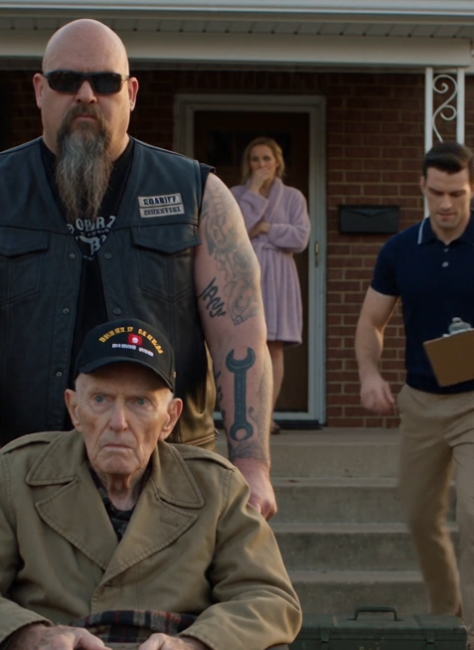
Frank turned his head very slowly.
“Your property,” he repeated.
Tank felt the old man’s whole body go rigid under his hand.
Michael Doyle still hadn’t stepped away from the car. He was forty-eight, tall, with gray at his temples and expensive shoes. He looked at his father in the wheelchair and the medals scattered in the gutter, and his mouth opened and closed.
“Pop,” he said. “It’s not what you think.”
Tank had heard enough of the story yesterday to understand what it was.
He’d been riding home from a parts run along Linden Street a little after four in the afternoon. He saw an old man in a wheelchair sitting alone at the curb in front of a brick bungalow. A deputy’s cruiser was pulling away. A lockbox hung on the front door, and a dumpster sat in the driveway. The man wore a black veteran’s cap and held a rusty tin box on his lap like it was the only thing he had left.
Tank had seen a lot of old soldiers. He’d never seen one look that lost.
He pulled over, cut his engine, and sat down on the curb beside him without asking.
It took twenty minutes before the old man said anything. Then it came out all at once.
His name was Frank Doyle. He’d come home from Vietnam in 1969 with a bum leg and a Purple Heart. He married a schoolteacher named Ellen, and they bought this house in 1974 for $31,000. They couldn’t have children. In 1986, they adopted an eight-year-old boy from St. Brendan’s Home for Boys across town.
Michael.
Ellen died six years ago. A stroke three years ago put Frank in the wheelchair. His eyes were going too. Macular degeneration had turned the middle of everything into a gray smudge.
Three weeks ago, Michael had come by for the first time in months. He brought a folder of papers and a pen.
VA home repair grant, Pop. They’ll fix the roof and put in a ramp. Just sign where I marked.
Frank couldn’t read them, so he signed where his son pointed.
Ten days later, a letter arrived from a company called Hale Ridge Holdings. Frank’s neighbor read it to him. It said Frank had sold his house, and he had ten days to vacate. Michael stopped answering his phone.
Yesterday, the deputies came.
“I kept thinking somebody made a mistake,” Frank had told Tank on the curb. “I kept calling Michael to fix it.”
Then he had said something else. Tank didn’t tell anyone about it until much later. He’d gotten back on his bike, ridden to the end of the block, pulled out his phone, and made one call.
Now, in the cold morning light, Frank looked at his son across a wall of motorcycles.
“Michael,” he said quietly. “Who is Hale Ridge Holdings?”
Michael swallowed.
Tanner cut in before he could answer. “That’s really not relevant. Deputy, you have a recorded deed. Do your job.”
Part 3
Sergeant Rhonda Gaines had been with the county sheriff’s office for twenty-two years. She’d done plenty of evictions. She had never done one surrounded by two hundred motorcycles.
She looked at the paperwork on Tanner’s clipboard, then at the old man in the wheelchair, then at Tank.
“Sir,” she said, “the deed was recorded with the county two weeks ago. Legally, Mr. Doyle doesn’t own this house anymore. I can’t let him stay on the property.”
Tank nodded.
“Then he won’t stay on the property.”
He took hold of the wheelchair and rolled Frank gently down the driveway and over the curb onto the public sidewalk. Then he stopped, set the brake, and stood beside it with his hands folded in front of him.
“Sidewalk’s public,” he said.
Up and down Linden Street, two hundred riders stepped up onto the sidewalks too. They didn’t touch the grass or cross the property line. They stood shoulder to shoulder in their black leather around the little brick house, silent.
Sergeant Gaines looked at them for a long moment. Then she quietly walked back to her cruiser and sat down in it.
Tanner turned red. “You can’t just let them—”
“They’re on a public sidewalk, Mr. Hale,” she said through the open window. “I let people stand on sidewalks.”
Michael got back into the SUV without another word. The driver backed out slowly through a gap the bikers opened for him, and they closed it again behind the car.
Frank watched until the SUV turned the corner. He didn’t cry. His hands just tightened on the tin box until his knuckles went white.
Tank knelt beside the chair until his eyes were level with Frank’s. He took off his gloves and pushed up the sleeve of his jacket.
On his right forearm was an old faded tattoo: a single wrench, and under it two initials and a word.
F.D. — SATURDAYS.
“You don’t remember me,” Tank said. “That’s okay. It’s been forty years.”
Frank leaned closer, squinting through the gray fog in the middle of his vision. He reached out and ran a trembling fingertip over the wrench.
“St. Brendan’s,” he whispered.
“Every Saturday for six years. You came in with a toolbox and an old lawnmower engine and taught a bunch of orphan boys how to fix things. Said a man who can fix things never has to beg.”
Frank’s mouth fell open.
“Tommy Brody,” he said slowly. “You’re the kid who took apart my carburetor and put it back together better than I did.”
“Yes, sir.”
“You were eleven.”
“Yes, sir.”
Frank looked past him at the ring of motorcycles, at all the men standing on the sidewalks in their leather. Some were gray-bearded. Some were young.
“Who are all these people, Tommy?”
“Some of them are your Saturday boys. Twenty-six of us came from St. Brendan’s. The rest are their sons, and their clubs, and their friends.” Tank shrugged. “I made one call. Word got around.”
Frank looked down at the tin box in his lap. His fingers worked at the rusted latch.
“I wanted to take you home too, Tommy,” he said. “Did you know that? Ellen and I…”
His voice broke off.
Part 4
Tank had spent forty years believing one thing about himself.
When he was eleven, a couple from the Saturday program had adopted his best friend Michael. Tommy watched from the window of the boys’ dormitory as Michael climbed into Frank’s old station wagon with a duffel bag. Nobody came for Tommy. He aged out of St. Brendan’s at eighteen with $200 and a bus ticket, and he decided that somebody had looked at both of them and picked the better boy.
He’d carried that his whole life, through the Marine Corps and two tours and a divorce. He carried it through twenty years of building a motorcycle shop from nothing. He never said it out loud to anyone.
Frank got the latch open.
The tin box was full of paper: letters, photographs, a lock of baby-fine hair in an envelope marked Ellen, 1951. Near the bottom was a folded document, yellowed at the creases. Frank held it out with shaking hands.
“I can’t read it anymore,” he said. “You read it.”
Tank unfolded it.
It was an adoption application to the Franklin County Children’s Services Board, dated March 1986, typed on an old typewriter. Under Child or children requested, there were two names.
Michael Anthony Reese, age 8.
Thomas James Brody, age 11.
Stapled to the back was a letter from the county.
After review of household income and the applicants’ current living space, the board is able to approve placement of one (1) child at this time. We encourage the Doyles to reapply in the future.
Below that, in faded blue ink, Ellen had written a note.
We’ll try again next year for Tommy. Frank will get the second job.
“I worked nights at the tire plant for two years,” Frank said quietly. “Saved every dime to add a bedroom. By the time we reapplied, you’d been moved to a group home in Columbus. They wouldn’t tell us where. We wrote letters. They sent them back.”
Tank sat back on his heels on the cold sidewalk. He couldn’t speak.
“I’m sorry, son,” Frank said. “We wanted you. We always wanted you.”
For a long time, the only sound on Linden Street was the wind moving dead leaves along the gutter.
Then Tank’s phone buzzed. It was a text from one of the younger riders.
Check Facebook. The real estate guy posted.
The video was ninety seconds long, taken by Tanner from inside his car. It showed motorcycles filling the street, deputies standing by, and big bearded men surrounding a house. The caption read:
A BIKER GANG has occupied a legally purchased property in Marlow and is intimidating law enforcement. The previous owner SOLD this home, accepted $40,000, and now refuses to leave. This is what happens when mobs think they’re above the law.
Within an hour, Michael’s attorney had filed an emergency trespass complaint. By noon, the local news had picked it up.
Then Frank’s neighbor, Mrs. Abernathy, brought out her laptop and pulled up his bank account. He had asked her to. There it was: a deposit of $40,000, from Hale Ridge Holdings, dated the same day he’d signed the papers.
Frank stared at the gray blur of the screen.
“Maybe I did sell it,” he whispered. “Maybe I’m losing my mind, Tommy. Maybe I signed it and just don’t remember.”
Before Tank could answer, a small blue sedan pulled up at the edge of the motorcycles. A woman in nurse’s scrubs climbed out with a spiral notebook clutched to her chest.
“Mr. Frank,” she called, pushing between the bikers. “Mr. Frank, I wrote it down. I wrote everything down.”
Part 5
Her name was Rosa Delgado. She was fifty-three, and she’d worked as Frank’s home health aide twice a week for three years. She was small and fierce, with reading glasses pushed up into her hair.
“I was there that day,” she said, out of breath. “The day your son brought the papers. I was doing your blood pressure in the kitchen.”
She opened the notebook. It was her official care log, with the agency’s letterhead at the top of every page, filled out in neat cursive.
Tank read the entry aloud.
September 18. 2:15 PM. Client’s son Michael arrived with documents. Stated they were VA home repair forms. Client asked me to read documents to him, as client unable to read due to vision loss. Son stated, “No need, Rosa, it’s just government paperwork.” Son directed client where to sign. Client signed four pages. Notary arrived with son, young woman, did not ask client any questions. Client did not appear to understand documents were related to sale of property.
Below it, she had added a line in different ink.
Felt uncomfortable. Reported concern to agency supervisor 9/19. No response.
Frank put his hand over his mouth.
“He told me it was the VA,” he said. “He said it was for the roof.”
“I know, Mr. Frank,” Rosa said gently. “That’s why I wrote it down. It’s a medical record. It’s dated. They can’t make it go away.”
Tank looked up. “The money. The forty thousand.”
“The house is worth four hundred,” Rosa said. “My cousin sells houses. Forty thousand is not a sale. Forty thousand is so it looks like a sale on paper.”
“What about the notary?” Tank asked. “You said a young woman.”
Rosa nodded. “Blond, maybe twenty-five. She came with your son and the other man, the one in the blue sweater.” She looked toward the driveway, where Tanner Hale stood talking on his phone. “She called him babe when she thought nobody was listening.”
Tank’s jaw tightened.
“There’s one more thing,” Rosa said, lowering her voice. “When they were leaving, your son stepped out on the porch to make a call. The window was open. I heard him.”
She hesitated.
“He said, The developer closes Friday. If I don’t have the money by Friday, they take the whole business. Everything. I’ll lose everything.”
Frank closed his eyes.
Tank stood up and pulled out his phone. He scrolled to a name he’d only called twice in ten years: Marcus Bell, a retired defense attorney who rode with the club on Sundays and was known as Counselor.
Marcus picked up on the second ring.
Tank told him everything in under two minutes.
There was a long pause.
“Tank, listen carefully,” Marcus said. “If Hale Ridge sells that house to a third-party developer on Friday, the developer’s an innocent buyer. Undoing it gets ten times harder. Maybe impossible.” He paused. “When exactly is the closing?”
Part 6
Rosa had the answer. She’d heard it on the porch: Friday, 10 a.m., at Keystone Title on Main Street.
That gave them three days.
Marcus Bell set up in Mrs. Abernathy’s dining room across the street with a laptop, a legal pad, and the patience of a man who’d spent thirty years taking apart other people’s stories. Riders brought him coffee in shifts. Frank sat in his wheelchair by the window, watching his house over the hood of somebody’s motorcycle.
Two hundred bikers didn’t stay on Linden Street. Most went home to their jobs and families. But a dozen stayed every hour of every day and night in shifts on the public sidewalk. Mrs. Abernathy set up a folding table with sandwiches. By Wednesday, other neighbors were bringing casseroles.
On Wednesday afternoon, Marcus pulled the county records.
The deed had been notarized by a Kayla Simmons. A quick search showed she lived at the same address as Tanner Hale. The deed also listed a witness, as Ohio requires: Harold Pike, Frank’s next-door neighbor of thirty years.
“Harold?” Frank said when Marcus read it to him. “Harold wasn’t there. Harold’s in Florida. He goes every September.”
Marcus called him. Harold Pike, seventy-six, answered from a condo in Sarasota.
“I haven’t been in Ohio since Labor Day,” Harold said, bewildered. “I never signed a thing. I can show you my plane ticket.”
“Can you also show me your signature?” Marcus asked.
Harold sent a photo of his driver’s license. His signature was a tight, careful scrawl. The one on the deed was big, looping, and completely different.
Forged.
Marcus sat back and rubbed his eyes. “That’s not a bad real estate deal anymore. That’s a felony. Several of them.”
On Thursday, Marcus dug into Hale Ridge Holdings. It was registered in Delaware eight months earlier, with two members: Tanner Hale and Michael Doyle.
Michael’s own company, Doyle Capital Partners, had been sued four times in the past year. One lender alone claimed he owed $612,000, with a default judgment coming due at the end of the month. The developer buying Frank’s house had agreed to pay Hale Ridge $395,000 for the lot. They planned to tear down the bungalow and build four townhomes.
The math wasn’t complicated. Michael was going to lose his business unless he found money by Friday. And the only thing he had left that was worth anything was the house his father lived in.
Tank sat in the dark on Mrs. Abernathy’s porch that night, looking at the little brick house across the street. Frank’s old porch light still came on automatically at dusk.
Frank rolled out beside him, a blanket over his knees.
“He came to my Saturday class when he was seven,” Frank said after a while. “Michael. Before we adopted him. You remember? He was scared of everything. Wouldn’t touch the tools.”
“I remember. I showed him how to hold a screwdriver.”
“You did.” Frank was quiet. “He always looked up to you, you know. He cried for a week after we brought him home because you weren’t there.”
Tank didn’t answer.
“I don’t want him in prison, Tommy,” Frank said finally. “I just want to know why he didn’t ask me. If he needed money, why didn’t he just ask me?”
Tank looked at the old man’s face in the porch light.
“Tomorrow,” he said. “You can ask him yourself.”
Part 7
Keystone Title occupied the ground floor of an old bank building on Main Street in downtown Marlow. At 9:55 on Friday morning, its conference room held three people from the development company, a title officer, Michael Doyle in a navy suit, and Tanner Hale. Kayla Simmons sat at the end of the table with her notary stamp.
At 9:58, the windows started to rattle.
The title officer went to the glass. Main Street was full of motorcycles in both directions, parked two deep along the curbs. Riders were already climbing off. They lined the sidewalk outside Keystone Title, silent, arms folded.
At 10:00 the door opened.
Tank came in first, pushing Frank in his wheelchair. Frank wore his black veteran’s cap and his good olive jacket, with his Purple Heart pinned over the pocket. Rosa Delgado came behind him holding her care log. Then Marcus Bell came in with a thick binder. Sergeant Rhonda Gaines was last, still in uniform.
The developers’ lead attorney stood up. “I’m sorry, this is a private closing—”
“Not anymore,” Marcus said pleasantly, setting the binder on the table. “Before anybody signs anything, you should know what you’re buying.”
He laid it out piece by piece. He showed Rosa’s care log, dated and signed, with the report to her agency. He showed the county adoption paperwork that proved Frank’s legal name and his relationship to Michael. He showed the shared address of Tanner Hale and the notary, and the Delaware registration of Hale Ridge Holdings with Michael’s name on it.
Then Marcus opened his laptop and placed a video call. Harold Pike appeared on the screen from Sarasota, holding up his boarding pass from September and his driver’s license next to a printed copy of the deed.
“That’s not my signature,” Harold said, his voice shaking with anger. “I’ve known Frank Doyle for thirty years. I would never.”
The developers’ attorney closed his folder. “We’re withdrawing from this transaction. Effective now.”
Kayla Simmons had started crying. “Tanner said it was fine,” she blurted. “He said the old man knew. He said he just couldn’t see well enough to sign the witness part, so I should just—”
“Shut up, Kayla,” Tanner snapped.
Sergeant Gaines stepped forward. “Ma’am, I’d stop talking until you’ve got a lawyer. Mr. Hale, please stand up and put your hands behind your back.”
Tanner looked at Michael. Michael didn’t look back.
Michael was looking at his father.
Frank rolled himself forward until his wheelchair touched the edge of the conference table. He couldn’t see Michael’s face clearly. He could see the shape of him, the son he’d driven home from St. Brendan’s in a rusty station wagon forty years ago.
“Why didn’t you ask me?” Frank said.
Michael’s face crumpled.
“I couldn’t,” he said. “Pop, I couldn’t. You and Mom gave me everything. You worked nights at the plant for me. I was supposed to be the success story. I was supposed to be the kid who made it.” He put his face in his hands. “I lost all of it. I was so ashamed I couldn’t even look at you. And then it was just easier to lie.”
“I’d have given it to you,” Frank said softly. “The house. Every dime. All you had to do was ask.”
The room was completely silent.
Michael lowered his hands. His eyes found Tank standing behind the wheelchair, and something passed over his face, recognition and then a deeper shame.
“Tommy?” he whispered. “Tommy Brody?”
Tank nodded once.
Michael began to sob.
Sergeant Gaines waited a long moment, then quietly stepped toward him.
Frank turned his head toward Tank.
“Take me home, son,” he said. “Please. Take me home.”
Part 8
A county judge voided the deed eleven days later and declared the transfer fraudulent from the start. The $40,000 went back to the court. The house on Linden Street went back to Francis Doyle, the man who had bought it for $31,000 in 1974.
Tanner Hale was charged with forgery, deed fraud, and elder financial exploitation. He took a plea deal and was sentenced to four years. Kayla Simmons lost her notary commission and testified against him in exchange for probation. Rosa Delgado’s agency supervisor, who ignored her report, was fired.
Michael Doyle pleaded guilty. Frank wrote the judge a letter asking for mercy, and the judge read part of it aloud in court. Michael received eighteen months, followed by restitution and probation. His company was dissolved.
Frank visited him once in March. He wouldn’t say what they talked about. He came home quiet and sat on the porch for a long time. When Tank asked how it went, Frank only said, “He’s still my son.”
Tank didn’t argue.
Before the weather turned, the Saturday boys came back.
There were forty of them this time, with tools instead of motorcycles. They put a new roof on the bungalow, a real one this time. They built a wooden ramp up to the front door with handrails on both sides, and they widened the bathroom doorway. They repainted the porch the same pale green Ellen had picked in 1974. Rosa brought tamales. Mrs. Abernathy brought pie. Harold Pike flew up from Florida and supervised from a lawn chair, mostly by complaining.
When it was done, Frank sat in his wheelchair at the top of the new ramp and looked out at forty grown men covered in sawdust.
“Ellen would have cried,” he said. “Then she would have made all of you wash up before coming inside.”
But there was one more thing Frank wanted.
In May, he asked Tank to drive him to the Franklin County Probate Court. He didn’t say why. Tank wheeled him into a small courtroom on the third floor, where a judge in reading glasses sat behind a desk with a single file in front of her.
Marcus Bell was already there in a suit. So were Rosa, Harold, and Mrs. Abernathy.
And through the courtroom windows, Tank could see the street below. It was full of motorcycles, rows and rows of them, parked two deep along the curb.
“What is this, Frank?” Tank said quietly.
Frank reached into his jacket and took out a folded document. It was the old adoption application from 1986, the one from the tin box, with two names typed under Child or children requested. Ellen’s note was still in faded blue ink on the back.
We’ll try again next year for Tommy.
“Ohio lets you adopt an adult,” Frank said. “If he says yes.”
Tank stared at the paper.
“I’m fifty-four years old, Frank.”
“And I’m eighty-one. So we’d better hurry.” Frank’s voice wobbled, but his eyes were steady. “I told Ellen I’d get the second job and try again. I’m forty years late, son. But I’m trying again.”
The judge peered over her glasses. “Mr. Brody? Do you consent?”
Tank Brody had been a Marine. He had buried friends overseas and rebuilt his life from a bus ticket and $200. He hadn’t cried since he was eleven years old, watching a station wagon pull away from St. Brendan’s without him.
He knelt down beside the wheelchair and put his big tattooed hand over Frank’s.
“Yes, ma’am,” he said. “I consent.”
When they wheeled out of the courthouse twenty minutes later, two hundred bikers on the street below started their engines all at once.
Frank laughed until he had to wipe his eyes.
His name on the paperwork now reads Thomas James Brody Doyle. He still goes by Tank. But every Saturday morning, he drives to the little brick house on Linden Street with a toolbox. Frank sits at the top of the ramp and tells him he’s doing it wrong.
“An old soldier got tricked out of the house he’d lived in for fifty years,” Tank says, when people ask him about that week. “Deputies wheeled him off his own lawn. I pulled over just to see if he was okay. Turned out he was the man who taught me how to fix things when I was eleven. Turned out he’d wanted me all along.”
A man in a quarter-zip saw a crowd of bikers and a confused old man, and he decided he knew who the criminals were. A son in a nice suit decided his father couldn’t see what he was signing.
They were both wrong.
The decent people that week were the ones standing quietly on the sidewalk in leather jackets. They kept a promise to an old man who once gave up his Saturdays for a room full of boys nobody else wanted.
If this story meant something to you, follow our page for more stories like this one. And call your dad.