A Soldier Came Home Two Months Early to Surprise His Daughter and Found Her Asleep in the Doghouse in November—His Wife Just Laughed, but the Man Who Came to “Check” on Her Was Hiding Something Worse
“Outside, Emma. Mr. Tyler isn’t coming till Tuesday.”
Miss Kayla says it every night after she washes the dinner plates. Emma doesn’t cry anymore. Crying makes it longer.
She walks across the cold grass in her socks and crawls into Duke’s house.
Duke is big and white and old, and he used to be Mommy’s dog. He lifts one heavy paw and lets her slide in under it.
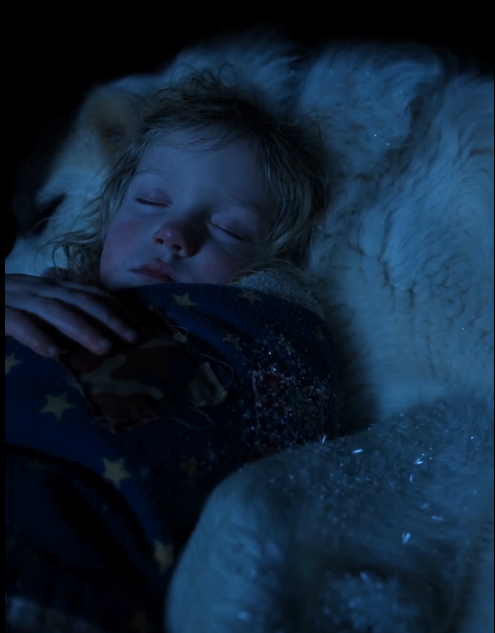
It’s so cold tonight that the stars look sharp.
Emma pulls Mommy’s quilt up to her chin. It’s navy blue with little gold stars, and one square in the corner is cut from Daddy’s old uniform. She rubs her thumb over the stiff stitched letters until she falls asleep.
B-R-O-O-K-S.
Then a light hits her face.
Boots crunch on the frost.
A big shadow kneels in the doorway.
And a voice she hasn’t heard in nine months says the words it always said at bedtime.
“Lights out, Peanut. Daddy’s got the watch.”
Nobody else says it like that. Nobody else knows it.
“…Daddy?”
He’s in his uniform. He has his big green bag. He’s home before Christmas.
But he isn’t smiling. His mouth is shaking.
He pulls her out, quilt and all, and holds her so tight she can hear his heart banging.
The back door opens. Miss Kayla stands in the light in her fuzzy slippers, holding her phone.
And she laughs.
“Babe! Oh my God, you’re home! Don’t look at me like that. She likes sleeping with the dog. Honestly, don’t worry about it.”
Daddy doesn’t answer her.
So Emma whispers the rule into his collar.
“I only get to sleep inside when Mr. Tyler comes to check.”
“Who’s Mr. Tyler, Peanut?”
“The man from the county. He writes that I’m happy.”
She peeks at the back door.
“He’s Miss Kayla’s little brother.”
Part 2 — The Empty Bedroom
For a moment, nobody moved. Duke’s breath fogged in the porch light. Kayla’s smile stayed exactly where it was.
“Tyler’s a professional, Danny,” she said. “He’s county DSS. He’s been checking on her for you. You’re welcome, by the way.”
I carried Emma past her into the house without a word.
It was seventy-one degrees inside. It smelled like pumpkin candles, and there was a Netflix show paused on the TV. I filled the bathtub with lukewarm water, because Emma flinched when I turned it any hotter.
“Hot water’s for when Mr. Tyler comes,” she said. “So I smell nice for the pictures.”
I sat on the edge of the tub and looked at the tile until I could breathe again.
Her room was spotless, and that was the worst part. The white headboard. The pink comforter, tucked tight. A row of stuffed animals arranged by color. It looked like a bedroom in a furniture ad, not a place where a little girl lived.
The closet held one hanger with a sparkly purple dress on it, tags still attached.
“That’s my check-day dress,” Emma said from the doorway, wrapped in a towel.
Kayla leaned against the hallway wall with her arms crossed.
“She has night terrors, Danny. Screaming, kicking. The only thing that calms her down is that dog. Tyler said to let her self-soothe.” She tilted her head. “But you’d know that if you’d FaceTimed her even once since August.”
I opened my mouth to argue.
Then I closed it.
Because she was right. I hadn’t called since August, and I couldn’t tell her why. I wasn’t ready to say it to anyone yet.
I tucked Emma into her pink bed that night with the star quilt over her, and I sat on the floor until she fell asleep.
Around two in the morning I woke up on that carpet in a cold sweat. My hand was reaching across my chest for a rifle that wasn’t there. My heart hammered like I was back on a range in Poland.
When I looked up, Emma was sitting upright in bed, staring at me.
Then she did something that cut deeper than anything Kayla had said. She slid out of bed without a sound, gathered her quilt, and crept into her closet. She pulled the door shut behind her.
She was hiding from me.
I sat there in the dark and asked myself the question I’d been dodging for three months.
What if Kayla was right about me?
At six a.m. Kayla’s phone buzzed on the kitchen counter while she was in the shower. The preview lit up the lock screen.
TYLER: Heard he’s back early. You know what that means about his paperwork. We’re fine. Delete this.
My paperwork?
What exactly did my wife’s brother know about why I came home?
Part 3 — Duke’s Castle
Four summers ago, our backyard on Raeford Road smelled like cut grass and sunscreen.
My wife Sarah was sitting cross-legged on a tarp with two-year-old Emma in her lap. They were both covered in yellow paint. Between them sat the brand-new doghouse I’d built for Duke from cedar planks and a whole weekend of swearing.
“Duke’s castle needs flowers,” Sarah announced.
So they painted sunflowers. Big lopsided ones, all across the front boards above the door, with brown centers made from Emma’s thumbprints. There were eleven of them in all. Emma counted them every morning for a month.
That winter Sarah finished the star quilt. It was navy blue with gold calico stars, sewn from Emma’s baby blankets and my old things. In the bottom corner she stitched one square cut from the sleeve of my first uniform, name tape and all.
“So Daddy’s always tucking her in,” Sarah said. “Even from the other side of the world.”
Every night I put Emma to bed with the same five words.
“Lights out, Peanut. Daddy’s got the watch.”
She’d say it back with me, mushing the words together. Daddysgotthewatch. Then she’d rub the letters on that square with her thumb until her eyes closed.
Two years later, Sarah collapsed in the produce aisle at the Harris Teeter on Skibo Road. It was a brain aneurysm. She was gone before the ambulance reached Cape Fear Valley.
Eight months after the funeral, I married her friend from the gym, Kayla Pruett. Kayla was bubbly and organized, and she brought lasagnas to the house and folded Emma’s laundry. I told myself Emma needed a mother, and that I needed help.
I never asked what Kayla needed.
I should have.
Part 4 — The Brother Who Tried
Tyler Pruett showed up at nine the next morning. He wore khakis and a gray quarter-zip, and a Cumberland County Department of Social Services badge hung from his lanyard. He was twenty-eight, with a boyish face and a firm handshake, and he looked genuinely sick.
“Sergeant Brooks. I need to say something before anything else.” He glanced toward the kitchen, where Kayla was loading the dishwasher a little too loudly. “I’ve been worried about my sister for months.”
He sat at my table and opened a laptop.
The case had opened in March, after Emma’s kindergarten teacher reported that she seemed exhausted and was falling asleep at her desk. It was assigned to him by rotation. He’d told his supervisor he was related to the caregiver.
“I pushed for her to get help,” he said. He turned the screen toward me. There was a case note dated May 2nd.
Caregiver appears overwhelmed. Recommended parenting support classes. Caregiver declined. Will continue to monitor closely.
Another note from July said: Recommended respite care. Caregiver declined.
“She’s my sister,” Tyler said quietly. “I kept hoping she’d get better. I never once saw Emma outside. Every time I came, she was clean and inside and okay. I should’ve pushed harder. That’s on me.”
He looked me right in the eye as he said it.
Kayla came around the corner with a dish towel over her shoulder and her face already red.
“Oh, so now it’s all me?”
“Kay, nobody’s saying—”
“You want to know why she sleeps out there?” She spun toward me. “Because every time I try to put her to bed, she screams for you. For you, Danny. For eight months. And you never called. So yeah. Sometimes I let her go out to the dog, because I needed to sleep.”
Tyler put his hand on his sister’s arm, calm and gentle.
“I think it would be best,” he told me, “if Emma stayed with you while Kayla gets some help. I’ll put that in my report today.”
It was everything I wanted to hear.
For about forty-eight hours, I believed that Kayla had simply cracked under the pressure, and that her brother was the one decent person in this whole mess.
That lasted until Thursday afternoon.
Our back neighbor, Mrs. Loretta Gaines, waved me over the fence. She was seventy-one and a retired school nurse. She had been Sarah’s friend, and she’d been Emma’s babysitter before Kayla moved in.
She pressed a spiral notebook into my hands without a word.
On the cover, in careful block capitals, she’d written EMMA — NIGHTS.
Inside were dates and temperatures, and the times the back light went off and the times Emma crawled into the doghouse. The entries went back to February.
On one page from March, she’d written something and underlined it three times.
Called DSS. Case worker came out: T. Pruett. Next day Kayla told me to mind my own business or she’d report ME. Emma outside again that night.
“I called them, Danny,” Loretta said, her voice shaking. “In March. The day after, that young man came out and sat in my kitchen and told me Emma was ‘thriving.'”
I looked down at the date.
March 14th.
Tyler’s file said the case had opened on March 20th, after the teacher’s call.
So where was Loretta’s report?
Part 5 — Direct Deposit
I found it on a Friday, sitting on the floor of our spare room with a box of Kayla’s paperwork she’d assumed I would never touch.
It was a Social Security Administration award letter.
SSI — Child Disability. Beneficiary: Emma R. Brooks. Representative Payee: Kayla M. Brooks. Monthly benefit: $943.
The supporting diagnosis was Reactive Attachment Disorder with severe sleep disturbance. The evaluation was signed by a Cumberland County DSS case manager.
Tyler Pruett, MSW.
Emma had never met a psychologist in her life. I called her pediatrician at Womack Army Medical Center. The nurse checked twice.
“No referral, no diagnosis, Sergeant. Just well-child visits and a sprained wrist from the monkey bars.”
Stapled to the SSA letter were two pages Kayla had printed and apparently forgotten about. They were screenshots of a text conversation with her brother, maybe saved as insurance.
TYLER: Loretta’s call came in. I’ll take the intake myself and code it as the teacher report. Hers disappears.
KAYLA: Is the SSI approved?
TYLER: Approved. Retro to March. I want my half by Friday. My bookie doesn’t do payment plans.
KAYLA: And Danny’s allotment?
TYLER: Keep taking it. $1,800 a month to “care” for her. The Army will never check.
KAYLA: She can’t sleep inside anyway. She looks at me with Sarah’s face. I can’t do it.
TYLER: Then put her in the doghouse. I’ll give you 24 hours’ notice before visits. Wash her, dress her, take pictures. My reports say she’s thriving.
My hands were shaking so badly the papers rattled.
Every month since March, my daughter had been worth $2,743 to them. That was my allotment plus a disability she didn’t have, all built on a diagnosis written by a man who’d never once seen her sleep.
And the part that had convinced me he was the good brother, those May and July case notes about Kayla being “overwhelmed”? He’d written those too. They were his insurance, in case anyone ever looked.
I called the Cumberland County DSS director’s office. I got voicemail. I called the SSA fraud hotline and was put on hold. I called the Army’s Family Advocacy Program at Fort Bragg and got an appointment for the following Wednesday.
Then I did the only thing that made sense. I packed a bag for Emma.
I was buckling her into my truck, with Duke already in the back seat and the star quilt around her shoulders, when a Fayetteville PD cruiser swung across the end of the driveway, lights on.
Then another one.
Then a third, with an officer already out and crouched behind the open door.
“SIR! SHOW ME YOUR HANDS!”
Kayla stood on the porch with her phone to her ear, crying loudly.
“He’s got a gun in that truck,” she sobbed to the dispatcher. “He came home early because the Army sent him home. He’s not right. He’s taking my daughter.”
What did Kayla know about why the Army sent me home?
Part 6 — Seventy-Two Hours
There was no gun in my truck.
There were three officers, two rifles, and a German shepherd from the K-9 unit. The whole cul-de-sac came out on their porches to watch while I lay face-down on my own driveway in the frost, with my daughter screaming “DADDY” from the back seat.
They searched the truck and found a booster seat, a dog, and a kid’s backpack with a unicorn on it.
It didn’t matter. Kayla had shown the responding sergeant a document on her phone, a photograph of a page from my Army medical file.
Referred for Behavioral Health Evaluation. Early Redeployment Recommended.
“He’s been hiding it from everyone,” she said. “He wakes up screaming. He tried to grab a gun in his sleep. Ask him.”
The sergeant looked at me. “Is that true, sir?”
I couldn’t say no.
Under North Carolina law, a family member’s sworn statement is enough to hold a person for an involuntary psychiatric evaluation. Kayla swore it, and Tyler co-signed it as a “concerned professional.”
I spent the next seventy-two hours at Cape Fear Valley Behavioral Health, in paper scrubs, with no phone and no shoelaces.
On the first night, an intake nurse told me my daughter had been placed in “emergency kinship care with the stepmother,” pending a DSS safety assessment.
The assessment would be conducted by Tyler Pruett.
On the second day, my first sergeant visited. He was a good man, and he was clearly uncomfortable. The command had flagged me and suspended my weapons access. I was to report to Behavioral Health upon release. “Hang in there, Brooks,” he said, and didn’t meet my eyes.
My mother called from Ohio and cried. “Honey, maybe Kayla’s right. You haven’t sounded like yourself.”
I had never felt so alone in my life.
On the third night, a psychiatric tech named Marisol slipped me a folded note during med rounds.
Loretta Gaines says: Doghouse again. 26°F. Duke is with her. Loretta has her binoculars on it all night. She is NOT leaving that window. Hold on.
I pressed that note flat against my chest and stared at the ceiling until dawn.
On the morning I was released, a woman in a charcoal suit was waiting in the lobby.
“Sergeant Brooks. Lieutenant Colonel Anne Whitford, retired. Former JAG, current pain in the neck for the state of North Carolina.” She handed me a coffee. “Mrs. Gaines hired me. She paid my retainer out of her own pension, and she refused to let me give it back.”
“Why would she do that?”
“Because she says Sarah would’ve.” Whitford sipped her coffee. “Now. Before I walk into a courtroom for you, I need the truth. Every piece of it. Starting with why you really came home two months early.”
Could I tell her something I hadn’t even admitted to myself?
Part 7 — The Range in Drawsko
We sat in her office above a barbershop on Hay Street, and I told her.
In August, during a live-fire exercise at Drawsko Pomorskie in northern Poland, a training accident killed one of my soldiers. Specialist Jordan Mills, twenty-two, from Rocky Mount. It happened forty feet from me. It wasn’t my fault, and the investigation said so.
But I stopped sleeping after that.
I stopped calling home. I couldn’t look at Emma’s face on a phone screen without seeing Jordan’s mom at the airport, the way she’d hugged him goodbye.
In October, during a routine drill, a vehicle backfired. I found myself face-down in the mud with no memory of getting there. My commander referred me to Behavioral Health. They recommended I go home early for evaluation and treatment.
“So I told everyone it was a surprise,” I said. “I told myself it was a surprise. I bought Emma a snow globe at the Warsaw airport and pretended I was just a dad coming home for Christmas.”
Whitford didn’t write anything down for a while.
“So your wife isn’t completely lying,” she said at last.
“No.” My throat burned. “I’m not okay. I haven’t been okay for three months. And if I’d been okay, if I’d called my daughter even once in September, I would’ve heard it in her voice. Loretta heard it through a fence. I didn’t hear it from four thousand miles away, because I wasn’t listening.”
Whitford leaned back.
“Sergeant, I’ve spent twenty years in rooms with soldiers who think admitting that makes them unfit parents.” She tapped her desk. “Hiding it made you vulnerable. Getting help doesn’t. Your wife is counting on a judge not knowing the difference. Our job is to make sure he does.”
“How?”
“By proving what she did while you were gone. By treating what happened to you openly. And by getting Kayla Brooks to tell the truth in front of people she wants to impress.” She opened a folder. “Tell me. What’s the 82nd Airborne Division Holiday Family Gala?”
I blinked.
“It’s next Saturday. At the Crown Complex. Kayla’s up for Family Readiness Volunteer of the Year. She’s been campaigning for it for months. She’s giving a speech. The whole thing is livestreamed on the division’s Facebook page.”
Whitford smiled for the first time.
“Then that’s where she’ll tell it.”
“You think she’ll confess in front of a thousand people?”
“No. I think she’ll show off in front of a thousand people.” She closed the folder. “Show-offs always bring pictures.”
Part 8 — The Slideshow
The ballroom at the Crown Complex held nine hundred people that Saturday night. There were soldiers in dress blues and spouses in sequins. Round tables were crowded with centerpieces of little red, white, and blue parachutes. Up front, a camera crew from the division’s public affairs office streamed the whole evening live.
Kayla looked stunning in an emerald dress. When they called her name for Volunteer of the Year, the room applauded on its feet.
Tyler sat at her table in a borrowed suit, clapping hardest of all.
I stood in the back by the doors, in my dress uniform, with Loretta holding my arm. Whitford was beside us. Next to her stood a quiet man from the Social Security Administration’s Office of the Inspector General, and the director of Cumberland County DSS, who had driven down from the county building on a Saturday night after Whitford sent her one email.
Kayla stepped to the podium and dabbed her eyes.
“This year has been the hardest of my life,” she said. “Holding a family together while my husband served overseas. Loving a little girl who lost her mother. She had terrible nights. But I was there. Every single one.”
Behind her, a slideshow began. There was Kayla at an FRG bake sale and Kayla handing out care packages. Then came a photo of Emma, asleep, which drew a soft awww across the room.
“This is my favorite picture,” Kayla said warmly. “Emma, safe and sound in her bed, under her mama’s star quilt. That’s what this year was about.”
I looked at the screen.
Emma was asleep, curled small, under the navy quilt with gold stars. Her cheek was pressed against a thick white shoulder of fur.
Above her head, painted on rough cedar boards, were sunflowers. Big, lopsided sunflowers with thumbprint centers.
Eleven of them.
The photo was dated in the corner, the way Kayla’s phone always dated her pictures.
February 9.
I walked down the center aisle before I’d decided to.
“Those are the sunflowers my wife painted on Duke’s doghouse,” I said. My voice carried farther than I expected. “With our daughter. Four summers ago.”
Nine hundred heads turned.
Kayla’s smile froze. “Danny, sit down. That’s her headboard—”
“Her headboard is white, Kayla.”
A murmur swept across the ballroom like wind through tall grass.
“It’s February,” someone said out loud at one of the front tables. “That’s dated February.”
“She liked it out there!” Kayla’s voice cracked into something high and ugly. “She begged! Tyler said it was fine as long as she was clean for the pictures, he said—”
She stopped.
At her table, Tyler Pruett had gone gray. He stood and turned toward the side exit.
The DSS director was already standing there.
“Mr. Pruett,” she said quietly. “I’ve pulled your intake log for March 14th. And the Office of the Inspector General would like to talk to you about a disability evaluation you’re not licensed to perform.”
Tyler looked at his sister. Then at the camera, with its small red light still glowing.
“It was her idea,” he said.
“You signed it!” Kayla screamed from the podium.
Loretta squeezed my arm so hard it hurt.
And in the middle of the silence that followed, my phone buzzed. It was a text from the neighbor’s teenage son, who was babysitting Emma at Loretta’s house that night.
She’s still up. She says she won’t go to sleep until you say the words.
What words would I have left, after a night like this?
Part 9 — Daddy’s Got the Watch
The livestream from that night was viewed more than two million times before the division took it down.
Kayla Brooks pleaded guilty in Cumberland County Superior Court to felony child abuse and to obtaining property by false pretenses. In federal court, she pleaded guilty to SSI fraud. She was sentenced to seven years. Tyler Pruett pleaded guilty to obstruction of justice, falsifying public records, and federal fraud conspiracy. He got five years and a permanent ban from social work in North Carolina. The county audited every case he’d ever handled. They found three more families where a visit had been “documented” and never actually happened.
Every dollar of the SSI money was repaid from the sale of Kayla’s new Kia Telluride. The Army recovered my allotment.
I got full custody. I also got something harder: a standing appointment every Tuesday at the Fort Bragg Intrepid Spirit Center. I sit in a room with a psychologist named Dr. Okoye and talk about Jordan Mills and a range in Poland until the words stop sticking in my throat. Some weeks it helps. Some weeks it doesn’t. I keep going.
Emma sees a counselor too, a real one this time. She still wakes up some nights. On those nights, she comes down the hall with her quilt, and I let her sleep on the floor of my room with Duke. The counselor says that’s okay. She says the goal isn’t the bed. The goal is that she chooses where to go now.
Loretta comes to dinner every Sunday. Emma calls her Nana Lo. She says “Nana Lo” while she’s still chewing, and Loretta pretends to be scandalized.
We didn’t tear down Duke’s doghouse.
Emma asked me not to. “It’s Mommy’s sunflowers,” she said. “It’s not the house’s fault.”
So last weekend the three of us, Emma, Loretta, and me, sanded it down and painted it again. We kept the old sunflowers and added new ones. Emma pressed her six-year-old thumb into the center of each one. There are twenty-two now. She counted.
Duke still sleeps in there some afternoons, in the sun. At night he sleeps at the foot of her bed.
Tonight the first real cold snap came through Fayetteville. Twenty-four degrees, according to the kitchen thermometer.
Emma was inside. She was in her own bed, the white headboard, under the navy star quilt, with Duke’s big head resting on her feet. Her thumb was rubbing the stitched letters in the corner square. B-R-O-O-K-S.
I sat on the edge of the bed.
“Daddy?” she said sleepily. “Do I have to go outside tonight?”
“Never again, Peanut. Not ever.”
She thought about it, very seriously, the way she thinks about everything now.
“Okay,” she said. “Then you say it.”
So I turned off the lamp and said the five words I’d said to her since she was a baby. This time, for the first time since Poland, I meant them with my whole chest.
“Lights out, Peanut.”
She smiled with her eyes already closed.
“Daddy’s got the watch.”