A NEIGHBOR TOLD THE BROKE FATHER TO LOCK HIS DOOR—THEN THIRTY BIKERS PARTED AND A PICKUP WITH A RED BOW ROLLED THROUGH
Part 1
A NEIGHBOR TOLD NOAH TO LOCK HIS DOOR WHEN THIRTY BIKERS PULLED UP. THEN A SILVER PICKUP ROLLED INTO THEIR HEADLIGHTS.
Three days earlier, Noah Miller had been driving home on a county road outside Wrenfield, Ohio, with the driver’s window stuck halfway down. It was hot enough that the air coming through felt like the air above his stove. He saw a big man pushing a motorcycle past the white fence at the old feed lot. The man had made it from one fence post to the next by the time Noah turned around.
The next gas station was nearly nineteen miles away. Noah had no cash for a can of gas and enough in his own car to be careful about how far he drove. He took out an old plastic transfer hose and gave the man what he could spare. The biker reached for his wallet. Noah shook his head.
“Everybody gets stuck sometimes.”
The man asked his name. Noah told him. Before he rode off, the man’s eyes went to the blue hospital parking tag swinging from Noah’s rearview mirror. He didn’t ask about it.
At ten on Friday night, Noah opened his front door in plaid pajama pants and saw Curtis Dyer in the yard with his phone up.
“Lock it,” Curtis called. “You don’t know what they came for.”
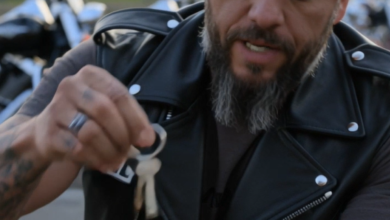
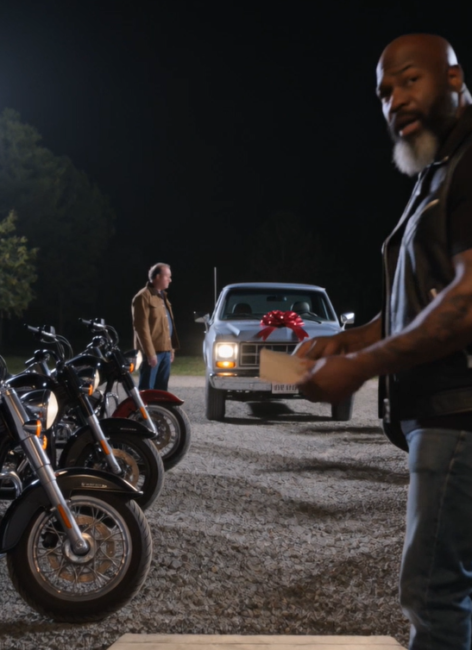
Thirty motorcycles stretched along the gravel lane. The man from the road stood at the front in the same short-sleeved black leather jacket. He pulled one worn glove off, finger by finger, and stood with it in his bare hand while Curtis asked who’d sent him. Noah could hear the engines over the loose spring in his screen door.
“Those boys don’t come out at ten to say thank you,” Curtis said.
Noah put a hand on the doorframe. He was aware of Emma behind him, clutching the stuffed rabbit she usually left in bed. From the neighboring porch, Ruth told Curtis to put his phone down. Curtis lowered it a little. He left the camera pointed at the house.
The engines stopped, one after another. Their headlights stayed on. A silver pickup rolled through the opening between the rows of bikes and stopped facing the porch. A red bow sat flat against its hood. Noah covered his mouth without meaning to. Curtis’s phone dropped to his side. Emma asked if all those people had come with the man from the road.
“There’s something for your dad,” the biker said.
He walked to the windshield, turned his shoulder to the light, and peeled a sealed envelope out from under a strip of tape. Noah recognized the worn glove, the one he’d watched the man tuck into his pocket before they shook hands by the fence. He hadn’t thought the man would remember his name.
The biker came to the bottom step. He held the envelope by one corner. Noah could see it was thick enough to hold several sheets of paper. He put one bare foot down onto the next board. The man waited until Noah looked him in the eye.
“Open it out here.”
Part 2
Noah slid a thumb under the flap. It tore crooked, leaving a little triangle of paper stuck to the glue.
The first sheet had the hospital’s name at the top. He knew the layout before he read a word. For months, he’d opened letters with that same amount of white space above his name and the same thin blue line down the side. He used to bring them in with the grocery flyers so Emma wouldn’t notice him sorting the mail at the door.
He read down to the number at the bottom.
Then he took the paper to the porch light and read it again.
“What’s it say?” Emma asked.
“One second, honey.”
The old balance was there. Twenty-two thousand dollars. The payment had posted that afternoon. Below it, where he’d gotten used to seeing a figure he couldn’t get his head around, the statement said $0.00.
Noah glanced toward the lane. Several of the riders had switched their headlights off. Others stood beside their bikes, helmets hooked over their arms. Nobody called up to ask what he thought. Without the engines he could hear a cooling exhaust tick and a moth hitting the porch fixture.
“Is this the bill for all of it?” he asked.
“The balance through today,” the biker said. “Your billing office can confirm it. The number’s on the back.”
“Who paid it?”
“A few of us.”
Noah looked at the motorcycles.
“More than a few,” the man said.
Emma pushed the screen open just enough to put her face in the gap. “Does zero mean I can stop going?”
Noah folded the paper once before he answered.
“It means we don’t owe for those visits anymore. You still go when Dr. Patel says.”
“Oh.” She thought about it. “Can I still get the purple tape?”
“If they have it.”
She let the screen go. It clicked shut between them. Noah had imagined telling Emma some enormous piece of good news and knowing, from her face, that she understood what it meant. What he’d gotten was a question about tape. He was grateful for it. He knew how to answer that one.
The second sheet was from the company that handled his mortgage. He saw the loan number, then the date he’d been keeping track of by counting how many Fridays were left. Somebody had paid the amount it took to bring the loan current, including the past-due payments and the fees listed in the reinstatement quote. The notice said the scheduled sale had been canceled.
Noah sat down on the step. He caught the edge of it with one hand. The other stayed curled around the papers.
“Dad?” Emma said.
“I’m sitting. That’s all.”
The biker reached for his own back pocket, then seemed to think better of whatever he’d been about to take out. He came no closer. Noah could see his glove still folded in the hand that had held the envelope.
“I’m Mason Reed,” he said. “They call me Bridge.”
Noah looked at the mortgage letter again. He’d authorized a local advocate to work with the loan servicer after his shift on Thursday. He’d expected a callback about whether he could buy more time. At no point had he heard Mason’s name.
“How did you even know where I lived?”
Mason glanced across the gravel at the woman in the rust-colored cardigan. Ruth was still standing on her porch.
“I asked the woman who got you to the hospital on Wednesday.”
Part 3
Noah looked at Ruth. She lifted her tea mug, although it had to be empty by now.
On Wednesday morning, he’d gone out before six to start the car. Emma had been ready since five forty-five. She had her backpack on over her pajamas because the clinic told her she could wear whatever she was comfortable in and she planned to take them at their word.
The car caught for a breath. Then it went quiet.
“Try it again,” Emma had said.
He did, mainly because she’d asked. He’d made it back from the feed lot on what was left in the old tank, but he’d felt the engine stumble as he pulled into the drive. He’d gone inside telling himself he could settle it in the morning. He had less than two dollars until payday, and the hospital was thirty-one miles away.
“Is it broken?” she asked.
“It’s out of gas.”
“Because of the man?”
Noah looked over the top of the steering wheel at the woodpile. He’d told her about the rider the night before. He hadn’t told her how carefully he’d been counting the miles left in the tank before he stopped.
“I gave him what I had,” he said. “I should’ve made another plan before I went to sleep.”
“Can we call Ruth?”
He’d already decided Ruth would be getting ready for work and he shouldn’t ask. Emma had picked up his phone, found Ruth’s name, and handed it back to him. By the time he got out his explanation, Ruth was in her kitchen looking for the car keys she’d put beside her kettle.
“Put something under that backpack,” she’d told him. “The seat’s wet from my lunch cooler.”
She drove them all the way there and stayed to bring them home. In the hospital’s public lobby a man in a gray work shirt had been sitting with an older woman near the doors. Noah remembered the woman because she’d told Emma the rabbit sticking out of her backpack had a nicer seat than either of them. He hadn’t looked closely at the man. He’d been at the desk trying to remember a password.
“Visiting day for my aunt,” Mason said now. “I recognized the blue parking tag on your mirror from taking her in. Then I saw you in the lobby.”
“You could’ve come over.”
“You were busy.”
Noah remembered what busy had meant. One hand on Emma’s shoulder while she asked if the tape could be purple, the other on a phone showing an overdue bill he was trying to swipe away. He couldn’t remember a thing about the man sitting ten feet from him.
“Ruth told me what happened with the car after I asked if I could get you some gas,” Mason said. “She said I ought to ask you directly before I did anything else.”
Ruth crossed the gravel at last. “Remember that call with Linda from the county family fund? The one you took in the break room?”
Noah nodded. He remembered the vending machine next to him humming loud enough that he had to cover one ear. He’d given Linda permission to work with the hospital and the loan servicer. She’d said donors might be able to help if she could confirm what each office would accept. He’d been careful to say he’d take whatever help they had. What he meant was that he’d take fifty dollars and try to make something out of it.
Ruth set her mug beside him on the porch. “Linda called me this afternoon. That’s when I gave Mason the address.”
Noah looked back at the silver pickup. “And whose truck is that?”
Mason took a key from his pocket. “It was mine until this afternoon.”
Part 4
Mason set the key on the step beside Noah’s bare foot.
“You buying a new one?” Noah asked.
“That is the new one.”
“I mean for you.”
Mason let out a little breath through his nose. “I own the dealership down by the water tower.”
Noah knew the place. Once, while his old car was getting a tire patched, he’d walked around the lot and looked through the window of a pickup about the size of the one in his yard. He’d asked what a plain one cost. The salesman had written the monthly payment on a slip of paper. Noah had thanked him, folded it in half, and thrown it away at the tire shop.
“I can’t make a payment on that,” he said.
“It’s paid for. Taxes and fees are covered. The title paperwork is in the packet. We can do that part tomorrow when you’re ready to read it.”
“Why didn’t you just tell me who you were at the feed lot?”
“You had my bike running before I had much to say.”
Noah put his elbows on his knees. Across the lane, one rider had removed his helmet to wipe the inside of it with the tail of his shirt. Another had stepped off the gravel to keep the beam of a headlight out of Ruth’s kitchen window. Noah could count the people nearest him, but the ones farther back stood where the lane curved and he couldn’t make out their faces.
“How many of you are there?” he asked.
“Sixty in the club. Thirty could come tonight.”
“Why ten o’clock?”
“Ruth said you wouldn’t get home till nine forty-five. We waited down by the feed lot till she called.”
Noah had worked a late shift sorting boxes at the distribution warehouse. He’d come home with his collar damp, put the pajama pants on before he finished his dinner, and decided he was too tired to wash the plate. He’d had no idea people were waiting at the same fence where he’d stopped on Tuesday.
“Who put the bow on?” Emma asked through the screen.
A woman beside one of the motorcycles raised her hand. “Me. I had to do it twice.”
“Why?”
“First time it looked like a red cabbage.”
Emma laughed hard enough that the rabbit’s feet shook. Noah put a hand over his mouth again. He’d spent the whole drive to treatment on Wednesday calculating what they could lose before the house, and here Emma was in the doorway laughing about a cabbage.
Then Curtis came closer. His phone was down now, the screen dark.
“Have you read the papers under the first two?” he asked.
Noah had forgotten Curtis was still there.
“You don’t have to sign anything just because a man’s standing there with a key,” Curtis said. “My brother took a truck home once. It was six months before we found out what he’d signed.”
Mason looked at Noah. “Read all of it. Take it to anybody you want.”
Curtis nodded as though that was what he’d been waiting to hear. Noah knew the story about Curtis’s brother. He also knew Curtis had just recorded him standing barefoot in his own yard, holding the first piece of good news he’d had in months.
“Did you put that video somewhere?” Noah asked.
Curtis looked down at the phone.
“I sent it to the lane group,” he said. “Before I knew about the truck.”
Part 5
“What’d you say with it?” Noah asked.
Curtis put the phone in his jacket pocket. That was answer enough for Noah to ask him to take it back out.
The message was still there. Anybody know who Noah borrowed from? Thirty guys just came to collect. A neighbor from the far end of the lane had asked whether she should call the sheriff. Someone else had asked if Emma was home. The woman who’d asked about Emma had left a casserole on their porch after the first hospital stay. Noah knew she would keep looking at her phone until somebody answered.
“Tell them what you saw after that,” he said.
Curtis glanced up at Mason. “I haven’t seen what’s in the envelope.”
“You don’t need to. Tell them nobody came here to collect.”
Curtis wrote with both thumbs. Noah watched him delete one line before he sent the next. I guessed wrong. They brought a truck. Nobody asked for money. Then Curtis took the video down. He stood for a little longer with his phone in his hand, as if there ought to be something else it could do.
“I’m sorry I put your kid in it,” he said.
Noah looked back at the screen. Emma had gone inside. Her rabbit was lying on the other side of the threshold, where she’d dropped it.
“Tell her yourself sometime,” Noah said.
The next morning, Noah called the hospital from the number on an older bill. He wanted to hear the balance from a person he’d reached himself. When the woman confirmed it, he asked her to read the amount a second time. Then he called the loan servicer through the number on his old statement and verified that the money had posted and the sale was off. He asked what he owed the following month. It was the first time in a long while he’d been able to ask about a single ordinary payment.
Mason met him at the dealership. The sales desk smelled faintly of coffee and the plastic mats they used to protect new carpet. Noah took his time over the paperwork. There was no loan. The truck was a basic model, with a cloth bench in back and a floor Emma could get dirty without either of them having a bad day about it.
“I thought the bow might be worth more than the radio,” Noah said.
“Bow’s borrowed,” Mason said. “We’ll need it back.”
Noah smiled. He could sign after that. Mason waited until he finished before taking the dealership’s copy.
When Noah got home, he moved the blue hospital tag from the old car to the truck. It looked a little shabby hanging there. The corners had gone soft from all the times he’d taken it down to make sure the date was still good. Emma brought her backpack out and tried all three seats in the back. She settled on the one behind him, then changed her mind when she realized she wanted to see his face in the mirror.
“We can go ourselves next time,” Noah said.
“Can somebody still come with us?”
He turned around. She was picking at a white thread on the rabbit’s ear.
“I like when there’s somebody to talk to in the back. Sometimes you don’t hear me.”
Noah had been proud of getting them there alone whenever he could. He hadn’t realized how much of the drive he’d spent watching the fuel needle and counting the hours he’d miss at work.
Before he could answer, Ruth knocked on the truck window. She had a folded sheet of paper.
“Mason asked me to find out whether you’d look at this,” she said. “He said the truck and this are two separate things.”
Part 6
The sheet had dates down the left side and two names beside each date. Noah thought it was a list of people the club wanted him to thank. Then he recognized the next appointment.
“You gave them the schedule?” he asked.
“Just the days you asked me to keep clear,” Ruth said. “They’ll need you to tell them the rest, if you want to.”
The first name on each line was a driver. The second was a backup. Mason had left a note at the bottom saying they could use the family’s truck or their own cars, whichever Noah and Emma preferred. It said to call if either of them wanted to change anything. Noah kept reading the last line. In all the papers he’d signed since Emma got sick, he’d rarely seen anybody make changing his mind that easy.
He called Mason.
“You just gave me a truck,” Noah said.
“Yep.”
“And now you want to drive it?”
“Only on my days.”
Noah sat down at the kitchen table. “How many days are you offering?”
“However many she has to go.”
“Could be a year.”
“Put the first month on the fridge,” Mason said. “We’ll get you the next one.”
Emma asked whether anyone on the list knew how to play the license plate game. Noah told her they’d find out. He called Ruth and asked if she’d come the first time, so Emma would have somebody she already knew in the back. Ruth said she’d come if she could sit on the side with the working cup holder. Noah told her both sides worked. She said the new truck was already making things too easy.
Mason drove that first morning. When Noah brought the backpack out, Mason was moving the passenger seat forward so Emma could get her feet up if she needed to. He wore the same black jacket. In daylight Noah could see the white bridge stitched on the back, and the blue line beneath it. Emma asked him why the bridge had only one rail.
“It’s the way my mother used to draw the bridge on the way to town,” Mason told her. “She always forgot the far rail.”
“Did she draw other things wrong?”
“She used to make all our dogs look like cows.”
Emma thought this was excellent. She spent half the trip drawing a dog that looked like a cow on the back of a grocery receipt. Noah watched the road from the passenger seat. About twelve miles from the hospital he realized he’d let his eyes close. He stayed awake out of habit for another mile, then fell asleep with his head against the window.
There were days over the next fourteen months when the driver came from an early shift and days when a backup took over. Once a van wouldn’t start. Emma was tying her shoes when the substitute rang the bell. Another morning Emma asked to come straight home afterward. The driver quietly put back the bag of library books she’d planned to offer and drove straight home.
When Dr. Patel told them the tests showed remission, Noah made it through most of the conversation before he had to ask her to say it again. Emma wanted to know when she could start swimming. Noah wanted to know when they’d have to come back. The doctor answered both questions.
He waited until they were outside to call Mason.
“We don’t need a treatment ride next Friday,” Noah said.
Mason was quiet for a few seconds. “Want me to take your names off the sheet?”
Emma was close enough to hear. She held her hand out for the phone.
“You can take us off,” she told him. “Can you put somebody else on it?”
Part 7
By thirteen, Emma could pack a bag for almost anything without asking Noah what she ought to bring. On the morning of the club’s pediatric cancer fundraiser, she came out to the garage with a water bottle, a pair of gloves, and a folded sheet of paper in the pocket of her sweatshirt.
“What’ve you got there?” Noah asked.
“What I’m going to say.”
“I thought you were just riding.”
“I am riding. I’m also going to say something.”
Mason had fitted his cruiser with a sidecar and offered her the lead spot for the ride. She’d tried the helmet on twice at home and again in the parking lot, where Mason checked the fit and showed her where her feet went. Noah had figured that was the part she was nervous about. While she talked to Mason, he saw her touch the folded paper three separate times through her pocket.
There were families by the registration tent, people from the hospital, and riders who’d driven the Millers on days when nobody felt like talking. Curtis was there, too. He’d spent the morning directing people to the overflow lot in an orange volunteer vest. As a car pulled up to the tent, he started to raise his phone, then went over and asked the family if they’d mind being photographed. They did. He put it away and showed them where to park.
Emma asked for the microphone before the riders got their helmets on. It squealed once. She held it farther from her face.
“When I was nine,” she said, “I thought those motorcycles were outside because my dad had done something wrong. That’s what somebody in the yard made it sound like.”
Curtis stopped beside a folding chair. Noah kept his eyes on Emma.
“Dad told me he gave somebody the gas out of our car. I was mad at him the next morning when it wouldn’t start.” She glanced over at Noah. “I still think he should’ve called Ruth the night before.”
Noah laughed. He hadn’t expected to laugh with the microphone pointed his way and so many people looking at him. Mason stood next to the sidecar with his gloves in one hand, smiling down at the pavement.
“My dad says the night they came was the first night he knew we could stay in our house. I remember it because the man with the envelope was the same man who knew how to make me laugh in the car when I felt awful. I wanted to say that if you donate today, some of it pays for gas and some of it pays for the other things families need to get to treatment. And you can ask for a ride over there without coming up here and telling everybody why.”
She pointed to the little table at the side of the tent. Noah had helped her move it out of the foot traffic that morning. He’d thought she was making room for the people selling coffee.
Emma handed the microphone back. On her way to the sidecar, she stopped beside the table. A father with a little boy was standing just far enough away to look as though he might be waiting for somebody. Emma said something Noah couldn’t hear. The man nodded and picked up a card. She left him room to read it.
Mason handed Emma her helmet. She put it on, settled into the sidecar, and gave Noah a small wave. Then she called him close enough to hear her over the bikes.
“Dad, can you wait at the table? That man said he had a question.”
Part 8
The man wanted to know how early somebody could pick him up. His son’s appointment was at seven thirty and the family car wouldn’t be back from the repair shop until Wednesday. He said it quickly, looking at the registration tent as if a longer version of the conversation might attract a line.
“Where do you need to be picked up?” Noah asked.
The man named a road on the other side of the feed lot. Noah knew it. He’d driven it in the old car when the window was stuck. There was a bend by a white fence where, on a hot day, the air stood still.
“We can get you,” Noah said. “I’ll call the night before.”
The man looked toward the lane, where the riders had begun to pull out behind Mason and Emma. “You one of them?”
“I drive the silver pickup.”
It was parked beyond the tent with a dent in the tailgate from a load of firewood. The red bow had gone back to the dealership years ago. Noah still used the truck to take Emma to follow-up appointments. That winter he’d used it to take Ruth to an appointment of her own, and she’d made the same joke about the cup holder. He kept an empty one for her now.
By the time the ride came back, Noah had written down two pickup requests and one offer to drive. Emma got out of the sidecar, took off her helmet, and checked the sheet before she asked whether anyone had gotten a picture of her waving.
“I did,” Curtis said. He held the phone out to her. “Want me to send it to your dad?”
Emma leaned over the screen. “That one’s good. You got Mason’s hand.”
In the photograph Mason had taken one glove off to steady the helmet while Emma fastened it. Noah remembered him pulling at the fingers of that glove in the yard, giving everybody time to decide what kind of man he was before he’d said a word. Curtis waited for Emma to hand back the phone before he did anything with the picture.
That evening, Mason dropped by the garage. Noah had mentioned a noise in the pickup’s passenger door. Mason opened it, tightened a loose fastener and closed it twice to hear the difference. When he reached over the workbench for a rag, he noticed a length of cloudy plastic tubing on a nail. It had been cleaned and put away years ago. Noah had moved it when he repainted the wall and hung it back up in the same spot.
“You kept that?” Mason asked.
“I did.”
Mason stood looking at it a little longer. Emma came out in her socks with the pickup sheet from the fundraiser. She asked if Noah had picked a driver for the early appointment.
“Me,” he said.
“Who’s your backup?”
Mason held his hand out for the pencil.
Emma gave it to him. Then she went back inside, came out with the stuffed rabbit she hadn’t carried anywhere in years, and set it on the pickup’s back seat.
“In case the little boy wants it,” she said.
Noah left it by the window, facing the road.
Follow the page for more stories about the people who make sure somebody gets there.