Part 2: The Night-Shift Mom Missed Every Parent Meeting and Was Called Irresponsible — Until the Truth Came Out at Appreciation Night
For most of the school year, Mara Whitfield existed at Brookstone Elementary as a signature.
Not a face.
Not a voice.
Just a hurried name at the bottom of forms, often written crooked, as if the pen had been moving in a car or on a bus. Sometimes the ink faded halfway through. Sometimes the date was missing.
Mrs. Keller kept those forms in a folder labeled Ethan W.
She did not mean for the label to feel sad.
But it did.
Ethan was eight years old, small for his age, with serious brown eyes and hair that never stayed flat. He was polite in a way that made adults praise him and made other children notice he was different. He always said thank you. He never asked for seconds. He wiped crumbs from his desk with the side of his hand before the custodian came in.
At first, Mrs. Keller thought he was simply shy.
Then she noticed him putting half his lunch into a napkin and sliding it into his backpack.
“For later?” she asked gently.
Ethan looked startled. “For my mom.”
Mrs. Keller did not know what to say.
The next week, during silent reading, Ethan fell asleep with his cheek pressed against a book about planets. The class giggled. Mrs. Keller hushed them and knelt beside him.
“Ethan,” she whispered.
He woke with a small gasp, the kind that sounded like someone used to being startled awake.
“I’m sorry,” he said quickly. “I’m reading.”
His book was upside down.
That afternoon, Mrs. Keller called Mara.
No answer.
She emailed.
No reply.
She called again the next morning, then again after school. The voicemail box was full.
By November, the story had written itself in other people’s minds.
Mara was careless.
Mara was too busy.
Mara expected the school to raise her son.
A few parents said it in nicer language. They talked about “engagement” and “priorities.” But the meaning was clear. They saw a mother missing from bake sales, conferences, field trips, and classroom parties, and they filled the empty chair with judgment.
Only Ethan seemed determined to protect her absence.
When the class made Thanksgiving place cards, he wrote Mom in careful letters, then erased it and wrote Mara.
Mrs. Keller saw the eraser marks.
“Do you call her Mara?” she asked.
Ethan shook his head. “No. But she says grown-up things look better on paper.”
“What does that mean?”
He shrugged. “She says people listen better when you don’t look like you need something.”
That sentence followed Mrs. Keller home.
A week later, she saw Ethan outside the front office holding a grocery bag filled with canned soup. It was from the school pantry, though students were not supposed to pick up pantry items alone.
The secretary looked embarrassed.
“His mother requested it,” she told Mrs. Keller quietly. “By email.”
Mrs. Keller frowned. “Mara emailed?”
“Three words,” the secretary said. “Anything shelf stable.”
Inside the bag, Ethan had tucked a library book and a drawing of a woman in purple scrubs.
“She’s a nurse?” Mrs. Keller asked.
Ethan’s face changed.
Not pride exactly.
Something more guarded.
“She works where people sleep,” he said.
“At a hospital?”
He looked down. “Sometimes.”
That was the first crack in the easy story everyone had built.
The second came in January, when a snowstorm closed school two hours early.
Parents arrived in a messy parade of boots, coats, and rushed apologies. Ethan remained in the office until nearly five. The buses were gone. The teachers were gone. Only Mrs. Keller, Principal Harris, and the custodian stayed behind.
Mara finally came through the door wearing a gray sweatshirt, work pants, and sneakers damp with slush. Her hair was tucked under a knit cap. Her face was pale, almost waxen with exhaustion.
She looked younger than Mrs. Keller expected.
And older.
“I’m sorry,” Mara said, breathless. “The bus got stuck on Lincoln.”
Principal Harris folded his arms.
“Mrs. Whitfield, this cannot happen again.”
Mara nodded immediately. “I know.”
“Ethan has been waiting for nearly two hours.”
“I know.”
“We have tried to reach you repeatedly.”
“I know.”
There was no defense in her voice, which somehow made it worse.
Ethan ran to her and wrapped both arms around her waist. Mara closed her eyes for one second as if the hug hurt and healed at the same time.
Mrs. Keller noticed then that Mara’s right hand was bandaged.
Fresh gauze.
A hospital bracelet peeked from beneath her sleeve.
Before Mrs. Keller could ask, Mara pulled the sleeve down.
Ethan saw it too.
“Mom,” he whispered. “You promised.”
Mara touched his hair.
“Not here, baby.”
Principal Harris paused.
But the moment passed.
Mara signed the late pickup form, took Ethan’s backpack, and left into the snow with her son pressed against her side.
In the parking lot, Mrs. Keller watched them from the window.
Mara opened an old sedan, but she did not get into the driver’s seat right away. She leaned one hand on the roof, closed her eyes, and breathed like someone trying not to collapse.
Then Ethan reached up and placed his small palm over hers.
A child comforting a mother.
That image stayed.
By spring, Appreciation Night was approaching. Students were asked to choose someone to honor. Most picked parents, grandparents, coaches, or teachers.
Ethan wrote one name on his form.
Mara Whitfield.
When Mrs. Keller asked if his mother could attend the ceremony, Ethan stared at his shoes.
“She’ll try,” he said.
He did not sound hopeful.
The day before the event, Mrs. Keller found a sealed envelope on her desk.
Inside was a note from Mara.
If I don’t make it tomorrow, please let Ethan read his speech anyway. He worked hard.
There was no excuse attached.
Only the faint imprint of a hospital stamp on the corner of the paper.
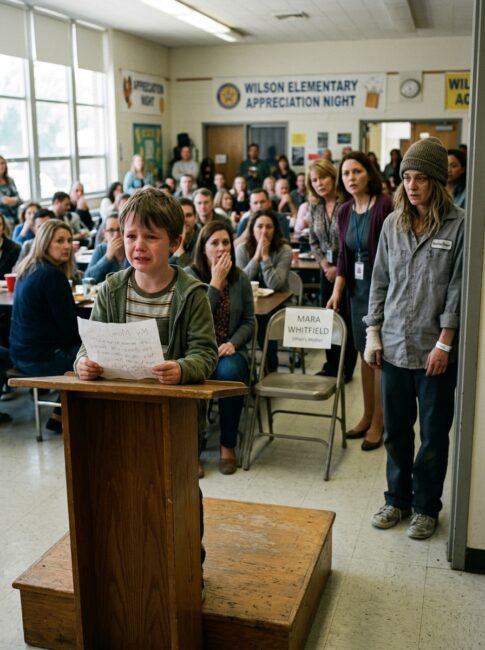
Appreciation Night filled the Brookstone Elementary cafeteria with folding chairs, paper flowers, and the smell of grocery-store sheet cake.
Parents arrived dressed for photographs. Grandparents carried bouquets. Children practiced speeches into their sleeves. A banner on the wall read: Thank You, Heroes in Our Lives.
Mara Whitfield’s chair stayed empty.
It was in the second row, right beside the aisle, marked with a construction-paper card Ethan had made himself. He had drawn tiny stars around her name.
Mrs. Keller watched him check the door every few minutes.
Each time it opened, his back straightened.
Each time it was someone else, he sank a little lower.
A mother nearby leaned toward another parent.
“Poor boy,” she murmured. “Tonight of all nights.”
Principal Harris heard it. So did Mrs. Keller.
So did Ethan.
He looked at the floor.
When his name was called, he walked to the microphone holding two sheets of paper. The first trembled in his hands. The second was folded smaller and tucked behind it.
“My appreciation speech is for my mom,” he began.
His voice was thin but clear.
A few people smiled politely.
“My mom works nights. Most people know that because she misses meetings.”
The room shifted.
Mrs. Keller’s heart tightened.
Ethan continued, eyes fixed on the paper.
“Some people think she doesn’t come because she doesn’t care. I used to think maybe if I got better grades, she would not have to work so much.”
Mrs. Keller saw Principal Harris lower his eyes.
“But my mom says kids should not carry grown-up bills in their backpacks.”
A few nervous laughs moved through the room, then faded when Ethan did not smile.
He unfolded the smaller paper.
“This is the part she told me not to read unless she was late.”
Mrs. Keller stood slightly.
“Ethan,” she said softly.
He looked at her, not defiant, just certain.
“She said truth should not embarrass people unless they already knew it and ignored it.”
The cafeteria became very quiet.
Ethan took a breath.
“My mom works at Maple Ridge Care Center from 7 p.m. to 3 a.m. She cleans rooms, changes sheets, and helps old people when there are not enough aides. She is not a nurse, but some residents call her one because she is the person who comes when they press the button.”
A woman in the back covered her mouth.
“She also works mornings at St. Catherine’s Hospital laundry on Tuesdays and Thursdays. She folds blankets for babies. She says babies should start life wrapped in something warm.”
Mrs. Keller felt the first tear fall before she could stop it.
“My mom misses meetings because if she misses one shift, we miss rent. If she misses two, we lose the car. If she misses three, she says we start pretending cereal is dinner.”
No one moved.
Ethan looked up from the paper.
“She doesn’t answer calls because she sleeps from 4 a.m. to 6 a.m., then gets me ready for school. After that, sometimes she goes to the clinic.”
Principal Harris looked sharply at Mrs. Keller.
The hospital bracelet.
The bandage.
The pale face in January.
Ethan’s voice became smaller.
“She didn’t want anyone to know she was sick because she said people are kinder when they think you are tired, but they get scared when they think you are dying.”
A chair scraped.
Mrs. Keller pressed a hand over her mouth.
“My mom has kidney disease,” Ethan said. “She goes to dialysis three times a week. She told me it is not a big word if we say it calmly.”
The cafeteria held its breath.
There it was.
The truth that had been standing in every empty chair.
Mara had not been absent because she did not care.
She had been absent because her body was failing while she kept the lights on.
Ethan looked toward the door again.
Still empty.
“So I want to thank my mom because she signs papers in the laundry room, packs my lunch before she sleeps, and writes notes to my teacher even when her hands shake.”
His voice cracked, but he kept going.
“She says love is not always showing up in the room. Sometimes love is the reason the room has heat.”
That line broke something open.
Mrs. Keller remembered the pantry bag.
The overdue lunch bill.
The upside-down book.
She remembered believing she understood the story because she had seen only the missing parts.
Ethan turned the page.
“My mom also told me not to say this, but I am saying it because she is not here to stop me.”
A faint ripple of laughter moved through tears.
“She gives rides to Mrs. Alvarez in our building after dialysis because Mrs. Alvarez is older and scared of the bus at night. She cleans Mr. Benton’s apartment on Sundays because he lost his wife and forgets to eat. She leaves quarters taped to the washer for whoever needs them, but she says not to tell because then people will act weird.”
Mrs. Keller looked around.
Several parents were crying now.
One of them was the mother who had whispered in September that Mara “never comes.”
Ethan held the microphone with both hands.
“And she makes me write thank-you cards. Even when someone only gives us a little. She says a little can be the difference between standing and sitting down on the floor.”
At that exact moment, the cafeteria doors opened.
Mara Whitfield stood there in the hallway light.
She was still wearing her work uniform from Maple Ridge, navy pants and a faded gray shirt with a name badge clipped crookedly near her collar. Her hair was pulled back badly, as if done in a hurry. One sleeve was rolled down lower than the other, but it could not hide the white bandage at her arm.
She looked at the room.
Then at Ethan.
Her face changed when she realized what he had read.
Not anger.
Fear.
The old fear of being seen too clearly.
Ethan stepped down from the stage before anyone could stop him. He ran across the cafeteria and into her arms.
Mara caught him, though the force made her stumble.
“I told you not to read that,” she whispered.
The microphone was still on.
Everyone heard.
Ethan buried his face against her.
“I know,” he said. “But they were wrong about you.”
Mara closed her eyes.
For a long second, the room did nothing.
No applause.
No speeches.
Just a mother holding her son under fluorescent lights, looking as if she would rather disappear than be pitied.
Then Mrs. Keller walked over.
She did not say she was sorry first.
Some apologies ask the wounded person to comfort the one who caused the wound.
Instead, she took the paper card from the empty chair and placed it in Mara’s hand.
“We saved your seat,” she said.
Mara stared at it.
The card had stars around her name.
Her mouth trembled.
“I was trying to get here,” she said. “The bus route changed.”
“I know,” Mrs. Keller said, though she knew she had not known nearly enough.
Principal Harris approached next. He looked older than he had that morning, as if shame had weight.
“Mrs. Whitfield,” he said quietly, “Brookstone has failed to ask the right questions.”
Mara looked down.
“I didn’t want special treatment.”
“No,” he said. “But you deserved basic understanding.”
The applause began slowly.
One person.
Then five.
Then the whole cafeteria.
Mara flinched at first, almost embarrassed by the sound. Ethan tightened his arms around her waist, and she placed one hand on the back of his head.
Mrs. Keller saw the hospital bracelet then.
Not folded away.
Not hidden.
Still on her wrist.
And for the first time all year, nobody looked at it like a problem to solve.
They looked at it like proof of a battle she had been fighting in silence.
After Appreciation Night, people wanted to help quickly.
Too quickly, sometimes.
One parent offered to start a fundraiser before asking Mara what she needed. Another brought three bags of groceries and cried in Mara’s doorway until Mara had to comfort her. Someone from the PTA suggested making Mara “a community project,” and Mrs. Keller quietly stopped that sentence before it became a plan.
Mara accepted some help.
Not all.
She let the school adjust meeting times. She let Ethan bring home pantry boxes without shame wrapped around them. She let Mrs. Keller text instead of call, because ringing phones woke her during the only hours her body could rest.
But she still worked nights.
She still packed Ethan’s lunch.
She still taped quarters to the washer, though now Mrs. Alvarez pretended not to know who did it.
The change was not magical.
Rent did not shrink because people felt guilty. Dialysis did not become easier because a cafeteria applauded. Mara still had mornings when her hands shook so badly she had to wait before buttoning Ethan’s shirt.
But something around her softened.
People stopped filling her empty chair with stories they had invented.
They started leaving space for the truth.
One afternoon in May, Mrs. Keller found Ethan asleep again during silent reading. For one sharp second, guilt returned. Then she noticed the book open beneath his cheek.
It was not upside down.
Beside him was a folded note in Mara’s handwriting.
Dialysis ran long. He helped me carry groceries before school. Please let him rest ten minutes if he needs it. Thank you for seeing him.
Mrs. Keller let him sleep.
When he woke, there was a granola bar on his desk and no one laughing.
At the end of the school year, Brookstone held a small volunteer breakfast. Mara almost did not come. She had worked until 3 a.m., slept two hours, and arrived wearing the same gray sweatshirt from the snowstorm months before.
This time, nobody looked at the sweatshirt.
They looked at her face.
Principal Harris handed her an envelope. Inside were bus passes, grocery cards, and a schedule of parents who had offered rides, each one listed without drama or pity.
Mara read the first page twice.
“I can’t pay this back,” she said.
Mrs. Keller smiled gently. “Nobody asked you to.”
Mara folded the envelope carefully, as if it were fragile.
Ethan stood beside her, proud enough to glow.
On the bulletin board nearby, students had posted drawings of their heroes. There were firefighters, soldiers, doctors, and grandmothers. Ethan’s picture showed a woman in navy work pants standing beneath a cafeteria light, one arm wrapped in a white bandage, the other holding a lunchbox.
Under it, he had written:
My mom comes when she can. She loves me even when she can’t.
Mara stared at the drawing for a long time.
Then she reached up and touched the paper, not the words, but the small lunchbox in the picture.
The gesture was so light Mrs. Keller almost missed it.
Years later, when Ethan remembered third grade, he would not remember the overdue cafeteria stamp first. He would remember his mother standing in the doorway on Appreciation Night, tired and embarrassed, while a room full of people finally went quiet long enough to see her.
Mara never became comfortable with praise.
But on hard mornings, when she packed lunch before dawn, she sometimes placed a tiny star sticker on Ethan’s napkin.
No message.
No explanation.
Just a star.
A small proof that love had passed through the kitchen before the sun came up.
And if this story stayed with you, follow the page for more heartfelt stories about the quiet lives we almost misunderstand.