Part 2: The Veteran Father Was Stopped at the School Gate for “Looking Scary” — Then the National Anthem Began
The first person who noticed something strange was not a teacher, a parent, or even the guard holding Henry back.
It was a little girl selling programs near the entrance.
She had been watching the whole thing with the careful eyes children have when adults pretend nothing is happening. She saw the scar. She saw the limp. She saw the old jacket. But she also saw the way Henry kept rubbing his thumb across the ticket.
Not angrily.
Tenderly.
Like the paper meant something.
“Sir,” she said softly, “are you here for Senior Night?”
Henry looked down at her. For a second, his hard face softened so much she almost forgot the scar was there.
“Yes, ma’am,” he said.
The girl blinked. No one had ever called her ma’am before.
The guard frowned. “Please step back from the gate.”
Henry stepped back at once.
That was the second strange thing.
Everyone had expected him to push forward, to curse, to make a scene. But he obeyed so quickly that a few parents looked confused. He moved away from the entrance and stood beside the chain-link fence, his eyes fixed on the field.
Inside the stadium, seniors in football jerseys lined up with their parents. Mothers adjusted collars. Fathers clapped their sons on the shoulder. Cameras flashed under the early evening sky.
Near the far sideline, a young woman in a white marching band uniform stood with a trumpet tucked under one arm.
Emily Walker.
Seventeen years old. Dark hair pulled into a neat bun. A gold braid across her uniform shoulder. She kept looking toward the gate.
Not toward the bleachers.
Not toward her friends.
Toward the gate.
“Emily,” her band director whispered, “you’re first chair. Stay focused.”
“I am,” she said, but her voice shook.
In her left glove, hidden from everyone else, was a tiny folded photograph. It had been creased so many times the image was fading. A younger Henry sat in desert camouflage, one arm around a toddler wearing a pink sunhat. The toddler had chocolate on her mouth and one hand wrapped around his dog tags.
Emily had carried that photo in every performance since seventh grade.
But tonight was different.
Tonight her father had promised he would sit in the front row.
The same father who had missed almost every school concert, every awards night, and every parent breakfast because crowded places made his breathing turn shallow and his hands turn cold.
He had tried once, when Emily was nine.
A balloon popped in the cafeteria.
Henry had dropped to the floor before anyone understood what was happening. By Monday, half the town had heard a different version.
He was unstable.
He had frightened the children.
He should not be around school events.
Nobody said it to Emily’s face, but children hear what adults bury in polite silence.
After that, Henry stopped coming.
He would wait in his truck with the heater running, parked under the oak tree beyond the lot. When Emily came out, he would smile like he had been there the whole time.
“How’d my girl do?” he would ask.
And Emily would always answer, “You would’ve been proud.”
He never corrected her.
He never said he had heard every note through the open gym doors.
At the gate, the younger security guard, Mason Cole, kept shifting his weight. He was new at the school, twenty-six, still learning how to sound confident when he was not. The older guard, Peterson, had already made up his mind.
“Seen guys like him before,” Peterson muttered. “Better safe than sorry.”
Henry heard him. His jaw tightened, but he stayed silent.
A woman in a red sweater stepped closer and said, “Sir, maybe you should just leave before this becomes embarrassing.”
Henry looked at her, then back to the field.
“It already is,” he said quietly.
The woman seemed satisfied, assuming he meant embarrassing for himself.
But that was not what he meant.
A few feet away, the little program girl noticed another detail. Henry’s right hand trembled badly, but he kept forcing it into his jacket pocket. Every few seconds, he touched something inside.
Not a weapon.
Not a phone.
A small velvet box.
He had bought it from a pawnshop three towns over. Inside was not jewelry. It was a tiny silver trumpet charm on a chain, polished until it shone.
He had planned to give it to Emily after the ceremony.
If he made it inside.
When the announcer called for families to prepare for the senior recognition walk, Emily stepped out of line.
Her band director caught her arm. “Emily, where are you going?”
“My dad is outside.”
“Security has it handled.”
“No,” she whispered. “They don’t.”
She took one step toward the gate, but the football coach called her name from the sideline. The anthem was about to begin. She was supposed to play the opening notes.
Emily froze, torn between the field and the fence.
Henry saw her.
For the first time that evening, his face changed. The scar did not look frightening then. It looked like damage that had survived a fire but not loneliness.
He lifted his hand just slightly.
Not enough to wave.
Enough to say, Stay where you are.
Emily’s eyes filled.
The guard saw the exchange and frowned. “You know that girl?”
Henry nodded.
“That’s my daughter.”
Peterson looked toward Emily, then back at him.
“That girl?” he said, as though the idea itself did not fit.
Henry did not answer.
Because he had spent years learning that some people needed proof before they offered basic kindness.
And he had not come that night to prove himself.
He had come to hear his daughter play.
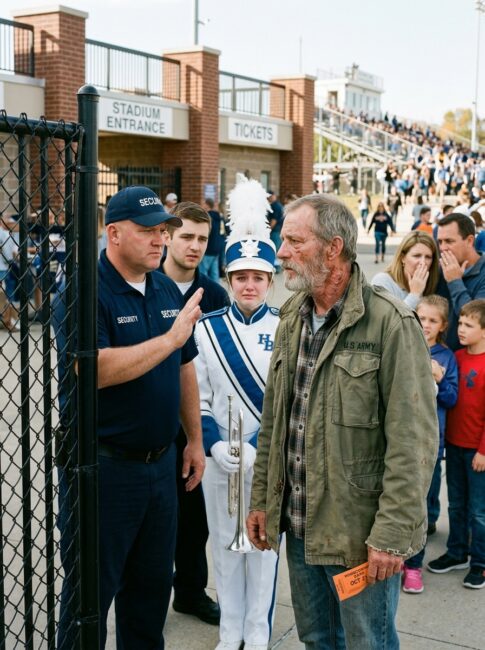
The announcer’s voice rolled over the stadium speakers.
“Ladies and gentlemen, please rise for the playing of our national anthem, performed tonight by senior trumpet soloist Emily Walker.”
At the mention of her name, Henry closed his eyes.
The crowd stood.
Hats came off. Hands moved to hearts. Conversations faded into a hush that made the lights hum louder.
Emily raised her trumpet.
But she could not play.
Her eyes were still locked on the gate.
On her father standing outside like a stranger.
A father who had spent years being mistaken for the worst part of himself.
A father who checked every window before sleeping, who sat facing doors in restaurants, who apologized when fireworks made him leave the room. A father who woke from nightmares and walked barefoot to the kitchen so he would not wake his daughter.
A father who packed her lunches after her mother died, even when his hands shook so badly the peanut butter tore the bread.
The first twist came when Principal Harris hurried toward the gate.
She was a small woman in a navy blazer, known for smiling through uncomfortable moments and avoiding public conflict whenever possible.
“What’s going on here?” she asked.
Peterson straightened. “We stopped this man for safety concerns.”
Henry lowered his head, as if the words were a weather condition he had learned to stand under.
Principal Harris looked at him.
Then her face went pale.
“Mr. Walker?”
The parents nearest the gate grew quiet.
“You know him?” Mason asked.
Principal Harris swallowed. “Yes. I know him.”
Peterson shifted. “Ma’am, he was alarming guests.”
The principal looked at the ticket in Henry’s hand, then at the old Army jacket. Her voice softened.
“He built the ramp outside our east entrance.”
Nobody spoke.
“After the school said we didn’t have funds for it,” she continued. “He came on weekends for six months. He never billed us.”
A few parents turned toward the east side of the building, where a wheelchair ramp curved gently beneath two maple trees.
Most had walked past it for years without knowing.
Henry’s face tightened. “That wasn’t for talking about.”
Principal Harris ignored that.
“And when our boiler failed two winters ago, he fixed the temporary heating system before the children arrived.”
The woman in the red sweater lowered her eyes.
Mason looked at Henry differently now, but Peterson still kept his hand near the gate.
“That doesn’t change procedure,” Peterson said.
Then the second twist arrived.
A football player broke from the senior line and jogged toward the fence. He was tall, wearing number 44, with his helmet tucked under one arm.
“Mr. Walker?” he called.
Henry looked surprised. “Darius?”
The boy’s mother gasped from the bleachers.
Darius turned to the guard. “He’s the reason I’m graduating.”
Whispers moved like wind.
“My mom worked nights,” Darius said, breathing hard. “I used to skip practice because I had to walk my little brothers home. Mr. Walker started driving us. Every day. He told the school not to tell anyone because he didn’t want me embarrassed.”
Henry looked down. “Darius, go stand with your team.”
But the boy did not move.
Then a woman with gray hair stood from the first row of bleachers.
“He brought groceries to my porch during my chemo,” she said.
Another man near the concession stand lifted his cap. “He fixed my truck after I got laid off.”
A cafeteria worker wiped her hands on her apron. “He paid off lunch balances one Christmas. Said it was from an anonymous church group.”
Henry’s breathing grew uneven.
This was exactly what he hated.
Attention.
Pity.
A crowd turning its eyes on him as if his life were now public property.
He had not done those things to be known. He had done them because after the war, kindness was the only thing that made him feel less haunted.
The third twist came from Mason, the younger guard.
He stepped closer to Henry, his voice low.
“Sir, were you with the 82nd?”
Henry looked at him carefully.
Mason pointed to a faded patch on Henry’s jacket. “My brother served. He had that same patch.”
Henry nodded once. “Different years.”
Mason’s face changed.
“My brother didn’t come home right,” he said.
Henry’s eyes softened. “Most of us don’t. Some just hide it better.”
Peterson exhaled sharply, impatient with the sudden sympathy. “This is not the place for a reunion.”
That was when Emily finally lowered her trumpet.
The whole stadium waited.
She walked across the field in her white uniform, every step measured, every eye following her. Her band director whispered her name, but she kept going.
At the gate, she stopped on the inside of the fence, close enough that her gloved fingers almost touched Henry’s.
“Dad,” she said.
That one word did what all the explanations could not.
It made him human in front of them.
Henry tried to smile. “You’re supposed to be playing, sweetheart.”
“I can’t,” she said.
“Yes, you can.”
“Not while they keep you outside.”
The fourth twist was the smallest, and maybe the deepest.
Henry reached into his jacket pocket.
The crowd stiffened.
Peterson moved fast, grabbing Henry’s wrist.
“Do not reach inside that jacket.”
The stadium seemed to hold its breath.
Henry froze.
Then the velvet box slipped from his trembling hand and fell open on the pavement.
A silver trumpet charm rolled out, catching the stadium lights.
Emily covered her mouth.
Henry looked at the tiny charm, then at his daughter. His voice came out rough.
“I wanted to give it to you after you played.”
The red-sweater woman put a hand over her heart. Mason bent down and picked up the charm, his face burning with shame.
Peterson let go slowly.
Emily reached through the fence, and this time Henry took her hand.
His scarred hand shook inside her white glove.
“I’m sorry,” she whispered.
Henry frowned, confused. “For what?”
“For all the times I said I didn’t care if you came.”
He closed his eyes.
She had said that to protect him. He knew. She had stopped asking around age twelve, when she realized each invitation left him looking wounded.
But Henry had kept every program.
Every concert flyer.
Every award ceremony notice.
They were in a shoebox under his bed, stacked beside old letters from her mother.
“I was there,” he said.
Emily looked up.
“At the winter concert, I stood by the back door. At your first solo, I sat in the truck with the window down. At the scholarship night, I was behind the gym, where I could hear the applause.”
Tears slipped down her face.
“You heard?”
“Every time.”
The final twist came from Principal Harris.
She reached into her blazer pocket and pulled out a folded envelope.
“I was going to give this to Emily after the game,” she said, “but maybe this belongs here.”
She handed it through the gate to Henry.
He stared at his name written across the front.
Inside was a letter from Emily’s late mother, dated thirteen years earlier, before the illness took her. Principal Harris had found it tucked inside an old file when preparing senior night records.
Henry opened it with hands that no longer looked frightening to anyone.
They looked tired.
The letter was short.
Not enough to break copyright, not enough to feel rehearsed, but enough to break him.
Tell Henry that Emily will need him in the seats someday, even if he can only stand by the door.
He read the line twice.
Then folded the paper carefully, as if it might dissolve.
The anthem still had not begun.
The flag waited above the field.
Hundreds of people stood in silence, watching a man they had nearly pushed away.
Principal Harris turned to Peterson.
“Open the gate.”
Peterson did not move at first.
Then Mason reached around him and unlocked it.
The chain gave a soft metallic sound.
Henry did not rush through.
He stood there, just beyond the open gate, like he did not trust mercy when it arrived in public.
Emily stepped out, took the charm from Mason, and placed it back in the velvet box.
Then she turned to her father.
“Walk with me.”
Henry shook his head. “This is your night.”
She lifted his hand to her arm.
“It always was.”
Together, they walked onto the field.
Not quickly. Not dramatically.
Just a daughter in white and a scarred veteran in an old jacket, crossing fifty yards of grass while a town watched its own judgment unravel.
No one clapped at first.
The silence was too heavy.
Then Darius removed his helmet and held it against his chest.
One by one, the football players did the same.
Parents followed.
Teachers.
Students.
Even the little program girl by the gate stood taller, though she had already been standing.
When Henry reached the sideline, Emily gave him the trumpet charm.
“After I play,” she whispered, “you put it on me.”
He nodded, but his eyes were wet.
She returned to the center of the field.
And when she lifted the trumpet again, this time the first note rose clear into the evening.
It was not perfect.
It trembled at the start.
But then it steadied.
Henry stood with his hand over his heart, facing the flag. The stadium stood with him.
And for once, people were not looking at his scars like warnings.
They were looking at them like evidence of a life they had not bothered to understand.
After the anthem ended, there was no sudden cheer, no movie-like roar that washed everything clean.
For a few seconds, there was only quiet.
Then the applause came slowly, almost carefully, as if people were afraid to cheapen what they had just witnessed.
Emily walked back to her father. She did not bow. She did not smile for the cameras. She simply stood in front of him and lowered her head so he could place the silver trumpet charm around her neck.
His fingers fumbled with the clasp.
The whole stadium waited.
Emily laughed softly through her tears. “Still can’t do tiny clasps, huh?”
Henry’s mouth curved just a little. “Never could.”
That small laugh loosened something in the air.
Not everything. Some things do not heal just because a gate opens.
Peterson approached Henry after the ceremony. His face looked older than it had thirty minutes earlier.
“Mr. Walker,” he said, “I was wrong.”
Henry studied him.
People nearby leaned in, expecting a sharp answer, maybe even a speech.
Henry only nodded.
“Yes,” he said. “You were.”
Peterson swallowed.
Then Henry added, “Try not to be wrong so fast next time.”
It was not cruel. That made it heavier.
By the end of the game, the story had already begun changing as it moved through the bleachers. Some people told it as the night the town honored a veteran. Some told it as the night Emily Walker played the anthem of her life.
But the little program girl remembered it differently.
She remembered a man standing outside a fence with a ticket in his hand.
She remembered how quickly grown-ups decided fear was the same thing as truth.
And she remembered the sound of the chain unlocking.
Two weeks later, Maple Ridge High School replaced its old entrance sign.
Not because of Henry.
He would have hated that.
Instead, Principal Harris added a small brass plate beside the east ramp, where children in wheelchairs, parents with strollers, and elderly grandparents passed every morning.
It read:
Built by hands that asked for nothing.
Henry saw it once.
He had come early, before the school day began, to drop off a box of repaired band stands. He stood in front of the plaque for a long moment, then shook his head like the school had made too much of it.
Emily, now wearing the trumpet charm beneath her collar, watched from the passenger seat of his truck.
“You okay?” she asked.
Henry climbed in slowly and closed the door.
The morning sun touched the scars on his face. In that light, they did not disappear. They simply became part of him, like the wrinkles near his eyes, like the gray in his beard, like the silence he carried without asking anyone to understand it.
“I’m okay,” he said.
Emily knew that was not the whole truth.
But it was more than he used to say.
As they pulled away, a group of freshmen crossed the sidewalk near the ramp. One boy dropped his books, and Henry stopped the truck at once.
Before Emily could speak, he was already opening his door.
His limp was still there.
So was the scar.
So was the old jacket.
But this time, when the boy looked up and saw Henry coming toward him, he did not step back.
He only said, “Thank you, sir.”
Henry bent down, picked up the scattered books, and handed them over.
Then he gave the boy a small nod and returned to the truck.
Emily looked at him, smiling softly.
“What?” he asked.
“Nothing,” she said.
But it was not nothing.
It was the way the world looked different when one person finally walked through the gate.
Follow this page for more emotional stories that stay with you long after the last line.