Part 2: The Autistic Boy Was Asked to Leave the Concert for “Making Noise” — Then the Orchestra Stopped and Waited for Him
No one moved after the music stopped.
The last violin note faded into the high ceiling, leaving the auditorium in a silence so sharp that people could hear the soft buzzing of the stage lights.
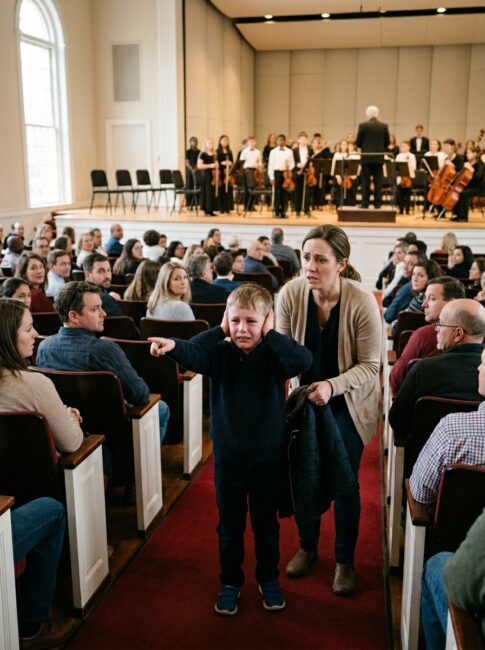
Noah stood in the aisle with tears on his cheeks, one hand still pressed over his left ear. His other hand pointed toward the second row of the orchestra, where four empty black chairs sat behind a row of music stands.
To most people, those chairs meant nothing.
A late student. A missing section. A reshuffled arrangement.
To Noah, they were a hole in the world.
Grace Keller stood behind him, holding his coat, her face pale with the familiar exhaustion of someone who had apologized in public too many times.
“I’m sorry,” she whispered, not knowing whether she was speaking to the volunteer, the conductor, or the hundred eyes turned toward her son.
The volunteer kept her hand near Noah’s shoulder without touching him.
“Ma’am, please,” she said. “We need to continue.”
But the conductor had not continued.
His name was Mr. Leonard Hayes. He was sixty-three, silver-haired, and known for demanding silence before a performance. Students feared his raised eyebrow more than they feared detention. Parents admired him because his concerts always began on time and ended with dignity.
Now he stood frozen, staring at Noah.
Not angry.
Not confused.
Recognizing something.
That was the first strange thing.
Noah lowered his pointing hand and began rubbing his thumb against the sleeve of his sweater. It was navy blue, worn thin near the cuffs, and too formal for him. Grace had convinced him to wear it because it was his cousin Lily’s big night.
Lily was twelve, a cellist, and the only person in the family who could get Noah to sit through an entire song.
Except Lily was not onstage.
Grace noticed the empty chairs then.
Her eyes shifted quickly over the orchestra. Violins. Violas. Flutes. Clarinet. Percussion.
No Lily.
Her stomach tightened.
She had dropped Lily at the backstage entrance an hour earlier, kissed her forehead, and watched her carry her cello case through the side door.
Noah had been quiet then.
Too quiet.
He had stared at the stage door and said, “The song has a missing sound.”
Grace had thought he meant the crowd noise, or the lights, or the way the auditorium smelled faintly of floor polish and perfume.
She had not listened closely.
That was the first small guilt of the evening.
The second twist came from a boy onstage.
A young Black American violinist, about thirteen, leaned toward the conductor and whispered something. Mr. Hayes did not turn, but his face changed.
The violinist whispered again, more urgently.
Parents in the front rows began shifting in their seats.
“What is happening?” someone murmured.
Noah heard the whispering and covered both ears.
Grace crouched in front of him.
“Baby, we’re going outside now,” she said softly.
“No,” Noah said, his voice breaking. “Lily’s not in the song.”
Several parents exchanged looks.
One woman rolled her eyes.
Grace saw it and felt the old burn rise in her chest. Not anger first. Shame first. The kind that came from years of being looked at as if her child were a problem she had failed to solve.
She began leading Noah toward the aisle exit.
Then Mr. Hayes lowered his baton.
“Mrs. Keller,” he said.
His voice carried through the auditorium.
Grace froze.
A few people turned again, waiting for the reprimand to become official.
Instead, the conductor asked, “Where is Lily?”
The question changed the air.
Grace blinked.
“She’s backstage,” she said, but the sentence weakened as it left her mouth.
Mr. Hayes turned toward the side curtain.
A stagehand, a White American man in his twenties, stepped out from behind the black drape. He looked nervous, his headset crooked.
“Mr. Hayes,” he said, too quietly.
The conductor’s expression hardened.
The stagehand came closer and whispered.
This time, the front row heard enough.
“Cello case.”
“Storage room.”
“Door stuck.”
Grace stood slowly.
“What door?”
The stagehand looked at her, then at the conductor.
Mr. Hayes’s face had gone pale.
The third twist was small, almost invisible.
Noah stopped crying.
He tilted his head, listening to something no one else could hear.
Then he pointed toward the hallway beside the stage.
“She’s tapping,” he said.
No one understood at first.
Noah repeated it, frustrated now, tapping his own chest with two fingers.
“She’s tapping the cello rhythm. She’s stuck.”
The auditorium fell quiet in a different way.
Not annoyed.
Afraid.
Grace dropped Noah’s coat.
Before anyone could stop her, she ran toward the stage door.
The next few minutes unfolded with the strange slowness of moments people replay for years.
Grace reached the side hallway first, followed by the stagehand, then Mr. Hayes, still holding his baton like he had forgotten it was in his hand.
The hallway behind the auditorium smelled of dust, instrument polish, and old curtains. Fluorescent lights buzzed overhead.
Noah followed too.
The volunteer tried to stop him, but he slipped around her with a suddenness that surprised everyone. He did not run like other children. He moved with fierce purpose, one hand trailing along the wall, counting doorframes under his breath.
“Three. Four. Five. Storage.”
Grace turned back. “Noah, stay with me.”
He was already ahead of her.
At the sixth door, he stopped.
It was a narrow storage room door half-hidden behind stacked folding chairs. From the outside, it looked harmless. Just another beige door in a school auditorium, the kind adults pass without seeing.
Noah placed his ear near it, then flinched from the texture and pulled back.
“There,” he whispered.
Everyone listened.
At first, nothing.
Then came a faint sound.
Tap. Tap-tap. Tap.
Grace’s knees nearly failed.
“Lily!” she shouted.
From the other side came a muffled sob.
“Aunt Grace?”
The stagehand cursed under his breath and grabbed the handle. It would not move. He pulled harder.
“It jammed,” he said. “The latch sticks sometimes.”
Grace looked at him in horror. “You knew?”
He shook his head quickly. “It never locks from the outside. It just catches.”
The fourth twist came when Mr. Hayes stepped forward and put one hand against the door.
“Lily,” he called, his voice calm in a way Grace could not manage. “Are you hurt?”
“No,” Lily cried. “I was getting rosin. The door shut. I couldn’t get out.”
“How long?” Grace asked.
There was a pause.
“Since before the first song.”
Grace covered her mouth.
Inside the auditorium, the audience had begun to stand. Not all at once. One person, then another, drawn by the silence and the unanswered music.
The woman who had rolled her eyes at Noah stood near the aisle, suddenly very still.
Mr. Hayes looked at the stagehand. “Get the custodian. Now.”
The stagehand ran.
Noah pressed his fingers together tightly, rocking once.
“She tapped the missing part,” he said.
Mr. Hayes looked down at him.
“What do you mean, Noah?”
Noah glanced at the conductor, then away. Eye contact hurt when too many feelings crowded the room.
“Cello comes under the violins after the soft part,” he said. “But it didn’t. She knows. She tapped it.”
Mr. Hayes stared at him.
The piece being performed was an arrangement he had written himself for the youth orchestra. The cello entrance after the soft violin passage was delicate, almost hidden. Most parents would never have noticed if it went missing.
But Noah had.
Not because he was trying to ruin the performance.
Because he had memorized it.
Because Lily had practiced in the Keller living room every Tuesday and Thursday for three months. Because Noah sat under the dining table with noise-reducing headphones, arranging toy trains by color while the cello lines settled into his memory like a map.
He knew where Lily belonged.
And when she was missing, the music felt wrong enough to hurt.
The custodian arrived, a broad White American woman in her fifties with keys clipped to her belt and worry in her face. She tried one key, then another.
The latch did not give.
Grace knelt in front of the door.
“Lily, honey, keep talking to me.”
“I tried yelling,” Lily said. “Nobody heard because the orchestra started.”
Noah’s face tightened.
He turned toward the hallway crowd, then back at the door.
“Don’t yell,” he said.
Everyone looked at him.
Grace whispered, “Noah?”
He tapped the door gently.
“Play it.”
Inside, Lily sniffled. “What?”
Noah’s voice softened.
“Play your part.”
There was a pause.
Then, from behind the door, came a low, trembling cello note.
Not loud.
Not perfect.
But unmistakably alive.
Grace began crying silently.
Mr. Hayes closed his eyes.
The custodian worked the latch while Lily played the phrase she had missed onstage. The melody slipped through the door and into the hallway, wounded but beautiful.
Something changed in the people listening.
The parents who had wanted Noah removed now stood behind him, watching a boy they had dismissed as disruptive become the only reason Lily had been found.
The main twist settled over them without anyone announcing it.
Noah had not interrupted the concert.
He had interrupted their blindness.
The door finally opened with a sharp metallic snap.
Lily stood inside, cheeks wet, her cello clutched to her chest. A stack of music stands had fallen against the wall behind her, and an old coat rack blocked part of the door. She looked smaller than twelve.
Grace pulled her into her arms.
Lily tried to hold on while protecting the cello, and Noah immediately reached for the instrument case, not her.
Some people might have thought that strange.
Lily did not.
She smiled through tears.
“You heard me,” she said to him.
Noah looked at the floor.
“You were late.”
Lily gave a shaky laugh, and that laugh nearly broke Grace.
Back in the auditorium, the crowd had fallen completely silent. News traveled row by row, though no one knew the whole story yet.
Mr. Hayes walked onto the stage first.
He did not lift his baton.
He faced the audience.
“There will be a short pause,” he said, his voice rougher than usual. “One of our musicians was accidentally locked backstage. She is safe.”
A collective gasp moved through the room.
Then Lily walked out with Grace behind her.
And behind them came Noah.
He stopped at the edge of the stage lights, overwhelmed by the brightness and the sudden attention. He covered one ear.
A few parents began clapping, uncertainly.
Mr. Hayes raised one hand.
The applause stopped.
Not because Lily did not deserve it.
Because Noah could not bear the sound.
That was the fifth twist.
The orchestra understood before the audience did.
One by one, the young musicians lowered their instruments into their laps. No one coughed. No one whispered. No chair scraped.
They waited.
For Noah.
A boy many had wanted removed.
A boy standing at the side of the stage, breathing too fast, trying to survive the same room that had judged him.
Grace crouched beside him.
“We can go,” she whispered. “You did enough.”
Noah looked at Lily.
She was sitting now in the empty cello chair, wiping her face with her sleeve. Her bow hand still shook.
Then Noah looked at Mr. Hayes.
“They start after she breathes,” he said.
Mr. Hayes nodded slowly.
“Yes,” he said. “They do.”
Noah stepped backward, away from the lights, and sat on the carpeted stair beside the stage curtain. Not in the audience. Not onstage.
Somewhere between.
Lily lifted her cello.
Mr. Hayes waited until Noah’s hands came down from his ears.
Then he raised his baton.
The orchestra began again from the soft passage.
This time, when the violins thinned into silence, the cello entered.
Lily’s note trembled at first.
Noah rocked once, then stilled.
The music found its missing sound.
And the entire room listened differently.
The concert did not end with thunderous applause.
At least, not at first.
When the final note faded, Mr. Hayes kept his baton raised for an extra few seconds. It was an old conductor’s trick, his way of protecting the last silence from being trampled.
That night, people obeyed.
They did not rush to clap. They sat with what had happened.
Then Mr. Hayes turned slightly toward the carpeted stair beside the curtain.
Noah was still there, knees pulled close, one hand wrapped around a small red toy train he had carried in his pocket all evening.
The conductor did not point at him.
He did not call him a hero.
He only placed one hand over his heart and gave the smallest bow.
To a child who had heard what everyone else missed.
The orchestra followed.
Lily bowed from her chair, cello resting against her shoulder. Her eyes stayed on Noah.
Grace sat in the aisle now, unable to move back to her seat. Her coat was wrinkled in her lap. Her face looked tired, tearful, and strangely peaceful.
The applause came softly.
Not the sharp crashing applause of people trying to prove they were moved. It came gently, like rain beginning.
Some people clapped with fingertips against palms.
Some did not clap at all, remembering just in time.
The woman who had turned around in annoyance earlier found Grace near the exit after the concert.
She stood there for a moment, holding her program with both hands.
“I’m sorry,” she said.
Grace looked at her.
The woman’s face flushed. “I thought he was being difficult.”
Grace did not rescue her from the discomfort.
After a quiet pause, she said, “A lot of people do.”
The woman nodded, and for once, she had no answer.
Near the stage, Lily packed her cello slowly while Noah lined up three spare pencils from the conductor’s stand. Yellow, yellow, blue. Yellow, yellow, blue.
Mr. Hayes crouched a few feet away, careful not to crowd him.
“Noah,” he said, “you know the whole piece?”
Noah did not look up.
“Yes.”
“Would you like to come to rehearsal next week and listen from the back?”
Grace started to speak, afraid of offering too much too quickly.
Noah placed the blue pencil at the end of the line.
“Only if Lily doesn’t get locked in rooms.”
Mr. Hayes’s mouth softened.
“Fair condition.”
Lily laughed, and this time Noah smiled.
It was small, sideways, and brief.
But Grace saw it.
On the drive home, the streets were wet from a rain they had missed inside the auditorium. Streetlights stretched long across the windshield. Lily slept in the back seat with her cello case beside her. Noah sat behind Grace, holding the program folded into a perfect square.
For several minutes, no one spoke.
Then Noah said, “The second time was better.”
Grace looked at him in the rearview mirror.
“The music?”
He nodded.
“Because Lily was there.”
Grace swallowed.
“Yes,” she said. “Because Lily was there.”
At home, she found the program the next morning on Noah’s desk. He had drawn the stage from memory. Every chair. Every stand. Every musician.
In the corner, beside the carpeted stair, he had drawn a small boy sitting with a red train in his hand.
Above the orchestra, he had written one sentence in careful block letters.
Wait until everyone is ready.
Grace taped the drawing to the refrigerator.
For weeks, she passed it while making coffee, packing lunches, and answering emails from people who suddenly wanted to tell her how remarkable her son was.
She kept thinking of the auditorium.
Not the judgment.
Not even the apology.
She thought of the moment the orchestra stopped.
A hundred children holding instruments.
A conductor lowering his baton.
An entire room learning, for just a few seconds, how to wait.
Follow this page for more heartfelt stories about kindness, family, and the quiet moments that change how we see one another.