A Billionaire Disguised Himself as a Homeless Man Outside His Own Tower to Test His Son—Only One Poor Girl Stopped, and What His Son Picked Up Off the Sidewalk Changed Everything
Part 2
The guards dumped Arthur in the alley off Third Street, beside a dumpster that smelled like old grease and cardboard.
One of them hesitated. Young, maybe twenty-five, with a contractor’s patch on his sleeve. “You okay, sir?”
“Fine,” Arthur said.
The guard walked away.
Arthur sat on the wet asphalt and waited for his knees to stop shaking. Sixty-seven years old. Forty-five years of building the largest privately held trucking company in the Southeast. And his only son had just had him thrown out like trash.
Footsteps. Fast and light.
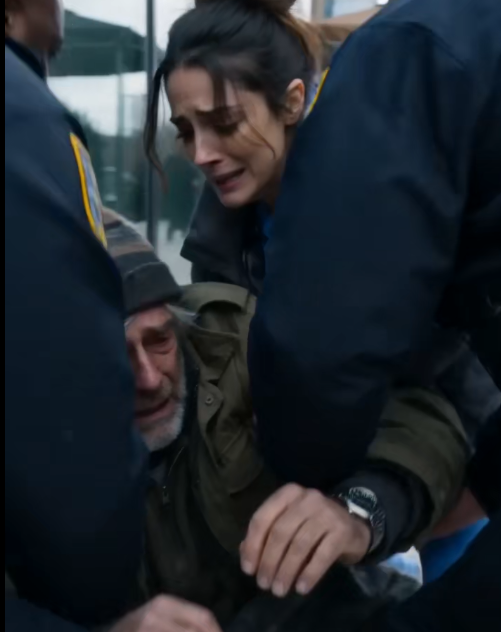
Nora Quinn came around the corner, out of breath, mascara streaked, her little sister clinging to her hand. She knelt in the puddle in her scrubs and pressed the paper bag with the blueberry muffin into his hands.
“I’m so sorry,” she said. “He’s not usually… I mean, he’s never…” She stopped. “Here. It’s my bus pass. It’s got two weeks left on it. The 9 goes to the Urban Ministry Center.”
He looked at the bus pass. He couldn’t speak.
“I have to get Mia to school.” Nora wiped her face. “Please eat something.”
She turned to go. The little girl didn’t move.
Mia leaned in close to Arthur’s ear, very serious.
“He took your watch,” she whispered. “He read the back and smiled. Then he put it in his pocket.”
Then she ran after her sister.
Arthur looked down at his bare wrist. The pale band of skin where the Timex had been for twenty-six years.
Earl’s black Suburban pulled into the alley exactly at 11:00, the way they’d planned. Arthur climbed into the back seat and sat with the muffin in his lap all the way to Myers Park, saying nothing.
At home, in the study, he poured a bourbon he wasn’t supposed to have and tried to think clearly.
Four months ago, Dr. Martin Feld had sat across a desk in his SouthPark office and said the words mild cognitive impairment. Early. Manageable. Not Alzheimer’s, not yet. But the word yet had sat in Arthur’s chest ever since. He’d forgotten names. Once, driving to the lake house, he’d missed his own exit and ended up in Mooresville with no idea how he got there.
He’d told two people. Earl and Preston.
Had he told Preston about today’s test too, and forgotten?
He couldn’t remember. That was the terrifying part. He genuinely could not remember.
And what did he really have? The word of a seven-year-old child, who’d seen a man pick something up off a sidewalk. Maybe Preston had seen a homeless man and a broken watch and simply picked up litter. Maybe Mia had imagined the smile.
Maybe Arthur was exactly what everyone was going to start saying he was. A confused old man in a costume.
At 7:40 that evening, Preston called. His voice was warm.
“Hey, Dad. Crazy day. Some homeless guy was harassing employees out front this morning. Security handled it.” A pause. “Listen, the board moved the vote up to Friday. And I talked to Dr. Feld this afternoon. He agrees it’d be better if you stepped back sooner rather than later.”
Arthur set down the glass.
Why was his son talking to his neurologist?
Part 3
August 2000. Interstate 85, somewhere south of Gastonia, three in the morning.
Arthur owned two hundred trucks by then, but once a month he still drove a route himself, so he’d never forget what it felt like. That summer he brought Preston along. Eight years old, asleep half the time in the bunk behind the seats, sitting up wide-eyed for the other half to watch the highway lights roll past.
At a Pilot truck stop, Preston climbed into the cab with a small paper bag.
“Happy birthday, Pop.”
Inside was Arthur’s old steel Timex, the twelve-dollar watch he’d bought the day he signed for his first Peterbilt in 1981. Preston had borrowed it two weeks earlier “to fix the strap.” He’d emptied his piggy bank at the engraving kiosk at SouthPark Mall instead.
Arthur turned it over.
KEEP ON TRUCKIN’ — PIP
Pip. The nickname nobody but Arthur and June ever used.
Arthur didn’t say anything for a while. He just put the watch back on.
Later that night, at the same truck stop, a cluster of drivers stood around a folding table with a framed photo and a coffee can for donations. One of their own had gone off the road in the rain near Spartanburg. Arthur stuffed every bill in his wallet into the can.
Back in the cab, Preston asked why he looked so sad.
“Every driver out there is somebody’s daddy, Pip,” Arthur said. “Don’t you ever forget that. Not when you’re running this thing. Not ever.”
“I won’t, Pop.”
He fell asleep with his head on Arthur’s arm.
Part 4
Preston came to the house the next morning before eight, still in his running clothes, and sat across from his father at the kitchen island with red-rimmed eyes.
“Dad. Earl called me last night. That was you?”
Arthur watched him.
“Oh my God.” Preston put his head in his hands. “Dad, I swear to you, I didn’t know. I was on thirty until security radioed up about a guy bothering people. By the time I got downstairs they were already walking him off. I saw the back of a blanket. That’s it.”
“You said, ‘Get him off my sidewalk.'”
“Because some woman in accounting said he’d grabbed her purse.” Preston looked up, stricken. “Dad, why would you do something like that? Sitting on the street in a costume, the week before the vote? Do you know what the board would think if they’d seen you?”
It was a fair question. Arthur didn’t have a good answer.
“And Nora?” Arthur asked. “You broke up with her right there on the sidewalk.”
Preston’s face hardened. He reached into his gym bag and slid a manila folder across the marble.
“I was going to handle this quietly. I hired an investigator in September, after she asked too many questions about the company.” He opened the folder. “Her father was Danny Quinn. Holloway driver. Killed on I-77 in 2016. We settled with the family. And last month, Nora met with a wrongful-death attorney in Charlotte about reopening it.”
A photograph of Nora walking into a law office on East Morehead.
“She’s not my girlfriend, Dad. She’s a lawsuit with a toothbrush in my bathroom.” Preston’s voice softened. “I didn’t want you to get hurt. But think about it. Out of a thousand people, she’s the one who stopped? You really think that was an accident?”
Arthur stared at the photograph.
The coffee. The muffin. The bus pass. Black, three sugars.
She had asked, he reminded himself. She’d just asked.
Hadn’t she?
Preston squeezed his shoulder on his way out. “Get some rest. Let me handle Friday.”
When he was gone, Arthur opened the folder again and turned to the last page. It was a photo, taken from across the street, of Nora sitting on a bench outside Holloway Freight on a different morning in October.
Looking straight up at the thirtieth floor.
Had she known who he was all along?
Part 5
The person who came to him wasn’t Earl. It was Victoria Lane.
The company’s chief financial officer arrived at the house on Wednesday afternoon, unannounced, in a gray suit and a terrible mood. She sat in Arthur’s study without being asked and put her phone on the desk.
“I’ve worked for your family for eleven years,” she said. “I’m about to do something that will probably end my career. I want you to know that before I do it.”
She opened her messages.
Preston, Monday, 8:52 a.m.: Dad’s on the sidewalk out front dressed like a bum. Find My iPhone, lol. He forgot we’re still on the family plan.
Preston, 8:54 a.m.: Perfect timing. If he makes a scene, even better. Feld can use it.
Preston, 11:06 a.m.: Got his watch. Sentimental old fool still wears it.
Arthur read them three times. His hands didn’t shake. That surprised him.
“There’s more.” Victoria opened a laptop. “Bracken Capital. A private equity firm out of New York. They’ve offered to buy Holloway Freight. The deal requires you to be removed as chairman before closing.” She turned the screen toward him. “This is the term sheet Preston negotiated. Section eleven.”
A transition bonus to Preston Holloway: thirty million dollars, payable at closing.
Section fourteen: termination and restructuring of the Holloway Drivers’ Pension Plan. Four thousand drivers.
“He owes eleven million dollars on a failed condo project in Miami,” Victoria said. “His lenders are calling it in December. This is his way out.”
She clicked to the last file. Wire transfers from an LLC called Pinehurst Advisory, owned by Preston, to Martin Feld, MD. Two hundred and fifty thousand dollars over six months. Memo line: consulting.
“Feld wrote a letter last week,” Victoria said. “It says you lack the capacity to manage your affairs.”
Arthur sat back in his chair.
Four months ago, a doctor had looked him in the eye and told him his brain was failing. He had believed every word. He had gone home and grieved for the man he used to be.
“Is it real?” he asked quietly. “The diagnosis?”
“I don’t know, Arthur. I’m a CFO, not a neurologist.” Victoria closed the laptop. “But Feld was being paid by your son before he ever examined you.”
Arthur thought of the alley. Earl’s gray face. He knew it was you. Not because Earl told him. Because of a phone app Arthur had forgotten existed.
“Why are you doing this, Victoria?”
“Because Bracken’s going to fire me the day the deal closes,” she said honestly. “And because my grandfather drove for you in 1984.” She stood. “And because of this.”
She laid a printed court notice on his desk.
In the Matter of Arthur J. Holloway. Petition for Emergency Appointment of Interim Guardian. Hearing: Wednesday, 10:00 a.m., Mecklenburg County Clerk of Superior Court.
Arthur looked at the clock on the wall.
It was 2:15 in the afternoon.
“It already happened,” he said slowly. “This morning.”
“You were never served,” Victoria said. “What did the clerk decide?”
Part 6
He found out when he tried to drive to his lawyer’s office at four o’clock.
The gate at the end of the drive wouldn’t open. Two men he’d never seen before stood by the garage in navy polo shirts. Home health aides, they said, from an agency called Carolina Companion Care. A third man in khakis, an off-duty Charlotte-Mecklenburg police officer, held a court order.
Interim guardianship of the person and estate of Arthur J. Holloway, granted to Preston A. Holloway, pending full hearing in thirty days.
They took his phone “for his safety.” His credit cards had been frozen at noon. His access badge to the Holloway tower had been deactivated. When Earl’s Suburban pulled up to the gate that evening, the off-duty officer walked out and told Earl he was no longer authorized on the property.
Arthur watched from the study window as his oldest friend sat in the car for a long time before he finally drove away.
Preston came by on Thursday morning with flowers and a sympathetic face.
“It’s temporary, Dad. Just until you’re better. You’d do the same for me.”
“Would I?”
Preston’s smile flickered. “Get some rest. Tomorrow’s a big day for the company.”
That night, Arthur went to June’s old kitchen cookie jar, the one nobody had touched since her funeral in 2019, and found forty-three dollars in folded bills inside. He put on the thrift-store army coat from Monday, still smelling of alley grease. He walked through the dark garden to the old service gate behind the potting shed, the one June had used to slip out to the neighbor’s for coffee. Nobody had changed that code in twenty years.
It was her birthday.
The CATS bus took an hour to reach East Charlotte. The address was in Preston’s investigator’s folder: a two-story apartment complex off Albemarle Road, unit 14B.
He knocked at 11:30 at night.
The door opened on a chain. Nora, in an oversized T-shirt and scrubs pants, her face going blank with shock.
Then the chain came off.
Mia peered out from behind her sister’s legs. “It’s the rich man pretending to be poor.”
Nora pulled Arthur inside, sat him at a small kitchen table, and put a kettle on without a word. Then she stood with her back to the stove, arms crossed tight, as if bracing for something.
“Mr. Holloway,” she said. “Before you say anything, I have to tell you something.”
She swallowed.
“I knew it was you on Monday. Before I ever bought that coffee.”
Part 7
“Preston has a photo of you on his bookshelf,” Nora said. “You and him in a truck cab when he was little. Same eyes. Same way of holding your coffee cup with your thumb over the lid.” She stared at the floor. “I walked past you on that sidewalk, and I knew.”
“Then why did you stop?”
“Because I’d been waiting three years to look you in the face.”
She took a framed photo off the refrigerator and put it on the table in front of him. A big, grinning man in a Holloway Freight cap, holding a toddler on his shoulders.
“Danny Quinn. My dad. He drove for you for fourteen years.” Her voice stayed level, but her hands were shaking. “In 2016, Holloway started an on-time bonus. Dispatchers got paid extra when drivers made their delivery windows. So the dispatchers told drivers to fudge their logbooks. My dad drove nineteen hours straight to make a delivery in Columbia. He fell asleep on I-77 near Rock Hill.”
Arthur closed his eyes.
“The company paid us eighty-five thousand dollars and made my mom sign a gag order. Mia was eight months old.” Nora’s chin lifted. “I started dating Preston on purpose. Last year. I wanted access. I wanted the emails, the dispatch memos, anything that proved somebody upstairs knew. And I got them.”
She went to a drawer and took out a USB drive.
“I’m not a good person, Mr. Holloway. I used your son. And on Monday, when I bought you that coffee, part of me was being kind, and part of me wanted you to look me in the eye and owe me something.”
Arthur was quiet for a long time. Mia had fallen asleep on the couch with a stuffed rabbit.
“The bonus policy,” he said finally. “That was mine.”
Nora looked up.
“I signed it in 2015. I wanted on-time numbers that would impress the banks. I told myself the dispatchers would use common sense.” His voice cracked. “I never checked. I never wanted to know. I went to that funeral, Nora. I remember the casket. I didn’t remember the name.”
Nora didn’t say anything. She didn’t forgive him. She just pushed the USB drive across the table.
“Preston was VP of Operations in 2016,” she said. “There’s an email in there from him to the dispatch managers. ‘Logs are a formality. Hit the windows.’ That’s the email my dad’s dispatcher was following.”
Arthur looked at the drive. Then at the photo of Danny Quinn with a toddler on his shoulders.
Every driver out there is somebody’s daddy, Pip.
“Tomorrow is the company’s forty-fifth anniversary,” Nora said. “There’s a Driver Appreciation Day on the plaza. Two thousand drivers and their families. Preston’s being announced as CEO on a stage. Bracken’s people will be there.”
“Then so will I,” Arthur said.
“In that coat?”
“In this coat.” He looked down at the filthy army surplus sleeve. “It’s the first honest thing I’ve worn in years.”
From the couch, Mia’s sleepy voice floated up.
“Can I come too? I’m the only one who saw what he put in his pocket.”
Part 8
The plaza in front of the Holloway tower was packed by ten. Drivers in company jackets, their wives and husbands, kids on shoulders, a barbecue truck, a bouncy castle, and a vintage 1981 Peterbilt 359 polished to a mirror shine and parked at the foot of the stage. Television crews from WBTV and WSOC set up along the edge. Bracken Capital’s partners stood in the front row in dark suits.
Preston took the microphone at 10:30.
“Forty-five years ago, my father bought one truck,” he said. “Today, I’m humbled to carry his legacy forward.” He paused, his face going solemn. “Many of you know my father hasn’t been well. It breaks my heart, but this week a court agreed he needs to step back and rest—”
“I’m right here, Pip.”
The voice came from the middle of the crowd.
Heads turned. People stepped back from the old man in the filthy army coat as he walked forward. Nora was on one side of him, Mia holding his hand. Earl was on his other side in his good black suit. Behind them came Victoria Lane, and behind her, more drivers than anyone could count, falling in step.
An old driver near the barbecue truck squinted, then dropped his plate. “That’s Arthur,” he said. “That’s Arthur!”
The name moved through two thousand people like wind through wheat.
Preston’s face went perfectly still.
“Folks, I’m so sorry,” he said smoothly into the mic. “This is exactly what I’ve been worried about. My father has been confused, wandering—”
Arthur climbed the stage steps slowly, his knees aching. He stopped three feet from his son.
“Monday morning,” Arthur said, loud enough for the front rows to hear, “I sat on a cardboard box on that sidewalk for three hours. You had security drag me into an alley.”
“I didn’t know it was you!” Preston turned to the crowd, palms open. “I never got within twenty feet of that man. I never saw his face. I never touched him. I had no idea who he was.”
“But you took his watch.”
Every head turned toward the small voice at the foot of the stage.
Mia stood in her purple coat, pointing up at Preston.
“You picked it up off the ground,” she said. “You read the back and you smiled. Then you put it in your pocket. The inside one.”
A nervous laugh ran through the crowd.
Preston laughed too. “Sweetheart, I don’t have any—”
His hand went to his chest. Instinctively. To the inside pocket of his navy suit.
He stopped. But it was too late. Two thousand people had seen the gesture.
“Show them, son,” Arthur said quietly.
Preston didn’t move.
The chairwoman of the board, Helen Strickland, stood up from the front row. “Preston,” she said. “Show us.”
Very slowly, Preston reached into his jacket and took out an old steel Timex with a cracked face.
Arthur took it from his hand and turned it over. Held it up so the cameras could see the back.
“I’ve worn this since 1981,” he said into the microphone. “In the summer of 2000, an eight-year-old boy emptied his piggy bank to have it engraved for my birthday. Keep on truckin’, Pip.” His voice wavered. “Pip was what his mother called him. Nobody else alive knows that name. If you didn’t know who I was on Monday, son, why have you been carrying my watch next to your heart all week?”
Preston’s mouth opened. Nothing came out.
Victoria stepped up to the second microphone. In thirty seconds she read the Monday texts aloud. Find My iPhone, lol. Feld can use it. Then Section eleven. Then Section fourteen.
The word pension hit the crowd like a dropped wrench.
In the front row, one of the Bracken partners quietly buttoned his jacket and walked toward the curb. The other two followed.
Helen Strickland didn’t raise her voice. “The board will be meeting this afternoon, Preston. Without you.”
Preston looked at his father. For a moment he looked eight years old again, standing in a truck cab with a paper bag.
Arthur turned away from him, back to the microphone, and to the two thousand faces looking up at him.
“There’s one more thing every driver here deserves to hear,” he said. “About 2016. About a man named Danny Quinn.”
Nora’s hand found Mia’s.
Was Arthur Holloway really about to destroy himself in front of all of them?
Part 9
He told them everything.
The bonus policy. His signature. The funeral he’d attended without remembering the name. Preston’s email. The eighty-five-thousand-dollar settlement and the gag order. Two thousand drivers stood on the plaza in absolute silence while the founder of their company confessed to all of it into a microphone, in a coat he’d bought for eleven dollars at a Goodwill.
That afternoon, the board ended the on-time bonus program permanently. The following week, Holloway Freight announced the Danny Quinn Driver Safety Fund: forty million dollars for fatigue monitoring in every cab, and full scholarships for the children of any Holloway driver killed or disabled on the job. The Quinn family’s settlement was reopened, without a gag order.
The Mecklenburg County Clerk dissolved the interim guardianship in nine days. Arthur saw a new neurologist at Atrium Health. His mild cognitive impairment was real, it turned out. It was also mild, and stable, and nowhere near what Martin Feld’s letter had claimed. Feld’s medical license was suspended by the North Carolina Medical Board in March.
Preston pleaded guilty in federal court to wire fraud and conspiracy. He was sentenced to thirty-three months at the Federal Correctional Complex in Butner. The Miami lenders took everything else.
Victoria Lane was named CEO. Earl retired, finally, and spent his mornings at the Waffle House on Tryon Street telling anyone who’d listen that he’d always known Arthur would come out of that alley swinging.
Nora finished her nursing degree at Central Piedmont that spring. The first Danny Quinn Scholarship paid for it. She refused to let Arthur cover anything else. She did, eventually, let him take her and Mia to the Thursday spaghetti night at the Mecklenburg County fire station, where Arthur’s driving-days buddies ate. Mia decided he was her honorary grandpa. Arthur did not argue.
* * *
On a gray Sunday in November, one year after the sidewalk, Arthur Holloway sat across a scratched metal table in the visiting room at Butner.
Preston looked thinner. Older. He didn’t make eye contact for the first ten minutes.
Finally he said, “I kept it because I couldn’t throw it away. The watch. I tried, Monday night. I stood over the trash can in my kitchen and I couldn’t do it.”
Arthur nodded.
“Is it still running?” Preston asked quietly.
Arthur reached into his coat pocket and set the old steel Timex on the table between them. The cracked face. The worn band. The engraving on the back, rubbed nearly smooth by twenty-six years against his wrist.
He slid it across to his son.
“It never stopped, Pip.”
Preston picked it up with both hands and held it the way he had when he was eight.
Arthur stood and put his hand on his son’s shoulder.
“Keep on truckin’.”