Part 2: Boy Mocked for Using a Free Lunch Card — His Words at the Honors Ceremony Left the Auditorium Silent
Mason did not cry in the principal’s office.
That was the first thing Mrs. Evelyn Carter noticed.
She had been principal at Brookside Middle School for nine years. She knew the usual sounds of trouble. Angry excuses. Trembling apologies. Loud denials. Children talking too quickly because fear had outrun truth.
Mason Reed sat in the chair across from her desk with his hands folded in his lap.
His lunch card lay between them.
Blue plastic.
White sticker.
Small scratch near the barcode.
A card that had suddenly become evidence.
“Mason,” Mrs. Carter said gently, “you understand that lunch cards can’t be shared.”
He nodded.
“Do you know why?”
He nodded again.
But he still did not speak.
The smaller boy from the lunch line, Isaiah Brooks, sat in the chair near the bookcase. He was eleven, Black American, thin-shouldered, with a fresh haircut and shoes too new for the rest of his clothes. He stared at the floor as if the tiles had answers.
Mrs. Carter looked from one boy to the other.
“Isaiah,” she said, “did Mason tell you to use his card?”
Isaiah swallowed.
“Yes, ma’am.”
“Did you ask him to?”
Isaiah shook his head quickly. “No.”
Mason glanced at him.
Not angry.
Warning.
Almost pleading.
Mrs. Carter saw it.
That was the second thing that did not fit.
Children caught doing wrong usually tried to pull someone else down with them. Mason looked like he was trying to keep Isaiah from falling any farther.
The office door opened, and Ms. Hernandez, the cafeteria manager, stepped in holding Mason’s tray. The food was untouched. Chicken sandwich. Apple slices. Milk carton. The kind of lunch thousands of children ate without thinking about how loud a tray could feel in the wrong hands.
“I’m sorry,” Ms. Hernandez said. “I didn’t know what else to do.”
Mrs. Carter nodded. “You did the right thing bringing them here.”
Mason’s eyes moved to the tray.
Then away.
“Are you hungry?” Mrs. Carter asked him.
“No, ma’am.”
It was almost noon.
His stomach made a small sound anyway.
Ms. Hernandez heard it. So did Isaiah.
Mason kept his face still.
Mrs. Carter leaned back in her chair.
“Mason, this isn’t the first time your card has been used strangely.”
His shoulders tightened.
“Last month,” she continued, “it was scanned twice on three different days. Before that, a lunch was left on the bench outside the gym. And yesterday, someone put a wrapped sandwich in the lost-and-found box.”
Isaiah looked up sharply.
Mason looked at the window.
“Mason,” Mrs. Carter said, “what is going on?”
He picked at the sleeve of his hoodie. The stretched cuff fell over his knuckles.
Finally, he spoke.
“I didn’t want anybody to get in trouble.”
His voice was small, but not weak.
Mrs. Carter studied him.
“Who would get in trouble?”
Mason looked at Isaiah again.
Isaiah shook his head, eyes filling.
“Don’t,” Isaiah whispered.
That word changed the room.
Mrs. Carter had spent years learning that children often hid things adults should have noticed sooner. Hunger. Shame. A parent gone missing. A bill unpaid. A house too quiet or too loud.
She lowered her voice.
“Isaiah, are you eating at school?”
He shrugged.
“Sometimes.”
“You have a lunch account.”
“My mom filled out the form,” he said quickly. “She said she did.”
Ms. Hernandez frowned. “His application hasn’t processed yet.”
Isaiah’s face burned.
“She works nights,” he said. “She said she sent it.”
“No one is blaming her,” Mrs. Carter said.
But Isaiah had already folded into himself.
Mason spoke before anyone else could.
“It’s not just him.”
Mrs. Carter turned.
Mason’s lips pressed together, as if he regretted the sentence the second it left him.
“What do you mean?” she asked.
He said nothing.
Ms. Hernandez placed the tray on Mrs. Carter’s desk.
“Mason,” she said softly, “sweetheart, you’ve been giving away food?”
His eyes flashed.
Not with pride.
With panic.
“No.”
The answer came too fast.
Mrs. Carter knew enough not to push all at once.
She sent Isaiah back to class with a hall pass and a quiet promise that she would call his mother, not to accuse her, but to help with the lunch form. Isaiah hesitated at the door.
Mason would not look at him.
But Isaiah whispered, “I’m sorry.”
Mason replied, almost too quietly to hear, “Don’t be.”
After the door closed, Mrs. Carter waited.
Silence can be a key if an adult does not rush to fill it.
Mason stared at the tray for a long time.
Then he said, “Can you not call my mom during her shift?”
Mrs. Carter softened. “What time does she work?”
“Today? Seven to three at the clinic. Then five to eleven at the grocery store.”
Ms. Hernandez closed her eyes for a second.
Mason noticed and looked ashamed, as if his mother’s exhaustion were something he had exposed by mistake.
“She’s trying,” he said quickly.
“I believe you,” Mrs. Carter said.
The third detail came when Mason lifted his backpack to his lap.
A corner of brown paper slipped out.
Mrs. Carter saw it before he shoved it back in.
“Is that lunch?”
“No.”
“Mason.”
He pulled out the paper bag.
Inside was half a peanut butter sandwich wrapped in wax paper, a bruised banana, and a note written in blue ink.
For after practice. Love, Mom.
Mrs. Carter looked at the untouched tray again.
Free lunch at noon.
Bagged lunch for later.
A stomach that growled anyway.
“Mason,” she said carefully, “are you saving your school lunch for other kids and eating that after school?”
He did not answer.
His eyes filled for the first time.
Not because he was caught.
Because someone had said it out loud.
Ms. Hernandez touched the edge of the desk.
“Oh, honey.”
Mason hated that.
He hated being pitied almost as much as being laughed at.
He stood suddenly.
“I’m not stealing,” he said, voice shaking now. “I just know what it feels like when everybody hears your stomach before they hear you.”
Then he stopped.
The words had come out too honest.
Mrs. Carter did not move.
Ms. Hernandez did not breathe.
Mason wiped his face with his sleeve and sat back down.
Outside the office window, the cafeteria had gone back to its noise. Children laughed. Trays slid. Chairs scraped against tile.
Life continuing is sometimes the cruelest sound.
Mrs. Carter picked up the blue card.
“Mason,” she said, “you’re not suspended.”
He looked surprised.
“But I need you to understand,” she continued, “you cannot carry this alone.”
He stared at her.
Like he did not trust adults with truths that could become announcements.
“I won’t embarrass anyone,” she said.
Mason looked toward the hallway.
“What about Tyler?”
“What about him?”
“He’ll tell everybody.”
Mrs. Carter’s face grew serious.
“Then maybe Tyler needs to learn there are things he does not understand.”
Mason’s eyes dropped.
He whispered, “He understands more than people think.”
Mrs. Carter paused.
There it was again.
A small door opening into a larger room.
“What do you mean?” she asked.
Mason shook his head.
“Nothing.”
But that was not nothing.
It was another secret.
And by the end of that week, the entire school would learn Mason Reed had been protecting more than one child.
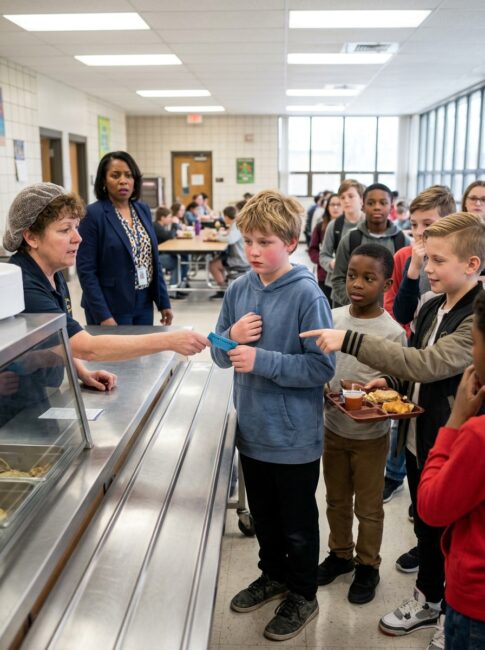
The honors ceremony was held the following Friday morning in the Brookside auditorium.
Parents filled the rows with phones and folded programs. Teachers stood along the walls. Students sat by grade level, whispering until the lights dimmed and the principal walked onto the stage.
Mason Reed sat in the second row with the other students receiving awards.
He wore a white button-down shirt that pulled slightly at the wrists because he had grown since Thanksgiving. His mother, Claire Reed, sat near the back in navy scrubs, hair still damp from a rushed shower between shifts.
She had made it with three minutes to spare.
Mason kept turning to make sure she was still there.
She gave him a small wave each time.
Across the aisle, Tyler Whitman sat with the student council group. He had not spoken to Mason since the lunchroom incident. That alone made people notice something had shifted.
Tyler usually had something to say.
That morning, he stared at his shoes.
Mrs. Carter stepped to the microphone.
“Today is about achievement,” she said, “but it is also about the kind of character that often happens when adults are not watching.”
Mason looked down.
He knew that sentence had something to do with him.
He wished it did not.
The ceremony moved through the usual awards first. Perfect attendance. Science fair. Reading challenge. Math bowl. Applause rose and fell in polite waves.
Then Mrs. Carter announced a new recognition.
“This year,” she said, “we are presenting the Brookside Kindness and Courage Honor.”
Students shifted in their seats.
“This award is not for being perfect,” she continued. “It is for doing something difficult when doing nothing would have been easier.”
Mason’s hands tightened around his program.
Mrs. Carter smiled gently.
“The first recipient is Mason Reed.”
For a second, Mason did not move.
His mother covered her mouth.
A few students clapped. Then more joined.
But near the center section, someone whispered, “Isn’t he the lunch card kid?”
The words carried just far enough.
Mason heard them.
So did Tyler.
Tyler’s face changed.
Mason walked onto the stage slowly.
Mrs. Carter handed him a small plaque, then gestured toward the microphone.
“You do not have to speak,” she whispered.
Mason looked out at the auditorium.
At the teachers.
At the students.
At his mother in the back row, who had come in scrubs because there was no time to change and no money to miss work.
At Isaiah, sitting with the sixth graders, shoulders tense.
At Tyler, who looked like he wanted to disappear.
Mason stepped to the microphone.
The room quieted in that restless way children quiet down when they expect something awkward.
Mason held the plaque with both hands.
“I used to think free lunch meant everybody could see what was missing from your house,” he began.
The auditorium went still.
Claire Reed lowered her hand from her mouth.
Mason swallowed.
“I thought the sticker on my card was bigger than my name.”
A teacher near the wall looked down.
Mason continued, his voice thin but steady.
“When Tyler laughed at me in the cafeteria, I wanted to hate him. It felt easier than being embarrassed.”
Tyler’s head lifted.
Mason did not look away from the audience.
“But I knew something about Tyler that most people didn’t.”
A murmur moved through the students.
Tyler’s face went pale.
Mason took a breath.
“Last winter, after basketball practice, I saw him sitting on the curb behind the gym. His dad was late again. He was pretending to text somebody, but his phone was dead.”
Tyler stared at him.
Mason kept going.
“I sat near him, not too close. He said he wasn’t hungry, but his hands were shaking. So I put my sandwich on the curb between us and said I didn’t want it.”
The auditorium was silent now.
Not school-silent.
Real silent.
“He ate it after I walked away,” Mason said. “I know because I looked back.”
Tyler wiped his face quickly with his sleeve.
Mason’s voice trembled.
“So when he laughed at my free lunch card, I knew he wasn’t only laughing at me. He was trying to make sure nobody looked at him.”
The first twist had landed.
The bully was hungry too.
But Mason was not finished.
He looked toward Isaiah.
“Isaiah’s lunch form got messed up,” he said. “He didn’t want his mom called at work because she already felt bad. I understood that.”
Isaiah’s grandmother, seated in the back, bowed her head.
“I gave him my tray because I remembered the first time I had to use that card. I stood in line thinking everybody could hear the machine say, ‘This kid needs help.’”
He paused.
“But the machine never said that.”
His hands tightened on the plaque.
“People did.”
That sentence moved through the room without making a sound.
Mason looked toward the back row.
“My mom works at a clinic and a grocery store. Sometimes she falls asleep at the kitchen table with her shoes still on. She still writes notes on my lunch bag like we’re not tired.”
Claire began crying openly now.
Mason’s own eyes filled, but he kept speaking.
“She told me once that needing help is not the same as being empty. I didn’t believe her then.”
He looked at the blue card hanging from his pocket.
“Now I think maybe help is something people pass from hand to hand until nobody has to stand alone in line.”
No one moved.
Mrs. Carter had one hand over her heart.
Mason turned toward Tyler.
“I should have told a teacher you needed help too,” he said. “But I was scared you’d hate me more.”
Tyler stood suddenly.
A teacher reached toward him, but he shook his head.
“I’m sorry,” Tyler said.
The words cracked in the middle.
Everyone turned.
Tyler was crying now, but not hiding it well.
“I said it because I was mad you had a card,” he said. “My dad lost his job, but my mom said not to tell anybody. I didn’t know how to ask.”
His mother, seated two rows behind him, pressed both hands to her face.
Mason nodded once.
Not forgiving him loudly.
Not turning it into a performance.
Just letting the apology land.
Then Mrs. Carter stepped to the microphone, but Mason lifted one hand.
He had one more thing to say.
“This award shouldn’t just have my name on it,” he said.
He reached into his pocket and pulled out a folded paper.
Mrs. Carter looked surprised.
Mason unfolded it carefully.
“I wrote down names of kids who shared when nobody clapped for them.”
He read slowly.
“Sophia gave her gloves to a girl on the bus. Malik brought extra granola bars after football practice. Emma walked with me to the office when I was too embarrassed to ask about the lunch form. Isaiah saved half his breakfast for his little brother.”
Isaiah wiped his eyes.
Then Mason looked up.
“And Tyler gave me his hoodie yesterday when I spilled chocolate milk and everyone started laughing.”
A small sound went through the auditorium.
Tyler looked stunned.
Mason gave a faint smile.
“He said it was because he hated the hoodie. But he asked for it back after school.”
For the first time that morning, a gentle laugh moved through the room.
It did not break the emotion.
It made it human.
Mrs. Carter stepped beside Mason.
“Students,” she said softly, “I had planned to announce something today, but Mason has already explained why it matters.”
She turned to the audience.
“Starting Monday, Brookside will change how lunch assistance is handled. No stickers. No separate cards. No visible labels.”
Parents began whispering, but this time the sound felt different.
“All students will scan the same ID,” Mrs. Carter continued. “And we are creating a confidential meal support fund for families whose paperwork is delayed, whose circumstances change, or whose children are too proud to ask.”
Claire Reed looked down at her hands.
Tyler’s mother leaned over and hugged her son so tightly he looked embarrassed and relieved at the same time.
Mason stood beneath the stage lights, holding a plaque he still did not seem to want.
Then, slowly, the audience began to stand.
The teachers first.
Then parents.
Then students.
The applause came late, but it came differently than before.
Not loud for the sake of noise.
Careful.
Ashamed.
Grateful.
Mason looked at his mother.
Claire mouthed, “Stand straight.”
He did.
And for the first time all year, the blue card at his side looked smaller than his name.
After the ceremony, the auditorium emptied slowly.
Children who usually ran toward the doors lingered near the stage. Parents spoke in lower voices. Teachers folded chairs and wiped their eyes when they thought no one was watching.
Mason tried to give the plaque back to Mrs. Carter.
She smiled. “That is not how awards work.”
“I don’t really have a shelf,” he said.
His mother, standing beside him, laughed through tears.
“We’ll make one,” she said.
Mason looked at her scrubs.
There was a small stain near the pocket, probably coffee. Her name badge had flipped backward. Her hair had dried unevenly because she had brushed it in the car.
For years, he had worried people could see their life on her.
That morning, he looked at her and felt something else.
Not pride exactly.
Something quieter.
Something sturdier.
Tyler approached with his mother behind him.
He held Mason’s folded hoodie in both hands.
“I washed it,” Tyler said.
Mason raised an eyebrow. “You washed my hoodie?”
“My mom did.”
Tyler’s mother touched his shoulder.
“I’m sorry, Mason,” she said. “To you and to your mom.”
Claire nodded.
There was no grand forgiveness scene.
No perfect words.
Just four people standing in a school aisle, all of them tired from carrying things in different ways.
Tyler held out a small white envelope.
“What’s that?” Mason asked.
“My lunch money from this week,” Tyler said. “For the fund.”
Mason looked at Mrs. Carter.
She nodded.
“You can put it in the office box on Monday,” she said.
Tyler hesitated.
“Can Mason do it with me?”
Mason shrugged, trying not to smile.
“Yeah,” he said. “But don’t make it weird.”
Tyler gave the first real laugh Mason had ever heard from him.
Outside, the late morning sun covered the school steps in warm light. Students posed for pictures with certificates. Parents opened car doors. Somewhere near the bus loop, a group of sixth graders shared a bag of chips without making a big deal out of it.
Mason and his mother walked toward their old silver sedan.
Claire unlocked the door, then stopped.
“I need to tell you something,” she said.
Mason looked up.
“I was ashamed too,” she admitted. “Not of you. Never of you. But of not being able to make things easier.”
He did not know what to say.
So he leaned against her.
She wrapped one arm around his shoulders, still holding her clinic badge in the other hand.
For a long moment, neither of them moved.
Then Mason reached into his pocket and pulled out the blue lunch card. He turned it over in his fingers, feeling the scratch near the barcode.
“What happens to this now?” he asked.
“I guess you still use it until Monday.”
He nodded.
Then he slipped it back into his pocket.
Not hidden deep this time.
Just put away.
On Monday, the lunch line looked the same at first.
Same trays.
Same noise.
Same smell of pizza and applesauce.
But when Mason reached the cashier, every student scanned the same kind of ID.
No sticker.
No label.
No little white square telling the room who needed help.
Isaiah stood behind him with a tray.
Tyler stood behind Isaiah.
Mason scanned his card.
The machine beeped.
That was all.
No announcement.
No laughter.
Just a beep.
Mason picked up his milk, then paused. He looked at the lunch table near the window, the one where he used to sit with his shoulders rounded inward.
Tyler sat down across from him without asking.
Isaiah joined them.
For a few minutes, nobody said anything important.
They ate.
They traded apple slices for cookies.
They argued about whether the science teacher’s turtle was older than the building.
Near the end of lunch, Mason took the note from his bag.
For after practice. Love, Mom.
He read it, folded it carefully, and placed it back inside.
Then he looked around the cafeteria.
Nobody was staring at his card.
Nobody knew what anybody’s tray cost.
For once, the loudest thing in the room was just kids being kids.
Years later, Mason would forget the exact words printed on his plaque. He would forget where his mother put it after they moved to a better apartment. He would even forget the faces of some classmates who stood and clapped.
But he would remember that first Monday beep.
Small.
Ordinary.
Almost nothing.
And somehow, it sounded like a door opening.
Follow the page for more emotional stories about the quiet moments that change how we see each other.