Part 2: The Girl Mocked for Wearing a Thrift-Store Prom Dress — The Ending Left the Whole School Silent
For three seconds after Lena tore the dress, nobody moved.
The DJ lowered the music without being told. The opening notes of a slow song faded into a thin, awkward hum, like even the speakers were embarrassed to be present.
Lena stood beneath the rented lights with one hand still gripping the torn seam. Her fingers were white at the knuckles. The rip had opened from her hip almost to her knee, but she did not look down at it. She looked across the ballroom at Madison Vale.
Madison’s face had gone red.
“What is wrong with you?” Madison said, but her voice came out smaller than she wanted.
A few students laughed again, though this time the sound was uncertain.
Lena did not answer.
She simply reached into the small beaded purse hanging from her wrist and pulled out a folded paper napkin. It was not from the prom. It was thin and brown, like something taken from a diner.
She pressed it against the torn seam for a moment, almost as if she were trying to hide something beneath the fabric.
That was the first strange detail.
Principal Harris started walking toward her, careful and slow, as if approaching a student standing on the edge of a roof. He had known Lena Carter for four years, mostly as a quiet girl who sat in the back of English class and turned in essays with coffee stains on the corners. She had never been in trouble. She had never raised her voice.
Still, the scene in front of him looked impossible to defend.
“Lena,” he said gently. “Come with me for a moment.”
She looked at him then, and something in her face shifted. Not fear. Not guilt.
Pain.
It passed quickly, but he saw it.
Madison saw it too, and for the first time that night, she stopped performing for the room.
“I didn’t do anything to her,” Madison said, turning toward the students around her. “She’s trying to make me look bad.”
That sentence made the crowd breathe again.
It gave everyone a place to put their discomfort.
Of course. Lena was jealous. Lena wanted attention. Lena had come to prom in a secondhand dress and decided to ruin the night for someone who had everything.
It was an easy story.
People liked easy stories.
A boy from the football team muttered, “She’s always been weird.”
Another girl said, “My mom saw her buying that dress at Second Chance on Maple.”
Someone else added, “Madison donated a bunch of dresses there last month. Maybe she stole one.”
That word moved through the ballroom faster than music.
Stole.
Lena heard it and closed her eyes.
Not long. Just long enough for Principal Harris to notice that she was counting her breaths.
Then Mrs. Delgado, the school secretary, appeared at the edge of the dance floor. She was holding a clipboard, but her eyes were not on the students. They were on Lena’s dress.
More specifically, on the pearl cluster near Lena’s waist.
Mrs. Delgado’s hand rose to her mouth.
“Where did you get that?” she whispered.
The students closest to her turned.
Lena shook her head once, barely.
Mrs. Delgado took one step forward. “Lena, honey, where did you get that dress?”
The question sounded ordinary, but her voice did not.
Lena swallowed.
“Second Chance,” she said.
A few girls snickered again.
But Mrs. Delgado did not laugh. Her face had gone pale.
Madison crossed her arms. “That’s where my mother donated dresses. So?”
Lena’s eyes moved to Madison, then away.
That was the second strange detail.
She would not look at Madison for more than a second.
Principal Harris noticed something else. The brown paper napkin Lena had pulled from her purse had writing on it. He could see only part of it, because Lena kept it folded beneath her thumb.
Three words were visible.
Do not tell.
“Lena,” he said quietly, “what is that?”
She tightened her grip.
“Nothing.”
Madison gave a cold laugh. “She’s making this so dramatic.”
Across the room, Madison’s mother, Evelyn Vale, had just entered from the lobby. She wore a tailored black dress and the expression of a woman used to being recognized before she spoke. Evelyn served on the parent committee. She had paid for the flower wall near the photo booth. Her name was printed at the bottom of the prom program.
She took in the scene quickly: her daughter upset, the poor girl in the damaged dress, the phones, the principal hesitating.
“What is going on here?” Evelyn asked.
Madison hurried to her mother’s side. “She tore her dress in front of everyone and started staring at me like I did something.”
Evelyn looked Lena over once.
It was not a long look, but it was enough to make several students lower their eyes.
“Principal Harris,” Evelyn said, “perhaps this young lady should be taken somewhere private before she causes more disruption.”
Lena’s face hardened.
There it was again, that look people mistook for pride.
But beneath it, her hand was shaking.
Mrs. Delgado stepped closer. “Evelyn,” she said, “did you donate this dress?”
Evelyn frowned. “I donated many dresses.”
“This one,” Mrs. Delgado said.
The room grew quiet again.
Evelyn looked at the blue gown, at the uneven hem, the repaired sleeve, the pearls sewn near the waist.
Something flickered in her eyes.
Recognition.
Then fear.
Only for a heartbeat.
But Lena saw it.
Principal Harris saw it.
Madison did not.
“That dress is old,” Evelyn said. “I don’t remember every item I give away.”
Lena finally spoke, and her voice was so soft that the students leaned in without meaning to.
“You remembered it last Tuesday.”
Evelyn’s face changed.
Madison turned sharply toward her mother. “What does that mean?”
Lena took one step back. She looked suddenly younger than seventeen, standing there in a room full of glittering teenagers who had decided what she was before she said a word.
“I shouldn’t have come,” she whispered.
Principal Harris softened. “Then why did you?”
Lena looked down at the torn seam.
For the first time, everyone followed her gaze.
Inside the torn layer of the thrift-store dress was another fabric, carefully hidden beneath the lining. It was not blue. It was white, yellowed with age, folded flat and stitched into place like someone had been trying to preserve it.
Mrs. Delgado began to cry.
Evelyn Vale whispered, “No.”
And that was when Madison stopped breathing like the night belonged to her.
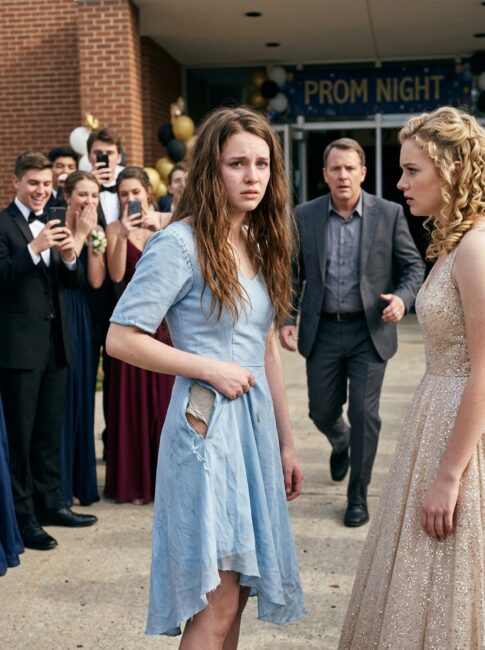
Principal Harris asked everyone to step back.
No one did.
The students had spent the evening waiting for music, slow dances, and photos they could post before midnight. Now they stood frozen in a circle around a girl they had mocked ten minutes earlier, watching a story tear itself open in real time.
Lena looked at Principal Harris. “Please don’t make me explain it here.”
That was the first sentence that made the room feel ashamed.
Because it did not sound like a threat.
It sounded like mercy.
Evelyn Vale moved forward quickly. “There is nothing to explain.”
Mrs. Delgado turned toward her. “Evelyn, I worked in this school when your sister was a senior.”
The words landed hard.
Madison stared at her mother. “Aunt Grace?”
Evelyn did not answer.
Lena closed her eyes again.
Principal Harris knew the name Grace Vale. Everyone who had worked at Briar Glen long enough knew it. Grace had been the beautiful older sister, the one whose picture still sat in a dusty trophy case near the auditorium. Grace had been prom queen in 1998. She had died three months after graduation in a car accident on County Road 12.
The school told that story every few years when warning seniors not to drink and drive.
But nobody told it like this.
Mrs. Delgado pointed gently at the hidden white fabric inside Lena’s torn dress.
“That looks like part of Grace’s prom sash.”
Madison put one hand over her mouth.
Evelyn snapped, “It is not.”
Lena looked at her then, really looked at her, and the whole room felt the force of it.
“It is,” Lena said. “Your mother gave it to mine.”
Evelyn went still.
That was the third strange detail.
Lena had said your mother, not my grandmother, not some woman, not the thrift store.
Madison whispered, “Mom?”
Evelyn’s voice lowered. “Lena, stop.”
And Lena did.
That stunned people more than if she had shouted.
She stopped because Evelyn asked her to. She stopped even though Evelyn had just tried to have her removed. She stopped even though every phone in the room was pointed at her and every cruel word was still hanging above her head.
Principal Harris stepped between them. “Mrs. Vale, I think we need to go to my office.”
“No,” Lena said.
Her voice cracked on that one word.
Everyone looked at her.
She swallowed hard. “Not your office. Not behind another door.”
Evelyn’s eyes filled suddenly, but she turned her face away before tears could fall.
Lena looked at Madison. “I didn’t come here to hurt you.”
Madison’s face was pale now. “Then why are you wearing my aunt’s dress?”
Lena almost laughed, but it broke before becoming sound.
“I’m not.”
She reached for the torn seam again, and Principal Harris stepped forward as if to stop her.
But Lena shook her head.
Carefully, with hands that trembled, she pulled back the blue outer layer. Beneath it, stitched into the lining, were pieces of another garment: a satin sash, a strip of lace, and a small embroidered patch with two initials.
G.V.
Grace Vale.
Mrs. Delgado cried openly now.
Evelyn covered her mouth.
Madison stared at the initials as if they were a door opening into a house she had never been allowed to enter.
“My mother cleaned houses,” Lena said. “Before she got sick, she cleaned for your grandmother.”
No one spoke.
Lena’s voice remained soft, but now it carried across the ballroom because the room wanted every word.
“Your grandmother kept Grace’s things in cedar boxes. Dresses, letters, photos, a pair of white gloves from prom. My mom never touched them except to dust around them.”
Evelyn shook her head, but she did not deny it.
“One winter,” Lena continued, “my mom found your grandmother sitting on the closet floor holding this sash. She had been crying for hours.”
Madison looked at her mother, but Evelyn was staring at the floor.
“Your grandmother told my mom she couldn’t stand that Grace’s things were locked away like she had never lived. She wanted one piece of her daughter to go somewhere young again. Somewhere with music.”
Lena’s mouth trembled.
“So she gave my mom the sash and some lace from Grace’s torn prom dress. She said, ‘Someday, sew this into something for a girl who needs to feel beautiful.’”
The ballroom was so quiet that someone near the chocolate fountain sniffled and everybody heard it.
Madison whispered, “Why would your mom have it?”
Lena pressed the brown napkin against her chest.
“Because your grandmother trusted her.”
Evelyn looked up sharply. “My mother was grieving. She gave away things she didn’t understand.”
Lena flinched.
There it was. The old accusation hiding inside a polite voice.
Principal Harris heard it. Mrs. Delgado heard it. Madison heard it too.
Lena nodded once, as if she had expected that sentence all along.
“My mom tried to return it,” she said. “Three times.”
Evelyn’s jaw tightened.
“She went to your house after your grandmother passed. You wouldn’t open the door.”
Evelyn whispered, “That is not fair.”
“My mom left letters,” Lena said. “You sent them back.”
Madison’s eyes moved slowly to her mother.
The students who had laughed earlier were no longer holding their phones high. Some had lowered them to their sides. A few looked sick.
Lena unfolded the brown napkin.
It was not a napkin. It was a piece of old paper wrapped in napkin layers to protect it. The ink had faded, but Mrs. Delgado recognized the handwriting before anyone else.
Grace’s mother.
Lena handed it to Principal Harris.
He did not read it aloud at first. He looked at Evelyn, asking without words.
Evelyn did not move.
So he read only the part that mattered.
“Let this be worn by a girl who understands what it means to be overlooked. Let Grace dance once more, not as a memory in a box, but as kindness in motion.”
Madison began to cry.
Not loudly. Not beautifully.
She cried like a girl whose whole life had just been rearranged.
Lena looked at her and said, “I didn’t know this dress came from your donation bag until Tuesday.”
That twist hit differently.
Madison’s brows pulled together. “What?”
Lena looked at Evelyn.
Evelyn closed her eyes.
“My mom got worse last year,” Lena said. “Hospital bills took everything. I wasn’t going to come to prom. Then I found this blue dress at Second Chance for twelve dollars.”
A girl in the front row looked down at her own four-hundred-dollar heels.
“When I brought it home, Mom cried,” Lena said. “She recognized the pearls. She said it had been your aunt’s rehearsal dinner dress. Not the prom dress. Something Grace wore the week before she died.”
Evelyn’s breath caught.
“She had sewn the sash pieces into a lining years ago,” Lena said, “but never finished it. Her hands got too weak.”
Madison looked at the dress again, not as something ugly now, but as something carrying hands from two different families.
“My mom begged me not to wear it,” Lena said. “She said people would think we stole from the Vales again.”
Again.
That word opened another door.
Madison turned toward her mother. “Again?”
Evelyn’s face crumpled for the first time.
The whole school watched a wealthy woman lose the armor money had helped her polish.
“When Grace died,” Evelyn whispered, “things went missing from her room.”
Mrs. Delgado said gently, “They were donated by your mother.”
Evelyn shook her head, crying now. “I was nineteen. I was angry. I needed someone to blame.”
Lena looked down.
Her voice dropped so low that the room had to lean toward it.
“My mom carried that blame for twenty-four years.”
Principal Harris removed his glasses.
No one mocked him for wiping his eyes.
Lena continued, “She told me not to correct you. She said grief makes people cruel sometimes, and poor women don’t survive by arguing with rich ones.”
That was the line that changed the room.
Not because it was dramatic.
Because too many adults there knew it was true.
Madison took one step toward Lena. “Why tear it?”
Lena looked at the rip she had made herself.
“Because your mom told me in the hallway that if I cared about dignity, I would leave before people noticed what I was wearing.”
Evelyn sobbed once, a small broken sound.
Lena’s eyes filled, but she kept going.
“She said my mother had already taken enough from her family.”
The words emptied the ballroom.
Evelyn reached for Madison, but Madison moved away.
Lena held up the old letter. “I came here to give this back. Not to wear it like a trophy. Not to shame anyone.”
She looked at the torn seam.
“But when Madison laughed, and everyone started filming, I realized nobody would believe me unless they saw what was underneath.”
She folded the blue fabric back over the hidden sash with heartbreaking care.
“My mom died this morning,” Lena said.
A sound passed through the room, not a gasp exactly, but something lower.
“She died at 6:12. I wasn’t going to come. Then I found this note on her nightstand.”
Lena unfolded a second piece of paper from her purse.
This one was newer. The handwriting was shaky.
She did not hand it to anyone.
She read it herself.
“Go dance once for me. And if they look down at your dress, let them. Some people only learn to look closer after they are ashamed.”
Madison covered her face.
Lena finally cried then, but only a little, as if she did not have the strength for more.
“I didn’t come because I wanted attention,” she said. “I came because my mother spent her life being invisible in other people’s houses. Tonight she asked me not to be.”
For a long moment, nobody moved.
Then Madison Vale stepped out of her champagne heels.
Everyone watched.
She walked barefoot across the dance floor until she stood in front of Lena. Her mascara had run. Her perfect curls were coming loose.
“I’m sorry,” Madison said.
Lena did not answer.
Madison looked down at the torn blue dress, at the crooked stitches, at the old satin hidden inside it.
Then she took the glittering prom queen sash from the table beside the stage, the one waiting for the announcement later that night.
She held it in both hands.
For one terrible second, people thought she was going to offer it to Lena, and that would have ruined everything, because pity can feel like another kind of insult.
But Madison did not.
She folded it gently and placed it on an empty chair.
Then she said to the DJ, “Play something slow.”
The DJ stared at her.
Madison turned toward the room, her voice trembling. “Please.”
The music began.
No one danced.
Not at first.
Then Mrs. Delgado stepped forward, took Lena’s hand, and led her slowly to the center of the floor.
Principal Harris joined them. Then a boy from Lena’s chemistry class. Then two girls who had laughed near the photo wall and were now crying too hard to speak.
Madison stood at the edge of the circle, unable to forgive herself quickly enough.
Lena closed her eyes.
And for the first time that night, the smile on her face did not look like defiance.
It looked like a daughter keeping a promise.
By ten-thirty, nobody cared who became prom queen.
The crown remained on the table under the stage lights, throwing tiny reflections across the folded sash beside it. The photographer stopped arranging couples by height and started taking pictures quietly from the corners, capturing things that would not look glamorous online but would matter later.
Madison sitting alone with her mother in the hallway.
Principal Harris holding Grace Vale’s old letter with both hands.
Mrs. Delgado sewing the torn seam of Lena’s dress with a tiny emergency kit she kept in her purse.
Lena did not ask anyone to apologize.
That somehow made the apologies hurt more.
Students came to her one by one, not in a dramatic line, not with speeches, but with small sentences they could barely get out.
“I shouldn’t have laughed.”
“I’m sorry I filmed.”
“I deleted it.”
“I didn’t know.”
Lena answered most of them with a nod.
To the last one, she finally said, “That’s usually the problem.”
No one knew what to say after that.
Near the coatroom, Evelyn Vale stood with her arms wrapped around herself. She looked smaller than she had when she entered. Wealth had not left her, but certainty had. That was different.
She approached Lena just before the final song.
Madison followed a few steps behind, as if she wanted to be there but did not want to protect her mother from the consequences.
Evelyn held something in her hands.
A small velvet box.
“I found this in my car,” Evelyn said. “I brought it tonight for the memorial display. We were going to place it beside Grace’s photo.”
She opened the box.
Inside was a pearl hair comb, old and delicate, with one missing stone.
Lena stared at it.
“My mother wore that in her wedding picture,” she whispered.
Evelyn nodded, crying quietly. “My mother gave it to her too, didn’t she?”
Lena did not answer right away.
Then she said, “Yes.”
Evelyn held out the box.
“I think I have been holding on to things that were never only mine.”
That sentence did not fix twenty-four years.
It did not bring back Lena’s mother.
It did not erase the laughter, the phones, or the way poverty had been treated like a costume everyone was allowed to mock.
But Lena took the box.
Not because Evelyn deserved forgiveness in that moment.
Because the comb had belonged to women who had known how to give beauty away.
Mrs. Delgado helped place it in Lena’s hair.
One pearl was missing. Nobody tried to hide that.
Under the lights, the absence looked almost intentional.
The last song began as a soft piano piece nobody had requested. The DJ later swore he did not remember choosing it. Maybe it had been queued by accident. Maybe the night had simply grown tired of noise.
Lena danced alone at first.
Not because nobody asked her.
Because for one minute, everyone understood that she was not alone.
Her mother was in the crooked stitches. Grace Vale was in the hidden satin. An old grieving grandmother was in the letter. Mrs. Delgado was in the repaired seam. Even Madison, standing barefoot at the edge of the floor, was in the silence that finally knew how to be respectful.
Then Madison stepped forward.
She did not ask for attention.
She simply held out her hand.
Lena looked at it for a long time.
The whole school seemed to hold its breath.
Finally, Lena took it.
They did not dance like friends. Not yet. Maybe not ever.
They danced like two girls standing in the wreckage of what adults had left behind, trying carefully not to step on the pieces.
When the song ended, nobody clapped.
That was the most respectful thing they could have done.
Lena walked out before the prom court announcement. Principal Harris offered to drive her home, but she shook her head and said she wanted to walk to the corner first.
Outside, the spring air was cool.
The school’s golden lights spilled across the sidewalk. Behind the glass doors, the students remained quiet, as if loudness would break whatever had been repaired.
Lena stopped beneath the old oak tree near the parking lot.
She removed the pearl comb from her hair, held it against her chest, and looked up at the sky.
Madison watched from the doorway but did not follow.
Evelyn stood behind her daughter, one hand near Madison’s shoulder, not touching, waiting for permission.
At the curb, Lena’s blue dress moved gently in the wind. The torn seam had been mended, but the thread was visible if anyone looked closely.
This time, people did.
The next Monday, a photo appeared in the school hallway. Not on the trophy wall. Not beside the prom court.
It was placed near the front entrance, where everyone had to pass.
In the picture, Lena Carter stood in a thrift-store dress with one missing pearl in her hair, eyes closed, one hand over her heart.
Beneath it, Principal Harris had written only seven words.
“She asked us to look closer.”
And every morning after that, students did.
Follow this page for more emotional stories that stay with you long after the last line.