Colonel Travis Keene Knocked a Tray From an Older Woman’s Hands—Then Her Raincoat Opened and Three Silver Stars Changed the Cafeteria
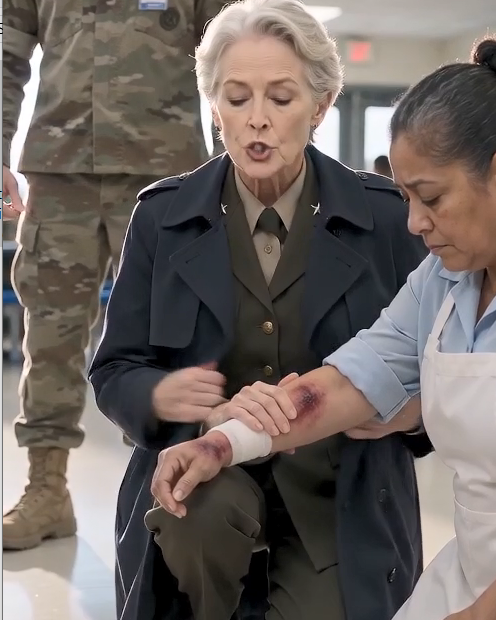
Colonel Travis Keene knocked the lunch tray out of the older woman’s hands before I could reach her. The blue plastic struck the tile on one corner, bounced, and sent chicken, green beans, and a paper cup skidding across the officers’ side of Ridgeway Dining Facility. The woman did not step back. She tightened her left arm around Linda Alvarez, whose injured wrist was already swelling above the cuff of her cafeteria uniform, and kept her from falling.
I had been halfway out of my chair when Keene entered the serving lane. By then I had learned that moving too quickly around him could look like defiance, and defiance had a way of becoming a sentence in an evaluation. I was First Lieutenant Emily Ross, twenty-nine years old, four years into an Army career I still wanted, serving as logistics plans officer for the Fort Bellwether Support Group. Keene had been my commander for nine months. That was long enough for everyone in the room to understand why forty conversations stopped without anyone being told.
“Staff use the service aisle,” Keene said.
Linda’s face had gone the color of wet paper. A loaded tray rack had jammed beside the steam table, and when she pulled the handle, the top rail buckled. I had seen the stack shift and heard her cry out. The older woman in the charcoal raincoat had been closer. She had caught Linda under the elbow, moved the fallen trays away with her shoe, and told someone to call the clinic in the calm, exact voice of a person used to being obeyed.
Keene saw only the temporary visitor badge clipped crookedly to her coat.
“She needs to sit down,” the woman said.
Her voice was low, neither timid nor challenging. She appeared to be in her early sixties, with short silver hair swept away from an angular face. Rain darkened the shoulders of her coat. A thin scar ran from the base of her left thumb into the sleeve, and an old brass watch circled her wrist. Nothing about her invited pity. Nothing, to my eye, explained why she seemed to be studying the cafeteria while holding an injured stranger upright.
Keene glanced at the food on the floor. “Then sit her in the employee break room. Visitors don’t direct my soldiers or interfere with operations.”
“A damaged rack injured her,” the woman replied. “The area should be closed until it is secured.”
That was when he struck the tray. Not a wild blow. Just a quick, contemptuous slap against its edge, the kind of motion a person makes when clearing something that should not be in his way.
“Clean it up before you start giving orders.”
Linda whispered, “Please, ma’am. Let me handle it.”
The woman looked at her wrist. “You are not lifting anything.”
I stepped forward. “Sir, I called the clinic. They’re sending—”
Keene turned his head. His expression barely changed. “Lieutenant Ross, if you have enough free time to supervise lunch traffic, you have enough time for night inventory through the end of the month.”
Behind him, Captain Monroe lowered his eyes to his plate. Two civilian employees near the drink machines moved closer together but said nothing. I felt the familiar heat rise behind my ears. My previous evaluation was still unsigned. Keene had reminded me of that twice since I reported the bent rack and two other safety problems in the dining facility.
The woman eased Linda into a chair. As she bent, her raincoat opened for an instant. Beneath it I saw dark green fabric, the edge of a service-uniform jacket, and a flash of silver near the shoulder. Then the coat fell closed again.
Keene had already turned away.
The woman took out her phone. She photographed the spilled tray, the twisted rack, and Linda’s wrist. Then she pressed the screen once and held the phone low beside her coat.
Keene heard the soft vibration and smiled without humor. “Calling someone to rescue you?”
She looked at the phone, then at him.
“No,” she said. “I’m telling them they can come in now.”
Part 2
Keene’s power rarely looked dramatic. It lived in unsigned evaluations, altered duty rosters, canceled schools, and the quiet phrase we can revisit your future here. He never threatened anyone loudly enough to sound unstable. He made consequences appear administrative, almost accidental, which meant every person affected wondered whether speaking about them would make matters worse.
I knew because I had tried.
Three months earlier, I had submitted a maintenance packet showing that Ridgeway’s tray rack, two warming cabinets, and a leaking floor drain had passed their replacement dates. The packet disappeared from the tracking system. When I resubmitted it, Keene called me into his office and asked whether I wanted to be known as a logistics officer or “the lieutenant who panicked over cafeteria furniture.” A week later, my slot at an advanced planning course went to Captain Monroe.
No order ever said the course was punishment. That was the point. Keene praised Monroe for being “mission focused,” moved a sergeant who supported my report to weekend duty, and began inviting me to meetings only after decisions had been made. Each act looked small on paper. Together they taught the staff to anticipate his preferences before he voiced them. By lunchtime, most of us had learned that the safest answer was the one he did not have to request.
Linda had apologized to me afterward, although none of it was her fault. She had been documenting equipment failures in a small black notebook, writing dates and work-order numbers in careful block letters. Civilian staff trusted her because she never asked them to take a risk she would not take herself.
Now, with her wrist cradled against her apron, she tried to stand.
“Stay seated,” the visitor said. She turned to me. “Lieutenant, has the rack been reported?”
The directness of the question startled me. “Yes, ma’am. More than once.”
“Work-order numbers?”
“I have copies.”
Keene heard that. “Lieutenant Ross, that conversation is over.”
The woman’s gaze moved to his name tape, then to the unit patch on his shoulder. She did not stare. She seemed to confirm details already known to her. When Sergeant First Class Tate approached with a first-aid kit, she told him to support Linda’s forearm above and below the joint and not attempt to straighten it. Tate obeyed before remembering that the instruction had come from someone he believed was a civilian.
Marcus Bell, Ridgeway’s oldest cook, emerged from the kitchen wiping his hands on a towel. He had served twenty-six years before taking the civilian job. He looked at the woman, stopped, and gripped the towel tighter.
“Ma’am?” he said.
She gave him the smallest shake of her head.
Keene missed it. I did not.
The clinic team arrived and placed Linda’s wrist in a temporary splint. When they asked who had stabilized her, the woman simply pointed to Tate. She collected nothing from the floor except a small brass envelope that had slipped from inside her coat. On its front was a handwritten name: ALVAREZ, TOMAS J.
Linda saw it and pressed her good hand against her mouth.
“You brought it,” she said.
The woman nodded. “I said I would.”
Keene took one impatient step toward them. “Whatever reunion this is, it can happen outside my facility.”
The woman slipped the envelope back into her coat. For the first time, I noticed that her visitor badge was not printed with an ordinary destination. Beneath the blurred temporary number were three typed words: COMMAND CLIMATE REVIEW.
She had not wandered into Ridgeway.
She had come looking for it.
Part 3
The clinic team wanted to transport Linda, but she refused to leave until Marcus retrieved her black notebook from the office. Keene told him to stay at his station. Marcus looked at the floor, at Linda, and then at the woman in the raincoat.
He went for the notebook.
It was the first direct order I had seen anyone disregard in nine months.
Linda had worked at Ridgeway for seventeen years, long enough to remember commanders who ate beside dishwashers and asked civilian cooks what was failing before they read readiness slides. She knew every young employee’s child, every soldier with a food allergy, and which new arrivals were too embarrassed to admit their meal accounts had not activated. That history gave her no formal rank, but it explained why Marcus chose her notebook over Keene’s threat.
Keene’s face tightened. “Mr. Bell, you can turn in your access card before you leave today.”
“Then I’ll leave after I get what belongs to her,” Marcus said.
The older woman watched him disappear through the swinging kitchen door. Her composure had not changed, but her thumb moved across the face of the brass watch, tracing a scratch along the crystal. Linda noticed.
“Tom broke that the same day,” she said.
The woman looked down. “It stopped at 14:17.”
I did not understand what they meant. Keene did, or pretended to. “This is a dining facility, not a veterans’ club.”
Linda’s expression hardened despite the pain. “My husband was still serving when he died.”
The woman crouched beside her. “You don’t owe him an explanation.”
Marcus returned with the notebook and a thick bundle of photocopied work orders held together by a rubber band. He placed both in Linda’s lap. Dates covered almost a year. Beside several numbers she had written short descriptions: rack shifted again; employee cut; cabinet overheated; reported to command. Some entries carried initials I recognized from Keene’s operations staff.
Keene extended his hand. “Give those to me.”
Linda held them closer. “They’re my copies.”
He could have stopped then. He could have called the clinic, secured the equipment, apologized for losing his temper, and allowed the complaint process to work. Instead, he reached for the bundle.
The woman rose between them.
“Colonel, don’t touch her records.”
He gave a short laugh. “You have no standing here.”
“That is an assumption.”
Her raincoat shifted again. This time I saw a row of service ribbons beneath the lapel and the lower edge of a black nameplate. Keene saw only that she had blocked him. He ordered Tate to escort her out.
Tate did not move.
“Sergeant?” Keene said.
Tate swallowed. “Sir, the medic asked us not to move Mrs. Alvarez until transport is ready.”
“I told you to move the visitor.”
Before Tate had to choose, the woman’s phone vibrated twice. She checked it. No expression crossed her face, but she slipped the device into her pocket and unbuttoned the top of her raincoat as if preparing to leave.
At the rear of the cafeteria, the double doors remained shut. Through their narrow windows I could see three figures waiting in the corridor: one in a dark service uniform, one carrying a folder, and Command Sergeant Major Brooks, whom every soldier on Fort Bellwether recognized.
They were not waiting for permission from Keene.
They were waiting for permission from her.
Part 4
Keene followed my gaze toward the doors, but a delivery cart rolled past the windows and briefly hid the figures. When it cleared, the corridor appeared empty. He decided, visibly, that he had imagined nothing worth considering.
“This spectacle ends now,” he said. “Ross, take Mrs. Alvarez to the clinic. Tate, escort the visitor to the security desk. Mr. Bell, my office at thirteen hundred.”
For a few seconds, his authority reassembled itself around us. Captain Monroe stood. Tate shifted his weight. Linda looked at me with the exhausted apology of someone who believed other people were being punished for helping her. Keene straightened his blouse and surveyed the room as if order had been restored.
I bent to gather the work orders from Linda’s lap.
“Leave them,” Keene said.
My hand stopped over the bundle. My course slot, my evaluation, and every promotion board I hoped to face seemed to occupy the distance between my fingers and those pages. Then I remembered his palm striking the tray, not in anger but in certainty. He believed no one in the room would make him answer for it.
I picked up the bundle.
“These accompany the patient,” I said.
Keene stepped closer. “That is a direct order, Lieutenant.”
“It is also evidence of an unresolved safety hazard, sir.”
My voice sounded steadier than I felt.
He told Captain Monroe to take the documents. Monroe moved toward me, but Marcus placed Linda’s black notebook on top of the stack. “Make sure you take all of it,” he said. From beneath the notebook, he pulled a small memory card sealed in a plastic food-service glove.
Keene stared at it. “What is that?”
“Camera backup,” Marcus answered. “Main system overwrites every thirty days. I started saving the clips after the second rack failure.”
That was the first crack in Keene’s false victory. He demanded the card on the grounds that cafeteria footage belonged to the command. Marcus replied that a duplicate had already been provided to the safety office. I knew from Keene’s expression that no duplicate had reached him.
The woman in the raincoat looked at Marcus. “How many incidents?”
“Eleven equipment failures. Four injuries. And six times the colonel came in afterward.”
“Six?” I asked.
Marcus nodded. “He told us injuries affected readiness numbers. Said we should handle minor things ourselves.”
Keene’s voice sharpened. “You are mischaracterizing routine guidance.”
The woman removed her visitor badge and placed it on the table beside the spilled cup. Beneath the temporary card hung a slim government credential wallet, still closed. Then she opened her raincoat another inch.
Marcus came to attention.
No one else moved yet. We could see the dark green service jacket now, the ribbons, and the unmistakable shape of stars partly covered by the coat. Keene’s face lost some color, but disbelief protected him for another moment.
“Costume jewelry doesn’t establish authority,” he said.
The rear doors opened.
Brigadier General Leonard Harland entered first, followed by Command Sergeant Major Imani Brooks and Inspector General Colonel Priya Desai carrying a thick gray folder. Harland saw the woman and stopped in formal reporting posture.
“General Shaw,” he said. “The review team is assembled.”
The name traveled through the room more quickly than a shouted command.
Keene looked down at the three silver stars now fully visible on her shoulder. Then he looked at the closed credential wallet beside the cup, as if hoping it might still belong to someone else.
Colonel Desai set the gray folder on the table and turned its cover toward him.
Clipped to the front was the memorandum that had placed Travis Keene in command—with Evelyn Shaw’s signature at the bottom.
Part 5
No one saluted. We were indoors, and General Shaw had not called the room to attention. Still, posture changed everywhere at once. Chairs moved back. Backs straightened. The same soldiers who had tried not to see the food on the floor now understood that the woman beside it was Lieutenant General Evelyn Shaw, commanding general of the Atlantic Readiness Command and chair of the leadership panel that had recommended Keene for his current position.
Keene’s mouth opened, but General Shaw raised one hand.
“Linda goes to the clinic first.”
That was all. The room moved again.
The medics moved Linda to a wheelchair. I followed with the notebook. At the doorway Linda looked back at General Shaw.
“The envelope,” she said.
Shaw touched the inside of her coat. “I’ll bring it.”
Brigadier General Harland asked Keene to accompany the review team to the conference room. Shaw declined to leave Ridgeway yet. She asked Colonel Desai to secure the camera card, photograph the rack, and identify every witness present. Her voice remained even. She did not mention the tray or demand an apology.
Keene tried to recover through procedure. “General, I was not informed of an official visit. This individual entered a controlled area with a temporary badge and interfered with civilian operations.”
“Mrs. Alvarez was injured,” Shaw said.
“I had not established the facts.”
“You established her status before you established her injury.”
He looked at the stars on her shoulder. “Ma’am, had I recognized—”
“That sentence is the problem, Colonel.”
She said it quietly. No one in the cafeteria needed the rest explained.
Desai opened the gray folder. It contained more than the memorandum on its cover. There were civilian injury reports, canceled maintenance requests, copies of altered duty schedules, and statements from junior officers whose schools or assignments had changed after they questioned Keene. My own name appeared on a tab halfway down.
I had believed the complaint I submitted six weeks earlier had disappeared. It had joined nine others.
General Shaw’s presence at Ridgeway was not an accident or a social visit interrupted by bad behavior. She had requested an unannounced command-climate review after the inspector general found repeating language across complaints from soldiers and civilian staff. The temporary visitor badge was deliberate. She wanted to enter without an entourage and observe ordinary operations before the formal team appeared.
Keene had not created the investigation by knocking down the tray. He had demonstrated its central allegation in front of forty witnesses.
But the envelope inside Shaw’s coat still had nothing to do with the review.
At the clinic, while a technician prepared Linda for X-rays, General Shaw joined us and finally opened it. Inside lay a worn field watch with a cracked crystal and a faded photograph of three soldiers beside an armored vehicle. A younger Evelyn Shaw stood in the center. Staff Sergeant Tomas Alvarez stood to her right, grinning beneath a dust-covered helmet.
“They finished the restoration last week,” Shaw told Linda. “The museum wanted to replace the crystal. I told them not to.”
Linda turned the watch over. The hands remained fixed at 14:17.
In 2008, Shaw had been a battalion commander traveling in a convoy when an explosive struck the lead vehicle. The blast trapped her and ignited leaking fuel. Tomas Alvarez went back through fire after two other soldiers had been pulled clear. He freed Shaw, carried her behind a barrier, and returned once more because he heard someone calling from the vehicle. The second explosion killed him. The watch stopped at the recorded time of his death.
Shaw had recommended him for a posthumous award and stayed in contact with Linda for years. Linda had never asked her to intervene at Ridgeway. Instead, she had sent the inspector general copies of the unsafe work orders because two younger employees were afraid they would lose their jobs.
“You came because of Tom?” I asked.
Shaw shook her head. “I brought the watch because of Tom. I came because Linda was doing what he did—going back for people who believed they had no safe way out.”
Colonel Desai appeared at the clinic door with Marcus’s memory card sealed in an evidence pouch.
“General,” she said, “the cafeteria footage is only the beginning. We recovered the deleted evaluation drafts.”
Through the open doorway, I saw Keene waiting between two members of the review team.
He was no longer looking at Shaw’s rank.
He was looking at the folder containing all the people he thought had remained silent.
Part 6
The first formal interview took place that afternoon. Colonel Desai conducted it in a conference room while Brigadier General Harland served as the command representative. General Shaw listened from the end of the table but did not lead the questioning. She had witnessed the cafeteria incident, and Desai was careful to preserve the independence of the review.
Keene described the tray strike as accidental contact during a congested service period. The security footage showed an open lane, his hand changing direction, and the tray leaving Shaw’s hands a fraction of a second later. He said he had reassigned me to night inventory because of operational need. Desai placed two versions of my evaluation beside each other. The earlier draft rated me highly; the later one, saved three hours after my safety report, questioned my judgment and loyalty.
“Routine leader assessment,” Keene said.
I was called in after him. My hands trembled under the table, so I placed them flat where everyone could see them. Desai asked only what I had personally observed. I described the rack, the missing work orders, the course cancellation, and the cafeteria threat. When she asked whether Keene had ever instructed me to hide an injury, I told her about a cook who burned his forearm on a defective warming cabinet and was ordered to finish the shift before visiting the clinic.
Captain Monroe entered next. Keene had counted on his loyalty. Monroe confirmed the order and produced a saved message directing him to describe the burn as an “off-duty kitchen event.”
That was the evidence Keene could not explain away.
The final revelation did not come from a general or an officer. It came from Linda.
Her wrist was fractured, but she returned in a sling long enough to give a statement. She brought the black notebook and asked Marcus and the younger cafeteria employees to sit beside her. Then she explained why the record began eleven months earlier.
A nineteen-year-old food-service worker named Noah Price had been injured when a warming cabinet door detached. Keene’s staff persuaded him not to file a report, warning that his probationary employment could be reviewed. Linda found him crying in the loading area and drove him to urgent care herself. Tomas’s last letter to her had contained one request: if she ever saw someone frightened and alone, she should stand where they could see her.
Linda began the notebook that night.
General Shaw lowered her eyes when Linda repeated the line. It was the same promise Tomas had lived in the final minutes of his life, and Linda had carried it into an ordinary cafeteria where courage looked like dates, work-order numbers, and copies hidden from deletion.
Desai closed the interview at 18:40. Keene was temporarily relieved of command pending a broader investigation. His access to evaluation systems and personnel actions was suspended. Harland emphasized that these were administrative measures, not a predetermined finding. There would be counsel, review, and due process.
As Keene stood to leave, he looked toward Shaw. “Ma’am, I know how this appears.”
She did not answer for him.
Linda did.
“It appears exactly the way you taught us it would,” she said. “You thought our jobs belonged to you.”
Keene looked around the table at the lieutenant, captain, cook, cafeteria worker, inspector, and general whose separate fragments had become one account.
For months, each of us had believed we were alone.
The investigation file showed that isolation had been his most effective tool—and that it had just stopped working.
Part 7
The review lasted eleven weeks. Keene was formally removed from command after investigators substantiated retaliation, interference with safety reporting, misuse of personnel actions, and false statements during the inquiry. Other allegations were referred for separate review. The final report did not use dramatic language. It listed dates, decisions, witnesses, and consequences. That plainness made it harder to dismiss.
Brigadier General Harland signed my corrected evaluation. I received the planning-course slot the following spring, but the change that mattered first was smaller: junior officers no longer had to route safety concerns through a single commander. Civilian employees gained direct reporting access to the installation safety office, and maintenance requests could not be deleted without a visible audit trail.
Ridgeway closed for six days. The bent rack was replaced, the floor drain repaired, and every warming cabinet inspected. Marcus kept his job. Noah Price returned after Linda called him and told him what the investigation had found. He did not come back to the cafeteria, but he accepted an apprenticeship with the facilities team and testified during the review.
General Shaw gave no interview about the incident. When the installation newspaper asked for a statement, she directed the reporter to the safety reforms and refused to let the story become a celebration of her rank. Privately, she admitted that she had replayed the tray striking the floor more often than she expected. It was not the insult that troubled her. It was the speed with which everyone else had looked down. “A room learns fear one ordinary moment at a time,” she told me. “It has to learn something different the same way.”
For the first week, officers entering Ridgeway seemed unsure where to sit. Marcus removed the unofficial section markers, and no one asked him to replace them.
Linda’s wrist healed slowly. On her first morning back, I found her standing beside the new rack, testing each wheel with her shoe. General Shaw arrived without cameras or an entourage. This time she wore civilian clothes and carried two coffees.
Linda held the restored watch beneath the light. “It still doesn’t run.”
“It wasn’t supposed to,” Shaw said.
“Tom hated broken things.”
“He also hated people pretending a scar wasn’t part of the story.”
Linda smiled, then fastened the watch around her left wrist. Its hands remained at 14:17, but the repaired band fit.
We ate at the same table where the tray had fallen. No reserved signs, no officers’ section, no careful separation between uniforms and aprons. Shaw asked Marcus about his retirement plans. Linda teased me about organizing my napkins by size. Nothing in the conversation sounded historic, which may have been why I remembered it.
Before leaving, Shaw carried her tray to the return station. Linda reached for it automatically, then stopped. Her healing hand hovered between them.
Shaw did not surrender the tray, and Linda did not insist. They walked the last few steps together, one holding each side, keeping it level above the clean tile.
The old watch rested between them, silent beneath Linda’s sleeve.