The Night the Landlord Threw Her Out, a Biker’s Headlight Cut Through the Dark
“Don’t touch the truck,” the biker said, while a little girl in pink socks stood barefoot beside a pile of trash bags on a freezing Ohio sidewalk, and every window on the block lit up at once.
It was 11:47 p.m. on a Thursday in late November, on a narrow street off East Main in Columbus, where the duplexes leaned close together and every porch seemed to hold a memory nobody wanted. The air had that raw, metallic cold that made your lungs tighten. A cheap plastic nativity scene rattled in the wind across the street. Somewhere far off, a siren moaned and faded.
Lena Morales stood at the curb with one hand around her daughter’s shoulder and the other gripping the handle of a cracked suitcase that no longer zipped. She was thirty-two, exhausted, and trying not to cry in front of her child. The child, Ava, was six and half-asleep, wrapped in a yellow blanket printed with faded cartoon stars. Her coat was too thin. Her hair was tangled from being woken too fast.
At Lena’s feet were three black trash bags, one laundry basket, a dented slow cooker, and a cardboard box labeled WINTER CLOTHES in blue marker. The box was already softening from the damp.
On the porch behind them stood Randall Keene, the landlord, broad in the stomach, gray sweatshirt hanging over pajama pants, holding a ring of keys like a weapon. He had already changed the deadbolt. Lena had heard it click.
“You were late again,” he said loudly, not just to her but to the neighborhood. “I gave you chances.”
“It’s forty degrees,” Lena said. Her voice sounded thin even to herself. “My daughter is sick.”
“That’s not my problem anymore.”
A porch light snapped on next door. Then another. Curtains shifted. Someone opened a second-floor window two houses down.
And then the motorcycle had come.
The sound arrived first—a low, steady growl, not revving, not dramatic, just controlled. A black touring bike rolled to the curb through the spill of yellow streetlight and stopped a few feet from Lena’s scattered things. The rider killed the engine, and silence rushed back in hard.
He was big. That was the first thing everyone noticed.
Broad shoulders under a dark leather vest. Heavy boots. Thick beard silvered at the chin. Gloves. A faded patch on the vest that was hard to read in the dark. He swung off the bike without hurry, like a man who knew exactly how much space he took up and had stopped apologizing for it years ago.
The second thing people noticed was where he looked.
Not at the landlord. Not at the mother.
At the little girl.
Ava had drifted one step toward the motorcycle because children always moved toward light, warmth, noise—anything that broke fear for a second. The biker took two long strides and blocked her with his body before she could reach the chrome exhaust still ticking with heat.
“Don’t touch the truck,” he said.
Truck. Not bike.
The word sounded old. Wrong. Strange enough that two people watching from their porches exchanged a look.
Lena pulled Ava back instinctively. “Hey.”
The biker stopped. Lifted both hands a little. Not surrendering. Just showing them empty.
A porch door banged open across the street, and Mrs. Delaney, who never missed a reason to involve herself, came out in slippers and a housecoat with her phone already up. “I’m calling the police,” she announced. “That man has no business around that child.”
Randall straightened on the porch, suddenly bold now that another target had appeared. “Exactly.”
The biker didn’t answer.
His headlight was still on, washing Lena’s things in harsh white. The beam caught the edge of a framed photo half-hidden in one of the open boxes. It caught Ava’s small ankles, pink with cold. It caught Lena’s face, drawn and pale and ashamed.
For one awful moment, it looked less like help and more like a trap.
“What do you want?” Lena asked.
The man looked at her, really looked at her, and something in his expression changed—just a flicker, then gone.
“You can’t stay on this curb,” he said.
His voice was low and rough, almost too calm for the scene around him.
Randall barked a laugh. “Hear that? Even he knows it.”
Lena felt heat rise into her face. Humiliation could feel hotter than anger. “I didn’t ask him.”
“No,” the biker said. “You didn’t.”
He stepped toward the pile of bags.
Randall pointed from the porch. “Don’t you touch anything on my property.”
The biker stopped at the edge of the walkway. Looked up. “Curb’s not yours.”
That was all.
But the way he said it—flat, without volume, without performance—did something worse than shouting. It made Randall step back half an inch.
Ava coughed. A bad one. The kind that started in the chest and bent her small body forward. Lena crouched fast, rubbing her back through the blanket.
When she looked up again, the biker had already bent down and lifted the soaked cardboard box of winter clothes as if it weighed nothing.
“Put that down!” Mrs. Delaney shouted from across the street. “She doesn’t know you!”
“No,” Lena said sharply, standing. “Put it down.”
The biker held the box, waiting.
His headlight cut through the dark. People were watching from every house now. Phones were out. A man from the corner property had started down the sidewalk in work boots and a Steelers hoodie, drawn by the shape of trouble.
And in the middle of all that cold and judgment and white light, Lena realized the worst part:
She had no idea whether the most dangerous person on that street was the man who’d thrown her daughter out into the night—
or the man who had just arrived.
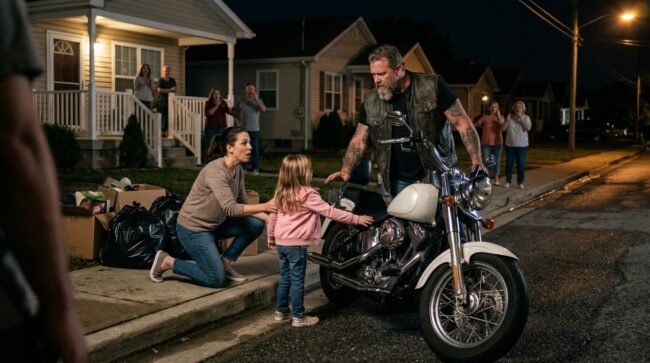
By 11:52 p.m., the block felt like a stage and Lena hated being at the center of it.
Mrs. Delaney was narrating into her phone as if she were streaming a crime. “Single mother evicted, suspicious biker interfering, child present—yes, child present.”
“Interfering?” Randall snapped. “He’s trespassing.”
The man in the Steelers hoodie came closer, planting himself near Lena’s things with the righteous eagerness of someone who never missed a chance to become useful in public. “Ma’am,” he said to Lena without taking his eyes off the biker, “you want me to stay here?”
“I don’t know what I want,” Lena said.
That was the truth, and she hated how weak it sounded.
Ava was shivering harder now. Lena knelt to pull the blanket tighter around her shoulders, but the little girl’s eyes stayed on the motorcycle. On the light. On the huge man beside it.
“Mom,” Ava whispered, “is he bad?”
Lena swallowed. “Stay next to me.”
The biker set the box down carefully on the strip of grass between curb and sidewalk, away from the wet gutter. Then he moved the suitcase beside it. No sudden motions. No swagger. Still, every movement made people tense harder, because he didn’t move like a confused stranger. He moved like someone used to making decisions in ugly moments.
That made him seem more dangerous.
Randall came down two porch steps, keys jangling in one hand. “I said leave the property.”
The biker’s eyes slid to him. “You put a kid out in November.”
“I enforced a lease.”
“You did it at midnight.”
“None of your business.”
“No,” the biker said again. “It is now.”
Mrs. Delaney gasped like she’d been handed a script cue. “Did you hear that?”
The Steelers man stepped forward. “Buddy, back off.”
The biker ignored him. He crouched beside the laundry basket and picked up a plastic pill bottle that had rolled loose under the frame. He read the label, then held it toward Lena.
She stiffened before taking it. It was Ava’s antibiotic.
For one second, embarrassment punched through everything else. She hadn’t even realized it was missing.
“Thanks,” she muttered.
He gave one nod. Nothing more.
Ava coughed again. Worse this time. Lena pressed her palm to the child’s forehead and felt the heat there.
“Does she have a fever?” the biker asked.
Mrs. Delaney threw up a hand. “Don’t answer him!”
Lena almost said something sharp back, but the cold and exhaustion were scraping her raw. “Yes.”
“How high?”
“I don’t know exactly.”
“When did it start?”
“What is this?” Randall snapped. “An interview?”
The biker stood, slow and deliberate. “When did it start?”
“Late afternoon,” Lena said before she could stop herself. “Urgent care said it was pneumonia starting, not full yet. We got meds. I was supposed to keep her warm and watch her breathing.”
A crack passed through the watching crowd. Not sympathy. Not yet. But uncertainty.
The biker’s jaw tightened once. “How long have you been outside?”
“Ten minutes.”
“Closer to twenty,” Mrs. Delaney said, though no one had asked her.
Lena hugged Ava closer. The child’s pink socks were already dark at the soles. One heel had a hole.
The biker glanced at the bike, then back at Lena, and the air on the sidewalk seemed to shift.
“No,” she said instantly.
He hadn’t spoken, but she knew the thought before it formed.
“I’m not putting my daughter on a motorcycle in the middle of the night with a stranger.”
“Good,” Mrs. Delaney said. “Finally.”
The biker didn’t react to the insult. “I wasn’t going to ask that.”
Lena stared at him.
He looked past her to the duplex. To the deadbolt. To the drawn curtain in the upstairs window where Randall’s son sometimes stood smoking. To the soaked boxes. To the little girl.
Then he reached into the inside pocket of his vest.
That was the moment the whole block broke.
“Hey!” the Steelers man shouted, lunging forward.
Mrs. Delaney screamed.
Randall stumbled backward up the steps.
Lena grabbed Ava and turned her body sideways, heart slamming.
But what the biker pulled out was not a weapon.
It was a folded piece of paper and a pen.
He clicked the pen open with his thumb, braced the paper against the motorcycle seat, wrote something quickly, and held it out to Lena.
She didn’t take it at first.
“Read it,” he said.
His tone hadn’t changed. Still quiet. Still maddeningly unreadable.
The Steelers man hovered beside him, chest out, breathing hard, unsure whether he had nearly prevented a tragedy or embarrassed himself.
Lena took the paper.
The handwriting was blocky, disciplined, almost military in how little space it wasted.
Motel two blocks east. Vacancy sign on at 10:30. I pay desk direct. You keep your keys.
Lena looked up. “Why?”
The biker didn’t answer.
Randall found his courage again because the paper made the situation seem smaller, more human, and men like Randall were brave only when things could be reduced. “You trying to play hero now?”
The biker folded his arms.
“Maybe he wants something,” Mrs. Delaney said. “Men don’t just show up.”
There it was. The neighborhood verdict. Familiar. Easy.
Lena felt it too because life had taught her to. Offers always cost. Kindness from strangers came with angles. Rooms had locks. Men had expectations. Fear had kept her alive before.
“I’m not taking money from you,” she said.
“You won’t,” he replied. “Desk gets paid. Your name on the room.”
“Why?”
Still he said nothing.
A police cruiser turned onto the street just then, blue lights washing the houses in a dizzy pulse. Somebody exhaled. Somebody else whispered, “Good.”
Officer Benner got out first, young, broad-faced, hand near his belt because that was what the sight picture told him to do: big biker, crowd upset, woman and child on curb. His partner, Officer Ruiz, older and sharper around the eyes, came around the passenger side already reading the people instead of the posture.
“All right,” Benner said. “What’s going on?”
Everyone answered at once.
Randall talked about lease violations and trespassing. Mrs. Delaney talked about a suspicious man approaching a child. The Steelers man emphasized that he had intervened. Lena opened her mouth and found she was too tired to sort the truth into the right order.
The biker said nothing.
That silence made him look worse than anyone else.
Officer Benner turned to him. “Sir, step away from the motorcycle.”
The biker obeyed immediately.
“Hands where I can see them.”
He obeyed that too.
“ID.”
The biker reached slowly toward his back pocket.
Ava, burning hot against Lena’s side, lifted her head just enough to look past the adults, past the lights, past the cold breath and the accusations, and fixed on the biker with the blunt, eerie certainty children sometimes had.
Then she whispered, barely audible, “Mom… he was crying.”
Lena looked at the man again.
His face was hard as stone.
But on the leather glove of his right hand, just above the knuckle, there was a dark wet mark catching the patrol lights.
And before she could understand why that mattered, Officer Ruiz took one look at the faded patch on the biker’s vest—
and her whole expression changed.
The street went quieter after that, though the cruiser lights still flashed and Randall was still muttering and somebody’s dog was barking two houses away.
Officer Ruiz stepped closer to the biker, not aggressively now, but with the sharp caution of someone who had recognized a detail that didn’t fit the easy story.
“Take off the glove,” she said.
Officer Benner glanced at her. “Ruiz?”
“Just do it, sir.”
The biker pulled off the right glove.
His hand was scarred across the palm, old rope-like lines running toward the wrist. The wet mark wasn’t blood. It was water. Or maybe melted frost. Or maybe something from his face that he had wiped away without thinking.
Ruiz looked from the hand to the patch again.
Lena could see it better now in the wash of blue-red light: not a gang patch like the street had probably assumed, but a worn rectangular one stitched above the chest seam, almost rubbed blank with time. A few letters remained.
VET RIDE OHI—
Not enough to explain anything. Just enough to disturb the picture people had chosen.
Benner held out his hand for the ID. The biker passed it over without a word.
Benner scanned it with his flashlight. “Elias Mercer.”
The name meant nothing to Lena. But Ruiz seemed to turn it over internally, searching memory.
Randall folded his arms tighter on the porch. “If he’s not related to them, I want him removed.”
Ruiz didn’t even look at him. She looked at Lena instead. At Ava’s cheeks, too flushed. At the half-packed life on the curb.
“Ma’am,” she said, voice gentler than before, “do you need medical?”
Lena hesitated. She hated how that question felt like failure. “I need a place to get her warm.”
Mercer spoke for the first time since the police arrived. “Motel on Bryden still has rooms.”
Benner shot him a look. “You can talk now?”
Mercer met it evenly. “Didn’t seem useful before.”
Mrs. Delaney made a disapproving noise. Benner ignored her.
Ruiz turned slightly toward Mercer. “How do you know the motel has rooms?”
He paused a beat too long.
“I checked.”
“When?”
“Tonight.”
“Why?”
He didn’t answer.
That silence again. Heavy. Frustrating. The kind that made people invent the worst.
Randall seized it. “Because he’s lurking around here, that’s why.”
“Enough,” Ruiz said, and the one word hit harder than any shouting had all night.
Ava suddenly coughed so hard she gagged. Lena dropped to one knee with her, the blanket slipping, the child’s tiny body shaking in her arms. Everything else blurred. The sidewalk. The crowd. The embarrassment. None of it mattered like the heat in that small forehead, the crackle in her breathing.
Mercer moved before anyone else did.
Not toward the child.
Toward the motorcycle.
Benner stepped in front of him instantly. “Stop right there.”
Mercer froze.
“My saddlebag,” he said.
“No.”
Mercer’s jaw flexed. “She needs the silver blanket. Left side.”
Lena looked up.
Ruiz moved faster than Benner this time. She went to the bike herself, opened the left saddlebag, and searched with one hand while keeping the other free. From inside she pulled a tightly packed emergency blanket, a sealed bottle of water, and a compact first-aid kit so neatly arranged it looked inspected.
Not random. Not improvised.
Prepared.
Ruiz stared at the contents for half a second, then carried the blanket to Lena and knelt. “Here.”
The material crackled loudly as they wrapped Ava in it over the cartoon blanket. The little girl whimpered but leaned into her mother.
Mercer stayed where he was, hands visible, face unreadable.
Benner lowered his voice. “You some kind of medic?”
“No.”
“Then why carry that?”
Mercer looked at Ava, not Benner. “Because cold kills faster than pride.”
The line landed on the street like a dropped stone.
Lena felt it in her chest.
For the first time all night, she saw the shape of something under the silence. Not danger exactly. Not yet trust either. But purpose. Old pain. Discipline worn thin.
Ruiz stood and studied the items from the saddlebag again. On top of the first-aid kit, tucked into a clear pocket, was a photo. Small. Weathered. Probably there so long the edges had gone soft.
She pulled it free before Mercer could object.
He did object then—not loudly, but immediately. “Don’t.”
Too late.
Ruiz looked at the picture. So did Benner. Then, without meaning to, Lena did too from where she knelt on the pavement.
It was a snapshot taken years ago, maybe in summer. A younger version of Mercer stood beside a woman on an apartment stoop, both squinting into the sun. In front of them was a little girl of about five, grinning wide, one front tooth missing.
The woman in the photo had Lena’s eyes.
Or close enough to make the air vanish from her lungs.
No. Not her eyes.
Her mother’s.
Lena stood too fast. “Where did you get that?”
Mercer held her gaze for the first time without looking away.
He didn’t answer.
“Where did you get that?” she said again, louder now.
Randall stopped talking. Mrs. Delaney lowered her phone. Even Ava, half-wrapped in silver, looked between them with dazed confusion.
Ruiz turned the photo over.
On the back was writing. Faded. Blue ink.
A date from fifteen years ago.
And four words.
For Eli. You stayed.
Ruiz’s brows drew together. She looked from the writing to Mercer, then to Lena.
“You know her?” Ruiz asked.
Mercer’s voice came out rougher than before. “I knew Marisol.”
Lena’s entire body went still.
Nobody on that street knew that name. Not Randall. Not the neighbors. Not even most of Lena’s coworkers anymore. She had stopped saying it because saying her mother’s name out loud too often made the loss feel fresh again.
Marisol.
Only people from before used it like that. Without explanation.
Lena heard herself speak, but the voice felt far away. “My mother died twelve years ago.”
Mercer gave one small nod, as if he had been carrying that fact for a long time.
“I know.”
Cold wind moved down the block, lifting the edge of the silver blanket and rustling the trash bags at the curb.
Benner looked between them, confused. “Wait. You know this guy?”
“No,” Lena said immediately.
But even as she said it, doubt opened under her feet.
Because Mercer was looking at her with something more unbearable than recognition.
Debt.
Ava reached a small hand from the blanket toward the weathered photograph. “That lady looks like Mommy.”
Nobody corrected her.
Randall finally found his voice again. “This is insane. Officer, can you please remove these people from my property?”
Ruiz turned on him with such cold precision that he actually shut up.
Then she looked back at Mercer. “You knew the mother. How?”
Mercer’s throat worked once. He seemed to weigh the cost of speaking against the cost of silence.
When he did speak, the words were short. Careful. As if each one had to pass a gate.
“Winter of 2011,” he said. “South Linden. I was sleeping in my truck behind a closed body shop. Snowstorm came in early. Your mother found me half-frozen.”
Lena stared.
The whole street seemed to lean toward him.
He looked at Ava, then back at Lena.
“She gave me her daughter’s room for two nights,” he said. “And she told me if I wasted the chance, I deserved what came after.”
Lena’s heart slammed once so hard it hurt.
Because suddenly she could see it—not clearly, not fully, but enough: her mother opening a door to someone dangerous-looking and broken because that was exactly the reckless, impossible thing Marisol Morales would have done.
Mercer went on, quieter now.
“She made soup. Gave me dry socks. Called a number I’d been too ashamed to call myself.”
His eyes flicked toward the motel note still clenched in Lena’s hand.
“I’ve been looking for her for three years.”
Lena could not move. Could not think past the roaring in her ears.
Ava coughed softly inside the silver blanket.
And then Mercer said the one sentence that changed the night again—
“I came here because this wasn’t the first time your landlord put your things on the curb.”
No one spoke for a few seconds after that.
Not Randall. Not the officers. Not Mrs. Delaney with her phone still half-raised, suddenly unsure where to point it. Even the cold seemed to pause, as if the night itself were waiting for someone to prove this was still simple.
Lena looked down at the note in her hand, then at Mercer, then at the photograph Officer Ruiz still held between two fingers.
“This wasn’t the first time?” she repeated.
Mercer didn’t nod right away. He seemed to hate being pulled into words. “I saw him do it in October.”
Randall straightened on the porch. “That is a lie.”
Mercer ignored him.
“I was stopped at the light,” he said. “You were carrying two bags and a laundry basket. Kid was crying. He put the rest of your things on the grass and locked the door. Twenty minutes later he let you back in.”
Lena’s face went cold.
She remembered that night. Not because it had been the worst, but because it had been so humiliatingly small. Randall had called it “motivation.” She had been short on rent by eighty dollars after Ava’s school called for pickup and she lost hours at the diner. He had dragged her bags outside, then unlocked the door only after she paid half and signed a note promising the rest in three days.
No one had seen, she thought.
Apparently someone had.
“I told myself it wasn’t my business,” Mercer said, staring somewhere past her shoulder. “Then I saw you again two weeks later at the pharmacy. Kid had a fever. You were counting coins.”
Lena remembered that too. The tech who had let her come back after payday. The shame. The fluorescent lights. The way Ava had slept against her neck while she stood there pretending not to notice the line behind her.
Mercer’s mouth tightened.
“Tonight I saw his truck outside and the porch light on. I circled once. Then I saw the bags.”
Officer Ruiz looked at Randall. “You’ve done this before?”
“I have enforced a lease,” Randall snapped. “She is chronically late, and this is a private matter.”
Ruiz’s expression did not change. “In Ohio, you do not get to physically remove a tenant and lock them out without court process.”
Randall blinked. “She was informed—”
“No,” Ruiz cut in. “You do not get to decide midnight roadside eviction because you’re tired of waiting on rent.”
The sentence landed harder than any siren.
Mrs. Delaney lowered her phone completely. The Steelers man looked at Randall, then quickly away, as if embarrassed to have chosen the wrong villain too early.
Randall’s cheeks reddened. “I’ve got notices.”
“Then file them properly,” Ruiz said. “What you did tonight is illegal.”
Mercer said nothing, but his gaze stayed fixed on Randall with a stillness that felt more severe than anger.
Lena realized, with a strange mix of relief and dread, that the ground was shifting under everyone at once.
Officer Benner cleared his throat. “Ma’am, is that true? Has he put you out before?”
Lena could have lied. Pride wanted her to. Pride wanted to keep at least one thin piece of dignity intact in front of the neighbors, the police, the child, the stranger carrying the memory of her dead mother.
But Ava shivered in her arms.
And she was too tired to protect Randall from the truth.
“Yes,” she said.
The word came out quiet. It still cut through the block.
Randall laughed once, harsh and brittle. “This is ridiculous. She always comes back in. I’ve been patient with her for months.”
The silence that followed was ugly.
Because now everyone understood what that meant.
Not patience. Power.
Not help. Training.
Lena looked down. Her fingers tightened around the silver emergency blanket wrapped around Ava. She hated that Mercer now knew the shape of her failure. Worse—he had known pieces of it before tonight. He had seen her on the edge of her life, small and exposed, again and again, and said nothing.
Why?
As if he sensed the question, Mercer reached into his vest again, slower this time because no one on that street would survive another misunderstanding.
He pulled out a worn leather wallet. Not the whole wallet—just something tucked behind the clear ID sleeve. He slid it free and held it toward Lena.
It was a folded receipt.
She took it, confused.
A pharmacy receipt from six months ago. Antibiotics. Cough syrup. Children’s ibuprofen. Paid in cash.
On the back, in the same block handwriting as the motel note, were four words:
She helped me once.
Lena stared at it. “What is this?”
“You dropped your wallet in the parking lot,” Mercer said. “You didn’t notice. I picked it up.”
Her chest tightened. “That was you?”
He gave one short nod.
“I came inside to return it. Saw you at the counter with the medicine. Card kept declining.” His gaze drifted for the first time, as if even now the memory bothered him. “You went outside to make a call. I paid it and left the receipt with the clerk.”
Lena remembered the clerk saying, Some man covered it. Didn’t give a name.
She had spent weeks wondering whether it had been charity, pity, or an accounting error that would be reversed later.
“It was you,” she whispered.
Mercer looked away, jaw set hard, as if the admission embarrassed him.
Officer Ruiz watched the exchange, then quietly handed Lena the old photograph.
Lena held it with both hands.
Her mother smiled up from the faded paper, alive in sunlight, arm touching Mercer’s in that casual way people only touched when fear had already been decided against. On the back, beneath the words For Eli. You stayed, there was a second line she hadn’t noticed at first because the ink had almost disappeared:
Next time, be the light for someone else.
Lena’s breath caught.
Mercer saw that she had read it and lowered his eyes.
That was the turn.
Not because everything was clear. It wasn’t.
But because the whole night tilted around a sentence written by a dead woman who had somehow reached into the present and put her hand on all of them.
Randall still tried to recover the scene.
Men like him always did. They mistook technicalities for innocence.
“This sob story changes nothing,” he said. “She owes rent.”
“No one said she doesn’t,” Ruiz replied. “What changes is that you locked out a tenant and a sick child without lawful process. Tonight. In the cold.”
Benner had gone from cautious to grim. He was writing now.
Mrs. Delaney, who had spent fifteen minutes performing outrage for the whole block, finally found a quieter register. “I didn’t know he’d done that before.”
Lena almost laughed at that. Didn’t know. The neighborhood religion.
People heard crying through walls. Saw women carrying too much alone. Saw kids in thin coats. They just named it “private” and kept moving.
Mercer bent down and began sorting the scattered belongings into cleaner piles. He did not ask permission this time, and Lena did not stop him.
He worked with the peculiar care of someone who knew household objects could become humiliating in public if handled the wrong way. He turned the box with the family photo face-down so the glass wouldn’t crack. Set the slow cooker upright. Pulled a coloring book from under one of the trash bags and brushed grit off the cover before handing it to Ava.
Ava took it solemnly.
“Thank you,” she said.
Mercer nodded once, but his face changed when she spoke. Not softened exactly. More like something under the surface flinched.
Officer Ruiz noticed too. “You have kids?”
Mercer’s shoulders went still.
“No.”
He said it too fast.
Ruiz didn’t push, but Lena felt the answer settle into the air like a door closing before anyone had reached it.
Benner stepped onto the porch to speak with Randall directly while Ruiz stayed curbside with them. The lights from the cruiser rolled over the wet street and the parked cars, making everything look briefly unreal.
Lena kept staring at the photograph.
“My mother never mentioned you,” she said at last.
Mercer was lifting the laundry basket into a more stable position. “I asked her not to.”
“Why?”
“Because I hadn’t earned the story yet.”
The line was so strange, so plain, that Lena had to look at him again.
Ruiz crossed her arms against the cold. “What happened after she helped you?”
Mercer stood upright. For a moment Lena thought he would refuse.
Then he spoke.
“I was twenty-nine. Iraq vet. Home less than a year. Drinking too much. Sleeping in vehicles, sheds, wherever the wind didn’t cut straight through. Lost one job, then another. Didn’t answer my sister’s calls. Didn’t answer anybody’s.”
His voice stayed level, but the flatness had cost to it.
“Snowstorm hit. Truck battery died. I figured I’d wait it out. Didn’t realize I’d fallen asleep hard enough not to wake up right.”
He glanced toward the photograph in Lena’s hands.
“Your mother knocked on the window with a broom handle because she didn’t trust getting too close.”
That was so exactly Marisol that Lena almost smiled despite herself.
“When I opened my eyes, she was yelling at me in English and Spanish at the same time. Told me I looked like death with better boots. Told me if I scared her daughter, she’d put me back outside herself.”
Ava, sleepy and feverish, leaned against Lena and listened as if the story were happening in a different weather than the one they stood in.
Mercer continued.
“She gave me soup and dry clothes. Her place was small. She made up the couch. I tried leaving before dawn. She put coffee in my hand and said, ‘No. Not until you call.’”
“Call who?” Ava asked softly.
Mercer looked at her. “My sister.”
The answer came so gently that it changed him more than anything else had tonight.
Ruiz’s face eased. Even Mrs. Delaney had stopped pretending to adjust her robe and was simply listening now.
“My sister drove from Dayton,” Mercer said. “Took me to the VA. Stayed on me. Didn’t let go when I would’ve made it easy.”
Lena swallowed. “So my mother saved you.”
Mercer shook his head once. “She interrupted me. That’s different.”
Lena thought about that.
Interruptions. Not miracles. A hand on the pattern before it hardened into fate.
Benner returned from the porch with a thin sheet of paper and a colder expression than before. “Ma’am,” he said to Lena, “we’re documenting the unlawful lockout. You’ll also want to contact legal aid first thing in the morning. We can stay while you re-enter the unit for essential items.”
Randall exploded. “Absolutely not.”
Ruiz turned. “Then you can explain your position downtown.”
That silenced him.
Lena should have felt triumphant. Instead she felt tired enough to collapse. None of it solved tonight. None of it put Ava in a warm bed within the next ten minutes.
Mercer looked toward the east end of the block where the motel sign pulsed red behind bare trees.
“I’ll drive behind the cruiser,” he said. “You go get what you need. Five minutes.”
Lena stared at him. The idea of trusting him still scraped against everything experience had taught her. But now trust no longer looked like innocence. It looked like choosing the least dangerous truth available.
Before she could answer, Ava tugged weakly at the emergency blanket.
“Mom,” she whispered, eyes on the photo. “Grandma knew him.”
That was the simplest thing said all night.
And maybe the truest.
Inside the duplex, the air felt stale and mean.
Lena moved fast under Officer Ruiz’s watch, grabbing medicine, Ava’s school backpack, two sweaters, the folder of documents she kept in the bottom kitchen drawer, and the small tin box of papers that had belonged to her mother. The apartment looked stripped already, as if humiliation left a residue even after the shouting stopped.
From the living room window she could see Mercer below, loading the last of the bags into the rear of his bike trailer.
Bike trailer.
She hadn’t noticed it at first in the dark because it sat low and black behind the motorcycle, narrow but solid, built for hauling gear long-distance. Not flashy. Practical. That one detail altered the first image of him again. He hadn’t arrived looking for spectacle. He had arrived prepared to carry weight.
Ava was half-asleep by the time they got back outside. Ruiz helped settle her into the back seat of the cruiser just long enough to warm up while Lena locked what Randall had failed to keep from her.
Mercer secured the last strap, then stepped away.
“Room’s paid for two nights,” he said.
“Two?” Lena asked.
He shrugged once. “One night solves only one night.”
Benner walked Randall through the next unpleasant steps while the neighbors retreated into their porches and shadows, embarrassed by their own certainty. Mrs. Delaney murmured something that might have been an apology, but it never fully formed.
Lena stood beside the motorcycle trailer, the old photograph in one coat pocket, the pharmacy receipt in the other.
“I still don’t understand,” she said.
Mercer looked at the pavement.
“There’s more,” she said.
He didn’t answer.
The silence stretched until she almost gave up. Then Ava, wrapped in silver and cartoon stars in the cruiser’s back seat, coughed and murmured in her sleep.
Mercer closed his eyes for a second.
When he opened them, the last wall seemed to come down by an inch.
“My sister had a daughter,” he said.
Lena waited.
“She was seven. Leukemia.” His voice was even, too even. “The year after Marisol helped me, I was sober, working, showing up. Thought that meant I was in time for life. It didn’t.”
Something inside Lena tightened.
“She died in February.”
He said it without drama, and that made it worse.
“I used to carry blankets and medicine because my sister never traveled without them after the first winter she got sick.” He looked toward Ava. “Some habits don’t leave.”
Lena could barely breathe.
“That photo stayed with me because your mother told me something the second morning before I left.” He paused. “She said, ‘You don’t repay people by looking backward. You repay them the day you see someone standing where you once stood.’”
The cold seemed to move through Lena differently after that.
Not sharper. Deeper.
Because now the night was no longer only about a mother and a child thrown into the street, or a biker arriving under the wrong light, or even a debt carried too long.
It was about a man who had lost a child he could not save, seeing another one shivering under a streetlamp and refusing—quietly, stubbornly—to let the pattern repeat.
Lena turned away for a second, not because she doubted him, but because belief hurt more than suspicion.
She thought of her mother in that small apartment years ago, making room where there wasn’t any. Thought of Mercer sleeping on the couch, boots by the door, shame probably filling the room bigger than his body. Thought of him carrying that photograph through years of weather, across states maybe, through grief, through silence, through the strange discipline of staying alive.
Then she thought of one more thing.
“My mother’s room,” she said slowly. “You said she gave you her daughter’s room for two nights.”
Mercer nodded.
Lena’s pulse stumbled. “We only had one bedroom.”
For the first time all night, Mercer looked surprised.
Then something almost like sadness crossed his face.
“No,” he said quietly. “Back then you had two.”
Lena stared at him.
The little tin box of Marisol’s papers was suddenly heavy in her arms.
There had always been gaps in her family story before Ohio. Years in Cleveland she barely remembered. Her mother refusing questions when Lena got old enough to ask why they moved so much, why there were old hospital bracelets in the drawer, why some birthdays made her mother vanish inward for days.
Mercer saw the understanding hit her in fragments.
“She told me her younger daughter had died the year before,” he said. “She said grief made the apartment feel too big and too small at the same time.”
Lena’s knees nearly failed.
A younger daughter.
A sister.
Not an abstract loss. Not some distant relative. A child. Marisol had carried that grief right beside Lena all those years and never set it fully in her hands.
The final twist did not come like thunder.
It came like a missing stair.
Lena looked toward the cruiser where Ava slept under blankets, feverish but breathing.
Then back at Mercer, who had been saved by a grieving mother, who had been shaped by a dying niece, who had spent years trying to find the woman who once interrupted his collapse—only to arrive on the exact night her surviving daughter stood on a curb with a sick child in her arms.
Not fate in some magical sense.
Just the brutal, beautiful mathematics of human mercy.
The motel room smelled faintly of bleach and old heat.
It was on the second floor, Room 214, with a buzzing light outside and curtains that didn’t fully meet in the middle. The bedspreads were rough. The carpet was tired. The radiator knocked twice before settling into a steady hum.
To Lena, it felt like safety.
Officer Ruiz walked them to the door, gave Lena a card with two numbers written on the back, and crouched briefly to tell Ava to keep the silver blanket because “it’s lucky now.” Benner carried up the heavier box without making a show of it. Then the officers left.
Mercer set the last bag just inside the threshold and stopped.
He did not come in.
Lena stood in the doorway, one hand on the knob, the other still holding the tin box of papers and the photograph.
Ava had already curled onto the near bed, still in her coat, breathing easier in the warmth.
“You should sleep too,” Mercer said.
It sounded like the end of something. Maybe that was why Lena said, “Wait.”
He did.
She opened the tin box on the small motel table.
Inside were documents, old receipts, a few photos, and an envelope she had never opened because it had her mother’s handwriting on the front and grief had strange rules. The envelope was addressed simply:
For later. When later comes.
Her fingers shook as she opened it.
Inside was a folded note.
Only a few lines.
Lena,
If you ever meet a man named Eli Mercer, it means two things: first, that he kept his promise, and second, that trouble found you before pride let you ask for help.
Listen to him when he is quiet. Men who talk less often carry the heaviest things honestly.
And if he shows up when the world is dark, let him stand in the doorway awhile. He knows what cold can do.
Lena could not speak.
She handed the note to Mercer.
He read it once. Very slowly. When he finished, he folded it back along the old crease with a care so deliberate it felt like prayer.
His face did not break.
But his shoulders did.
Only slightly. Only enough for Lena to see how much effort it had taken him all these years to remain held together.
“She wrote that?” he asked.
Lena nodded.
He gave the note back and looked toward Ava sleeping on the bed. Then at the space just inside the room. Then at the hallway behind him.
As if deciding whether he had earned the doorway after all.
Lena stepped back.
Not dramatically. Not like forgiveness in a movie.
Just enough room.
Mercer came inside and set one gloved hand on the motel chair, but he did not sit. He stood there while Lena crushed up the next dose of medicine, coaxed Ava awake enough to swallow it, and tucked the blankets around her. He turned the thermostat up with the practical focus of someone who trusted tasks more than emotions. Then he checked the window latch, adjusted the curtain, and placed the extra room key on the table within Lena’s reach.
Small things.
Silent things.
The kind that stayed with you longer than speeches.
When Ava drifted back to sleep, Lena looked at him across the thin motel room.
“What now?” she asked.
Mercer glanced toward the parking lot, where his motorcycle sat under the sodium light, black and still.
“Now?” he said. “Now you sleep. Morning’s for paperwork.”
It was such an ordinary answer that Lena almost laughed through the tears she had been fighting for hours.
He moved to the door.
“Eli.”
He paused.
“Thank you.”
He gave one nod, eyes lowered, like a man accepting a weight rather than praise.
Then Ava, half-dreaming on the bed, whispered into the warm room, “Goodnight, light man.”
Mercer stopped with his hand on the knob.
For a second, Lena thought he might turn around. Might say something about the name. Might let the whole long night crack open.
He didn’t.
He only stood there very still, then looked down at the silver emergency blanket folded at the foot of Ava’s bed, and answered in the quietest voice Lena had heard from him yet.
“Goodnight, kid.”
After he left, Lena stood at the motel window and watched his silhouette cross the parking lot under the hard yellow lamps. He did not roar away. Did not perform departure like a savior in a story.
He checked the trailer straps once more.
He looked up at Room 214.
Then he walked to the vending machine, bought a bottle of water, and left it outside her door without knocking.
That was the last thing she saw before she closed the curtain.
Years later, Lena would remember many parts of that night in flashes—the deadbolt clicking, Randall’s porch light, the cruiser lights on wet pavement, her mother’s handwriting returning from the dead, the photograph soft at the edges from being carried too long.
But what stayed deepest was smaller than any twist.
A bottle of water outside a motel door.
A man who had been saved once, choosing not to be thanked loudly.
And a child asleep at last, warm in a room she would still be breathing in when morning came.


