Part 2: Her Teacher Feared the Five Bikers in the Drawing — Then She Noticed Their Crowns
The Men From Route 66
My name is Hannah Reed.
Before Lily’s drawing landed on my desk, I knew almost nothing about bikers beyond what I had absorbed from other people’s reactions.
I knew the sound.
Everyone in Gallup did.
On Sunday afternoons, just before four, five Harley-Davidson cruisers rolled east along Route 66 before turning into the quieter streets near the railroad tracks. Their V-twin engines struck the storefront windows and faded murals with a low mechanical pulse.
You heard them before you saw them.
Then came the boots.
Leather shifting.
Keys tapping against belt loops.
The faint mixture of fuel, cold air and road dust that followed men inside when they stopped at a diner.
Sarah knew those sounds differently.
Her older brother Eli had ridden with the same five men for nearly twelve years.
They called themselves the Red Mesa Riders. Not an outlaw club. No real-world patches. No trouble they wanted attached to their names. Mostly mechanics, veterans, warehouse workers and men whose lives had taken enough hard turns that they understood the value of showing up when somebody called.
Eli had been the youngest.
He was Lily’s favorite person.
He taught her how to whistle badly. He bought her strawberry milkshakes at Earl’s Diner near Route 66. He arrived at Sarah’s house every Sunday with tortillas, a bag of groceries and some unnecessary toy he claimed he had “found on sale.”
Lily called him Uncle E.
The other men came with him often enough that they became part of the background of her childhood.
Rook was the largest.
His real name was Raymond Ortega. Fifty-two. Six-foot-three. Thick shoulders. Black beard turning gray near the chin. A faded scar across one cheek from a mistake he never described in detail. His forearms were covered in tattoos, but his fingernails were always trimmed short and clean.
That small detail mattered later.
Moose was a heavyset white man with a shaved head, a long reddish beard and a laugh loud enough to shake silverware. He repaired heating systems and carried dog treats in his vest even though he did not own a dog.
Doc was not a doctor.
He had been an Army medic years earlier and still kept bandages in every saddlebag he owned. He spoke softly, watched carefully and could fix a scraped knee without making a child feel embarrassed for crying.
Cal was lean, Black, quiet and methodical. He worked nights at the rail yard. He could repair anything with a motor, a wire or a hinge.
Reggie was the youngest, forty-one, with tattooed hands and reading glasses he pretended not to need. He was a recovering alcoholic who counted sober Sundays instead of years.
From the outside, they looked like men parents might move away from at a playground.
Inside Sarah’s house, they removed their boots near the door because Lily hated mud on the floor.
They washed their hands before dinner.
They argued about who burned the garlic bread.
They let a seven-year-old girl assign them seats.
Rook always sat at the end of the table.
Eli’s chair stayed empty.
Sarah never removed it.
At first, I thought that empty chair was a memorial.
Later, I learned it was also a promise.
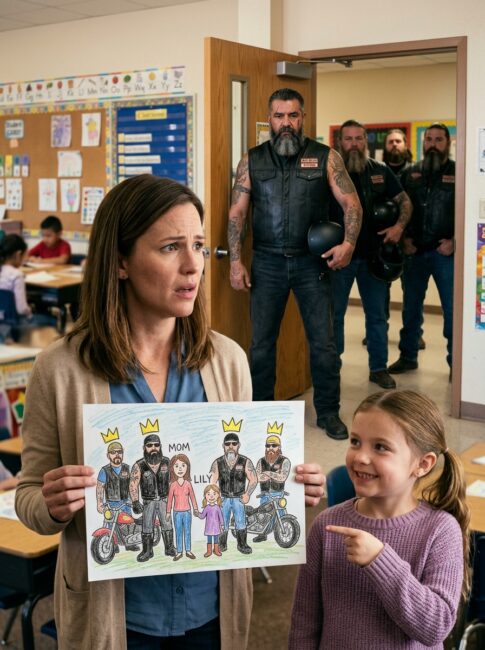
The Drawing That Looked Like a Warning
That Friday afternoon, after Lily returned to class, Sarah stayed in my room.
The school hallway had gone quiet. Somewhere near the cafeteria, a custodian pushed a cart with one squeaking wheel. Outside, a freight train groaned across Gallup with a long metallic rhythm.
Sarah sat in a child-sized chair and looked at her daughter’s drawing.
“I understand why you called,” she said.
Her voice held no anger.
That made me feel worse.
“I did not want to make assumptions,” I said.
“You made an assumption.”
I nodded.
“But you made it because you were trying to protect her.”
Sarah traced one of the yellow crowns with her thumb.
“Those men are the reason I can work Sundays when the pharmacy needs me. They are the reason the back porch light works. They are the reason Lily knows multiplication tables better than I do.”
Then she told me about Eli.
Two years earlier, he had been diagnosed with pancreatic cancer.
By the time doctors found it, the disease had already moved too far.
He had months.
Not years.
Eli kept riding as long as his body allowed. When that became impossible, the Red Mesa Riders came to him instead.
Their motorcycles lined Sarah’s driveway every Sunday.
Five engines rolling down the block.
Five engines cutting off one by one.
Then boots on concrete.
Then a quieter sound: grown men entering a sick man’s house and pretending not to notice how much weight he had lost.
Eli hated pity.
He tolerated soup, card games and bad jokes.
He tolerated Doc checking whether he had taken his medication.
He tolerated Moose replacing a loose bathroom rail without asking.
He tolerated Rook sitting beside him on the back steps without speaking.
But one Sunday night, three weeks before Eli died, he finally said what frightened him.
Not death.
Lily.
Sarah had been washing dishes. Lily had fallen asleep on the couch beneath a cartoon blanket. Eli sat in his chair with both hands wrapped around a mug he had stopped drinking from.
Rook, Moose, Doc, Cal and Reggie sat around the table.
Eli looked at each of them.
“I need something.”
Nobody joked.
Rook leaned forward.
“Say it.”
Eli glanced toward Lily.
“Sarah can handle most things. She always has.”
His voice was thin. Uneven.
“But that kid lost her dad before she knew him. She’s about to lose me too.”
He swallowed.
“I don’t want her growing up thinking men leave.”
The room went still.
Eli rested one trembling hand against the tabletop.
“You boys come around sometimes. Fix stuff. Eat dinner. Make sure she has people.”
Rook stared at him.
“Sometimes?”
Eli tried to smile.
Rook shook his head.
“Every Sunday.”
Moose nodded first.
Then Doc.
Then Cal.
Reggie wiped both hands against his jeans.
“Every Sunday,” he repeated.
That became the promise.
Eli died nineteen days later.
The funeral filled a small church west of town with the smell of flowers, leather and stale coffee. Five bikers carried the casket. Sarah walked behind them holding Lily’s hand.
Lily did not cry until she saw Eli’s motorcycle parked outside.
After the burial, the men rode away together.
Sarah assumed grief would scatter them.
Everyone makes promises beside a dying man’s bed.
Keeping them is harder.
The following Sunday, at four o’clock, Sarah heard motorcycles turning onto her street.
Five bikes stopped outside her house.
Five men walked to the door carrying groceries.
Rook held a bag of hamburger buns beneath one arm.
Moose carried a casserole dish his sister had prepared.
Cal carried a toolbox.
Doc brought children’s cold medicine because Lily had a cough.
Reggie held a package of crayons.
Sarah opened the door and stared at them.
Rook shifted his weight.
“Eli said Sundays.”
That was all.
But the hardest Sunday came later.
The promise almost broke before Lily ever drew the crowns.
The Sunday With Four Motorcycles
Six months after Eli died, Sarah heard only four engines outside.
She noticed immediately.
By then, the Sunday ritual had become precise.
Four o’clock.
Five Harleys.
Five helmets lined against the wall.
Dinner by five.
Homework before dessert.
Something fixed before everyone left.
But that afternoon, Rook’s bike was missing.
Moose carried groceries inside without making a joke. Doc stared at his phone. Cal placed his toolbox on the kitchen counter harder than usual.
Reggie stood near the door.
“Where is he?” Sarah asked.
Nobody answered quickly enough.
Rook had not relapsed. He had not gotten into trouble.
He had simply stopped moving.
That morning marked six months since Eli’s death. Rook had opened his garage, looked at the Harley and sat down on the concrete floor beside it.
He could not start the engine.
Rook had known Eli longer than the others. They met in a county reentry program after Rook served time for a bar fight that left another man badly injured. Rook never romanticized that period.
He called it the worst version of himself.
Eli was the first person who refused to treat him like a permanent sum of his mistakes.
They rebuilt carburetors together. Found steady work. Joined sober charity rides. Learned to spend a Saturday repairing a neighbor’s fence instead of searching for an argument.
When Eli got sick, Rook handled practical things.
Hospital rides.
Prescription pickups.
Groceries.
He did not talk about fear.
After Eli died, he kept showing up for Lily because it was easier than sitting alone with his own grief.
Until that Sunday.
Moose, Doc, Cal and Reggie stood in Sarah’s kitchen debating what to do.
Sarah expected them to stay.
Instead, Cal picked up his keys.
“Dinner waits,” he said.
All four bikers returned to their motorcycles.
Their engines rolled away toward Route 66.
Sarah stood on the porch, confused and hurt.
Lily sat on the floor near Eli’s empty chair, holding a coloring book.
“Are they leaving?” she asked.
Sarah did not know how to answer.
Forty minutes later, the V-twin rumble returned.
Not four engines.
Five.
Rook rode in the center.
His eyes were red. His beard looked uncombed. His leather cut sat open over a wrinkled black shirt. When he entered the house, he smelled like cold garage concrete, gasoline and coffee he had forgotten to drink.
Nobody gave him a speech.
Nobody asked whether he was all right.
Moose handed him a bag of hamburger buns.
Cal pointed toward the flickering kitchen light.
“Bulb’s bad.”
Rook looked at the ceiling.
Then at Lily.
She held out a crayon drawing.
It showed six stick figures beside motorcycles.
One figure floated above the others inside a blue cloud.
“That’s Uncle E,” she explained.
Rook took the picture with both hands.
His fingers trembled.
“Looks like him,” he said.
Lily frowned.
“He did not have blue legs.”
Rook cleared his throat.
“No. Guess not.”
That Sunday, Rook changed the kitchen bulb.
Then he stayed for dinner.
The promise survived because the brotherhood did not allow one grieving man to disappear quietly.
Two years later, Lily drew another picture.
This time, Eli was not in the blue cloud.
His brothers were standing where he had asked them to stand.
Around his family.
Why the Kings Wore Leather
After Sarah finished telling me the story, I asked whether I could visit on a Sunday.
I expected her to hesitate.
She did not.
“Four o’clock,” she said. “Come hungry. Moose cooks too much.”
The following weekend, I parked across from Sarah’s small stucco house near Route 66.
At 3:58 p.m., I heard the motorcycles.
Five engines rolled down the street with a low pulse that seemed too large for the quiet neighborhood. A curtain moved in the house next door. A dog barked once, then stopped.
The bikes pulled into the driveway.
The men removed their helmets.
I recognized them immediately from Lily’s drawing.
Rook was even larger in person. His beard was thicker. His tattoos climbed from his wrists beneath his sleeves. When he noticed me standing near the porch, his expression tightened.
Sarah introduced us.
“This is Lily’s teacher.”
Rook nodded once.
“Ma’am.”
Moose handed me a foil-covered casserole dish.
“Hold this. Hot.”
That was how I entered.
Inside, the transformation happened quietly.
Leather cuts went onto hooks near the door.
Boots came off.
Cal noticed a loose hinge on a cabinet and opened his toolbox before dinner.
Doc checked the scrape on Lily’s elbow from recess.
Reggie sat beside Lily at the table with a spelling worksheet.
She pointed to one word.
“Necessary.”
Reggie frowned at it.
“Word has too many parts.”
“You always say that.”
“Because English is suspicious.”
Lily laughed.
He sounded playful, but Sarah told me later that Reggie had struggled with reading since childhood. He had left school early. For years, paperwork embarrassed him enough that he avoided it.
After Eli died, Lily began asking for homework help.
Reggie started attending adult literacy classes on Tuesday nights.
He never told Lily.
He simply got better at spelling.
At the kitchen counter, Moose carved a roast while pretending not to listen to a children’s audiobook playing from Lily’s tablet.
Doc replaced batteries in the smoke detector.
Cal fixed the cabinet hinge.
Rook stood on a chair changing a porch light bulb even though the old bulb still worked.
Sarah noticed.
“That one is fine,” she said.
Rook shrugged.
“New one’s brighter.”
Then I saw the inside of his leather cut.
Stitched near the inner seam was a small square of purple fabric with uneven yellow thread around the edges.
Lily noticed me looking.
“I made those,” she said proudly.
Each biker had one.
Five small patches hidden inside five leather vests.
Purple fabric.
Crooked yellow crowns.
Lily had stitched them with Sarah’s help after learning that real club patches had meaning.
“These are family patches,” Lily explained. “They go inside because they are not for strangers.”
Rook lowered his eyes.
His huge tattooed hands folded the leather carefully before placing the vest back on its hook.
That was the seed I had missed in the classroom.
In Lily’s drawing, the men were large because they were large.
They surrounded her because they surrounded her.
But she was not trapped.
She was protected.
After dinner, Sarah placed six plates on the table.
Five for the bikers.
One for Lily.
She set her own plate near the counter because she planned to eat after cleaning up.
Rook immediately moved a chair.
“Sit.”
Sarah shook her head.
“I have dishes.”
“Sit first.”
His tone allowed little debate.
They made room for her.
Eli’s chair remained empty at the end of the table.
Nobody treated it like a shrine. Moose placed a serving spoon near it by accident. Lily rested her crayons on the seat. Life moved around the absence.
After dinner, Lily brought out the original family drawing from school.
The bikers studied their portraits.
Moose looked offended.
“Why am I wider than the refrigerator?”
“Because you ate three pieces of pie last week,” Lily said.
Cal pointed at his crown.
“Mine is crooked.”
“You moved while I was drawing.”
Reggie adjusted his reading glasses.
“I look handsome.”
“You look bald,” Doc said.
Rook remained quiet.
He looked at the little crown above his head.
Then at the empty chair.
His jaw tightened for only a moment.
“Good picture, kid,” he said.
Lily leaned against his arm.
That was all he could manage.
It was enough.
Sundays at Four
I stopped worrying about the five men in Lily’s drawing.
Instead, I began noticing the evidence of them everywhere.
On Mondays, Lily brought stories.
Moose burned the biscuits again.
Doc taught her how to wrap a scraped knee.
Cal showed her where the circuit breaker was but made her promise never to touch it without an adult.
Reggie helped her memorize spelling words using motorcycle names and diner menus.
Rook listened while she read chapter books aloud, turning pages slowly with scarred fingers.
The ritual remained steady.
Five engines every Sunday.
Five helmets near the wall.
Five leather cuts hanging beside Lily’s school backpack.
One empty chair.
The brotherhood kept being tested in ordinary ways.
Doc took a job in Albuquerque and drove more than two hours each direction to keep Sunday dinner.
Cal injured his shoulder at the rail yard and arrived in a pickup truck for six weeks. Lily complained that the driveway sounded wrong without his Harley.
Moose developed high blood pressure and began bringing vegetables nobody trusted.
Reggie reached five years sober.
At dinner, Sarah placed a small grocery-store cupcake near his plate. Lily pushed a handmade card toward him.
On the front, she had drawn a crown.
Inside, she wrote:
KINGS COME BACK EVEN WHEN IT IS HARD.
Reggie stared at the sentence for a long time.
Then he removed his reading glasses and pressed his thumb near one eye.
“Dust,” he muttered.
“There is no dust,” Moose said.
“Eat your vegetables.”
At school, Lily’s artwork changed as she grew.
The motorcycles became more recognizable.
The crowns became smaller.
Eli began appearing in the background, usually near a blue sky or beside a poorly drawn diner sign.
But the structure stayed the same.
Sarah.
Lily.
Five bikers.
When Lily turned nine, she brought a new drawing to class.
This one showed the front porch.
Rook held a light bulb.
Cal held a wrench.
Doc carried a first-aid kit.
Moose balanced a casserole dish.
Reggie held a spelling worksheet.
Above the house, Eli rode through a blue cloud on a motorcycle with wings far too large for the frame.
I asked Lily whether I could display it near my desk.
She considered the request carefully.
Then she nodded.
“Okay,” she said. “But do not cover Uncle E.”
I did not.
The Crowns Inside the Vests
Lily is eleven now.
She no longer calls them her five dads in front of her classmates because eleven-year-olds understand how quickly other children can turn something precious into a joke.
At home, she still does.
Last month, Red Rock Elementary held a family reading night.
Parents and grandparents arrived carrying folding chairs, younger siblings and paper cups of coffee.
At 6:12 p.m., the windows trembled.
Five Harley engines cut off outside the gym.
Conversation dipped.
The doors opened.
Rook entered first.
Gray in his beard now. Scar across his cheek. Black leather cut over a clean shirt. Heavy boots striking the polished floor more carefully than usual.
Moose followed with a tray of cookies.
Doc carried extra bottled water.
Cal held the door.
Reggie wore his reading glasses without pretending he had forgotten them.
A few parents watched them cautiously.
I understood the reaction.
I had once looked at five crayon men and imagined the worst.
Lily ran across the gym.
Rook lowered himself slightly, bracing one hand against his knee as she hugged him. Moose complained that nobody greeted the cookie tray. Cal reminded Lily not to run indoors. Doc noticed a loose lace on her sneaker. Reggie asked which book she had chosen.
They sat together near the back.
Five large men folding themselves into small metal chairs.
Lily stood at the microphone and read a story she had written herself.
It was about kings.
Not kings with castles.
Not kings with swords.
Kings who fixed broken porch lights.
Kings who checked smoke detectors.
Kings who showed up with groceries every Sunday at four.
When the reading ended, the gym filled with applause.
Rook looked down at his hands.
Then Lily walked over and opened the inner edge of his leather vest just enough for me to see the patch she had sewn years earlier.
Purple cloth.
Uneven yellow thread.
A crooked crown hidden where strangers would never notice it.
Outside, Route 66 carried the sound of traffic through the dark.
Inside, five bikers waited for Lily to finish packing her books.
Eli’s brothers had promised they would stay.
So they stayed.
Follow the page for more stories about the people behind the leather cuts.