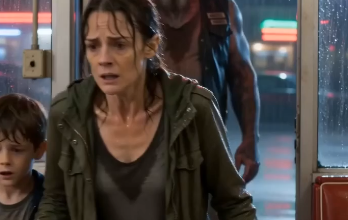
Everyone Called Him a Problem Kid—Until a Biker Asked to See the Principal
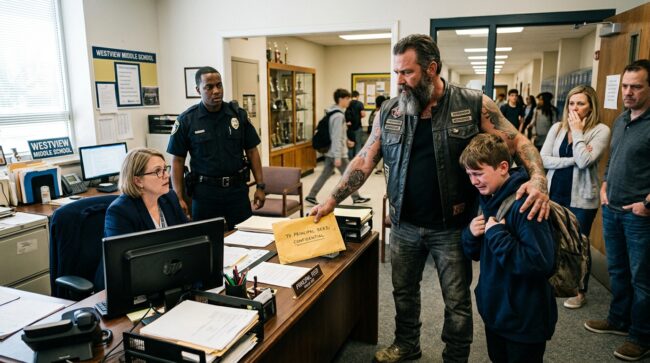
Everyone backed away when a tattooed biker entered the school office, pointed at the crying boy, and said, “I’m here about him.”
For a second, nobody spoke.
The secretary’s hand froze above the phone. A mother waiting by the front desk pulled her little girl closer. Two eighth-grade boys stopped laughing near the trophy case and stared at the man in the doorway like trouble had just learned how to walk.
He looked like the kind of man schools lock their doors against.
Big shoulders. Gray-black beard. Tattooed arms showing beneath a sleeveless leather vest. Heavy boots dusted from the road. A face too still to be friendly, and eyes that moved around the room without asking permission.
Outside Jefferson Middle School in Cedar Rapids, Iowa, the rain had just stopped, leaving the parking lot slick and silver under a cloudy March sky. The final bell would not ring for another forty minutes, but the front office already had the tense, stale air of a place where adults had run out of patience.
At the end of the row of plastic chairs sat twelve-year-old Noah Bennett.
He was small for his age, thin at the wrists, with dark blond hair that refused to stay flat and a hoodie two sizes too large. One sleeve had a rip near the cuff. His backpack sat beside him on the floor, unzipped, papers bent and spilling out. A red disciplinary referral lay on the secretary’s desk with his name written across the top.
Again.
Noah had been called many things that year.
Disruptive.
Defiant.
Difficult.
But that morning, in front of half his class, Mr. Ellison had said the words that stuck to him hardest.
“Problem kid.”
Not shouted. Not exactly.
Worse.
Said like a fact.
Now Noah sat in the office with both hands tucked under his legs, staring at the floor so hard it seemed like he was trying to disappear into the tiles.
The biker looked at him.
Noah looked up once.
Just once.
Then his face went pale.
The secretary, Mrs. Weller, recovered first. “Sir, you can’t just walk into a school.”
The biker did not move.
“I signed in,” he said.
His voice was low, almost flat.
Mrs. Weller glanced toward the visitor clipboard. The name was there, written in block letters.
Caleb Rourke.
No appointment.
No explanation.
Just a name.
She looked back at him. “Are you Noah’s parent?”
“No.”
“Guardian?”
“No.”
“Then I need you to step outside until we verify—”
“I need to see Principal Garner.”
The little girl beside her mother whispered, “Mom, is he bad?”
The room heard it.
The biker heard it too.
His expression did not change.
But Noah’s did.
He lowered his head even further, shoulders tightening like he had just been blamed for the man’s arrival too.
From the hallway beyond the office, footsteps approached quickly. Principal Helen Garner appeared at the doorway of her office, wearing a navy blazer and the kind of tired smile adults use when they are already expecting a problem.
The smile vanished when she saw Caleb Rourke.
“Can I help you?” she asked.
The biker turned toward her.
“Yes,” he said. “You can stop calling that boy what he isn’t.”
The office went completely still.
And just like that, everyone decided he had come to make things worse.
Principal Garner stepped forward slowly, not frightened exactly, but careful.
She had dealt with angry fathers, exhausted mothers, grandparents in tears, and students who threw chairs because words failed them before lunchtime. But Caleb Rourke was different. He stood too quietly. He did not pace. He did not argue in the usual way. He watched everything like a man trained to remember exits.
“Noah is under school supervision right now,” she said. “This is not an appropriate time for outside involvement.”
Caleb looked past her at the closed office door.
“Then make it appropriate.”
Mrs. Weller inhaled sharply.
The mother in the waiting chair stood up, pulling her daughter behind her. One of the eighth-grade boys whispered, “Dude, he’s gonna get arrested.”
Noah heard that.
He looked smaller by the second.
Principal Garner’s voice hardened. “Sir, I’m going to ask you to lower your tone.”
“I didn’t raise it.”
That was true.
Somehow, it made him sound more dangerous.
The school resource officer had not been in the office when Caleb entered. Officer Daniels was across the building, handling a lunchroom dispute involving chocolate milk and a broken tray. Mrs. Weller’s eyes flicked to her phone, and Caleb noticed.
“I’m not here to scare anybody,” he said.
A father waiting to pick up his son gave a short, humorless laugh. “Could’ve fooled us.”
Caleb turned his head toward him.
Not fast.
Not threatening.
Just enough.
The father stopped laughing.
Noah’s breathing changed. He was trying not to cry now, and trying not to let anyone see that he was trying. He had already cried once that morning, after Mr. Ellison sent him out for “refusing to cooperate.” The truth was messier. The truth always was, and nobody at Jefferson Middle had much time for messy truths once a kid’s reputation had been filed in the right drawer.
Problem kid.
The label followed him from classroom to classroom. If a pencil dropped, someone looked at Noah. If a joke went too far, someone looked at Noah. If a substitute lost control of a room, someone wrote his name down because it was the easiest name to write.
Today had started in math.
Noah had refused to read aloud.
Mr. Ellison had insisted.
Noah had gone silent.
A boy behind him had snickered. Someone else had whispered, “He can’t read it.” Mr. Ellison told the class to settle down, then told Noah to stop making everything difficult.
Noah pushed his worksheet off the desk.
That was the part everyone saw.
Not the trembling hand before it.
Not the way his eyes kept moving over the page and finding nothing stable.
Not the word problem landing on him like a door locking.
Now Principal Garner held the referral slip and looked at Caleb with professional disapproval.
“Noah disrupted class, refused instruction, and threw materials. We are following procedure.”
Caleb said nothing for a moment.
Then he looked at Noah.
“You throw it at someone?”
Noah shook his head.
“Hit anyone?”
Another shake.
“Threaten anybody?”
Noah’s lips pressed together.
“No, sir,” he whispered.
The “sir” changed the room.
It was too respectful. Too familiar. Too afraid, maybe. People heard what they wanted to hear.
Mrs. Weller narrowed her eyes. “You know this man, Noah?”
Noah did not answer fast enough.
Caleb did not help him.
That silence became another problem.
Principal Garner stepped between them. “Mr. Rourke, unless you can explain your connection to this student, I will have to ask you to leave.”
Caleb reached slowly into the inside pocket of his vest.
The room reacted immediately.
“Sir, don’t,” Mrs. Weller snapped.
The mother gasped and pulled her daughter back another step. The eighth-grade boys stopped whispering. Principal Garner’s hand moved toward the office panic button under the desk.
Caleb froze.
Then he withdrew his hand empty and lifted both palms.
“Paperwork,” he said.
“Keep your hands visible,” Mrs. Weller said, voice shaking.
For the first time, anger flickered across Caleb’s face.
Not hot anger.
Cold.
Controlled.
He looked like a man swallowing a sentence because the boy in the chair was still watching.
“I came here with documents,” he said.
Principal Garner’s face remained cautious. “What documents?”
Caleb glanced at Noah again.
Noah shook his head slightly.
Almost invisible.
A child begging an adult not to open a door.
Caleb saw it.
And he stopped.
That made everyone more suspicious.
The father by the wall stepped forward. “This is ridiculous. There are kids here. Call the police.”
Mrs. Weller already had the phone in her hand.
Principal Garner raised one palm. “Let’s all stay calm.”
But calm had already left the room.
Because Noah suddenly stood up.
His backpack tipped over, spilling papers across the floor. A crumpled worksheet slid under the coffee table. A yellow envelope fell out last, landing face down near Caleb’s boot.
Noah saw it and moved fast.
Too fast.
He dove for the envelope at the same moment Caleb bent down to pick it up.
From the outside, it looked like the biker grabbed at him.
The mother screamed.
The little girl started crying.
The father lunged forward. “Get away from that kid!”
Caleb straightened immediately, both hands open, but the damage was done. Noah clutched the yellow envelope against his chest, breathing hard, eyes wide with panic.
Principal Garner’s voice rose. “Mr. Rourke, step back now.”
Caleb stepped back.
Only one step.
Not enough.
Noah whispered, “Please don’t.”
Nobody knew who he was talking to.
The adults looked from the boy to the biker and filled in the worst version.
Mrs. Weller was on the phone now. “Yes, we need Officer Daniels to the front office immediately.”
The word immediately made Noah flinch.
Caleb saw that too.
His jaw tightened.
“Principal Garner,” he said, “we need to talk before this goes further.”
“It has already gone further,” she replied.
“Then stop pushing him.”
That was the wrong sentence.
Every adult in the room heard accusation.
The father by the wall stepped between Caleb and Noah. “You don’t get to come in here and tell a school how to handle a kid.”
Caleb looked at him.
“No,” he said. “But I know what happens when grown people keep calling a child broken until he believes it.”
The room fell into a heavy, uncomfortable quiet.
For half a second, something almost changed.
Then Officer Daniels arrived.
And the sight of a uniform in the doorway made everyone remember what they thought they had seen.
A dangerous biker.
A terrified boy.
A secret envelope.
And a school office one breath away from becoming a scene.
Officer Daniels stopped just inside the office, one hand resting near his belt, his eyes moving quickly over the room.
He was a Black man in his late thirties, broad-faced and calm in the way good school officers learn to be calm. He looked at the crying little girl, the nervous secretary, the father standing like a barricade, Noah clutching the envelope, and Caleb Rourke in the center of it all.
“Everybody take a breath,” Daniels said.
Nobody did.
Mrs. Weller pointed at Caleb. “He entered without an appointment, became confrontational, and reached toward the student.”
“I did not reach toward him,” Caleb said.
His voice stayed level, but the edge in it was clear now.
The father snapped, “We all saw it.”
Caleb looked at him. “You saw what you were ready to see.”
Officer Daniels stepped closer. “Sir, I need your name.”
“Caleb Rourke.”
“Relationship to Noah Bennett?”
Caleb paused.
Too long.
Again, the silence punished him.
Noah’s fingers tightened around the envelope until the paper bent. His face was red now, eyes glossy and desperate. He looked less like a problem kid than a child trapped under too many adult voices.
Officer Daniels noticed.
“Mr. Rourke,” he said, “relationship.”
Caleb looked at Noah.
Noah gave the smallest shake of his head.
Not here.
Not in front of them.
Caleb exhaled through his nose.
“I’m someone who came when he asked.”
Principal Garner frowned. “Noah did not request a visitor today.”
Caleb’s eyes moved to her. “Not today.”
“What does that mean?”
He did not answer.
The father scoffed. “This is insane.”
Officer Daniels held up one hand. “Sir, please.”
But the father was angry now, and anger always likes an audience.
“My son goes here,” he said. “These kids shouldn’t have to be around some biker storming into the office because a kid got written up.”
Noah stared at the floor.
Some biker.
A kid.
A write-up.
All the small words adults used when they did not have to carry the weight.
Caleb’s face hardened. “That ‘kid’ has a name.”
“And a file,” Principal Garner said before she could stop herself.
The office went silent.
Noah looked up.
The words had slipped out cleanly, professionally, terribly.
A file.
Not a story.
Not a child.
A file.
Caleb turned to Principal Garner very slowly.
“What did you say?”
She straightened, embarrassed but defensive. “I mean Noah has a documented behavioral history.”
Caleb took one step toward her desk.
Officer Daniels moved immediately. “Mr. Rourke.”
Caleb stopped, but his voice dropped lower.
“Pull the reading reports.”
Principal Garner blinked. “Excuse me?”
“Pull the reading reports.”
“This is not your place.”
“Then make it his.”
He pointed toward Noah.
Not aggressively.
But the room still recoiled because the biker’s arm was large, tattooed, and shaking with contained anger.
Noah looked at that hand.
And something in him seemed to crack.
“I didn’t throw it at anybody,” he said suddenly.
Everyone turned.
His voice was thin, but once it came out, it kept going.
“I didn’t. I just pushed it off. I told him I couldn’t read it right, and he said I was making excuses.”
Principal Garner softened slightly. “Noah, we can discuss that privately.”
“No,” Caleb said.
Officer Daniels warned him with a look.
Caleb lowered his chin but did not apologize.
Noah’s eyes moved around the room. Too many adults. Too many witnesses. Too much shame. He clutched the yellow envelope like it might hold him together.
The mother with the little girl whispered, “Poor thing.”
Noah heard that too.
His expression closed.
He shoved the envelope into his hoodie pocket and stepped backward toward the hallway.
Principal Garner said, “Noah, sit down.”
He shook his head.
“Sit down,” she repeated, firmer now.
Caleb moved.
Not fast enough to be violent.
Fast enough to scare people.
He stepped between Noah and the adults, one arm low and angled behind him, blocking the boy without touching him.
The father shouted, “See? He’s doing it again!”
Officer Daniels stepped forward. “Mr. Rourke, move away from the student.”
Caleb did not.
Noah stood behind him, breathing in quick, broken pulls.
“Move,” Daniels repeated.
Caleb looked at him, then at Principal Garner.
“If you make him sit in that chair again,” Caleb said, “you’ll lose him.”
Principal Garner’s face tightened. “That sounds like a threat.”
“No,” Caleb said. “It sounds like experience.”
The words landed heavily.
For a moment, Officer Daniels studied him differently.
But the father reached for his phone again. Mrs. Weller was crying now, quietly, behind the desk. The mother took her little girl into the hallway. Students had gathered beyond the office glass, eyes wide, whispering.
The whole school seemed to know something was happening.
And nobody knew the truth.
Principal Garner stepped toward her office door. “Officer Daniels, please escort Mr. Rourke out. I’ll call Noah’s guardian.”
At the word guardian, Noah made a sound so small most people missed it.
Caleb did not.
He turned halfway. “Noah.”
The boy looked up.
For the first time since the biker walked in, Caleb’s face softened.
Just barely.
“Show her,” he said.
Noah shook his head hard.
Caleb’s voice stayed low. “Not for them. For you.”
Noah’s hand went slowly to his hoodie pocket.
Principal Garner watched.
Officer Daniels watched.
Even the father stopped talking.
Noah pulled out the yellow envelope and held it against his chest for one more second before handing it to Caleb with trembling fingers.
Caleb did not open it.
He placed it on Principal Garner’s desk.
The envelope was old, creased at the corners, with a child’s name written across the front in black marker.
NOAH BENNETT — KEEP SAFE
Principal Garner stared at it.
Her face changed, just a little.
“Where did you get this?” she asked.
Caleb looked at Noah.
Then at the office full of people who had already judged them both.
Before he could answer, Officer Daniels’ radio crackled from his shoulder.
A woman’s voice came through, urgent and clipped.
“Unit at Jefferson Middle, be advised—Noah Bennett’s guardian is not reachable. Dispatch received a welfare concern at the residence.”
Noah went completely still.
Caleb closed his eyes.
And everyone in the office suddenly understood that the problem had never started in math class.
The radio kept hissing after the dispatcher stopped speaking.
Noah did not move.
Not his hands. Not his eyes. Not even the small rise and fall of his shoulders. He stood behind Caleb Rourke in the middle of Jefferson Middle School’s front office as if the whole building had disappeared beneath him.
Principal Garner looked from the radio to Noah.
“What welfare concern?” she asked.
Officer Daniels touched the button on his shoulder. “Dispatch, repeat that.”
The answer came back through static. “Neighbor called in. Reported possible medical emergency at the Bennett residence. Adult guardian not answering door. EMS en route.”
Noah’s lips parted.
His voice barely came out. “Grandma.”
That one word changed the office more than any argument had.
Mrs. Weller stopped crying. The father by the wall lowered his phone. Principal Garner’s face lost its polished authority and became something smaller, more human. Officer Daniels stepped closer to Noah, but this time his movement was careful.
“Noah,” he said, “who’s home right now?”
Noah stared at the yellow envelope on the principal’s desk.
“My grandma,” he whispered. “She was sleeping when I left.”
“Anyone else?”
Noah shook his head.
Caleb’s jaw tightened, but he still did not touch the boy. He stood beside him like a fence, close enough to shield, far enough not to trap.
Principal Garner spoke softly now. “Noah, why didn’t you tell us your grandmother was sick?”
Noah looked at her.
The question hurt him. That was clear before he answered.
“Because every time I tell somebody something, it goes in my file.”
Nobody knew what to say to that.
The rain tapped lightly against the front office windows. Out in the hallway, students had been moved away by a teacher, but their whispers still traveled through the glass. The school smelled of wet jackets, copier toner, and cafeteria pizza. Ordinary things. Small things. All of them wrong for a moment like this.
Caleb finally picked up the yellow envelope.
He did not open it.
He slid it across the desk toward Principal Garner.
“You should see what’s inside.”
Noah flinched. “Caleb.”
The biker looked at him, and his face softened again in that almost invisible way.
“It’s time,” he said.
Two words.
Noah’s eyes filled.
Principal Garner hesitated, then reached for the envelope. She handled it differently now, not like evidence, but like something fragile. The flap had been opened and sealed too many times. Inside were several folded papers, a small photograph, and a card worn almost white along the edges.
The first page was not school paperwork.
It was a note written in uneven handwriting.
Principal Garner read the first lines silently, and whatever color remained in her face faded.
Officer Daniels stepped closer. “Principal?”
She did not answer right away.
Caleb did not look at the paper. He seemed to know every word already.
Principal Garner lifted the photograph next.
It showed a younger woman in a hospital bed, pale but smiling, one arm around a much smaller Noah. Beside them stood a tall man with a leather vest folded over his arm, beard darker then, eyes still serious. Caleb. On the back of the photograph, in blue ink, someone had written:
If I can’t be there, call him. He knows how to stand still when things fall apart.
Principal Garner read it twice.
Then she looked at Noah.
“Who wrote this?”
Noah wiped his nose with his sleeve, embarrassed by the question and by the answer.
“My mom.”
The office went quiet again, but this time the quiet had weight.
Not suspicion.
Shame.
Caleb kept his eyes on the floor.
Principal Garner unfolded the next sheet. It was a copy of an educational evaluation, dated three years earlier from another district. She scanned the page quickly. Dyslexia indicators. Processing delays. Recommended reading accommodations. Oral testing when appropriate. Written instructions paired with audio support.
Her hand went still.
She looked toward the referral slip on her desk.
Then toward Noah.
“He has a documented reading disability,” Caleb said.
Nobody corrected him.
Noah stared at his shoes.
Principal Garner closed her eyes for one second, just long enough to reveal that something inside her had shifted.
“Why wasn’t this in our system?” she asked.
Noah shrugged, a small, helpless motion. “Grandma tried.”
Caleb’s voice remained even. “She brought copies last fall.”
Mrs. Weller looked stricken. “I don’t remember—”
“I do,” Noah whispered.
Every adult turned toward him.
He swallowed hard. “She came after her dialysis appointment. She had the papers in a grocery bag because it was raining. She waited almost an hour.”
Principal Garner’s expression tightened.
Noah kept going, but his voice broke around the words.
“Someone told her they’d scan them.”
He nodded toward the envelope.
“Then I started getting written up again.”
No one accused anyone now.
No one defended procedure.
Officer Daniels looked at Caleb. “Why did you come today?”
Caleb’s hand closed around the edge of the desk.
“Noah called me from the nurse’s phone.”
Principal Garner frowned. “The nurse didn’t mention—”
“He asked her if he could call home,” Caleb said. “His grandmother didn’t answer. He had one number memorized.”
Noah’s face went red.
Caleb glanced at him. “Mine.”
Principal Garner looked at the boy she had known all year as a discipline concern, a disruption, a file growing thicker by the month. For the first time, she seemed to see the space around him too. The sick grandmother. The lost paperwork. The dead mother’s note. The biker who was not a threat but the only adult he trusted enough to call.
And still, nobody knew the whole truth.
Not yet.
Because Caleb picked up the worn card from the desk and held it in his palm as if it weighed more than paper.
Principal Garner saw the name printed on it.
Her eyes lifted slowly.
“Caleb,” she said. “Why does this say Bennett?”
Noah stopped breathing.
Caleb closed his hand around the card.
And for the first time since he entered the school, the biker looked afraid.
Officer Daniels drove Noah and Principal Garner to the Bennett house.
Caleb followed on his motorcycle.
That decision took three minutes of tense debate in the office, but Noah would not leave without him, and Principal Garner no longer had the certainty to force the issue. The father who had been ready to call the biker dangerous stood silent as Caleb walked out. Mrs. Weller whispered that she was sorry, though nobody seemed sure who the apology belonged to.
The Bennett house sat on a narrow street twenty minutes from the school, a small one-story place with peeling white paint and a porch sagging slightly at one corner. An ambulance was parked outside when they arrived. No sirens. Just lights. Quiet lights, which somehow felt worse.
Noah ran before anyone could stop him.
Caleb moved after him, fast but controlled.
Inside, the living room smelled of old wood, medicine, and the lemon cleaner older people use when they are trying to keep pride alive. A crocheted blanket lay folded on the couch. A stack of medical bills sat under a ceramic rooster on the side table. On the wall were school pictures of Noah from kindergarten through sixth grade, his smile shrinking a little each year.
Paramedics were helping his grandmother, Ruth Bennett, sit upright in a recliner.
She was conscious.
Weak, but conscious.
Noah dropped to his knees beside her chair and grabbed her hand.
“Grandma.”
Ruth’s cloudy eyes found him. “I’m all right, baby.”
“You didn’t answer.”
“I know.”
“You scared me.”
“I know.”
She touched his hair, and he folded at the gesture, pressing his forehead to her arm. The boy who had thrown worksheets and ignored teachers and sat like stone in the office was gone. In his place was a child who had been holding the roof up with both hands.
Caleb stood near the doorway.
He did not come closer until Ruth looked at him.
“Caleb,” she said.
He nodded once. “Ma’am.”
Principal Garner watched that exchange carefully. There was history in it. Not warmth exactly, but recognition. A door cracked open on something older than school paperwork.
The paramedic explained that Ruth’s blood sugar had dropped dangerously and that a neighbor had called after finding the front door unlocked and Ruth unable to stand. They wanted to take her to the hospital for monitoring.
Noah panicked immediately.
“I’m going with her.”
Ruth squeezed his hand. “You have school.”
“No.”
The word sounded like all his other refusals, but now everyone understood it differently.
Principal Garner stepped forward. “Noah, we’ll handle school.”
He did not look at her.
Caleb did. “He rides with her.”
The paramedic nodded. “One family member can come.”
That word changed the room.
Family.
Noah looked at Caleb.
Ruth looked away.
Principal Garner’s eyes moved to the worn card she still held from the envelope. It was an old hospital visitor pass, faded but readable.
CALEB BENNETT — AUTHORIZED FAMILY CONTACT
She held it out.
“Mrs. Bennett,” she said carefully, “is Mr. Rourke related to Noah?”
Ruth closed her eyes.
Noah’s grip tightened around her hand.
Caleb’s face became unreadable again.
For a moment, the only sound was the paramedic adjusting equipment and the rain ticking against the window.
Ruth opened her eyes and looked at Caleb. “You never told him?”
Caleb’s voice was quiet. “Wasn’t my place.”
“It was always your place,” she said.
Noah looked between them. “Told me what?”
Nobody answered fast enough.
The old fear came back into his face, the fear of adults standing over him with secrets that would become rules.
Caleb stepped closer, then stopped before he reached the chair.
He knelt instead.
Slowly.
So Noah would not have to look up at him.
“Noah,” he said, “your mom was my sister.”
Noah stared at him.
The room seemed to shrink around the sentence.
“My mom didn’t have a brother,” Noah said.
“She did,” Ruth whispered.
Noah turned to her, wounded. “You told me she was an only child.”
Ruth’s eyes filled. “I told you what I thought would hurt less.”
Caleb looked down at his hands. The tattoos across his fingers had blurred with age. One of them, Noah noticed for the first time, was a date.
His mother’s birthday.
“I left before you were born,” Caleb said. “I was trouble then. Real trouble. Your mom got tired of saving me from myself.”
Noah did not move.
Caleb’s voice remained steady, but every word carried strain.
“She told me if I came back, I had to come back right. Not loud. Not half-drunk. Not making promises I couldn’t keep. So I stayed away longer than I should have. Then she got sick.”
Noah’s eyes filled.
“She called you?”
Caleb nodded. “Near the end.”
Ruth covered her mouth.
Caleb kept his gaze on Noah. “She asked me to be someone you could call if things got too heavy.”
Noah looked toward the yellow envelope in Principal Garner’s hand.
“She wrote that note.”
“Yes.”
“Why didn’t you come before?”
The question hit harder than anger.
Caleb accepted it.
“I did,” he said. “You just didn’t know.”
Noah’s face tightened with confusion.
Caleb glanced around the room. “The grocery cards in December. The repaired furnace. The new tires on Ruth’s car. The reading evaluation copy your grandma couldn’t find after the move.”
Ruth began to cry silently.
Noah looked at her, then back at Caleb.
“That was you?”
Caleb nodded.
Noah’s voice sharpened. “But you let everyone call me a problem kid.”
Caleb took the blow without flinching.
“I didn’t know it had gotten this bad,” he said. “That’s on me.”
Principal Garner lowered her eyes.
The truth was becoming unbearable because it did not belong to only one person.
It belonged to a system that missed him, a grandmother too sick to fight every battle, a mother who had tried to leave instructions from a hospital bed, and a biker who had mistaken quiet help for enough.
Noah wiped his face angrily. “I don’t want another file.”
Caleb nodded.
“No,” he said. “You need people who read the one you already had.”
Principal Garner looked up then.
And this time, she did not defend herself.
“You’re right,” she said.
Noah stared at her like he did not know what to do with an adult admitting fault.
But before anything more could be said, Ruth’s hand tightened suddenly around Noah’s.
“There’s another page,” she whispered.
Caleb froze.
Noah looked at her. “What page?”
Ruth nodded toward the envelope.
“The one your mother made me promise not to show unless Caleb came back.”
Caleb’s face went pale.
Principal Garner opened the envelope again.
And tucked behind the evaluation reports was one final folded sheet.
Noah did not want Principal Garner to read it.
He wanted to grab the paper, tear it up, stuff the pieces into his pocket, and run somewhere nobody could explain his life to him anymore. But Ruth looked so tired in the recliner, and Caleb looked so still by the doorway, and something about both of them told Noah this page had waited too long already.
Principal Garner handed it to Caleb.
He did not take it.
“Give it to him,” Caleb said.
So she gave it to Noah.
His name was written on the front in his mother’s handwriting.
For Noah, when the hard truth might help more than the easy one.
His hands shook as he unfolded it.
He knew her handwriting only from birthday cards and the labels on old photo boxes. Seeing it now, addressed to the version of him she never got to meet, felt like hearing her voice from the other side of a closed door.
He read the first lines silently.
Then he stopped.
“What does this mean?” he whispered.
Ruth began to cry harder.
Caleb closed his eyes.
Noah looked up. “What does it mean?”
Ruth’s voice broke. “Baby…”
Noah stood, the letter crumpling in his fist. “What does it mean?”
Caleb opened his eyes and looked at him.
This time, he did not hide behind silence.
“It means I’m your father.”
The room went still.
Not dramatic still. Not movie still.
The kind of still that happens when every sound in the world continues, but none of it reaches you.
Noah stared at him.
“No.”
Caleb nodded once, as if he had expected the word and deserved it.
“No,” Noah repeated, louder. “My dad left before I was born.”
“I did.”
“You said you were her brother.”
“I was,” Caleb said. “By adoption.”
Noah’s face twisted. “That doesn’t make sense.”
Ruth reached for him. “Your mother and Caleb were raised together after his parents died. He was family before he was anything else.”
Noah stepped back from both of them.
Caleb did not move toward him.
“Your mom and I were young,” Caleb said. “Too young, too angry, too proud. When she found out she was pregnant, I was already halfway to ruining my life. She told me I had to get clean, get steady, or stay gone.”
His voice roughened but did not break.
“I chose the road because I was a coward and called it freedom.”
Noah’s breath came fast.
Principal Garner stood near the wall, stunned into silence. Officer Daniels had turned away slightly, not to avoid the truth, but to give the boy a few inches of privacy in a room full of people.
Caleb continued.
“I joined up later. Got sober. Stayed sober. Came back when you were four.”
Noah looked at Ruth.
She nodded through tears.
“You saw me?” Noah asked.
Caleb’s face twisted, just once.
“At a distance.”
That hurt worse.
Noah’s voice became small. “Why?”
“Because your mother was dying, and she asked me not to make myself your grief too.”
Noah looked at the letter again.
His mother’s words waited there, patient and devastating.
If Caleb is standing in front of you, it means he finally did the brave thing. Don’t make it easy for him. But don’t let anger steal the chance to know the parts of you that came from him either. His stubbornness is yours. So is his silence. Make better use of both.
Noah sank slowly onto the couch.
He did not cry at first.
His face simply emptied.
For a child, betrayal is not one feeling. It is too many feelings arriving at the same door, all demanding to be let in first.
Caleb stayed on his knees near the recliner.
The big biker, the frightening stranger in the school office, the man everyone had thought came to intimidate a principal, now looked like someone waiting for a sentence he had earned years ago.
Noah looked at him.
“You let them think you were just some biker.”
Caleb nodded.
“You let them be scared of you.”
“Yes.”
“Why?”
Caleb swallowed.
“Because if they were mad at me, they weren’t looking at you.”
That was the sentence that broke Ruth.
She covered her face, shoulders shaking.
Principal Garner turned toward the window, eyes wet.
Noah stared at his father.
Not Dad.
Not yet.
Maybe not for a long time.
But father.
A word with weight. A word with damage. A word that did not become gentle just because it finally arrived.
“You should’ve come sooner,” Noah said.
Caleb bowed his head.
“I know.”
“You should’ve told me.”
“I know.”
“You should’ve stopped them before today.”
Caleb looked up then, and his eyes were red.
“I know.”
Noah wiped his face with his sleeve.
He hated that the answer was not an excuse. He hated that Caleb did not defend himself. He hated that some part of him wanted to believe the man anyway.
Outside, the ambulance lights washed over the window, red and white across the family pictures on the wall.
The paramedic stepped in softly. “We need to transport Mrs. Bennett now.”
Ruth held out one hand to Noah.
He took it.
Then he looked at Caleb.
“You can follow,” he said.
Caleb nodded once.
It was not forgiveness.
It was not reunion.
It was one door left unlocked.
And for Caleb Rourke, it was more than he had any right to ask for.
By sunset, Ruth Bennett was stable at Mercy Medical Center.
Noah sat in a vinyl chair beside her bed, wearing the same oversized hoodie, his knees pulled close, the yellow envelope resting on his lap. Principal Garner had stayed long enough to make calls. She arranged an emergency meeting for accommodations, contacted the district office, and promised Ruth she would personally track every document.
This time, nobody said “file.”
Not once.
Officer Daniels left quietly after bringing Noah a sandwich from the cafeteria. Caleb stood outside the hospital room most of the evening, leaning against the wall near a vending machine, hands folded in front of him.
He did not come in until Noah looked toward the doorway and said, “You can stop standing there.”
Caleb entered.
Slowly.
Ruth was asleep, her breathing even beneath the thin hospital blanket. The room glowed with the dull amber light of early evening, the kind that makes everything look softer than it is.
Noah studied Caleb’s face.
“Did she know I couldn’t read right?”
Caleb nodded. “Your mom?”
Noah nodded.
“She knew before anyone else,” Caleb said. “She said letters moved around on you when you were tired.”
Noah looked down.
“They still do.”
“I know.”
“No, you don’t.”
Caleb accepted that.
“You’re right,” he said. “I don’t. But I can learn.”
Noah did not answer.
For a long time, neither of them spoke. Outside the room, nurses moved past with quiet shoes. Somewhere down the hall, a machine beeped steadily. Ruth slept on.
Caleb reached into the inside pocket of his leather vest and pulled out a small object.
A pencil.
Short. Yellow. Bitten near the eraser. Ordinary enough to be nothing.
He held it out on his open palm.
Noah frowned. “What’s that?”
“Yours.”
“I never had that.”
“You did,” Caleb said. “Kindergarten open house. You dropped it outside the classroom. I was there.”
Noah looked at him sharply.
“You were?”
Caleb nodded.
“Mom let you come?”
“She didn’t know.”
That should have made Noah angry.
Maybe it did.
But he was too tired to spend anger properly.
Caleb placed the pencil on the tray table beside the envelope.
“I kept it because it was the only thing I had from you that didn’t belong to a story someone else told me.”
Noah stared at the pencil.
All day, adults had explained him, defended him, failed him, corrected themselves, and revealed pieces of a life he had not known he was living. But this small pencil did something the bigger truths had not.
It made the missing years real.
Caleb had been close enough to see him.
Far enough to leave.
Noah picked up the pencil and rolled it between his fingers.
“You don’t get to just become my dad,” he said.
Caleb nodded.
“I know.”
“And you don’t get to tell me what to do.”
“I know.”
“And I’m still mad.”
“You should be.”
Noah looked at him then.
Caleb’s face held no demand. No wounded pride. No speech about second chances. Just the steady patience of a man finally willing to stand in the consequences instead of riding away from them.
Noah placed the pencil back on the tray.
Then he slid the yellow envelope slightly toward the empty chair beside him.
Not all the way.
Just enough.
Caleb understood.
He sat down quietly.
They stayed like that while the evening faded, Ruth asleep between them and the city lights beginning to appear beyond the hospital window.
Noah did not call him Dad.
Caleb did not ask him to.
But when Ruth stirred in her sleep, Noah reached for her hand, and Caleb reached for the cup of water before it tipped over.
Their hands almost touched.
Almost.
Neither pulled away quickly.
And in the small silence after that, something broken did not heal.
Not yet.
But it stopped breaking.