The Old Man Sat Alone at Midnight—Then a Biker Pulled Out the Chair Across from Him
The coffee stopped pouring.
A fork hit a plate somewhere near the counter. The waitress behind the register turned with a pot in her hand and forgot she was still holding it. Two truckers in the corner booth leaned back, their conversation dying mid-sentence. Even the old neon clock above the pie case seemed too loud for the silence that followed.
It was 12:37 a.m. at Marlene’s Diner, just off Route 30 outside Fort Wayne, Indiana, on a wet November night when the rain made the whole highway shine black and silver. The place was half-empty, the way diners are after midnight: a few tired workers, a couple of long-haul drivers, one college kid with earbuds, and one old man sitting alone in the back booth under a flickering wall lamp.
His name was Arthur Whitaker.
Seventy-eight years old. Thin shoulders. White hair combed neatly back. A brown wool coat folded beside him. Hands spotted with age, wrapped around a coffee mug he had not touched in nearly ten minutes.
In front of him sat one slice of apple pie.
Untouched.
Beside the plate was a small envelope.
Also untouched.
Arthur had been coming to Marlene’s every Thursday night for almost three months, always around midnight, always sitting in the same booth, always ordering the same thing. Black coffee. Apple pie warmed for exactly fifteen seconds. No ice cream.
The waitresses knew his routine.
They did not know his story.
That night, he had arrived quieter than usual. He had looked toward the door three times before sitting down. He had asked if anyone had left a message for him, then smiled as if embarrassed by his own question.
“No, sir,” Marlene had told him gently.
He nodded.
Then he took the back booth and waited.
At 12:37, the motorcycle came.
The sound rolled across the wet parking lot first, low and heavy, vibrating through the diner windows before anyone saw the rider. A single headlight slid over the rain-streaked glass. The bike parked crooked near the entrance, too close to the door.
Then the biker stepped inside.
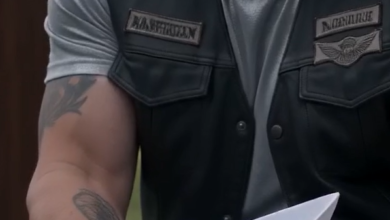
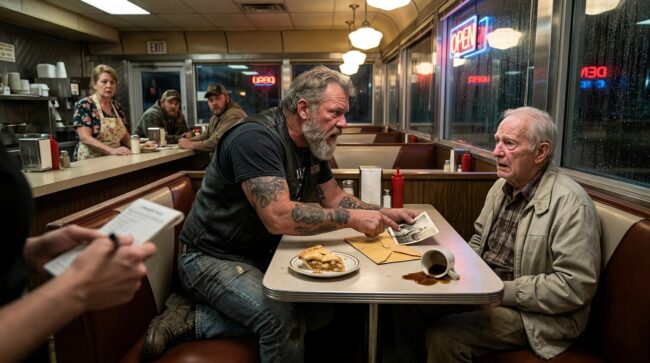
He was big enough to change the temperature of the room. Broad shoulders under a sleeveless black leather vest. Tattooed arms, thick wrists, gray beard, old scars near one eye. He wore no smile, no apology, and no expression that made anyone feel better.
His boots left rainwater on the checkered floor.
He looked around once.
Then he found Arthur.
The old man’s fingers tightened around his mug.
The biker walked straight toward him.
Marlene, the owner, came out from behind the counter. “Can I help you?”
The biker did not stop.
One trucker muttered, “Here we go.”
Arthur did not stand. He did not call for help. He only stared at the man approaching his booth with the strange, hollow look of someone who had been expecting a ghost.
The biker reached the booth, grabbed the chair from the next table, and dragged it across the floor.
The sound was awful.
Wood scraping tile.
Every head turned.
He sat down facing Arthur, leaned forward slightly, and repeated himself.
“You left early.”
Arthur’s lips parted.
No words came out.
And in that instant, every person in Marlene’s Diner believed the biker had come to settle something old and ugly.
Marlene moved first.
She was sixty-two, short, silver-haired, and not easily scared. She had thrown out drunk men twice her size, calmed runaway teenagers, fed truckers who could not pay, and once chased a raccoon out of the kitchen with a broom. But this was different.
This man was not drunk.
That made him worse.
“Sir,” she said, keeping her voice firm, “you can’t bother customers.”
The biker did not look at her.
Arthur stared at the table.
The envelope beside his pie trembled slightly, though no one had touched it.
“I said,” Marlene continued, “you need to step away.”
The biker’s eyes remained on Arthur. “He knows me.”
Arthur swallowed.
The whole diner waited for him to confirm it.
He did not.
That silence landed badly.
One of the truckers, a heavyset white man in his fifties with a red cap and tired eyes, stood halfway out of his booth. “Old man doesn’t look like he wants company.”
The biker finally turned his head.
Slowly.
Not threatening, exactly.
But enough.
The trucker stopped rising.
The college kid pulled one earbud out. A young waitress named Kayla stepped toward the phone mounted near the register. The cook in the back leaned through the service window, spatula still in hand.
Arthur’s voice came out dry. “It’s all right.”
But it did not sound all right.
It sounded like the kind of thing frightened people say because they do not want the room to explode.
The biker leaned back in the chair, big hands resting on his knees. His vest was soaked at the shoulders from rain. His tattoos disappeared beneath faded scars. On one forearm was a name no one could read from where they sat.
Marlene narrowed her eyes. “What’s your name?”
The biker hesitated.
“Jonah.”
“Jonah what?”
He looked back at Arthur. “He knows.”
Again, Arthur said nothing.
Now the tension sharpened.
Marlene took another step. “Arthur, do you want me to call someone?”
Arthur looked at her then.
For one second, his eyes seemed grateful.
Then ashamed.
“No,” he whispered.
The biker’s jaw tightened at the shame.
Not anger at Arthur.
Something else.
Something held back so carefully it looked dangerous.
The trucker in the red cap reached for his phone. “I’m calling county.”
Jonah did not object.
He simply said, “Do that.”
The diner stirred.
That was the wrong response.
Men who fear police do not invite them. Men who want a scene sometimes do.
Kayla whispered, “Marlene…”
Marlene nodded without looking away from Jonah. “Call.”
Kayla picked up the phone.
Arthur’s hand moved toward the envelope, then stopped.
Jonah saw it.
So did Marlene.
“What’s in the envelope?” she asked.
Arthur pulled his hand back as if burned.
“Nothing,” he said too quickly.
Jonah looked at the envelope for a long moment.
Then he reached across the table.
Arthur flinched.
The whole diner reacted.
“Hey!” the trucker shouted.
Marlene slapped her hand on the table between them. “Don’t touch his things.”
Jonah’s hand stopped inches from the envelope.
He did not argue. He did not apologize either.
He only looked at Arthur and said, “You brought it.”
Arthur’s face folded with pain.
The words made no sense to anyone else.
But they hurt the old man.
That was clear.
Marlene’s protective anger grew. Arthur Whitaker was not just another late-night customer anymore. He was the quiet old man who left too large a tip and always said thank you twice. He was the man who once helped Kayla carry a box of napkins in from the rain because her wrist was in a brace. He was alone, fragile, and clearly shaken.
And this biker had come in like a storm.
“What did he bring?” Marlene demanded.
Jonah looked at her for the first time.
His eyes were gray, colder than his voice.
“That’s between him and me.”
“No,” Marlene said. “Not in my diner.”
The trucker came fully out of the booth now. His friend followed, slower but ready. The college kid started recording with his phone from behind a menu. The cook stepped out of the kitchen, still holding the spatula, ridiculous and brave all at once.
Arthur lifted one trembling hand. “Please.”
Everyone stopped.
He seemed horrified by the attention, not relieved by it.
Jonah watched him carefully.
“You still doing that?” Jonah asked.
Arthur looked up.
“Doing what?”
“Letting everybody fight the wrong battle for you.”
The sentence was quiet.
It was also cruel enough, or intimate enough, to make Marlene’s face harden.
“Get out,” she said.
Jonah did not move.
“I need five minutes.”
“You’ve had one too many.”
“I waited thirty-two years for this table.”
That changed something.
Not enough to calm the room.
Enough to confuse it.
Arthur closed his eyes.
The envelope lay between them, small and pale beside the untouched apple pie.
Outside, rain tapped against the windows. A semi rolled past on Route 30, its tires hissing over wet asphalt. Inside, Kayla spoke into the phone in a low, urgent voice.
“Yes, a man is confronting an elderly customer. No, no weapons. He’s just… he won’t leave.”
Jonah heard every word.
He did not even glance her way.
Instead, he slowly reached into the inside pocket of his vest.
The trucker shouted, “Don’t!”
Marlene stepped back.
The cook raised the spatula like a weapon.
Jonah froze with two fingers still inside his vest.
Then, very slowly, he pulled out a folded photograph.
No knife.
No gun.
Just a photograph, softened at the corners from age.
He placed it on the table, face down.
Arthur stared at it like it might bite him.
Jonah pushed it forward one inch.
“You can turn it over,” he said.
Arthur shook his head.
His eyes filled.
“I can’t.”
The diner went quieter than before.
Because now the biker looked less like a stranger.
And the old man looked less like a victim.
But nobody yet understood why.
The sheriff’s deputy arrived eight minutes later, though it felt much longer to everyone trapped inside that diner.
Deputy Rachel Boone came through the glass door with rain on her jacket and one hand resting near her belt. She was in her early forties, sharp-eyed, practical, and already tired before she saw the room. Her gaze moved from the two truckers standing near the aisle, to Marlene beside the booth, to Arthur sitting rigid in the corner, to Jonah still seated across from him like a man who had made himself part of the furniture.
“Evening,” she said.
Nobody answered.
That told her enough.
Marlene stepped toward her quickly. “Deputy, this man came in and started threatening Mr. Whitaker.”
Jonah’s eyes flicked to Marlene.
“I didn’t threaten him.”
“You scared him half to death,” she snapped.
Deputy Boone looked at Arthur. “Sir, are you all right?”
Arthur opened his mouth.
Jonah spoke first. “Ask him if he knows me.”
The deputy’s eyes sharpened. “I wasn’t asking you.”
Jonah leaned back.
Arthur’s hands remained around the coffee mug, though the coffee had gone cold.
Deputy Boone repeated more gently, “Mr. Whitaker, do you know this man?”
Arthur stared at the photograph lying face down on the table.
Then he said, “I knew his father.”
Jonah’s face changed.
Only slightly.
But Marlene saw it.
So did the deputy.
The answer should have calmed things down. It did not. If anything, it made the air thicker. The old man had chosen his words too carefully. Not I know him. Not He’s safe. Only I knew his father.
Deputy Boone turned to Jonah. “Name.”
“Jonah Mercer.”
Arthur flinched at the last name.
There it was.
Something real.
Marlene’s eyes narrowed. “Arthur?”
The old man shook his head once, barely.
Not here.
Not now.
Jonah saw the gesture.
His patience cracked for the first time.
“No,” he said, voice low but sharp. “You don’t get to hide behind quiet tonight.”
The trucker in the red cap stepped closer. “That’s enough.”
Jonah stood.
The whole diner recoiled.
He was even bigger on his feet. Chair legs scraped backward. Kayla gasped near the register. Deputy Boone shifted immediately between Jonah and Arthur, one palm out.
“Sit down,” she ordered.
Jonah did not sit.
His eyes stayed on Arthur.
“You wrote to me,” he said.
Arthur’s voice trembled. “I shouldn’t have.”
“You asked me to come.”
“I know.”
“You picked the place.”
“I know.”
“You picked midnight.”
Arthur’s shoulders shook once.
Jonah leaned forward, not touching the table, not touching the man, but close enough to make everyone tense.
“Then look at it.”
Deputy Boone’s voice hardened. “Mr. Mercer, sit down now.”
Jonah’s jaw tightened.
For one second, it looked like he might refuse.
Then he sat.
Not because he was afraid of the deputy.
Because Arthur had closed his eyes.
That small mercy went unnoticed by most of the room.
Marlene saw it, and it troubled her.
Deputy Boone picked up the photograph, still face down. “What is this?”
Jonah’s hand moved quickly. “Don’t.”
The deputy froze.
Marlene stepped in. “You don’t tell her what to do.”
Jonah looked at Boone. “That picture is his to turn over.”
“Why?”
“Because he buried the truth with it.”
The words hit the room like dropped glass.
Arthur made a small sound.
Marlene turned to him. “Arthur, what is he talking about?”
Arthur’s lips moved without sound.
The deputy placed the photograph back on the table, still face down, and studied both men. “I need both of you to explain what’s going on.”
Jonah gave a short, humorless breath. “That’s why I’m here.”
Arthur shook his head again.
“Arthur,” Marlene said softly, “you don’t have to talk to him.”
That sentence seemed to break something in Jonah.
He looked at Marlene, and for the first time, his expression was not cold.
It was wounded.
“You all think I came to hurt him,” he said.
Nobody answered.
Because yes.
That was exactly what they had thought.
Jonah looked at Arthur again. “Maybe I did.”
The room erupted.
Marlene stepped back. Kayla covered her mouth. The trucker cursed under his breath. Deputy Boone moved one hand to the radio on her shoulder and told everyone to stay calm.
Arthur stood suddenly.
Too suddenly for his age.
The coffee mug tipped over, spilling black coffee across the table. The apple pie soaked at the edge. The envelope slid toward the floor, and Jonah caught it before it fell.
That made the room explode again.
“Put it down!” the deputy snapped.
Jonah froze, envelope in hand.
Arthur reached for it. “Please.”
Jonah did not give it back.
The old man’s face twisted with panic. “Jonah, please.”
The use of his name silenced everyone.
Not Mr. Mercer.
Not sir.
Jonah.
Personal.
Familiar.
Terrible.
Deputy Boone took one step closer. “Give him the envelope.”
Jonah looked down at it.
There was writing on the front, visible now under the diner lights.
For Daniel Mercer’s son. If he ever comes.
Marlene read it over Jonah’s arm.
Her face changed.
“Daniel Mercer,” she whispered.
The trucker in the red cap frowned. “Who’s that?”
No one answered.
Arthur sank back into the booth as if his legs had finally failed him.
Jonah stared at the envelope in his hand, then at the old man who had brought it to a midnight diner after thirty-two years of silence.
“Tell them,” Jonah said.
Arthur shook his head, tears running freely now.
Deputy Boone’s radio crackled, but she ignored it.
The rain hit the windows harder. The neon clock buzzed above the pie case. Nobody in the diner touched their food, their phones, or their coffee.
Then Jonah reached across the table and turned the old photograph face up.
Arthur whispered, “Don’t.”
But it was too late.
Marlene saw the picture first.
Then Deputy Boone.
Then the truckers.
It showed three young men in work uniforms standing beside a burned-out roadside diner, one of them smiling with his arm around a little boy.
On the back, in faded ink, were four words.
The night Daniel died.
Nobody touched the photograph.
It lay in the middle of the table, half in spilled coffee, half under the yellow diner light, as if it had been waiting thirty-two years for a room full of strangers to finally look at it.
Three young men stood in the picture.
All of them wore grease-stained work shirts. All of them were smiling the way young men smile before they understand what time can take. Behind them, a roadside diner sat damaged and blackened at one corner, windows shattered, roofline dark with smoke.
And in front of them stood a little boy.
Maybe four years old.
Small. Dark-haired. Holding a toy motorcycle in one hand.
Jonah stared at that child.
He did not blink.
Arthur Whitaker sat across from him with one hand pressed flat against the table, as if the floor had tilted and the table was the only thing keeping him in the present.
Deputy Boone looked from the photograph to Jonah. “Is that you?”
Jonah did not answer.
Arthur did.
“Yes.”
His voice sounded older than before.
Marlene lowered herself slowly into the empty booth beside Arthur. Not to trap him. To steady him if he fell. The anger in her face had not vanished, but something else had entered it now: dread.
“What happened that night?” she asked.
Arthur closed his eyes.
Jonah’s fingers tightened around the envelope.
“Say it,” Jonah said.
Not loud.
Not cruel.
Just impossible to ignore.
Arthur opened his eyes and looked at the biker. For the first time since Jonah entered the diner, he did not look away.
“I was twenty-six,” Arthur said. “Your father was twenty-eight. Daniel Mercer had a wife, a little boy, and a temper that burned out faster than it started.”
Jonah’s jaw worked once.
Arthur nodded toward the photograph. “That place was called Ruthie’s. It sat six miles west of here before the bypass killed most of the business. Your father cooked nights. I handled the register and the books. Eddie Blake did repairs when the fryer broke or the neon sign died.”
The truckers stayed silent. Kayla stood near the counter with both hands wrapped around the phone cord. Deputy Boone remained by the table, but her hand had moved away from her belt.
Arthur swallowed.
“There was a fire.”
Jonah’s eyes hardened. “I know that part.”
Arthur looked down at the envelope. “No. You know the version I let people keep.”
A semi passed outside, its headlights sliding across the diner windows, briefly washing every face white.
Arthur reached for the envelope.
This time Jonah let him take it.
The old man held it with trembling fingers but did not open it yet. He only rested his thumb over the words on the front.
For Daniel Mercer’s son. If he ever comes.
“I wrote this letter twenty years ago,” Arthur said. “Then rewrote it ten times. Then carried it in my coat pocket every Thursday for three months.”
Marlene whispered, “Why Thursday?”
Arthur looked toward the rain-streaked window.
“Because Daniel died on a Thursday.”
The room went still again.
Not shocked now.
Listening.
Jonah leaned back, but his shoulders remained rigid. He looked like a man who had fought his way into the room and now hated every second of being there.
Arthur opened the envelope.
Inside was a folded letter, a newspaper clipping, and something wrapped in a napkin. He placed the clipping on the table first.
The headline was faded, but readable.
ROADSIDE DINER FIRE CLAIMS LIFE OF LOCAL COOK
Jonah did not look at it.
“I read every article,” he said.
Arthur nodded. “Then you know what they said.”
“Gas leak. Accident.”
Arthur’s mouth trembled. “That was the lie.”
The word moved through the diner like a cold draft.
Deputy Boone stepped closer. “Mr. Whitaker, are you confessing to something?”
Arthur gave a small, broken laugh. “That depends on whether cowardice has a statute of limitations.”
Jonah looked up sharply.
Marlene put one hand lightly on Arthur’s sleeve. “Arthur.”
He shook his head.
“No. He came. I asked him to come.”
Then Arthur unwrapped the napkin.
Inside was a small metal key.
Blackened at the edge.
Jonah stared at it.
Something in his face changed so quickly that Marlene almost missed it. Recognition. Pain. A memory he did not want.
“My father’s locker key,” Jonah said.
Arthur nodded.
“I kept it.”
“Why?”
Arthur could barely speak.
“Because it was in my pocket when I walked out.”
Jonah went completely still.
The diner seemed to hold its breath.
Arthur looked at the key, then at the man across from him.
“I left early,” he whispered. “Just like you said.”
And this time, nobody mistook Jonah’s silence for danger.
They heard what it really was.
A son trying not to break.
Arthur told it slowly, because shame made every sentence heavy.
Thirty-two years earlier, Ruthie’s Diner had been failing. The highway had shifted traffic away, bills were late, and the owner had been talking about selling the land to a truck stop chain. Daniel Mercer worked nights because he had a young family and needed every hour he could get. Arthur handled the register, counted cash, and knew exactly how thin the margins had become.
“Eddie came to me with a plan,” Arthur said.
Jonah looked at the photograph again, at the third man in the burned-out diner picture.
“Insurance,” Jonah said.
Arthur closed his eyes. “Yes.”
Marlene pulled her hand away from his sleeve.
Not dramatically.
But enough.
Arthur felt it.
He deserved it.
“It was supposed to be smoke damage,” he said. “A small kitchen fire after closing. Nobody hurt. We’d close for repairs, collect insurance, pay back debts, reopen before Christmas.”
Deputy Boone’s face hardened. “Who knew?”
“Eddie and me,” Arthur said. “Not Daniel.”
Jonah’s hand curled slowly into a fist on the table.
Arthur noticed but did not stop.
“Daniel stayed late that night because your mother’s car broke down. He was waiting for a friend to pick him up after he finished cleaning the grill. I thought he had left. I swear to God, Jonah, I thought he had left.”
Jonah’s voice was flat. “But you didn’t check.”
Arthur flinched.
“No.”
The answer landed harder than any excuse could have.
Arthur looked at the key again. “I had his locker key because Daniel asked me to grab his coat before I left. I put the coat by the back door. I meant to tell him. Eddie said the timer was set. He said we had to go.”
The old man’s voice cracked.
“So I went.”
Kayla covered her mouth.
The truckers looked away.
Jonah’s face stayed controlled, but his eyes were no longer cold. They were burning with something much worse.
“The fire spread faster than Eddie said it would,” Arthur continued. “Grease in the vent. Old wiring near the freezer. By the time I heard the explosion from the road, the back of the building was already burning.”
“You went back?” Deputy Boone asked.
Arthur nodded, tears running down his face.
“I tried.”
Jonah’s head lifted.
Arthur forced himself to meet his eyes. “I got to the door. Smoke was pouring out. I heard him inside.”
The diner was silent except for the rain.
Arthur’s voice became barely a whisper.
“He was calling for you.”
Jonah inhaled once, sharp and quiet.
Arthur looked down.
“He kept saying, ‘My boy. Tell my boy.’”
Jonah pushed back from the table suddenly. The chair scraped hard across the tile, and everyone flinched, but he did not lunge. He did not yell. He walked three steps toward the window and stood there with his back to them, one hand braced against the sill.
His shoulders rose and fell once.
Then stilled.
Arthur kept talking because stopping now would have been another kind of running.
“Daniel got a dishwasher out through the side exit before the roof section came down. A seventeen-year-old kid named Miguel Torres. Nobody put that in the paper because Miguel was undocumented and terrified. Daniel saved him, then went back for the coat near the rear door because he thought your mother’s rent money was inside.”
Jonah turned slightly.
Arthur nodded.
“It was. Your father had hidden cash in the lining. He was saving to move you and your mother out of the apartment near the rail yard.”
Jonah’s face twisted, but he said nothing.
Marlene wiped her eyes with a napkin and looked angry at herself for doing it.
Arthur took the folded letter from the envelope. “I told the police it was a gas leak. Eddie backed the story. The owner took the insurance and left town. I stayed here. Married. Had two daughters. Paid taxes. Sat in church. Brought casseroles to funerals. All the things men do when they want a normal life to cover an unforgivable one.”
Deputy Boone looked at him. “Why confess now?”
Arthur looked at the untouched apple pie.
“Cancer,” he said simply.
Marlene closed her eyes.
Arthur gave a faint shake of his head. “Not that I deserve pity for it. But dying makes a man hear the voices he spent years burying.”
He pushed the letter toward Jonah.
“I tried to find you. Your mother moved after the fire. Changed her number. I heard she passed years later. Nobody knew where you went.”
Jonah stayed by the window.
Arthur’s voice broke again.
“Then three months ago, I saw you on Route 30.”
Jonah turned.
Arthur nodded toward the parking lot. “Same bike sound every Thursday. You stopped once to help a woman with a flat tire. Didn’t know I was inside watching.”
Jonah looked down.
Arthur continued, “I asked Marlene if she knew the biker. She didn’t. But I kept coming. Kept waiting. Then last week, I left a note under your seat when you parked outside the gas station.”
Jonah reached into his vest and pulled out a folded slip of paper.
The room saw it.
He had kept it too.
Arthur looked at the paper, then at him.
“I wrote, ‘If you are Daniel Mercer’s son, come to Marlene’s Thursday at midnight. I owe you the truth.’”
Marlene whispered, “That’s why you asked if someone left a message tonight.”
Arthur nodded.
Jonah came back to the table slowly.
He picked up the letter but did not unfold it.
“Why say I left early?” Arthur asked him softly. “When you walked in.”
Jonah’s face hardened again, but the pain was visible beneath it now.
“Because my mother used to say that every night,” he said.
Arthur froze.
Jonah stared at him.
“She’d sit in the kitchen after bills were paid and food was gone and say, ‘Somebody left early, Jonah. Your father wouldn’t have burned if somebody hadn’t left early.’”
Arthur covered his face.
Jonah’s voice lowered.
“She never knew who.”
The old man bent forward, shaking.
“She knew enough,” Jonah said.
And for the first time all night, no one saw him as the dangerous man at the table.
They saw the little boy in the photograph.
Still waiting.
Deputy Boone stepped outside to call her supervisor.
The fire was three decades old, most of the men involved were dead, the records were probably incomplete, and Arthur Whitaker was an old man with cancer confessing in a diner after midnight. But a confession was still a confession. A death was still a death. And truth, even late, made demands.
Inside, nobody spoke for a while.
Arthur sat with both hands on the table, palms down, like a man waiting to be taken somewhere. Marlene stood behind the counter but did not pour coffee. Kayla had stopped crying and started wiping the same clean spot near the register because her hands needed something to do.
Jonah finally unfolded the letter.
He read it standing.
Not at the table.
Not near Arthur.
Near the old pie case, under the buzzing neon light, where nobody could see his face clearly.
Arthur did not ask if he understood.
Some things do not deserve to be understood.
When Jonah finished, he folded the pages carefully and placed them back in the envelope.
Then he reached into his vest.
This time nobody flinched.
He pulled out something small wrapped in oilcloth. He held it for a long moment before laying it on the table beside the blackened key.
A wedding ring.
Thin gold. Scratched. Too small for his hand.
Arthur stared at it.
“My mother’s,” Jonah said.
Arthur’s lips parted.
“She wore it on a chain after Dad died,” Jonah continued. “Wouldn’t take it off. Not even when she got sick.”
Marlene stepped closer. “Jonah…”
He did not look at her.
“She told me my father died saving people from a fire,” he said. “She told me not to hate the world for taking him. But every year on the anniversary, she put this ring on the table and cried like somebody had come to the door and never knocked.”
Arthur was crying openly now.
Jonah looked at the ring, then at the key.
“She died when I was nineteen. Hospital in Toledo. No money, no family left, no reason to stay clean except I could still hear my father’s name in her voice.”
His jaw tightened.
“I joined the Marines two weeks later.”
Deputy Boone came back inside quietly but stopped near the door when she heard him speaking.
Jonah looked at Arthur.
“First deployment, a roadside blast took two men in my unit. One of them was named Miguel Torres.”
Arthur’s head lifted.
The name struck him like a physical blow.
“No,” Arthur whispered.
Jonah nodded slowly. “He was older than me. Kept a picture of a burned diner in his Bible.”
Arthur could not breathe.
Jonah’s voice stayed low.
“He told me a cook pulled him out of Ruthie’s when he was seventeen. Said he never knew the man’s name, only that the man died going back in.”
Marlene put one hand over her mouth.
The twist moved through the room quietly.
Not like shock.
Like grief discovering a hidden room.
Jonah continued, “Miguel saved my life in Afghanistan. Dragged me behind a wall after the blast. Took shrapnel meant for me.”
He looked down at the photograph on the table.
“My father saved him. He saved me. And I never knew.”
Arthur pressed both hands over his face.
The old man had carried guilt for one death.
He had not known the life Daniel saved had traveled across time and war to save Daniel’s son.
Jonah picked up the blackened locker key.
“I hated you for thirty-two years without knowing your name,” he said. “Then I hated nobody because hating a shadow makes a man stupid. Then your note came, and I thought maybe I’d finally know where to put it.”
Arthur looked at him through tears. “Put it on me.”
Jonah’s face tightened.
“What?”
“Your hate,” Arthur whispered. “Put it on me. I earned it.”
Jonah stared at him for a long time.
The whole diner waited.
Even Deputy Boone did not interrupt.
Then Jonah placed the blackened key back on the table, gently this time.
“No,” he said.
Arthur shook his head, desperate. “Jonah—”
“No,” Jonah repeated. “You don’t get my father. You don’t get my mother. You don’t get Miguel. And you don’t get the last decent thing I have left by making me spend it hating you.”
Arthur broke then.
Not dramatically. Not loudly. He simply folded forward until his forehead nearly touched the table, an old man collapsing under the weight of being denied punishment.
Sometimes mercy is not soft.
Sometimes it is the one thing a guilty man cannot control.
Deputy Boone stepped toward Arthur.
“Mr. Whitaker,” she said quietly, “we need to go outside and talk.”
Arthur nodded.
He tried to stand, but his legs shook too badly. Jonah moved before anyone else did.
Marlene tensed.
Jonah only reached out and steadied the old man by the elbow.
One second.
No more.
Then he let go.
Arthur looked at him, stunned by the small kindness.
Jonah did not meet his eyes.
“Walk slow,” he said.
Arthur nodded and followed the deputy out into the rain.
The bell over the door gave one tired chime.
Then he was gone.
Marlene’s Diner stayed open until dawn.
No one asked why.
The truckers eventually sat back down, but their food went cold. Kayla refilled coffee without speaking. The cook returned to the kitchen, though he kept the service window open, as if closing it would make the night feel too final.
Jonah sat alone in the back booth.
Arthur’s booth.
The apple pie remained on the plate, ruined by spilled coffee. The photograph had dried badly at one corner, curling slightly under the heat of the lamp. The ring and the key lay side by side on a clean napkin Marlene had placed there without asking.
At 3:18 a.m., Deputy Boone returned.
Arthur had been taken to county for a formal statement, then to the hospital when his blood pressure dropped. He was alive. He was talking. There would be reports, calls, old case files opened, and maybe no simple justice at the end of it.
Jonah nodded once.
That was all.
Marlene came over with a fresh slice of apple pie.
“No charge,” she said.
Jonah looked at it. “I didn’t order.”
“No,” she said. “But he did. Every Thursday.”
Jonah stared at the plate.
“Why apple?”
Marlene swallowed. “He said he was waiting for someone who might hate it.”
For the first time all night, Jonah almost smiled.
Not because it was funny.
Because grief had strange fingerprints.
“My father hated apple pie,” he said.
Marlene sat across from him without asking.
For a moment, he looked like he might tell her to leave. Then he did not.
The diner was quiet around them. Rain softened against the windows. Route 30 hummed with the occasional passing truck. The neon clock clicked forward in tiny, stubborn movements.
Jonah picked up the photograph.
He studied the young man who had been his father, the burned diner behind him, the small boy with the toy motorcycle in front.
Then he turned the photo over and looked again at the words.
The night Daniel died.
He took a pen from Marlene’s apron pocket.
She did not stop him.
Beneath the old writing, in small careful letters, Jonah added five words.
And the night he stayed.
Marlene’s eyes filled.
Jonah capped the pen and placed it on the table.
He did not eat the pie.
After a while, he slipped his mother’s ring back into his vest pocket, then picked up the blackened key. He held it longer, thumb moving over the burned edge, before placing it beside the photograph instead of taking it with him.
Marlene noticed.
“You leaving that?”
Jonah stood, pulling his vest straight.
“For him.”
“Arthur?”
Jonah looked toward the rain-dark windows.
“No. My father.”
Marlene did not ask what that meant.
Some answers do not need to be dragged into words.
At 4:06 a.m., Jonah walked out of the diner. The bell above the door chimed once, softer than before. He crossed the wet parking lot to his motorcycle, paused, and looked back at the booth through the glass.
The photograph lay there beneath the warm lamp.
The key beside it.
The untouched apple pie cooling slowly.
Then Jonah started the bike.
The engine rumbled low, not angry now, just tired.
He rode east on Route 30 as the first pale line of morning opened beyond the highway, leaving the old diner glowing behind him like a place where a buried truth had finally sat down.