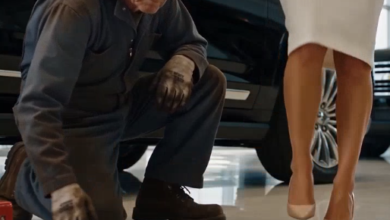
Part 2: The Night-Janitor Father Raised Two Daughters Alone — When the Youngest Became a Lawyer, Their Mother Returned Demanding Half the House
Part 2
Ray did not speak on the ride home.
He sat in the passenger seat of Hannah’s old Toyota with the grocery-store flowers across his lap, still wrapped in paper, still slightly damp at the stems.
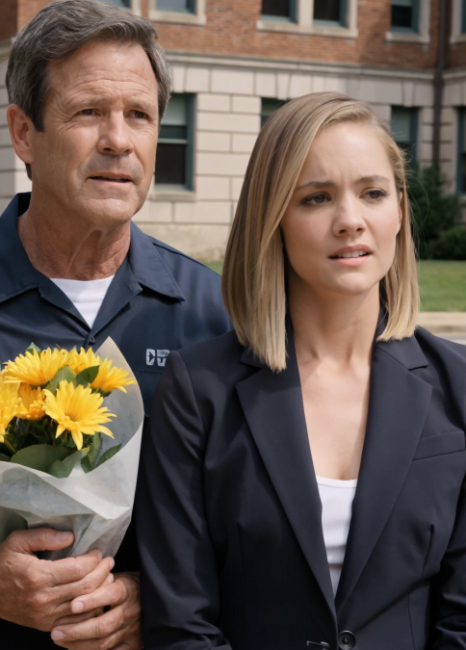
Grace drove behind them in her own car.
Hannah kept looking in the rearview mirror, as if she might see betrayal sitting in the car behind her.
“She gave Mom the key,” Hannah said.
Ray turned his head toward the window.
“I saw.”
“That house is all you have.”
Ray rubbed one thumb over a small tear in the flower wrapping.
“No,” he said quietly. “It isn’t.”
Hannah wanted to argue, but the words caught.
Their house on Maple Street was not much to anyone else. It had peeling white paint, a crooked porch rail, and a kitchen floor that dipped near the back door. The upstairs bathroom faucet squealed whenever someone turned it too quickly.
But that house had held every winter they survived.
Ray bought it before Denise left, when he still believed marriage meant two people repairing the same roof.
After she disappeared, he paid the mortgage alone by cleaning three buildings at night. He mopped law offices, emptied trash cans, scrubbed restrooms, and polished marble floors where men in suits stepped over him without looking down.
Every month, the payment cleared.
Some months, barely.
Grace remembered waking at 5:40 in the morning to the sound of his keys in the kitchen. Ray would stand by the sink, eating toast over a paper towel so he would not wake the girls with dishes.
Then he would braid Hannah’s hair badly, pack lunches, and walk them to school before sleeping four hours.
Denise knew none of that.
Or maybe she knew enough and chose not to know more.
At the house, Grace arrived a few minutes later. She parked behind Hannah and sat in the driver’s seat longer than necessary.
Hannah was already on the porch when Grace got out.
“What was that?” Hannah demanded.
Grace held her purse against her side.
“A key.”
“Don’t do that lawyer thing with me.”
Grace looked toward the house, not at her sister.
Denise had not followed them home yet, but the thought of her having a key made the porch feel different. Less safe. Like someone had cracked open a memory without asking.
Ray stepped between his daughters before the argument sharpened.
“Inside,” he said.
They went into the kitchen.
The same kitchen where Ray had baked birthday cakes from boxed mix because bakery cakes cost too much. The same kitchen where Grace studied at a card table under a flickering light while Ray’s uniform dried over a chair.
Grace placed her purse on the counter.
Then she took out a thick folder.
Hannah stopped breathing so loudly.
Ray noticed the folder before either daughter spoke. His eyes went to the label on the tab.
Miller v. Miller Property Record.
“Grace,” he said softly.
She did not answer.
Instead, she opened the folder and laid out copies on the kitchen table.
Mortgage statements.
Tax receipts.
Repair invoices.
School financial aid forms.
A handwritten ledger in Ray’s careful block letters.
Hannah picked up the ledger first.
It was old, the cover bent, the pages held together with a rubber band. On the first page, Ray had written dates from the year Denise left.
Mortgage: paid.
Electric: paid late.
Grace shoes: size 10 kids.
Hannah field trip: ask Mrs. Keller for payment plan.
Denise: no contact.
Hannah sat down slowly.
“You kept all this?”
Ray looked ashamed, which made no sense and broke Grace’s heart again.
“I had to know where the money went,” he said.
Grace turned another page.
The entries continued for years.
Extra shift at courthouse. Bought used winter coats.
Grace fever, clinic bill.
Hannah science fair board, borrowed glue from work.
Denise called, hung up when I answered.
Hannah looked up sharply.
“She called?”
Ray closed his eyes.
“Once.”
“You never told us.”
“She did not ask for you,” Ray said.
The kitchen changed around that sentence.
It was not loud. It did not need to be.
Grace watched her sister absorb it.
All those years, Hannah had imagined their mother somewhere far away, maybe ashamed, maybe unable to return. The truth had edges. Denise had called the house and chosen not to ask for her daughters.
Grace moved one more document forward.
“This is why I gave her the key,” she said.
Hannah stared at the paper.
It was a property record from the county.
Denise’s name was still on the original deed.
Ray had tried to remove it twice, but the attorney fees always lost to braces, school trips, and tuition deposits.
Hannah’s anger returned.
“So she does own half?”
Grace shook her head.
“She has a claim. A claim is not the same as truth.”
Ray looked at his youngest daughter.
For the first time since the parking lot, his eyes held something other than hurt.
Grace reached into the folder and pulled out a final page.
A sworn petition.
Her name was printed at the top as attorney.
Her father’s name was listed below.
Ray Miller, petitioner.
Hannah read the first paragraph and covered her mouth.
Grace had not given Denise a key because she surrendered.
She had given her one because the house was no longer just a house.
It was evidence.
Part 3
Denise came to Maple Street at six that evening.
She parked the white SUV too close to the curb, stepped out carefully, and looked at the house with the expression of someone evaluating furniture she planned to sell.
Grace opened the door before she knocked.
Denise lifted the key.
“I suppose I do not need permission now.”
Grace stepped aside.
“You can come in.”
Hannah stood behind her with folded arms. Ray stayed by the sink, one hand resting on the counter he had sanded and resealed himself after the old laminate cracked.
Denise entered slowly.
Her eyes moved across the room.
The cheap curtains.
The repaired chair.
The framed graduation photos.
Hannah in cap and gown from nursing school.
Grace outside the courthouse that morning.
Ray standing awkwardly between them in every picture, smiling like he had been caught doing something too large to name.
Denise paused at Grace’s photo.
“My daughter, the lawyer,” she said.
Grace did not respond.
Ray offered coffee.
Hannah looked at him as if he had lost his mind.
Denise accepted.
That was Ray Miller. Even when someone arrived with a threat, he still remembered how to be decent without turning decency into surrender.
Denise sat at the kitchen table.
“This can be simple,” she said. “Sell the house, split the proceeds, and everyone moves on.”
Ray set the coffee in front of her.
“I am not selling.”
Denise laughed once.
“You always were sentimental.”
Ray lowered his eyes.
For years, people had mistaken his quietness for weakness. Teachers, landlords, debt collectors, and sometimes even his daughters had watched him absorb blows without swinging back.
But quiet was not the same as empty.
Grace opened her folder.
“Mom,” she said, using the word with visible effort, “before we discuss anything, I need you to understand what Dad is filing.”
Denise leaned back.
“You are representing him?”
“Yes.”
“That seems emotional.”
“It is documented.”
Grace placed the first stack of papers on the table.
“For fifteen years, Dad paid the mortgage, taxes, insurance, utilities, repairs, and every expense connected to this property alone.”
Denise waved a hand.
“He lived here. Of course he paid.”
“He also raised two children here alone,” Grace said. “That matters in equity.”
Denise’s face tightened.
“This is not about parenting. This is about property.”
Ray looked toward the hallway wall.
There were pencil marks there, measuring Hannah and Grace year by year. Denise’s gaze followed his, and for the first time, something uncertain crossed her face.
The lowest mark had Hannah at eight.
The next mark had Grace at five.
There were no marks in Denise’s handwriting after that.
Grace noticed where her mother was looking.
She let the silence do its work.
Then she placed the ledger on the table.
“This is Dad’s record from the first year after you left.”
Denise did not touch it.
Hannah did.
She turned pages until she reached one entry from December.
Christmas gifts: one doll from thrift store, one drawing set, both wrapped after shift.
Grace remembered that drawing set.
She had used it until every crayon became too short to hold.
Denise stared at the page.
“I was struggling too,” she said.
Ray nodded.
“I believe you.”
The answer disarmed her.
It should have made him seem noble. Instead, it made him painfully ordinary, a man who had long ago accepted that two truths could sit at the same table.
Denise had struggled.
And she had left.
Grace pulled out another document.
“This is the first letter you sent after leaving.”
Denise looked up.
“I sent letters?”
“One,” Grace said.
It was not a letter exactly.
It was a postcard from Phoenix with a picture of red desert rocks. On the back, Denise had written: Hope the girls are well. I need time.
No address.
No promise.
No love, not by name.
Ray had kept it anyway.
Denise picked up the postcard and touched the corner.
“I thought I sent more.”
Hannah’s voice cut through the room.
“You thought wrong.”
Ray gave her a soft look, not scolding, only reminding her not to burn herself on every truth.
Grace continued.
“You called once. Dad answered. You hung up. He still wrote it down.”
Denise looked at Ray.
He said nothing.
She seemed ready to argue, but Grace placed a phone record beside the ledger. Ray had paid the phone company for old records when Grace started law school and asked for everything.
The date matched.
Denise’s face changed.
Not enough for forgiveness.
Enough for memory.
“I was ashamed,” she whispered.
Hannah laughed bitterly.
“Must have been hard.”
Ray finally spoke.
“Hannah.”
She turned on him.
“No, Dad. She gets to come back when the house is worth something, and we all have to sit politely?”
Ray looked tired.
“I did not teach you polite to make you small.”
That sentence stopped her.
Grace had heard it before.
So had Hannah.
Ray used to say it whenever the girls confused kindness with letting people take whatever they wanted.
Denise looked between them.
There were whole years in that sentence she did not own.
Grace slid the petition toward her mother.
“We are asking the court to recognize Dad’s sole equitable ownership or, at minimum, reimburse every expense he carried alone before any division is considered.”
Denise picked up the paper now.
Her eyes moved over the numbers.
Mortgage payments.
Repairs.
Taxes.
Insurance.
Child-related housing costs.
The total was larger than she expected.
Much larger.
Her hands tightened.
“You cannot do this to me.”
Grace’s voice softened.
“We are not doing anything to you. We are showing what happened after you left.”
Denise looked at Ray.
“You let her become this hard?”
Ray’s face shifted.
For the first time that evening, anger crossed it clearly.
“No,” he said. “I let her become honest.”
Denise flinched.
Grace did too.
Not because the words were cruel.
Because Ray almost never spoke about what he had let himself become.
He had let himself become tired.
Underpaid.
Lonely.
He had let himself become the parent who signed every form and waited outside every recital in a work uniform because there was no time to change.
He had let himself become invisible so his daughters could be seen.
Hannah sat down at the table.
Her anger had not vanished. It had simply found something deeper underneath.
“Dad sold his truck when Grace got into college,” she said.
Grace looked at her sister.
She had not known that.
Ray’s eyes closed.
“Hannah.”
“No,” Hannah said. “She should know.”
Denise looked confused.
“He said the transmission died,” Grace whispered.
“It did,” Ray said.
Hannah shook her head.
“The repair was cheaper than a semester deposit. He chose the deposit.”
Grace stared at her father.
Ray wiped one hand over his face.
“It got you there.”
That was all.
The room folded around those four words.
Denise looked at the graduation photo again, then at the old man standing by the sink, though Ray was only fifty-four. Night work had aged him in uneven places.
Grace reached into her folder and removed one final document.
“This is not for court,” she said.
It was a copy of her bar admission letter.
At the bottom, handwritten in blue ink, was a note Grace had written the night she received it.
Dad, you cleaned buildings where lawyers worked so I could become one.
Ray had not seen it before.
His breath caught.
Grace placed the letter in front of him, not Denise.
“I was going to give this to you today,” she said.
Ray touched the paper with two fingers.
His hands were rough, the nails trimmed short, one knuckle swollen from years of gripping mop handles.
Denise watched him.
For the first time since returning, she looked less like a claimant and more like a woman standing outside a house she had once lived in and never truly entered.
“I need money,” she said quietly.
There it was.
Not ownership.
Need.
Denise’s second marriage had ended. Her savings were gone. The SUV was leased. The linen suit was purchased on credit for meetings where she hoped looking stable might become the same thing as being stable.
Ray leaned against the counter.
“You could have said that.”
Denise’s eyes filled.
“Would you have helped?”
Ray did not answer right away.
That hesitation was honest.
“I do not know,” he said. “But I would have heard you better than a demand.”
Grace closed the folder.
“We are not selling the house.”
Denise looked at both daughters.
Hannah’s face remained hard.
Grace’s did not.
That made Denise more uncomfortable.
“What are you offering?” Denise asked.
Grace glanced at Ray, asking permission.
He nodded once.
“We will pay directly for three months of rent in a modest apartment,” Grace said. “Not cash. Not from the house. Dad has a small emergency fund, and Hannah and I can help. After that, you handle your life.”
Denise stared.
“You would do that after filing against me?”
Ray answered this time.
“The house is not payment for your struggle. Help can be help without becoming a surrender.”
Denise looked down at the key in her hand.
For hours, she had thought it meant access.
Now it felt heavier, like an object she had not earned and could not use.
She placed it on the table.
The metal clicked softly against the wood Ray had repaired.
“I do not know how to be your mother now,” she said.
Hannah looked away.
Grace breathed slowly.
Ray picked up the key and set it beside his coffee.
“Then stop starting with what you are owed,” he said.
No one spoke for a long time.
Outside, evening settled over Maple Street. A neighbor’s dog barked twice. Somewhere down the block, children rode bikes past cracked sidewalks and summer lawns.
Denise stood to leave.
At the door, she turned back.
“Did they ask for me?” she said.
Ray’s expression tightened.
“Every day at first.”
Denise nodded as if she had been struck carefully, without mercy.
Then she left.
Part 4
The court hearing took place six weeks later.
It was not dramatic in the way Hannah imagined it would be. No one shouted. No one confessed on a stand beneath shaking lights.
There were folders.
Numbers.
Dates.
Quiet questions from a judge who had heard enough property disputes to know that houses sometimes carried more than titles.
Denise appeared with a different attorney, one from a legal aid clinic. She wore a simple gray dress and no sunglasses.
When asked whether she disputed that Ray had paid all expenses for fifteen years, she looked toward him once.
Then she said, “No.”
Grace’s hand tightened around her pen.
Hannah, seated behind them, blinked hard.
Ray did not smile.
The judge ordered mediation and later approved a settlement recognizing Ray’s full ownership after a modest payment tied to the original equity from before Denise left. Denise accepted far less than half.
The house stayed with Ray.
But the strangest part happened after the hearing.
Denise approached the courthouse steps where Ray waited with his daughters.
She held out a manila envelope.
Grace stiffened.
Hannah stepped slightly in front of Ray.
Denise noticed, and the hurt on her face was real, though not enough to make them move.
“It is not a demand,” she said.
Ray took the envelope.
Inside were old photographs.
Hannah at six, missing two front teeth.
Grace asleep on Denise’s shoulder as a toddler.
Ray standing beside a younger Denise in front of the house, one hand shading his eyes from the sun.
“I kept some things,” Denise said.
Hannah looked at the photos but did not reach for them.
Grace did.
The paper had faded at the edges, but the house was unmistakable.
Same porch.
Same maple tree.
Same front step where Ray would later sit tying two sets of little shoes before school.
“I thought keeping pictures meant I had not completely left,” Denise said.
Ray looked at her.
“Pictures are not the same as staying.”
“I know that now.”
He nodded.
Not forgiving.
Not punishing.
Just receiving the sentence as something late but true.
Over the next year, Denise did not become a mother in any simple way.
She rented a small apartment near a bus line. She worked at a medical billing office. She came to coffee with Grace twice, then canceled once, then apologized without blaming traffic.
Hannah refused the first three invitations.
On the fourth, she came and brought her own car so she could leave when she wanted. She lasted twenty-seven minutes.
It was not much.
It was a beginning, if beginnings can arrive after the story already hurt everyone.
Ray kept working nights for another eight months before Grace and Hannah convinced him to move to day maintenance at the county library. He resisted because the pay was slightly lower, then accepted when Grace showed him the budget she had made with the same seriousness he once used on his ledgers.
“You became bossy,” he said.
“You raised a lawyer,” she replied.
The house changed slowly.
Hannah repainted the porch rail. Grace replaced the upstairs faucet that squealed. Ray planted tomatoes near the fence because, for the first time in years, he was awake in daylight enough to water them.
One evening in late spring, Grace came home after work and found Ray sitting at the kitchen table with the old ledger open.
She set her briefcase down.
“Are you adding bills?”
He shook his head.
The ledger page was blank except for one line.
Grace admitted to the bar. Hannah brought pie. Denise returned key. House stayed.
Grace sat across from him.
“You do not have to keep proving what you paid,” she said.
Ray looked at the page.
“I know.”
“Then why write it?”
He ran one finger over the old entries, all those years of rent, shoes, medicine, school fees, and impossible choices.
“Because I used to write down what we survived,” he said. “Now I want to write down what we kept.”
Grace reached across the table and covered his hand.
His fingers were still rough.
They probably always would be.
In July, Denise came by the house for the first time since giving back the key. She did not use the porch without permission. She knocked and waited.
Hannah answered.
For a few seconds, neither spoke.
Denise held a small envelope.
“I found another picture,” she said.
Hannah took it.
It was a photograph of Ray asleep on the couch with both girls curled against him, one on each side. Denise must have taken it before she left.
Hannah stared at it longer than she meant to.
“He was already tired then,” she said.
Denise’s eyes filled.
“Yes.”
Hannah did not invite her in.
But she did not close the door right away either.
Inside, Ray was fixing a loose cabinet hinge. Grace was setting plates on the table. The house smelled like tomato sauce and garlic bread from the discount bakery.
Denise looked past Hannah, not greedily this time.
Carefully.
“I hope dinner is good,” she said.
Hannah nodded.
“Me too.”
Then she closed the door gently.
That night, after dinner, Ray found the new photograph on the refrigerator held by a tomato-shaped magnet. He stood in front of it for almost a full minute.
In the picture, his younger self looked exhausted.
But both little girls were asleep against him, safe enough to dream.
Grace came up beside him.
“You okay?”
Ray smiled without looking away.
“I did not remember her taking that.”
“Do you want it down?”
“No,” he said. “Leave it.”
The house was quiet around them.
Not empty.
Quiet.
The kind of quiet Ray had worked nights to protect, the kind that took years to build and one careless demand to threaten.
He reached up and straightened the photo.
Then he turned off the kitchen light.
Follow this page for more heartfelt stories about the quiet people who build love one sacrifice at a time.