Part 2: Her Ex-Husband Mocked Her for “Only Carrying Coffee” — At Their Son’s Medical School Graduation, He Called Her Name First
Part 2
At first, the auditorium did not understand what Ethan had done.
Medical school graduations follow a rhythm. A name is called. A graduate crosses the stage. A handshake happens. A diploma case changes hands. Families clap, cry, and take photographs from bad angles.
Ethan Carter broke that rhythm in a way that made important people shift in their seats.
The dean still held the diploma case.
The photographer lowered his camera.
Faculty members in velvet-trimmed robes exchanged quick glances, the kind that asked whether someone should intervene.
Ethan stood at the microphone, calm on the outside, but Marianne could see his right hand trembling against the wooden podium.
She knew that hand.
She had held it when he was six and feverish.
She had wrapped it in a dish towel when he cut himself helping her slice tomatoes.
She had watched it grow from a child’s soft grip into the steady hand of a man who wanted to become a surgeon.
Richard leaned toward his new wife.
“This is unnecessary,” he whispered.
But the microphone caught just enough of it.
A ripple moved through the rows nearby.
Ethan heard it.
He did not look at his father yet.
“My mother’s name is Marianne Carter,” he said. “Most of you do not know her, but half of this degree has her fingerprints on it.”
Marianne shook her head slightly.
Not here, her eyes said.
Not in front of all these people.
Ethan’s expression softened for a moment, but he kept going.
“She works at Rosie’s Diner on Route 9,” he said. “She has worked the breakfast shift since I was in first grade.”
A few people turned to look at Marianne again.
This time, their eyes stayed longer.
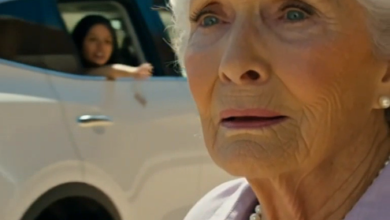
Her uniform was no longer just a uniform. The white apron folded under her cardigan, the sensible shoes, the old watch with a cracked band, all became part of a story they had not been expecting to hear.
Richard sat straighter.
His jaw tightened.
Ethan reached into the inside pocket of his robe and pulled out a small folded paper.
It was not part of the official program.
Marianne recognized it immediately.
A yellow diner receipt.
Her breath caught.
She remembered writing on the back of receipts because notebook paper was for Ethan. She remembered adding tips in pencil, calculating rent, car insurance, groceries, and the next tuition deposit while customers complained about cold eggs.
Ethan unfolded the receipt carefully.
“This is from September 14, 2009,” he said. “Two eggs, wheat toast, black coffee, and a three-dollar tip.”
Some people smiled gently, unsure why the detail mattered.
Ethan read the note on the back.
“Ethan shoes, $34. Lunch account, $18. Science fair board, $7. Save $20 for college jar.”
Marianne closed her eyes.
She had forgotten that particular receipt.
But she had not forgotten the jar.
It sat for years on top of the refrigerator, an old pickle jar with a blue lid and a label Ethan made in third grade.
DOCTOR MONEY.
He had written it in green marker after telling his mother he wanted to “fix people who hurt inside and outside.”
Richard had laughed when he saw it.
Not cruelly at first.
Then, later, more often.
Marianne still remembered him standing in their apartment kitchen, holding that jar with two fingers as if it were something dirty.
“You think tips and quarters are sending him to med school?” he asked.
She had taken the jar back without answering.
Onstage, Ethan placed the receipt beside the microphone.
“My mother kept every receipt she wrote on,” he said. “Not because she was sentimental. Because she was building a plan no one else believed in.”
A woman in the faculty row touched her chest.
Marianne sat down slowly, because her knees were no longer trustworthy.
Her sister, Diane, reached over and held her hand.
The dean stepped back from Ethan, no longer trying to hurry the moment.
Ethan looked toward the graduates seated behind him.
“Most of my classmates had parents who visited campus with care packages,” he said. “Mine mailed me envelopes of five-dollar bills wrapped in napkins from Rosie’s.”
A soft laugh moved through the room.
Marianne smiled through tears despite herself.
She had done that.
Cash hidden inside napkins because envelopes sometimes tore, and because she worried he would feel embarrassed if anyone saw small bills instead of checks.
Then Ethan’s face changed.
The next part would not be gentle.
“My father told people she was just a waitress.”
The auditorium sharpened.
Richard’s new wife looked down at her lap.
Richard’s ears reddened.
Ethan finally turned toward him.
“But I want to be accurate today,” Ethan said. “She was never just carrying coffee.”
He paused.
“She was carrying rent, biology textbooks, bus fare, fever medicine, college applications, and every morning I thought I could not keep going.”
No one clapped.
Not yet.
The room had become too still for applause.
Marianne wanted to disappear and be seen at the same time. It was an impossible feeling, the kind single mothers learn to live with when pride and exhaustion share the same chair.
Then Ethan reached behind the podium and picked up a small object.
A name tag.
White plastic. Red letters.
MARIANNE.
The metal pin on the back had been bent for years.
“She wore this name tag for thousands of shifts,” he said. “But when I was twelve, someone at the diner asked if she was disappointed she never became more.”
Marianne’s eyes opened.
She remembered that too.
A businessman at table six had said it while reading a newspaper, not even looking at her.
Must be hard, knowing this is all there is.
She had poured his coffee anyway.
Ethan had been in the corner booth doing homework.
She thought he had not heard.
“I heard it,” Ethan said into the microphone.
Marianne’s hand tightened around Diane’s.
“And that night, Mom told me something while she soaked her feet in a dishpan.”
He looked down at the name tag.
“She said, ‘Baby, work is not small when it keeps someone alive.’”
The dean removed his glasses.
Richard stared at the stage as if the room had turned against him personally, though no one had spoken to him.
The truth had not shouted.
It had simply arrived.
Part 3
Ethan did not tell the story in order.
Maybe he could not.
Some sacrifices do not line up neatly, because they happened between double shifts, unpaid bills, and breakfasts eaten standing over a sink.
He began with the shoes.
“When I was in eighth grade,” he said, “I needed dress shoes for a science competition. I told my mom the night before because I was embarrassed to say I did not have any.”
Marianne remembered the shame in his voice more than the shoes.
She had been taking off her apron at 9:40 p.m., her feet swollen, her tips counted in small piles on the table.
The stores were closing.
Her gas tank was low.
Richard had missed another child support payment and left a message saying he had “temporary financial priorities.”
Marianne drove Ethan to a discount store anyway.
She bought black dress shoes one size too big because they were on clearance, then stuffed the toes with tissue paper before the competition.
Ethan won second place.
In the auditorium, he smiled faintly.
“I walked funny the whole day,” he said. “But I walked across that stage.”
A quiet laugh moved through the room again.
Then he told them about freshman year of college.
The scholarship covered tuition, but not enough of everything else. Housing deposits, lab fees, winter clothes, transportation, and books arrived like waves.
Ethan almost quit in October.
He had called Marianne from a campus stairwell, whispering because he did not want his roommate to hear.
“I can come home,” he told her. “I can work for a year.”
Marianne had been wiping down the diner counter after closing.
Her feet hurt so badly she had been leaning on one hip all night.
She looked at the empty booths, the sugar packets, the lipstick stain on a coffee cup.
Then she told him, “You can rest tonight. You cannot quit tonight.”
The next morning, she picked up weekend shifts at a banquet hall.
Ethan did not know that part until years later, when Diane accidentally mentioned it.
“My mother missed birthdays,” he said. “Not because she did not care, but because time-and-a-half paid for anatomy books.”
Marianne bowed her head.
There were birthdays she still hated remembering.
Ethan at sixteen, blowing out candles at 10:30 p.m. because she had come home late.
Ethan at nineteen, opening a card in his dorm room over video call while she sat in the diner parking lot, too tired to drive home first.
Ethan at twenty-three, calling from the hospital after his first clinical rotation, while she ate vending machine crackers on a night shift.
Richard had been invited to all those birthdays.
Sometimes he came.
Usually he brought expensive gifts that looked good in pictures and disappeared when bills arrived.
Ethan did not say that.
He chose another truth.
“There were years I thought my father gave me ambition,” he said. “He spoke well. He knew important people. He always seemed comfortable in rooms where I felt like I was borrowing oxygen.”
Richard’s face softened slightly, perhaps hearing praise where none had fully formed.
Then Ethan continued.
“But my mother gave me endurance. And in medicine, endurance is not decoration. It is survival.”
A professor in the second row nodded slowly.
Ethan looked toward the class.
“When I failed my first surgical skills assessment, I was ashamed to call anyone. I had spent my whole life trying to be proof that Mom’s work meant something.”
Marianne’s tears fell faster now.
She had not known he carried it that way.
That was the hidden cost of sacrifice. Sometimes love becomes pressure when children try to pay it back with perfection.
Ethan held the edge of the podium.
“I called her at 1:12 in the morning,” he said. “I expected advice.”
Marianne remembered the call exactly.
She had been sitting in her kitchen with her shoes off, pressing a bag of frozen peas against her ankle.
“What did you tell him?” the dean asked softly, surprising everyone.
Ethan smiled.
“She said, ‘Then fail clean. Learn what cut you. Go back tomorrow.’”
A low sound moved through the auditorium.
Not laughter.
Recognition.
Every doctor in that room understood the sentence.
Ethan continued.
“I went back. I failed less. Then I passed.”
Marianne looked toward Richard then, not triumphantly, but almost by accident.
He was looking at her for the first time without a smirk.
Maybe he saw the uniform.
Maybe he saw the years.
Maybe he saw only the fact that a room full of doctors was listening to the woman he had spent decades reducing to a job title.
Ethan picked up another folded paper.
“This is the part I did not know until last month.”
Marianne straightened.
Diane whispered, “Oh no.”
Ethan unfolded a letter from Franklin Medical College’s financial office.
“In my second year, there was a balance due that would have stopped my registration.”
Marianne covered her face.
She knew what was coming.
“I thought the school made an error,” Ethan said. “I thought my aid had gone through.”
He looked toward his mother.
“It had not.”
That month, Marianne had sold her car.
Not traded it.
Sold it.
She told Ethan it had broken down beyond repair. Then she took two buses to the diner for almost a year, leaving home at 4:35 a.m. to make the breakfast shift by six.
Ethan learned the truth from Diane after matching into residency.
“I found out she sold the car to pay a bill I never saw,” he said.
The auditorium changed again.
A sacrifice like that does not need music. It enters quietly and takes the chair beside you.
Richard’s new wife wiped her cheek.
Richard did not move.
Ethan’s voice thinned slightly now.
“Mom, I was angry when I found out.”
Marianne looked up.
“I was angry because you carried it alone.”
She shook her head, crying openly.
He softened.
“But then Aunt Diane showed me the note you wrote on the receipt from the bus pass.”
He read it.
“Walking is cheaper than watching him give up.”
The dean looked down.
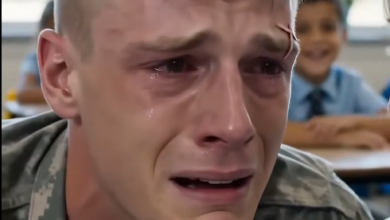
Several graduates behind Ethan were crying now.
One of them, a young woman who had worked nights in a nursing home through medical school, pressed both hands over her mouth.
Ethan placed the bus receipt beside the name tag and the old diner receipt.
Three small objects.
A life no one in tailored suits had thought to measure.
Then Richard stood.
The movement drew every eye.
For a moment, Marianne looked frightened, as if he might interrupt and make the room ugly.
He did not walk to the aisle.
He simply stood beside his seat, face tight with humiliation and something that might have been regret.
“I paid too,” he said.
The sentence came out defensive, smaller than he intended.
Ethan looked at him.
“You paid when it was convenient.”
Richard flinched.
Ethan’s voice did not rise.
“Mom paid when it hurt.”
The auditorium held that line without softening it.
Richard sat down slowly.
No one applauded his defeat because Ethan had not offered them a villain to enjoy. He had offered them an accounting of presence.
Then Ethan turned back to the dean.
“Sir, I know there is a program schedule.”
A few people laughed through tears.
The dean smiled gently.
“There was.”
Ethan nodded.
“I am ready now.”
The dean held out the diploma case.
Ethan did not take it.
Not yet.
He turned toward the back rows.
“Mom,” he said, voice breaking for the first time, “would you stand with me?”
Marianne shook her head immediately.
“No, honey,” she whispered, though the microphone did not need to catch it for everyone to understand.
Ethan waited.
This time, he did not rescue her from being seen.
Slowly, Diane helped Marianne stand.
Her cardigan slipped open enough for the blue waitress uniform to show.
Her name tag was still pinned there.
MARIANNE.
The whole auditorium rose before Ethan received his degree.
Not quickly.
Not as a performance.
One person stood, then another, then rows of families, graduates, professors, nurses, doctors, and guests whose own mothers had worked jobs the world called small.
Marianne stood in the back, one hand pressed to her mouth, looking like a woman who had spent her life carrying trays and had suddenly been asked to carry honor too.
Ethan accepted the diploma case.
Then he stepped away from the dean, descended the stage stairs, and walked straight down the aisle toward his mother.
No one stopped him.
When he reached her, he placed the diploma case in her hands.
“First patient is yours,” he said.
Marianne laughed and cried at the same time.
“What does that mean?”
He leaned close, the cap tassel brushing her cheek.
“It means you kept the doctor alive before he knew how to keep anyone else alive.”
She held the diploma with both hands, as if afraid it might be too heavy.
But it was not heavier than coffee pots.
Not heavier than rent.
Not heavier than all those mornings she rose before daylight and tied on an apron while the world slept.
Part 4
After the ceremony, families crowded the marble lobby with flowers, cameras, and shiny gift bags.
Marianne tried to give the diploma case back three times.
Ethan refused each time.
“Hold it for pictures,” he said.
“I do not belong in pictures like this.”
He looked at her with the gentle firmness doctors practice before they become doctors.
“You are the picture.”
Diane laughed so hard she cried again.
Richard approached near the lobby windows.
For once, he did not bring his usual easy confidence with him. His gray suit looked expensive, but his posture looked borrowed.
Marianne saw him coming and instinctively touched her name tag.
Ethan noticed.
Richard stopped a few feet away.
“Ethan,” he said.
“Dad.”
The word was neither warm nor cruel.
Richard looked at Marianne.
“I should not have said what I said.”
Marianne did not ask which thing.
There were too many.
“No,” she said quietly. “You should not have.”
He nodded.
“I did not know about the car.”
“You did not ask.”
The words were simple.
They left no room for performance.
Richard looked as if he wanted to defend himself, then thought better of it.
Ethan’s new stepmother stood behind him, holding her purse with both hands. She looked embarrassed, but not unkind.
“Congratulations,” she said to Marianne.
Marianne thanked her.
That was all.
Some moments do not need reconciliation to be complete.
Outside, the May sun fell across the medical school steps. Graduates posed in clusters, tossing caps, hugging grandparents, and trying to fit whole families into one frame.
Ethan guided Marianne to a quieter place near the side lawn.
He straightened her cardigan.
She laughed softly. “I look like I came from work.”
“You did,” he said. “You came from twenty-five years of it.”
That silenced her.
A photographer asked if they wanted a picture.
Marianne almost said no.
Ethan answered yes.
In the photograph, Ethan stands in his black robe with one arm around his mother. Marianne stands beside him in her blue waitress uniform, holding his diploma case against her chest.
Her eyes are swollen.
His smile is tired and enormous.
Behind them, sunlight catches the edge of her name tag.
Later, that picture went up on the wall at Rosie’s Diner.
Not in the back near the employee schedule.
Right by the register.
The owner, Rosie herself, put it there the next morning with a strip of tape and a frame she bought at a discount store.
Under it, she wrote on a napkin and taped it to the glass.
Marianne’s boy. Dr. Carter.
Customers asked about it for weeks.
Marianne tried to wave it off at first.
“He did the work,” she would say.
Rosie would call from the grill, “And who kept him fed?”
Marianne always pretended not to hear.
Two months later, Ethan began his residency at a hospital forty minutes away. His schedule became brutal. His calls became shorter. His eyes looked tired in a new way.
One morning after a night shift, he walked into Rosie’s Diner at 6:10 a.m.
Marianne was refilling sugar canisters.
She looked up and froze.
He was wearing scrubs now.
Real scrubs.
Hospital badge.
Stethoscope around his neck.
For a second, she saw the six-year-old with the fever, the eighth grader in too-big shoes, the college freshman trying not to quit.
Then she saw the doctor.
“Coffee?” she asked, because some habits are stronger than emotion.
Ethan sat at the counter.
“Yes, ma’am.”
She poured it.
Her hand shook only a little.
He reached into his pocket and pulled out a crisp twenty-dollar bill.
“For the coffee,” he said.
She rolled her eyes. “That coffee is two dollars.”
“The rest is a tip.”
Marianne looked at him.
“Ethan.”
He smiled.
“I heard tips can build things.”
She looked away toward the window, where morning traffic moved along Route 9 and the diner neon blinked against the glass.
Then she placed the twenty in the tip jar.
Not because she needed it.
Because he needed to give it.
At the far end of the counter, an older man looked at the framed graduation photo and then at Marianne.
“That your son?” he asked.
Marianne glanced at Ethan, who was stirring sugar into his coffee like he still had all the time in the world.
“Yes,” she said.
For once, she did not add anything small to make herself smaller.
The man nodded. “You must be proud.”
Marianne picked up the coffee pot, warm and familiar in her hand.
“I am,” she said.
Then Ethan looked at her over the rim of his cup.
“So am I.”
The morning rush began a few minutes later.
Orders came in.
Toast burned.
Someone complained about cold bacon.
A toddler spilled orange juice under booth four, and Rosie yelled for more napkins.
Marianne moved through it all with practiced grace, coffee pot in hand, name tag bright against her uniform.
Only now, when people called her name, it sounded different to Ethan.
Not because she had changed.
Because everyone else finally had.
Follow this page for more heartfelt stories about the quiet people whose love carries more than anyone sees.