Part 2: Father Mocked for Having “No Future” as a Sanitation Worker — His Daughter’s School Speech Made Everyone Lower Their Eyes
Samuel Brooks had never attended an event at Jefferson Academy without feeling slightly out of place.
The school sat on a hill above Cedar Falls, surrounded by tall maple trees and carefully trimmed hedges. Most students arrived in clean cars driven by parents who spoke easily about college visits, travel teams, and summer programs.
Grace had arrived differently.
She had entered Jefferson Academy on a need-based scholarship in seventh grade.
Samuel drove her to school each morning in an aging pickup truck with a cracked dashboard and a heater that took ten minutes to work.
Before sunrise, he dropped her at the side entrance.
Then he continued toward the sanitation yard, where his shift began at six.
Grace rarely complained.
She carried a secondhand backpack and packed her lunch in a faded cloth bag. When classmates compared spring break plans, she smiled and changed the subject.
Teachers knew her as the student who remained after class to ask one more question.
They knew she borrowed novels from the library and returned them with small sticky notes marking favorite passages.
They knew she wanted to study environmental engineering.
Few people knew much about Samuel.
To Grace’s classmates, he was the man in the orange jacket who waved from the truck.
To some parents, he was a reminder that not every family at Jefferson Academy belonged to the same world.
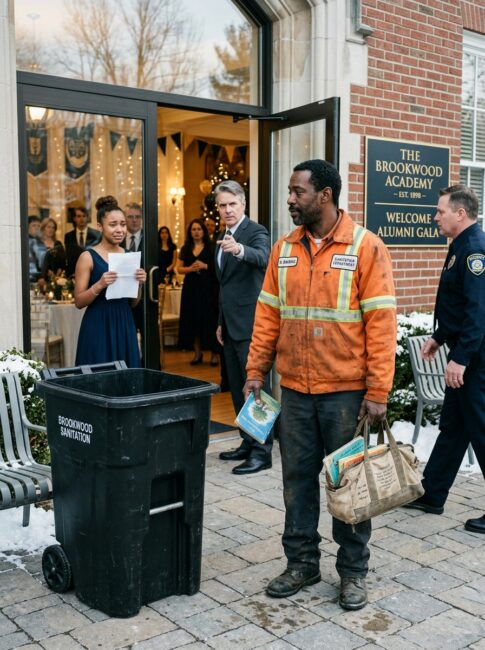
The man who confronted Samuel at the banquet was named Charles Whitman.
He owned a chain of home improvement stores and served on the school fundraising committee. His son, Ethan, was graduating in the same class as Grace.
Charles had seen Samuel before.
Months earlier, Samuel had arrived at the school during a rainstorm to pick Grace up after debate practice.
The truck had stalled near the front entrance.
While Samuel lifted the hood, Charles walked past with two clients.
He glanced at Samuel’s uniform and asked a staff member whether service vehicles were permitted near the main building.
Samuel heard him.
He did not respond.
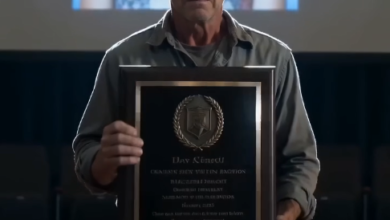
At the banquet, Samuel kept his chair near the back wall.
He listened while students received certificates for academic excellence, community service, and athletics.
When Grace’s name was announced for the school’s leadership award, he clapped longer than anyone else.
Then he stopped when he realized people were turning toward him.
During the meal, he barely touched his plate.
He ate half of a chicken breast and a spoonful of potatoes. He left the vegetables untouched and placed the rolls inside his pocket.
A server noticed.
So did Charles.
What nobody noticed was the folded note Samuel had read before entering the gymnasium.
The note came from Luis Ortega, his coworker on the morning route.
Luis had suffered a back injury two days earlier and was recovering in a small apartment with his eight-year-old grandson.
Samuel had covered the final hours of Luis’s shift before coming directly to the banquet.
At the sanitation yard, Luis had joked that the hospital food was terrible and asked whether the school banquet served real bread.
Samuel had laughed and promised to bring him something.
The rolls were not for Samuel.
But Samuel did not explain.
He had spent years learning that explanations rarely changed the minds of people determined to misunderstand him.
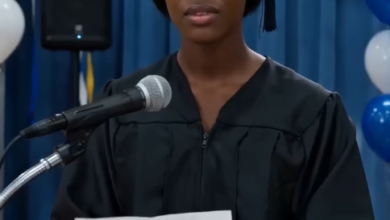
Grace stood behind the microphone and looked across the room.
Her hands trembled slightly.
She unfolded her paper.
“My father asked me not to write my speech about him,” she began.
A few people smiled politely.
Samuel lowered his head.
Grace continued.
“He said tonight should be about the students who are graduating. He said nobody needed to hear about a man who picks up other people’s trash.”
The room became quieter.
Charles shifted in his chair.
Grace looked toward the back wall.
“But I think the things people throw away can tell you a lot about what they fail to notice.”
Samuel’s fingers tightened around the napkin inside his pocket.
Grace reached beneath the podium and lifted a worn cardboard box onto the stage.
Inside were books.
The covers were scratched. Several pages had been repaired with clear tape. One book had a child’s name written across the front in green crayon.
“These came from my father’s route,” Grace said.
“He found them beside trash cans, inside broken boxes, and beneath piles of furniture people no longer wanted.”
She picked up a copy of Charlotte’s Web with a torn spine.
“When I was eight, this was the first book he brought home.”
Samuel looked at the floor.
Grace smiled softly.
“We could not afford many books then. Dad cleaned this one with a damp cloth, taped the cover, and read it to me one chapter at a time.”
She paused.
“What I did not know was that he was saving the others.”
After Grace’s mother died, Samuel’s life narrowed quickly.
Rebecca Brooks had been thirty-four when doctors found an aggressive form of ovarian cancer.
Grace was six.
At the time, Samuel worked at a small printing company. He earned modest wages, but the job offered no reliable health insurance.
Rebecca’s treatments lasted almost two years.
Samuel took extra shifts.
He borrowed money.
He sold his motorcycle and most of his tools.
When Rebecca died, Samuel still owed more than he could imagine repaying.
The sanitation department job was not part of a plan.
It was the first position he found with stable benefits, predictable hours, and a pension.
The shift began early enough for him to be home when Grace returned from school.
It paid enough to keep their small house.
It allowed him to attend parent-teacher meetings without asking a manager for permission.
Samuel never described any of that as sacrifice.
He simply woke before five each morning, made Grace’s lunch, and left a note beside her cereal bowl.
Some notes reminded her to bring an umbrella.
Some contained terrible jokes.
One read:
Your science test does not know how smart you are yet. Introduce yourself.
Grace kept that note inside her wallet.
On his route, Samuel began noticing things other people left behind.
Books.
Winter coats.
School supplies still sealed in plastic.
A desk lamp with a loose wire.
A wooden shelf missing two screws.
He brought useful items home, cleaned them in the garage, and repaired what he could.
At first, the books filled a corner of Grace’s bedroom.
Then they filled two milk crates beside the couch.
One Saturday, Grace asked why they needed so many.
Samuel looked at the stacks and shrugged.
“Maybe somebody else needs them too.”
He built a narrow wooden cabinet beside the bus stop near their house.
He painted it blue and attached a simple sign.
TAKE A BOOK. LEAVE A BOOK.
The first week, only three books disappeared.
By the second month, neighborhood children stopped there after school.
A retired teacher donated dictionaries.
A grocery store cashier left coloring books.
Someone placed a note inside the cabinet.
Thank you. My son reads every night now.
Samuel folded the note and kept it in his toolbox.
The little library became five libraries.
Then seven.
Samuel installed one outside a laundromat, another beside a community clinic, and another near the apartment complex where Luis lived with his grandson.
He never placed his name on them.
Grace told the story slowly.
The banquet room no longer felt like a banquet room.
Servers stopped collecting plates.
Students turned toward Samuel.
Parents who had glanced at his stained jacket now watched him with uncomfortable stillness.
Grace lifted another book from the box.
“This one was found behind an apartment dumpster,” she said.
It was a high school algebra workbook.
“The answers were written in pencil, so Dad erased every page by hand.”
Samuel remembered the workbook.
Grace had been twelve.
She wanted to join an advanced math program, but the preparation course cost more than Samuel could afford.
For three months, they sat together at the kitchen table after dinner.
Samuel did not understand every problem.
He had left community college before completing his associate degree.
But he erased the pages, sharpened pencils, and stayed awake beside her until she finished.
Grace earned the highest entrance score in the program.
She never told anyone how she studied.
“There is something else my father does not know,” Grace said.
Samuel looked up.
Grace reached into the box and removed a sealed envelope.
“Last fall, the Jefferson Academy scholarship office received an anonymous donation.”
The headmaster, seated near the stage, lowered his eyes with a small smile.
“The donation covered application fees, transportation passes, and school supplies for three students,” Grace continued.
Samuel stared at the envelope.
A murmur moved through the room.
Grace looked directly at her father.
“The office believed the money came from a local business owner.”
Samuel’s face changed.
He understood before she said the next words.
“It did not.”
The money came from Samuel’s overtime pay.
For eleven months, he accepted extra Saturday shifts.
He told Grace he was helping cover a coworker’s route.
That was partly true.
But every additional check went into an envelope inside his dresser drawer.
Samuel had noticed two middle school students reading beside one of his blue book cabinets during winter.
Their mother worked at the laundromat.
Both children had applied to Jefferson Academy but could not afford the additional costs that scholarships did not cover.
Samuel asked the school whether he could help without giving his name.
He expected the donation to remain private.
Grace discovered the truth by accident when she volunteered in the scholarship office.
“I asked the headmaster for permission to mention it tonight,” she said.
Samuel shook his head gently.
He did not look angry.
He looked exposed.
Grace’s voice softened.
“My father did not want anyone to know because he did not think it was a big thing.”
She looked around the room.
“He thought picking up trash was ordinary.”
Samuel sat motionless.
“He thought repairing books was ordinary.”
Her eyes filled with tears.
“He thought giving away his Saturdays was ordinary.”
Charles Whitman no longer looked toward the stage.
His gaze rested on the untouched plate in front of him.
Grace unfolded the final page of her speech.
“When I was younger, I thought having a future meant escaping the life my father lived.”
Samuel looked at her.
“I thought success meant wearing clean clothes to work and never smelling like diesel when you entered a room.”
Several students glanced toward Samuel’s jacket.
Grace steadied her breath.
“But my father never asked me to become better than him.”
She paused.
“He asked me to become useful.”
The words settled across the room.
Grace looked toward the back wall.
“My father collects what other people overlook. Books. Furniture. Time. People who need one more chance.”
Samuel’s eyes filled.
Grace smiled through tears.
“So when someone asks what kind of future a sanitation worker can offer his daughter, I know the answer.”
She looked down at the repaired books inside the box.
“He gave me a future built from things the world had already decided were worthless.”
Nobody applauded immediately.
The silence lasted several seconds.
It was not an empty silence.
It was the kind that arrives when people recognize themselves inside something they wish they had not done.
Then Luis Ortega entered the gymnasium slowly, using a cane.
His grandson walked beside him.
Samuel stood quickly.
“What are you doing here?”
Luis smiled.
“You took my route. I came for my bread.”
A few people laughed softly, though several were wiping their eyes.
Samuel reached inside his jacket and handed Luis the napkin-wrapped rolls.
Charles looked at the bread.
His expression tightened.
He pushed his chair back and stood.
For a moment, it seemed as though he might leave.
Instead, he walked toward Samuel.
“I owe you an apology,” he said.
Samuel nodded once.
Charles struggled to continue.
“I saw your uniform before I saw you.”
Samuel looked at him calmly.
“That happens.”
Charles lowered his eyes.
Then he extended his hand.
Samuel accepted it.
Not warmly.
Not coldly.
Simply because the gesture was there.
After the banquet, Samuel helped stack chairs.
The school custodian told him he did not need to.
Samuel picked up another chair anyway.
Grace stood near the stage speaking with teachers and classmates. Her leadership award rested beneath one arm.
The cardboard box of repaired books sat beside the podium.
Several parents stopped to look inside.
One woman asked whether the blue neighborhood libraries accepted donations.
Another asked where she could bring children’s books her family no longer used.
Samuel answered each question quietly.
Charles waited near the door until most guests had left.
His son, Ethan, stood beside him holding a plate wrapped in aluminum foil.
Ethan approached Luis’s grandson and offered him two slices of cake.
The boy accepted them carefully.
Charles looked toward Samuel.
“My company replaces display shelving every year,” he said. “Some of it is still usable.”
Samuel lifted one chair onto another.
“Usable is good.”
“I could have it delivered to your garage.”
Samuel nodded.
“We can make more book cabinets.”
Charles seemed relieved that the conversation had somewhere practical to go.
The following Saturday, a truck arrived outside Samuel’s house carrying shelves, paint, and several boxes of donated books.
Grace worked beside her father in the garage.
She wore an old sweatshirt and tied her hair back with a strip of cloth.
Samuel measured a wooden panel twice before cutting it.
“You embarrassed me,” he said.
Grace stopped painting.
“I know.”
Samuel tried to hide a smile.
“You told everyone about the algebra workbook.”
“I left out the part where you fell asleep on the answer key.”
“That was considerate.”
Grace laughed.
For several minutes, they worked without speaking.
The garage smelled of sawdust and blue paint.
A repaired copy of Charlotte’s Web rested on a shelf above Samuel’s tools.
Its taped spine had yellowed with age.
Grace noticed it and reached for the book.
“You kept this one?”
Samuel nodded.
“Some things are not ready to be passed along.”
By spring, the neighborhood had three new book cabinets.
One stood outside Jefferson Academy near the public sidewalk.
Students filled it with novels, workbooks, and children’s stories.
The school placed no plaque on the cabinet.
Samuel had asked them not to.
On graduation day, Grace walked across the stage and accepted her diploma.
Samuel sat near the front this time.
He wore a clean button-down shirt, but his work boots remained the same.
After the ceremony, Grace found him standing beside the blue cabinet.
A little girl had opened the door and was choosing between two picture books.
Her mother waited patiently nearby.
Grace leaned against her father’s shoulder.
“You know what I remember most about the banquet?” she asked.
Samuel looked at her.
“The applause?”
Grace shook her head.
“The bread rolls.”
Samuel smiled.
“Luis said they were dry.”
“That is not what I mean.”
She watched the little girl remove a book and hold it against her chest.
“You were standing in a room full of people judging you, and you were still thinking about someone else.”
Samuel looked toward the cabinet.
The girl closed the small wooden door carefully.
One repaired book was gone.
Several more remained.
Samuel placed his hands inside the pockets of his jacket and stood beside his daughter while the afternoon sunlight moved across the blue paint.
Follow this page for more heartfelt stories about the people whose quiet work is too often overlooked.