Fifty Bikers Surrounded My House and Broke Down the Door—But the Message Hidden on One Rider’s Phone Changed What Everyone Saw
Fifty motorcycles surrounded my house before sunset, and when their riders began pounding on the front door, every neighbor believed a biker gang had come to hurt the family trapped inside.
From the upstairs bedroom, I could hear the V-twin engines shaking the windows. Heavy boots crossed the porch. Leather creaked beneath voices so deep that they carried through the walls.
Then someone struck the front door again.
My eight-year-old son Noah buried his face against my side. I covered his ears, although nothing could hide the sound of fifty strangers calling my husband’s name.
To anyone watching from the street, the scene looked terrifying.
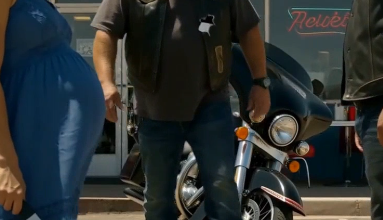
Men and women in black leather had parked their Harleys along both sides of Willow Creek Road. Several neighbors stood behind curtains, recording through their windows. One man shouted that he had called the police. Another demanded that the bikers leave.
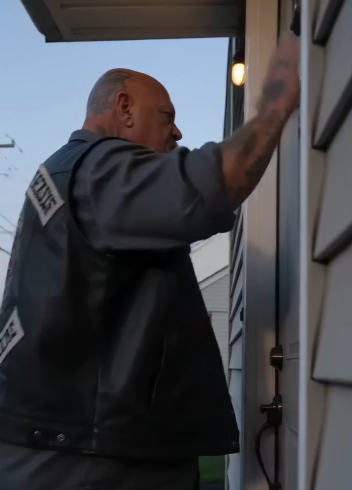
The largest rider stood at the center of the porch.
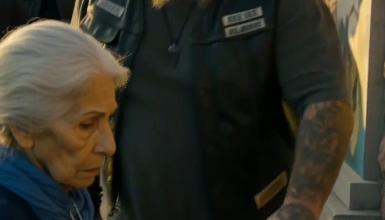
His name was Mason “Grizzly” Hale. He was fifty-two, six-foot-five, nearly three hundred pounds, with a shaved head, a chest-length gray beard, tattooed arms and a weathered face that rarely revealed what he felt.
I had known him before the beard turned gray.
But my neighbors had not.
They saw his leather cut, scarred knuckles and heavy boots. They saw forty-nine riders waiting behind him. They saw him raise one fist and strike the door hard enough to make its hinges tremble.
“Rachel!” he shouted. “Get away from the hallway!”
My husband Eric stood at the bottom of the stairs with my phone clenched in one hand. He had locked every exterior door, pulled the curtains and told police—when they called back—that everything inside was fine.
Then he looked up at me.
“You brought them here.”
I said nothing.
Only eleven words from me had reached Grizzly before Eric tore the phone from my hand:
He locked us inside. Noah is with me. Please hurry.
I had not known Grizzly was attending a charity ride three miles away. I had not known fifty members of the Iron Lantern Brotherhood would hear him read that message.
I only knew he had once told me that if I ever became afraid inside my own home, I should send him an address and nothing more.
Downstairs, the doorframe cracked.
Neighbors screamed. Phones rose above the crowd. Eric dragged a kitchen chair beneath the doorknob while calling the riders criminals.
Grizzly struck the door one final time.
Wood split near the lock.
Before stepping through, the enormous biker held up my message on his phone and spoke loudly enough for every camera outside to hear.
“We’re not here for the man at the door.”
Then Noah whispered something beside me that turned Grizzly’s face from anger to fear—and all fifty riders suddenly stopped moving.
Want to know what Noah whispered and what Grizzly found behind the locked bedroom door? Drop DOOR in the comments—I’ll share more soon.
Three months before fifty motorcycles surrounded my home, Grizzly came to repair our washing machine.
That was not his profession. He owned Hale’s Motorcycle and Machine, a narrow garage beside Route 23 where the air smelled of motor oil, burnt coffee and hot steel. Yet when my dryer failed, he arrived with tools because he had known my older brother Daniel since high school.
Daniel had died seven years earlier after a factory accident. At the funeral, Grizzly stood in the rain without an umbrella and held my mother upright when her knees failed.
He never spoke about that day afterward.
The week he repaired the washing machine, Eric hovered in the doorway and criticized everything I did. He complained that I had bought the wrong detergent, folded Noah’s clothes badly and allowed a stranger into his house without permission.
Grizzly remained beneath the machine, turning a wrench.
When Eric left the room, Grizzly asked whether Noah and I were safe.
I laughed too quickly.
“Of course.”
The wrench stopped moving.
Grizzly slid from beneath the appliance and studied me with pale blue eyes. He did not ask about the yellowing mark above my wrist. He did not tell me what he believed or demand that I confess something I was not ready to name.
He wrote his number on the back of the repair receipt.
“If you ever need a ride,” he said, “send the address.”
“I already know where you live.”
“Then send one word.”
“What word?”
“Any word you can get out.”
That frightened me because it meant my careful explanations had failed.
It also gave me something I had not possessed for months: a door that existed even when I could not yet walk through it.
Grizzly understood locked rooms for reasons he rarely discussed. His mother had spent years with a man who controlled every dollar, isolated her from relatives and persuaded the town that her fear was simply nervousness.
Grizzly was fourteen when he finally asked a school custodian for help. By the time an adult believed him, his mother had been living inside that silence for nearly a decade.
He carried guilt that had never belonged to him.
As an adult, Grizzly became a mechanic because engines were honest. A damaged bearing announced itself. A cracked belt left evidence. Human beings could smile through dinner while hiding what happened after the dishes were cleared.
His club, the Iron Lantern Brotherhood, was not an outlaw gang. Its members included mechanics, nurses, roofers, veterans, truck drivers, a family-law attorney and a retired sheriff’s dispatcher named Evelyn “Red” McCall.
Their leather made strangers cautious. The club used that attention for toy drives, funeral escorts and school anti-bullying rides, but Grizzly had strict rules whenever family violence was involved.
Call police first.
Do not threaten.
Do not chase.
Create distance between the endangered person and the aggressor, then surrender control when officers arrive.
Those rules existed because Grizzly knew how easily protection could become another display of power. A frightened child did not need to watch fifty adults lose control in the name of helping him.
The evening my message arrived, the club was completing a fundraising ride for a women’s shelter outside Millstone. Fifty motorcycles filled the parking lot of a roadside diner, their engines cooling beneath a sky heavy with approaching rain.
Grizzly was drinking coffee when his phone vibrated.
My message contained no explanation of what Eric had done. It did not need one.
He locked us inside. Noah is with me. Please hurry.
Grizzly called me immediately.
Eric answered.
“What does Rachel want?” Grizzly asked.
“My wife is upset.”
“Put her on.”
“She’s resting.”
“Let me hear her voice.”
Eric ended the call.
Grizzly dialed 911 and gave the dispatcher my name, address, message and everything he knew about the household. He explained that an adult woman and an eight-year-old child might be confined against their will.
The dispatcher sent officers, but a multi-vehicle collision on Route 23 had pulled several nearby units away. The estimated response time was uncertain.
“Do not enter unless someone faces immediate danger,” the dispatcher warned.
Grizzly agreed.
Then he heard Noah in the background when Eric accidentally answered a second call.
My son was crying.
The line went dead.
Grizzly stood, placed cash beneath his coffee cup and walked toward the door. Red followed him outside, along with forty-eight other riders who had seen the change in his face.
“What happened?” she asked.
“Rachel and her boy are locked in.”
“Cops?”
“Coming.”
“How long?”
“Too long to leave her alone.”
Grizzly told them nobody was being punished that night. They would surround the property only to keep every exit visible, give us a safe path if we escaped and provide witnesses until officers arrived.
“If that door opens, make room for Rachel and Noah,” he said. “Nobody lays a hand on Eric unless he stops them from leaving.”
“And if she asks us to enter?” Red asked.
Grizzly looked toward the darkening road.
“Then we bring them out.”
Fifty engines started almost together.
The sound rolled across the diner windows, deep and uneven, before the riders turned toward Millstone.
Inside our house, Eric placed my phone in his pocket and demanded the password to my email account.
The argument had begun with the packed bag he found beneath Noah’s bed. It contained two changes of clothes, copies of our birth certificates, medication, seventy-four dollars and the stuffed fox Noah carried when he could not sleep.
Eric held the fox by one ear.
“Where were you taking him?”
“Away for one night.”
“You were stealing my son.”
“I’m his mother.”
“You think that gives you the right?”
Noah stood behind me, silent and pale. I wanted him anywhere else, but Eric had locked the bedroom windows weeks earlier after claiming that old latches made the house unsafe.
He had also taken my keys.
That evening marked the first time I understood that control could become confinement without bars appearing on the windows. A person needed only the locks, the keys and the certainty that nobody outside would question him.
I had hidden the packed bag after speaking with an advocate at the shelter. She warned me that leaving could be the most unpredictable stage and helped me make a safety plan.
I was supposed to leave while Eric was at work.
His shift ended early.
When he discovered the bag, he swept a lamp from the table and blocked the back door with a kitchen cabinet. He did not strike Noah, and I will not invent an injury because the truth needs no decoration.
He frightened him.
That was enough.
I reached my phone while Eric searched the bag and sent the message to Grizzly. I saw the word delivered a second before Eric grabbed the device.
He read it twice.
Then we heard the first engine.
One became five. Five became twenty. Soon the glass in the cabinet doors vibrated beneath a continuous mechanical thunder.
Eric opened the curtain and stared outside.
Motorcycles filled the road. Headlamps cut through the early evening. Riders dismounted without rushing, removed their helmets and took positions where every side of the house remained visible.
Grizzly walked to the porch alone.
He knocked first.
“Rachel, it’s Mason.”
Eric yelled through the door that nobody needed help.
“I need to hear her say that.”
“This is private property.”
“I know.”
“You brought a gang to my house.”
“I brought witnesses.”
That answer made Eric angrier than a threat would have.
He called 911 and reported fifty armed bikers attacking his family. There were no visible weapons, but he repeated the claim until the dispatcher instructed him to remain inside and stay away from the door.
Outside, phones appeared in neighbors’ hands. Mrs. Daley began recording from her driveway while her husband shouted that children lived in the house.
Grizzly looked toward him.
“That’s why we’re here.”
The sentence sounded sinister without context.
Several riders stood near our fence, but nobody climbed it. Others moved their motorcycles off the road so emergency vehicles could pass. Red walked from neighbor to neighbor, asking everyone to stay back and confirming that police had been called.
From upstairs, I opened the bedroom curtain.
Grizzly saw me.
I raised one hand, then pointed toward Noah.
Eric noticed the movement and climbed the stairs. He seized my arm and pulled me from the window, telling me that I was humiliating him in front of the neighborhood.
Noah screamed for him to stop.
Every engine outside fell silent.
The sudden absence of sound was more frightening than the roar.
Grizzly called my name. I tried to answer, but Eric covered my mouth long enough to drag us into the bedroom. He released me only after turning the lock from the hall, trapping Noah and me inside.
He went downstairs.
Through the floorboards, I heard him push furniture against the entrance.
“Rachel!” Grizzly shouted.
“We’re upstairs!” I called.
Eric struck the ceiling with a broom handle and warned me to remain quiet.
Grizzly spoke to someone outside, but I could not hear the words. Later, Red told me he called 911 again and described the scream, my appearance at the window and Eric’s movement upstairs.
The dispatcher could hear Noah crying through Grizzly’s open line.
That changed the instruction.
If Grizzly could make a safe entry without escalating the danger, officers would not tell him to stand idle while a child called for help.
He placed the phone in Red’s hand.
“Keep dispatch listening.”
Then he stepped to the door.
Eric shouted that he had done nothing wrong. He claimed I was unstable, that the bikers had manipulated me and that Noah was frightened only because they had surrounded the house.
For years, he had made me question the meaning of what happened inside our walls. Now he was trying to rewrite the scene before anyone entered it.
Grizzly knocked again.
“Eric, open the door and step onto the porch. Nobody touches you.”
“Get off my property.”
“Let Rachel and Noah walk out.”
“They’re my family.”
“They’re not your property.”
The chair scraped beneath the doorknob.
Grizzly looked toward Red, who still held the dispatcher on speaker. She nodded once.
The first impact cracked the trim.
The second loosened the frame.
On the third, the latch broke and the door swung inward against the chair.
Neighbors shouted. Mrs. Daley’s camera shook. Several riders moved forward, but Grizzly spread one arm and ordered them to remain on the lawn.
Only Red, a former military medic named Jonah “Atlas” Reed and club attorney Marcus Bell followed him inside.
The other forty-six held their positions.
Grizzly crossed the threshold with his hands open.
“Rachel?”
“Upstairs!”
Eric stepped into the hallway and tried to block him. He pointed toward the broken door, screaming that the biker had invaded his home and would go to prison.
Grizzly stopped several feet away.
“Where’s the key?”
“Get out.”
“Open the bedroom.”
Eric moved toward the kitchen instead.
Atlas shifted sideways, keeping the stairway clear. Marcus told Eric that police were already coming and instructed him not to interfere with the mother and child leaving.
Nobody struck him.
Nobody threatened him.
Then Noah screamed again.
Grizzly ran upstairs.
The bedroom door was hollow wood, painted white and marked with Noah’s handprints from a family decorating project years earlier. Seeing those little blue prints around a lock on the outside changed something in Grizzly’s expression.
He tried the handle.
“Rachel, move back.”
I pulled Noah behind the bed and answered that we were clear.
Grizzly kicked beside the latch once. The frame split, and the door opened.
He did not enter immediately.
That detail stayed with me.
A man who had just broken two doors lowered his shoulders, stepped away from the opening and gave me space to decide whether I wanted to approach him.
Noah ran first.
Grizzly dropped to one knee as my son crossed the room, but he did not grab him. He simply held out both arms and waited.
Noah collided with his chest.
The leather creaked around them. Grizzly closed one scarred hand across the back of the boy’s pajama shirt while keeping the other where I could see it.
“You’re coming too,” he told me.
My legs would not move.
Eric was shouting downstairs. Neighbors were yelling outside. Fifty motorcycles surrounded my home, and the world I had spent years keeping hidden was now visible through a broken front door.
“I can’t,” I whispered.
Grizzly did not tell me to be brave.
He did not say everything would be fine.
He looked at the packed bag lying near Noah’s bed and asked one practical question.
“Is that yours?”
I nodded.
He lifted it with his free hand.
“Then we take it.”
The three of us reached the staircase as Eric tried to push past Atlas. He saw Noah in Grizzly’s arms and lunged toward them, demanding that the biker return his son.
Atlas stepped between them.
Eric swung an arm, but Atlas avoided it and guided him against the wall using a controlled hold. Marcus kept repeating that police were seconds away and Eric needed to stop resisting.
Grizzly turned Noah’s face against his shoulder so the boy would not have to watch.
“Outside,” he told me.
I descended behind him.
When Eric saw me nearing the door, he broke free for half a second and reached toward my sleeve. Grizzly shifted his body between us while Atlas and Red moved Eric away from the exit.
There was no beating.
No revenge.
The riders who had every reason to despise what they believed he had done kept their hands controlled because my son was watching.
Outside, the crowd reacted only to fragments.
They saw Eric forced away from the doorway. They saw Grizzly carrying a crying child from a damaged house. They saw me follow barefoot, shaking too hard to speak.
Several neighbors still believed the bikers were abducting us.
“Put that boy down!” a man shouted.
Grizzly did.
He set Noah gently on the lawn beside me, removed his leather cut and wrapped it around my son’s shoulders. Without the vest, Grizzly looked less like a feared club leader and more like an exhausted mechanic in a faded gray shirt.
The inside lining carried a small stitched sunflower.
It had been sewn there by his mother after she finally left the man who controlled her.
Noah touched it.
“What’s that?”
“A reminder,” Grizzly said.
“Of what?”
“That doors open.”
Police cruisers entered Willow Creek Road before he could say more. The riders had left a lane down the middle, and every motorcycle remained parked.
Officers stepped out with commands sharp enough to silence the crowd. They ordered everyone away from the house and instructed the bikers to keep their hands visible.
All fifty complied.
Grizzly raised both palms. Atlas released Eric the moment an officer took control, then stepped backward without argument.
Eric immediately pointed at the shattered entrance.
“They broke into my home! Arrest them!”
One officer glanced toward me.
“Ma’am, do you know these people?”
I looked at Grizzly, at Noah wearing his vest and at the phone still in Red’s hand.
“Yes.”
“Did you ask them to come?”
My throat tightened.
Eric answered for me. “She doesn’t know what she’s saying.”
The officer held up one palm.
“I asked her.”
For the first time in years, a stranger waited for my answer without looking at my husband.
I drew a breath.
“I sent the message.”
“What message?”
Red handed the officer Grizzly’s phone. My eleven words remained on the screen, followed by his unanswered calls, his 911 call history and the dispatcher still connected through Red’s device.
The officer read everything.
Eric stopped shouting.
Behind us, Mrs. Daley lowered her camera.
Grizzly looked at the neighbors who had called him a criminal and spoke the only public explanation he offered that night.
“We broke the door to save the mother and child inside.”
Then he stepped away from me voluntarily and let the police decide what happened next.
The police separated everyone into groups.
An officer took Eric to the porch while another led Noah and me to an ambulance—an actual county ambulance that had arrived after the patrol cars. A paramedic examined us privately and documented what she observed without pressing me to say more than I could manage.
Noah had no serious physical injuries.
Neither did I.
People sometimes hear that and decide an event was therefore less dangerous. They imagine rescue is justified only after a body carries visible proof.
The officers did not make that mistake.
They photographed the exterior locks, the furniture blocking the exits, the lock outside the bedroom and the packed bag Eric had emptied. They preserved my message, Grizzly’s calls and the 911 recordings.
Mrs. Daley gave them her video.
It captured the riders arriving, Grizzly knocking repeatedly, Red speaking with dispatch and the club leaving a lane open for emergency vehicles. It also recorded Eric refusing to release us and Noah screaming upstairs.
What looked like a gang attack from across the street became something different when investigators followed the sequence.
Grizzly had called law enforcement before the motorcycles moved.
He had attempted verbal contact.
He had requested that Eric let us leave.
He entered only after hearing a child cry for help and receiving updated guidance through the emergency call.
Most importantly, he stopped the moment officers arrived.
Eric was arrested that evening on charges connected to unlawful restraint, interference with emergency communication and domestic violence. Later proceedings included evidence from my earlier medical visits and messages I had saved with the shelter advocate.
The court handled him.
The Iron Lantern Brotherhood stayed away from the courthouse unless I asked someone to accompany me. Grizzly refused every interview request and told the other riders not to discuss Noah online.
“They’ve had enough strangers looking through their windows,” he said.
The broken door became the center of neighborhood gossip. Some residents praised the riders. Others argued that fifty motorcycles had escalated a private crisis and could have caused something worse.
Grizzly did not dismiss that criticism.
At the station, he told investigators exactly why the club had come in such numbers. They were already together when the message arrived, and he believed witnesses surrounding the property would discourage Eric from taking us through another exit.
Yet Grizzly admitted that the sight of fifty riders could terrify the same people they intended to protect.
“We looked like an army,” he said.
“You did,” the detective answered.
“Then judge what we did, not what we looked like.”
The videos showed restraint, but restraint did not erase risk. Grizzly understood that. Protection was not proven by claiming good intentions; it was proven through preparation, boundaries and the willingness to hand authority back to police.
Every rider submitted a statement.
Nobody coordinated their wording. Marcus insisted that each person describe only what they personally witnessed, even if an honest detail complicated the club’s image.
That decision mattered.
It showed that the Brotherhood had not arrived to create a heroic story. They had arrived because one unfinished message suggested a mother and child could not leave a locked house.
The district attorney declined to pursue charges against the riders who entered, citing the documented emergency and circumstances known to them at the time. The property damage remained an issue, so the club offered to repair both doors.
I refused.
Grizzly showed up the next morning anyway.
He brought a carpenter named Luis “Nails” Ortega, three sheets of lumber and a new lockset. The bikes remained at the curb, and only the two men entered after asking my permission.
They replaced the front frame before noon.
At the upstairs bedroom, Luis removed the exterior lock and filled every screw hole. Grizzly stood in the hallway holding the old latch in his palm.
“Want this?” he asked.
“No.”
He placed it in his toolbox.
“What will you do with it?”
“Make sure it never closes another door.”
Weeks later, he welded the metal into a small sunflower. He gave it to the women’s shelter without telling anyone where the material came from.
I recognized it immediately.
Noah and I did not return to the Willow Creek house after that morning.
The shelter found us a temporary apartment above a bakery on the north side of Millstone. Each dawn, the smell of bread rose through the vents before traffic began on Route 23.
For the first week, Noah slept beside the apartment door.
He said he was protecting me.
The counselor helped him understand that children were not responsible for guarding adults. She gave him a small battery lamp shaped like a moon and encouraged him to choose where it belonged.
He placed it on his windowsill.
Grizzly visited only after asking. He never arrived with fifty riders again. Most days, he came alone in an old pickup because the Harley’s engine frightened one of the younger children living at the shelter.
That choice told me more about him than the broken door.
When he did ride, he stopped the motorcycle half a block away and rolled the final distance with the engine off. Noah would hear the chain rattle, look through the window and run downstairs.
Their friendship grew through ordinary things.
Grizzly taught Noah how to hold a flashlight while someone worked. Noah showed him how to build impossible castles from cardboard. They disagreed about whether pineapple belonged on pizza and settled the argument by ordering two small pies.
The vest remained important.
On the night of the rescue, Grizzly had wrapped it around Noah without remembering the sunflower sewn inside. When Noah later asked about it, Grizzly explained that his mother made the patch after leaving a house where she had been afraid.
“Was she weak?” Noah asked.
“No.”
“Then why didn’t she leave sooner?”
Grizzly stared at the coffee between his hands.
“Leaving isn’t one step,” he said. “Sometimes it’s a hundred.”
That was the longest answer he gave about his past.
The Iron Lantern riders raised money for my legal expenses, but Marcus structured everything through the shelter so I never felt indebted to the club. No photographs were posted. No giant check appeared on social media.
The Brotherhood also changed its emergency protocol.
If another distress message arrived, only a small trained group would approach the property while the remaining riders waited nearby. Red developed a checklist for confirming police contact, preserving messages and keeping escape routes open.
Fifty bikers had helped us, but the club refused to turn that outcome into proof that fifty should always respond.
Brotherhood was tested in what happened after the engines stopped.
Some members wanted to confront Eric outside court. Grizzly prohibited it.
One rider complained that Eric deserved fear.
“Maybe,” Grizzly replied. “But Rachel deserves peace more.”
That ended the discussion.
Mrs. Daley visited me two months later. She carried a copy of the video on a small drive and apologized for posting thirty seconds online before police explained what had happened.
The clip had shown only the door breaking. It gathered thousands of views under captions describing an outlaw attack.
She removed it as soon as she understood.
“I thought they were coming for your husband,” she said.
“So did everyone.”
“What were they coming for?”
I looked toward Noah, who was drawing motorcycles at the kitchen table.
“An exit.”
Mrs. Daley began volunteering at the shelter that winter. She never stopped recording important events, but she learned that a camera captured only the direction it faced.
Sometimes the truth waited upstairs.
One year after the rescue, the Willow Creek house was sold.
I went back once before closing because Noah wanted the height marks from his old bedroom wall. Grizzly brought a thin saw and carefully removed the strip of trim where I had marked each birthday in pencil.
Eric’s handwriting appeared beside two of the dates.
I almost asked Grizzly to cut those sections away.
Instead, I kept the entire piece. Noah’s childhood belonged to him, including the years adults had complicated. Removing a name would not remove what happened, and keeping it did not excuse anyone.
The front door looked ordinary after Luis repaired it.
No scars remained around the frame. No evidence showed where Grizzly’s shoulder struck the wood or where fifty riders once waited across the lawn.
Upstairs, the bedroom door no longer had a lock on the outside.
I stood before it for several minutes.
Grizzly waited near the stairs without asking whether I was ready. That was his way. He created space and trusted me to cross it.
Noah ran down the hallway carrying his strip of trim.
“Can we go home now?”
The word stopped me.
He did not mean Willow Creek.
He meant the apartment above the bakery, where his moon lamp sat on the windowsill and nobody controlled the keys.
“Yes,” I said. “Let’s go home.”
Outside, three Iron Lantern motorcycles waited at the curb. Red and Atlas had joined us, not because we needed protection, but because Noah had asked whether they could ride behind our car.
Grizzly fastened his helmet. The old sunflower patch remained hidden inside his vest.
Before starting the Harley, he looked toward the repaired house.
“Doors should work both ways,” he said.
Then the engine came alive.
We drove north on Route 23 with three motorcycles in the mirror. They did not surround us. They did not lead us.
They simply stayed close enough to be seen.
That evening, Noah placed the strip of marked wood beside his moon lamp. Downstairs, the bakery shut off its lights one row at a time while three red motorcycle taillights disappeared beyond the intersection.
No fists struck our door again.
Nobody needed them to.
Follow our page for more unforgettable biker stories about rough-looking strangers, tested brotherhood and the quiet courage that appears when vulnerable families need an open door.