The Biker Kicked Down a Stranger’s Door at Dawn — But the Old Man Watching Didn’t Try to Stop Him
“Stop him—he’s breaking into that house!” someone yelled as a tattooed biker kicked hard against a quiet suburban door just after sunrise, while an elderly man stood behind him… not calling for help.
The sound echoed down Maple Ridge Drive like something had gone very wrong.
It was 6:18 a.m. in a quiet neighborhood outside Tulsa, Oklahoma. The kind of place where lawns were trimmed on Saturdays and neighbors waved without asking questions. The sky was pale blue, the air cold enough to sting, and the only usual noise at that hour was sprinklers clicking to life.
But not today.
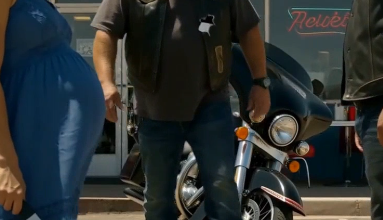
Today, a heavy black motorcycle sat crooked near the curb, its engine still ticking from the ride. And in front of a beige two-story house with drawn curtains, a large man in a sleeveless leather vest was trying to force the door open.
He wasn’t hiding it.
He wasn’t rushing either.
Just step. Kick. Pause. Again.
Like he had all the time in the world.
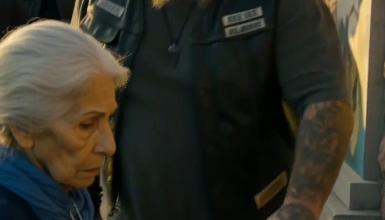
Across the street, Harold Bennett stood on the sidewalk in a worn brown coat that didn’t match the season. He held a folded envelope in both hands, gripping it too tightly. His fingers trembled—not from the cold.
From something deeper.
Seventy-three years old. Retired electrician. Widower.
And as of three days ago, completely broke.
He had spent forty-two years building something steady. Saving. Fixing. Living small so he wouldn’t be a burden to anyone later.
Then a phone call came.
A young voice. Urgent. Polite. From “the bank.”
There had been suspicious activity. Immediate action required. Verification needed.
He remembered hesitating.
He remembered apologizing for being slow with the online forms.
He remembered thanking them for helping him.
By the time he realized what had happened, every dollar was gone.
Not “missing.”
Gone.
And now, somehow, that biker was standing in front of the house connected to it.
Another kick.
The doorframe cracked slightly.
A woman across the street stepped out in her robe, hand over her mouth. “Oh my God…”
A dog started barking somewhere behind a fence.
Harold didn’t move.
Didn’t shout.
Didn’t stop him.
Because the truth was—he had been the one who led the biker here.
And now, watching that door splinter under each controlled strike, he wasn’t sure if he had just made the worst mistake of his life… or the only right one left.
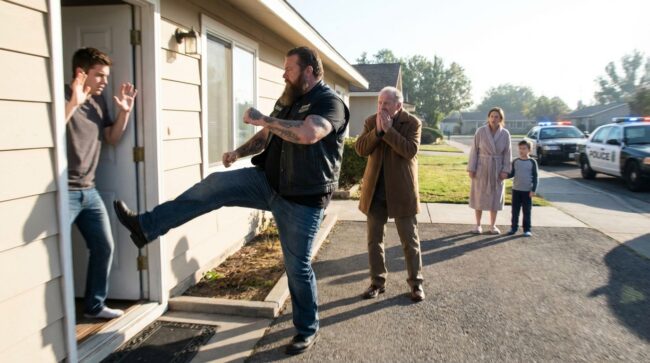
Within seconds, the quiet street wasn’t quiet anymore.
A man in gym clothes jogged up the sidewalk, slowing as he saw what was happening. “Hey! Hey! What the hell are you doing?”
No answer.
The biker didn’t even look at him.
Another kick.
This time, the door gave a little more.
The jogger pulled out his phone. “I’m calling the cops!”
From a nearby driveway, a middle-aged woman hurried over, dragging a young boy behind her. “Ethan, stay back.”
“But Mom—”
“I said stay back.”
The boy peeked anyway, wide-eyed.
“Is he robbing them?” he whispered.
No one knew what to say.
Because it looked like it.
A large man. Breaking into a house. No hesitation. No explanation.
Harold felt their eyes turn to him.
“You know him?” the jogger asked sharply.
Harold swallowed. His throat felt dry, useless. “No,” he said.
That was the easiest answer.
Not the truest one.
Because three nights ago, he had met that biker outside a diner off Route 66.
Harold had been sitting alone, staring at a cup of coffee he couldn’t afford anymore, replaying the phone call over and over in his head. The voice. The instructions. The moment he clicked “confirm.”
The biker had sat two stools away.
Said nothing at first.
Then, after a long silence, he had asked one question.
“You lose something?”
Harold had laughed. A broken, quiet sound. “Everything.”
Most people would have nodded and left it there.
Not this man.
He listened.
Didn’t interrupt. Didn’t comfort.
Just listened.
And when Harold finished, when there was nothing left but the sound of the diner fridge humming behind the counter, the biker had asked, “You remember anything? Names. Addresses. Mistakes they made.”
Harold had shaken his head at first.
Then stopped.
There had been something.
A shipping confirmation email. An address tied to a “verification device” they said they were sending.
He had written it down.
Didn’t know why.
Now he knew.
Back on Maple Ridge Drive, the door finally cracked open with a sharp splinter.
The crowd gasped.
“Stop!” the jogger shouted, stepping forward.
The biker turned slightly then.
Just enough.
One look.
Not angry.
Not wild.
But steady in a way that made the man stop mid-step without knowing why.
“Police are coming!” someone yelled from a porch.
Still, the biker didn’t rush.
He pushed the door open the rest of the way.
Darkness waited inside.
And for the first time, a flicker of doubt hit Harold hard enough to make his chest tighten.
What if he was wrong?
What if this wasn’t the man?
What if he had just sent someone dangerous… to the wrong door?
“Wait,” Harold called out suddenly.
His voice came out thinner than he expected.
The biker paused.
Just for a second.
Didn’t turn fully.
Didn’t step back.
Harold’s heart pounded.
“Are you sure?” he asked.
It wasn’t a challenge.
It was fear.
The biker stood there, half in shadow, half in morning light.
Then he said one quiet sentence.
“They always come back to what they think is safe.”
And stepped inside.
The street seemed to hold its breath.
No one followed him in.
No one dared.
The jogger paced near the sidewalk, phone pressed to his ear. “Yeah—yeah, he’s inside now. Big guy, tattoos, black vest. I think he’s armed—no, I didn’t see anything, but—just get here fast.”
The boy clutched his mother’s hand tighter. “Mom… what if someone’s in there?”
She didn’t answer.
Harold took one slow step forward.
Then another.
His legs felt heavy, like they belonged to someone else.
From inside the house, there was no shouting.
No crash.
No chaos.
That was worse.
Silence stretched long enough to feel wrong.
Then—
A faint sound.
A chair scraping.
A voice. Muffled.
Another voice responding.
Harold couldn’t make out the words.
The jogger looked toward the open door, uneasy now. “This is bad… this is really bad.”
A police siren echoed faintly in the distance.
Closer than before.
Harold stopped at the edge of the driveway.
He could see just inside now—the narrow hallway, a coat rack, a pair of shoes kicked off near the wall.
Normal.
Too normal.
Then a man appeared in the doorway.
Not the biker.
Younger. Late twenties. Pale. Wearing a hoodie.
His hands were raised.
“What the hell is this?” the young man shouted, voice shaking. “You can’t just break into my house!”
The crowd erupted.
“There’s someone in there!”
“Get out of there!”
“Police are coming!”
The young man looked past Harold, past everyone, straight at the biker inside.
“You think you know something?” he snapped. “You got the wrong guy!”
Harold’s stomach dropped.
Wrong house.
Wrong person.
He felt it crash over him all at once.
This was a mistake.
A terrible, irreversible mistake.
“Tell him to leave!” the jogger shouted at Harold. “Now!”
Harold opened his mouth.
Nothing came out.
Inside the house, the biker stepped into view behind the young man.
Calm.
Unmoved.
Holding something small in his hand.
Not a weapon.
A phone.
The young man’s face changed when he saw it.
Just for a second.
But it was enough.
The biker didn’t raise his voice.
Didn’t threaten.
He simply said, “You forgot to log out.”
The young man lunged forward instantly.
“Give me that!”
Everything snapped at once.
The crowd gasped.
The sirens grew louder.
And Harold realized, with a cold, sinking certainty, that whatever was about to happen next…
was going to be much bigger than stolen money.
The young man’s hand shot forward—but stopped halfway.
Not because the biker moved.
Because the biker didn’t.
He stood there, still as a wall, holding the phone just out of reach, not pulling back, not provoking—just waiting.
That hesitation cracked something.
The young man froze, his fingers hovering in the air like he’d suddenly remembered he wasn’t alone.
Sirens were close now.
Too close.
The crowd pressed tighter near the sidewalk. No one stepped in, but no one left either. That strange gravity held them all there—fear mixed with curiosity, pulling harder by the second.
Harold felt it too.
But what he felt more… was dread.
Because he saw it.
That flicker in the young man’s face.
Not anger.
Not confusion.
Recognition.
“You don’t get to come in here,” the young man said, but his voice had changed. Thinner now. Less certain.
The biker tilted the phone slightly.
Just enough for the screen to catch the morning light.
“Then why’s this still open?” he asked quietly.
No one else could see what was on it.
But the young man could.
And that was enough.
His shoulders tightened. His breathing shifted.
Behind him, deeper in the house, something moved—a shadow crossing the hallway.
Harold leaned forward instinctively.
“Is someone else in there?” the jogger called out.
The young man didn’t answer.
The biker didn’t turn.
He just said one word, barely above a breath.
“Kitchen.”
That was it.
No explanation.
No accusation.
Just a direction.
The kind that didn’t make sense… unless you already knew what you were looking for.
The young man swallowed hard.
Too hard.
And for the first time since he stepped into the doorway, he looked afraid.
The second man didn’t come out right away.
But everyone felt him before they saw him.
That shift in the air.
That quiet movement deeper inside the house.
Then footsteps.
Slow.
Measured.
An older man stepped into view from the hallway.
Late fifties, maybe early sixties. Hair thinning, face lined not from age—but from habits. The kind of man who had learned to smile just enough to make people trust him, but not enough to give anything away.
He didn’t look surprised.
That was the first thing Harold noticed.
He looked… interrupted.
“What’s going on?” the older man asked, his voice calm in a way that didn’t belong in that moment.
The younger man stepped back slightly, like instinct had finally kicked in.
“This guy just—he broke in,” he said quickly. “He’s got my phone—”
“Our phone,” the biker corrected.
That single word landed harder than shouting.
The older man’s eyes flicked to the device.
Then to the biker.
Then—briefly—to Harold.
It was a small glance.
Most people wouldn’t have noticed.
But Harold did.
And something inside him twisted.
Because that look… it wasn’t random.
It wasn’t the look of a stranger.
The biker spoke again, still quiet.
“Forty-two accounts,” he said. “Same routing path. Same script. Same voice pattern.”
The crowd fell silent.
Even the jogger lowered his phone.
The older man gave a small, dismissive chuckle. “You’ve been watching too many movies.”
But his hands…
His hands had stilled completely.
The biker took one step forward.
Not aggressive.
Just enough to close the distance.
“The last transfer,” he said, “came from a man who still writes his passwords on paper.”
Harold felt the words hit his chest like a physical thing.
The older man didn’t smile this time.
Didn’t speak either.
The silence stretched.
And in that silence, something began to crack.
The younger man looked between them. “What is he talking about?”
No answer.
The biker finally turned his head slightly—just enough to glance back at Harold.
Not fully.
Not obviously.
But enough.
Enough for Harold to feel seen.
Not as a victim.
As part of something.
Something bigger than he understood yet.
The police arrived fast.
Two cars.
Doors slamming. Voices cutting through the tension.
“Step away from the house!”
Hands raised.
Questions fired.
But the moment had already shifted.
Because the older man made a mistake.
A small one.
The kind people make when they think they still have control.
He took one step backward.
Toward the hallway.
Toward whatever he thought was still hidden.
The biker saw it.
Didn’t move to stop him.
Just said one quiet sentence.
“Too late.”
The officer nearest the door noticed it too.
“Sir, stop right there.”
The older man froze.
Then slowly turned back.
For a second—just one—his calm mask slipped.
And underneath it was something colder.
Something practiced.
Something that had done this before.
Many times.
Harold’s hands began to shake.
Because now he understood.
Not just what they had done.
But how many.
How many voices like his.
How many people who had trusted, apologized, thanked them… right before losing everything.
The younger man spoke again, more desperate now. “Dad… what’s going on?”
The word landed like a stone.
Dad.
The crowd reacted instantly.
The officers exchanged a glance.
The biker didn’t react.
But Harold did.
Because suddenly, everything rearranged itself in his mind.
Not just a scam.
A system.
A family.
A pattern passed down, refined, repeated.
The older man closed his eyes for a brief second.
Then opened them.
And when he spoke again, the calm was gone.
“What do you want?” he asked.
Not to the police.
Not to the crowd.
To the biker.
The biker didn’t answer immediately.
He looked at Harold.
Really looked this time.
And for the first time since this began, there was something different in his eyes.
Not anger.
Not judgment.
Something heavier.
Something older.
“You remember him?” the biker asked quietly.
Harold frowned.
“What?”
The biker reached into his vest.
The officers tensed instantly.
“Hands where I can see them!”
But he ignored them.
Slowly, deliberately, he pulled out a folded photograph.
Old.
Worn at the edges.
He held it out.
Harold stepped forward without realizing it.
Took it.
Looked down.
And everything inside him stopped.
The photo was faded.
But not enough.
Two men stood side by side in front of a small repair shop.
One younger. Strong. Quiet.
The other older.
Smiling.
Harold’s breath caught.
“That’s…” His voice broke. “That’s my brother.”
Ethan Bennett.
Dead twenty years.
The man who had taught him how to fix wires, how to save money, how to trust people—until life proved otherwise.
Harold looked up slowly.
The biker didn’t move.
“Your brother,” the biker said, “gave me my first job.”
The words settled deep.
“He found me after I got out,” he continued. “Said I wasn’t lost. Just… misplaced.”
Harold felt his chest tighten.
“He helped me when nobody else would.”
A pause.
Then:
“Told me if I ever saw his family in trouble… I don’t walk away.”
The morning light had shifted now.
Soft.
Almost quiet.
Behind them, officers were already moving inside the house.
Voices. Commands. The sound of drawers opening.
The system was breaking.
Right there.
Piece by piece.
The younger man sat down hard on the step, face pale.
The older man said nothing.
For once… nothing.
Harold stared at the photo again.
At his brother’s smile.
At the man beside him who had carried that memory all these years… and brought it back when it mattered most.
Not loudly.
Not heroically.
Just… when it counted.
“I didn’t know,” Harold whispered.
“I know,” the biker said.
That was all.
No lecture.
No comfort.
Just truth.
Harold folded the photo carefully.
Tried to give it back.
The biker shook his head.
“Keep it.”
Harold hesitated.
Then nodded.
Across the street, the sprinklers finally clicked on.
Water arced through the morning air like nothing had happened.
But everything had.
The biker turned, walking back toward his motorcycle.
No rush.
No need to stay.
Harold watched him go.
Then, without thinking, he did one small thing.
He straightened the biker’s vest as he passed—just for a second.
The way his brother used to do.
The biker paused.
Only slightly.
Then nodded once.
And kept walking.
No one stopped him.
No one spoke.
Because somehow… everyone there understood—
some things didn’t need to be explained.
They just needed to be done.