I Dragged an Old Dog Off a Bus Stop Bench by His Collar Because I Wanted to Sit Down — Five Minutes Later, the Bus Driver Stepped Off With a Bag of Dog Biscuits and Asked Me One Question
PART 2
The driver came down the steps holding a bag of Milk-Bones.
She was in her fifties, with long gray braids pulled back and a pair of reading glasses hanging from a beaded cord. Her name was Denise. I’d seen her every weekday for three years and never once learned that.
The dog heard the bag crinkle and swung around so fast his back end almost went out from under him. His tail was going like a fan.
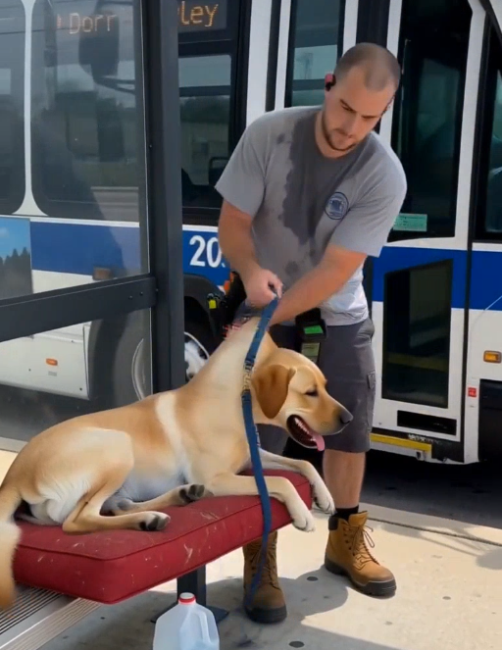
“There’s my guy,” Denise said. Then she looked up and down the shelter, at the bench, at me sitting on it. “Where’s Walter today?”
I took out my earbuds.
“Walter who?”
“Walter. Walt. Big Polish guy, Jeep plant jacket even when it’s ninety out.” She frowned at me. “He’s here every day. 5:24. Him and Buddy.”
Buddy.
I don’t remember standing up. I remember being on the curb, sitting in the gutter, with my steel toes in the street and my hands flat on the hot concrete.
“He died,” I said. “Two weeks ago Sunday.”
“Oh, Lord,” the woman with the cane said, quiet.
Denise didn’t say anything. She put her hazards on, sat down on the bottom step of her bus, and held the Milk-Bones in her lap. Somebody in the back yelled about being late. She didn’t turn around.
“You knew him,” she said finally. It wasn’t a question.
“He was my dad.”
She looked at me for a long time. At my face. At the fourth window.
“You’re Danny,” she said.
Then she told me.
Every weekday for almost three years, Walter Kowalski had been sitting on that bench at 5:24 with his dog and his old red cushion. Rain, snow, August. Mrs. Greene, the woman with the cane, said he brought two coats in January and sat on one of them. Denise said it was a blanket. They argued about it for a second right there, and I let them.
He never got on the bus. Not once.
About a month in, he’d asked Denise for a favor. Just slow down a little at this stop. He didn’t need to ride. He just wanted to see the fourth window on the right.
“Said his boy sits there every day,” Denise said. “Hood up, eyes closed. Said he just wanted to see you looked alright.”
I had always sat there. Hood up. Earbuds in. Eyes shut from Airport Highway to downtown. I never looked out that window at that stop. Not one time.
I’d felt the bus slow down there for three years. I thought it was a pothole.
I looked at the dog.
He was watching me now, ears half up, a white muzzle and two brown eyes I should have known the second I walked into that shelter.
I said his name the way I used to when I came in the back door at sixteen. Low and stretched out, two notes, the way my mother used to say it.
“Bud-dy.”
He stopped looking at the bus.
He walked over, stiff, and put the side of his head into my palm. Leaned there. I could feel how hot his skull was from the sun.
Then I lifted my other hand toward his neck, and he flinched. Ducked his head and backed off two steps, right out of my reach.
Toward his collar. The same collar I’d just dragged him by.
He went back to the bench, where Mrs. Greene had picked up the red cushion and set it back down, and lay on it facing the road.
Mrs. Greene swears to this day that I kicked that cushion. I didn’t. It slid. But I understand why she remembers it that way.
PART 3
My dad worked twenty-six years on the line at the Jeep plant on Stickney. He came home smelling like hot metal and Juicy Fruit, and he had exactly two ways of showing he loved you. He fixed things, and he took you to Mud Hens games.
That cushion on the bench was a giveaway from Fifth Third Field in 2009. Bring-your-kid night. I was thirteen. He let me keep it on my seat the whole game and then took it back and used it himself for the next sixteen years.
The blue collar was a Mud Hens collar too. I bought it for Buddy at the stadium gift shop with my first paycheck from Kroger, when I was sixteen and Buddy was a puppy chewing my shoes.
My mom died in March of 2021. Pancreatic cancer. Eleven weeks from the diagnosis to the funeral.
Dad went back to work the Monday after. He didn’t cry in front of me once. I started drinking, and I didn’t stop for a while.
In September of that year, I borrowed his Silverado without asking and put it into a light pole on Monroe Street at one in the morning. Nobody got hurt. He paid the thousand-dollar deductible and took my keys off the hook.
We had it out in the driveway. I said things to him I wouldn’t say to anybody. That he was never home anyway. That Mom basically raised me alone. That he cared more about the truck than about her.
He stood there and took it. Then he said, “You’re done with my keys.”
And I said, “Then I’m done with you.”
I moved into a buddy’s apartment downtown that week. I quit drinking about eight months later, on my own. I never told him. He never called. We were both Kowalskis.
Four years.
Ray Dutton told me the rest. Ray lived next door to Dad for twenty years, a skinny old Navy guy with a hearing aid he only turned on when he felt like it. He’d been keeping Buddy since the funeral. He’d left the side gate unlatched that morning, and Buddy had walked the six blocks to the bus stop on his own, like he’d done every weekday for three years.
Ray pulled up in his Buick while Denise was still sitting on the bus steps.
“Danny?” he said. “What are you—” Then he saw the dog, and the bench, and my face.
His nephew Tyler works at my distribution center. Back in 2022, Tyler mentioned at a cookout that he saw me catching the 22 every night. Ray told my dad. The next Monday, Dad was on that bench at 5:24.
“Why didn’t he just come knock on my door?” I said.
Ray looked at me like I was slow.
“Because you told him you were done. He believed you.”
The milk jug of water under the bench was for Buddy. Dad filled it every afternoon from his kitchen tap. The cushion was for his back. And Buddy faced the road because that’s what Dad did. Every day at 5:24, the two of them faced the road and waited for the fourth window.
There’s one more thing I have to say.
At the funeral, I sat in the back row. I left before the luncheon. Ray caught me in the parking lot and asked what I wanted to do about Buddy.
I told him to take him to the county. I said I couldn’t.
Ray didn’t. He’d kept him for two weeks with a bad hip, filling the milk jug, because he couldn’t make himself do it.
That’s who I was when I pulled that dog off the bench.
PART 4
Ray had hip replacement surgery scheduled for the following Thursday. He couldn’t keep a 70-pound dog afterward. He’d been planning to take Buddy to Lucas County Canine Care & Control on Monday.
“He’s yours,” Ray said, “if you want him. If you don’t, I need to know by Sunday.”
My apartment on Monroe Street didn’t allow dogs over thirty pounds. I called the leasing office Friday morning from the break room. They said they could make an exception with a vet record, a $400 pet deposit, and $35 a month in pet rent. I had $612 in checking.
I said yes.
Buddy said no.
Every night that week, I took the 22 home, got off at Dorr and Hawley, and walked to Ray’s. I sat on his porch steps and Buddy lay on the porch boards, as far from me as the porch went. He’d eat from Ray’s hand. He’d eat from Mrs. Greene’s hand when she came by with a slice of bologna. He would not eat from mine.
If I reached toward his neck, he ducked. Every time.
Ray said give it time. Mrs. Greene said I’d earned it. They were both right.
On Saturday, I cleaned out Dad’s house. Ray loaned me the Buick and Tyler came over with his pickup.
It went fast. Dad didn’t own much. A recliner with the arms worn through. A drawer full of rubber bands and twist ties. Mom’s reading glasses still on the windowsill above the sink, four years later.
The calendar was on the side of the fridge. A free one from the funeral home on Sylvania, the kind they mail out every December.
Every weekday had something written in it, in Dad’s square carpenter print.
Saw D. Hood up.
No D. Maybe sick?
Saw D. Looks thin.
Saw D. Laughing on phone. Good.
Saw D. New haircut.
August, July, June. I flipped back. Three full calendars in the drawer under it, rubber-banded together. Almost every weekday since the fall of 2022.
The last entry was a Friday. Two days before he died.
Saw D. Looked tired. Buddy wagged.
I sat on his kitchen floor with the calendars in my lap for a long time. Tyler finished loading the truck without me and didn’t say a word about it.
I kept the calendars. I kept the recliner. I kept Mom’s glasses. Everything else went to the Goodwill on Central.
Monday, I took Buddy to the vet on Ray’s dime because I didn’t have it yet. Thirteen years old. Arthritis in both hips. A cracked molar. Heart sounded good. The bill was $287, and I paid Ray back on Friday.
On Wednesday night, the night before Ray’s surgery, Buddy finally walked out to the Buick with me and climbed into the back seat. Ray had to help with his back legs.
He didn’t look at me the whole drive. He looked out the window.
PART 5
He paced my apartment all night. Back and forth from the door to the window. Whining low, like a kettle that never gets to a boil.
At ten after three in the morning, I took the trash down. I thought I’d closed the door. I hadn’t, all the way.
When I came back up, he was gone.
I ran down Monroe in my socks. I checked the parking lot, the alley, the Speedway on the corner. Nothing. I posted on the Toledo lost and found pets page on Facebook with the only picture I had, which was Buddy lying on Ray’s porch with his back to me. I called in to work. That was my second write-up in a week, and I knew it when I did it.
I walked and drove Ray’s Buick all over the west side all morning. A woman on Detroit Avenue thought she saw him. It was a golden retriever. A guy on Nextdoor said he saw a yellow dog near the Toledo Zoo. That was miles in the wrong direction. I went anyway.
By two in the afternoon, I was sitting in the Buick in a Speedway parking lot with my hands on the wheel, and I was ready to quit.
I’m telling the truth. I thought: Dad was right to take my keys. I can’t keep anything. I’ll call the county, give them my number, and let somebody better than me find him.
I had the phone in my hand.
Then I thought about the calendar. No D. Maybe sick?
My dad didn’t quit. He didn’t come knock on my door either, and that was wrong too. But he sat on a bench for three years and waited, every single day, because he didn’t know what else to do.
I’d never waited for anything in my life. I’d always been the one who left.
At 5:10, I parked on Hawley, took the red cushion off the back seat, filled the milk jug at the Speedway, and sat down on the bench at Dorr and Hawley.
At 5:24, the 22 came. Denise slowed down. She looked at me through the windshield. I shook my head. She pulled away.
At six, I was still there. At 6:30. Mrs. Greene came out to her porch across the street and didn’t come over. She just sat.
It cooled off a little. The sun got low behind the Rite Aid.
At 7:05, the last 22 of the night came up Dorr, and its brakes hissed at the stop.
I heard something behind the shelter. Toenails on the sidewalk, slow and uneven.
Buddy came limping up Hawley. His pads were raw. His tongue was hanging almost to his chest. He’d walked from downtown, three miles on those hips, to the only place he knew to go.
He didn’t stop at the curb this time. He didn’t look at the bus.
He came to the bench, put his front feet up on the cushion, and couldn’t get the back end up. I lifted him. He let me. He lay down on that red cushion, and then he put his head on my knee, and he left it there.
I put my hand on his neck. On the collar.
He didn’t flinch.
Denise was driving the last run. She looked out her side window at us, and she tapped the horn twice, short, and pulled away without slowing down.
Mrs. Greene says she heard me crying from her porch. I don’t know. I know I didn’t move from that bench until it was dark.
PART 6
That was a year ago this month.
I don’t live on Monroe Street anymore. Ray’s cousin had a duplex for rent three blocks from Dorr and Hawley, with a fenced yard and no weight limit. Buddy sleeps in Dad’s recliner. I sit on the floor next to it.
I still have the job. I still get written up for scan rate sometimes. I don’t drink. I told Ray that last fall, out loud, on his porch. It’s the first time I said it to anybody who knew my dad.
Every weekday, I get home by five. I fill the milk jug at the kitchen tap. I tuck the red cushion under my arm, and Buddy and I walk the three blocks to the stop, slow, at his speed.
At 5:24, the 22 comes up Dorr.
Denise still slows down out of habit. She says she can’t help it. Sometimes, when she sees us, she taps the horn twice.
When the bus kneels to the curb, I stand up first. I take Mrs. Greene’s arm and help her up the step. She told me my dad did that every day for three years, and he never once got the hand on her elbow right. Too high. She says I’ve got it right now. It took me about a month.
“You’re still a Kowalski,” she tells me. “Stubborn.”
She also still tells everybody on that bus that I kicked the cushion.
I keep a calendar on the side of my fridge. Free one, from the same funeral home on Sylvania. Every weekday, I write something in it.
Buddy ate all of it.
Mrs. G. new hat.
Hot. Buddy drank the whole jug.
Saw the fourth window. Kid in a hood. Hope he’s alright.
Ray asked me once why I bother. I told him I didn’t know yet. I think I do now.
Buddy is fourteen. He’s slower this summer. Some days I carry him the last block.
But every afternoon, he sits on that cushion and faces the road, and when the 22 comes, his tail hits the bench once.
Buddy still watches the fourth window. So do I.
Follow this page for more stories about the dogs who keep waiting where we left them.
Word count (ước tính): PHẦN 1 – A ≈ 510, PHẦN 1 – B ≈ 600, PART 2-6 ≈ 3,050, Total (A + Parts) ≈ 3,560