I Tossed an Old Boot Out From Under a Half-Starved Dog’s Head While Clearing a Homeless Camp Under a Bridge — Two Minutes Later, He Dragged It Back Out of the Trash Bag and I Saw the Handwriting Inside
PART 2
Two letters and a last name, in black Sharpie, on the inside of the tongue.
D. PRUITT.
The R had a little hook at the bottom of its leg, curled back on itself. Nobody makes an R like that. My dad did. He made it on everything. The checks for my Little League fees. The tags on Christmas presents. The brown paper lunch bags he left on the counter for me when he went out to a roofing job before the sun came up.
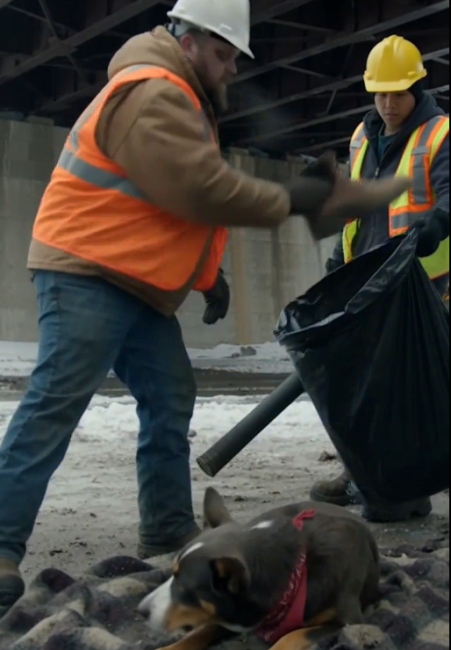
He wrote his name inside his boots because on a roofing crew, everybody’s boots end up in the same pile by the trailer door. At our house they ended up in a pile by the front door, and I used to trip over them on the way to the bus.
“Where’d this come from?” I said.
My voice didn’t sound like mine. Luis told me later I said it twice. I only remember once.
The woman looked at me like I’d asked something stupid.
“It’s Dale’s,” she said. “This is Dale’s spot. That’s Dale’s dog.”
I sat down. I didn’t decide to. My knees just quit, and the mud came up cold through my jeans.
“Dale who?”
“Dale. Older guy. Bad shoulder. Used to roof houses, he said.” She stopped. She was looking at my hard hat. At the tape across the front. At my name, which I’d written that morning in the truck without thinking about it, the same way I always write it.
With the hook on the R.
“Oh, honey,” she said.
Her name was Dot Halvorsen. I didn’t know that yet. I didn’t know anything yet except the cold and the boot and the sound of the leaf blower Luis was still holding, running at idle.
Dot told me then. She didn’t make it soft, and I’ve been grateful for that since.
Dale had died the Tuesday before, at Sacred Heart. Pneumonia. He’d had a cough since Thanksgiving and wouldn’t go in, because the hospital wouldn’t take the dog and he wouldn’t leave the dog. When he finally couldn’t get up, somebody from the next tarp over called 911. The ambulance took him from the exact spot where I was sitting.
Since then, Dot had been coming twice a day. Hot dogs. A leash. Her car with the heater running and the back door open. The dog wouldn’t go. He ate a little when she left and spent the rest of the time on those blankets, facing the road.
Luis shut off the blower. You could hear the trucks going by on Trent.
“That’s my dad,” I said.
Dot didn’t say anything. She already knew.
I looked at the dog. He was looking at the boot in my hands. I reached out, slow, to set it back down by him, and he made a sound. Luis swears it was a growl. I remember it more like a question. Either way, I pulled my hand back.
“What’s his name?” I said.
“Nails.”
Of course it was. My dad named a dog after the one thing he went through more of than coffee.
And then I said something without meaning to. Two words my dad said every single morning at the front door, to himself, to me, to whatever dog we had at the time. Like a starting gun.
“Boots on.”
Nails lifted his head off the blanket.
He got up, stiff, front leg first this time, and stood looking past me at the road. His tail moved twice. His ears went up.
He waited.
Nobody came. After a while he lay back down, put his chin on the empty spot where the boot had been, and kept watching.
Dot says I cried then. I don’t remember crying. I remember I couldn’t feel my hands, and I didn’t care.
PART 3
My dad was a roofer for twenty years in Spokane Valley. He was good at it. He could walk a 12/12 pitch like it was a sidewalk and give you a bid from the driveway without a tape measure.
In 2009, when I was 15, he came off a two-story in Liberty Lake. Wet shingles, a bad ladder, somebody else’s mistake. He tore his shoulder and broke two ribs. Three surgeries. Then the pills. Then, when the pills ran out, Rainier tallboys and whatever was cheapest after that.
He lost the business first. Then the truck. Then, one piece at a time, us.
My mom moved to Boise in 2011. I stayed with him through my senior year because I didn’t want to change schools. I figured I could handle him.
At my graduation in June 2012, he showed up in the parking lot of the arena without his ticket, arguing with an usher loud enough that people stopped to watch. I walked past him to my mom’s car. I didn’t look at him.
The last time he called me was in 2016. I was 22. He needed $200 for a deposit on a room. He said he had a line on steady work.
“Don’t call me again,” I told him. “I mean it.”
I changed my number the next week. Nine years.
Dot sat on an overturned bucket and told me the rest, the parts I’d never asked about because I’d never wanted to know.
Dale had been under that bridge a little over two years. He did day labor when his shoulder let him. Every morning at six, he walked to a temp labor office on East Sprague to get on the list. Nails went with him and waited across the street on the loading dock of an old furniture store, all day if he had to. Then they walked home together.
That’s why the dog faced the road. He was waiting for the walk home.
The bandana was Dale’s, too. He’d worn it as a sweat rag on roofs, knotted twice so the wind couldn’t take it. I had a picture of him wearing one like it, somewhere in a box.
“Why only one boot?” I asked.
Dot went to her car and came back with a clear plastic bag that said PATIENT BELONGINGS on the side. Dale had put her down as his contact, she said, because there wasn’t anybody else.
The ambulance crew had taken him in wearing his right boot. The left one had stayed on the blankets. Nails had kept it.
Inside the bag was the right boot. A wallet with three dollars and an expired ID. A receipt for a 15-pound bag of dog food. And a sheet of paper folded into a square so small and soft it felt like cloth.
I unfolded it.
It was a printout from a library computer. My company’s Facebook page, a post from the previous March. Congrats to Wes Pruitt, our newest site lead! A photo of me in the same orange vest I was wearing right then, squinting at the camera, holding the same kind of clipboard.
“He showed that to everybody out here,” Dot said. “‘My boy runs crews now.’ He’d hand it to you and wait for you to say something nice.”
He’d looked me up. He knew where I worked. He could have found me any day he wanted.
He never called.
It took me a long minute to understand why. Then I did.
I’d told him not to. I’d told him I meant it.
He had believed me.
My phone buzzed in my pocket. Rick. I let it ring.
Nails had turned his head and was watching the paper in my hands. Not me. The paper. Maybe it still smelled like Dad’s pocket. I don’t know. I folded it back up along the same soft creases and put it in my chest pocket, and the dog went back to watching the road.
PART 4
Rick pulled up at 10:30 in his white F-150 and walked over with his coffee.
I told him. He didn’t say anything for a second. Then he said he was sorry, and I believe he meant it.
“But this spot’s gone by noon, Wes. Or the contract’s gone. And SCRAPS is already on the way for the dog.”
SCRAPS is Spokane County’s animal control. They’re not bad people. But I’d seen what happens to a 10-year-old heeler mix with a bad leg who won’t let anybody touch him.
“Give me till Thursday,” I said.
“I can’t do that.”
“Then write me up.”
He did. Right there on the hood of his truck. Final warning, it said. Then he called SCRAPS and pushed them to Thursday at eight, and he told me that was the last thing he could do. Luis and the guys finished the rest of the site. They walked around Dad’s blankets like there was a fence there.
Nails still wouldn’t come to me.
I tried everything Dot had tried, and some things she hadn’t. I sat fifteen feet away. I talked to him. I didn’t talk to him. I set Dad’s right boot on my lap so he could smell it. Once, around three that afternoon, he got up and came close enough to put his nose on the boot. Then on my knuckles. Long, slow breaths.
Then he went back to his blankets and lay down facing the road.
Dot didn’t trust me either, and she had no reason to.
“An hour ago you threw his boot in the garbage,” she said. “You’ll understand if I don’t hand you his dog because you’ve got the same last name.”
I told her that was fair. It was.
I slept in my truck by the bridge that night and the next. Nineteen degrees the first night, fourteen the second. I ran the engine ten minutes every hour and tried not to think about my father doing this for two years without an engine.
I figured out the dog would only eat if I walked away. So I’d open a can, set it on the blanket, walk back to the truck, and watch him in the side mirror. I bought a bag of kibble at the Dollar General on Trent for $11.49 and a pack of hot dogs I mostly ended up eating myself.
My landlord texted again. I didn’t answer.
On Wednesday night Dot knocked on my passenger window, got in, and handed me a thermos of coffee so strong I could feel it in my back teeth.
“He’d have hated you sleeping in a truck,” she said.
“He did it for two years.”
She was quiet for a while. Then she told me about how Dad had built Nails a little lean-to out of a pallet and a scrap of shingle, with an overhang to keep the drip off. How he complained about the pitch of it to anybody who’d listen. How he saved the end of every sandwich for the dog and pretended he wasn’t.
“He wasn’t a saint,” Dot said. “He was grumpy and he drank and he owed half this bridge a dollar. But that dog never went hungry one day.”
I didn’t say anything. I just kept looking at the blanket through the windshield, at the white shape on it facing the road.
Thursday was in nine hours.
PART 5
At 7:58 Thursday morning, a young woman from SCRAPS got out of a county van with a catch pole. She was kind about it. She talked low. She was also on a clock, and so was everybody else standing there.
Nails saw the pole and went.
He was out from under the bridge and across Trent before any of us moved. A semi locked its brakes, and I heard myself yelling, and then I was in the road too, with the horn going, and then he was gone into the rail yard on the other side.
I looked for him all day.
Dot drove East Sprague with her window down. Luis took his lunch break walking the tracks. I posted on the Spokane lost dogs Facebook group and on Nextdoor, with a blurry picture Dot had taken on her phone back in December. People shared it. Somebody thought they saw him by a Jack in the Box. It was a different dog.
The forecast said eleven degrees overnight.
At 11 p.m., I was parked outside a bar on East Sprague with forty dollars in my wallet. The kind of place my dad would have gone. I sat there for twenty minutes with my hand on the door handle.
I’m not proud of that. I’m telling it because it happened.
I didn’t go in. I looked down at the passenger floor instead, where I’d put both of Dad’s boots in a grocery bag.
I took off my own boots. I put on his. They were half a size too big and stiff from the cold, and the left one had no laces, so I used two zip ties from the crew box. They smelled like him. Leather and smoke and something I can’t name but knew right away.
And I thought about what Dot had told me. Six every morning. The labor office. The loading dock across the street.
At 5:40 a.m., I parked at the bridge and walked it. The whole route, 1.3 miles, in my father’s boots, in the dark. My feet slid around inside them the entire way.
The labor office had its lights on. A few men were already lined up outside, stamping their feet. Across the street, the old furniture store was dark, its loading dock a black square.
I stood on the curb and said it.
“Boots on.”
Nothing.
I said it louder. One of the guys in line turned around to look at me.
Under the loading dock, something moved.
Nails crawled out with frost on his back. He was limping worse than before. He crossed the street slowly and didn’t look at my face at all.
He went to my feet.
He put his nose on the left boot. Then the right. A long time on each, breathing in and out. Then he leaned his whole body against my shins, the way you lean on a wall when you can’t stand up on your own anymore.
I sat down on the curb, and he let me. I put my hand on his neck, on the knot of that red bandana, and he let me do that too.
The older guy who’d turned around walked over, hands deep in his jacket.
“That’s Dale’s dog,” he said.
“Yeah. I’m his kid.”
He looked me up and down. “He said you’d be taller.”
I laughed so hard it turned into something else, right there on the curb.
That afternoon at the vet: about ten years old. Arthritis in the front left. Two bad teeth. Frostbite on the tips of his ears. The bill was $612. I paid it on the card I’d been saving for rent and didn’t think twice.
PART 6
That was a year ago.
I still have the job. Rick heard the whole story from Luis and tore up the write-up in front of me, which I didn’t expect. Then I asked him for something.
Now, the day before any sweep, I walk the camp with Dot. We ask about dogs and cats. We ask what people can’t afford to lose: papers, medicine, photos. We bag those things and I write each person’s name on the tag in Sharpie, and the company holds them in a storage cage for thirty days.
Somewhere around the second month, I noticed I’d started making the R with the hook. I didn’t try to. It’s just there now.
Every morning at 5:50, I lace up Dad’s boots. I had them resoled at a shop on North Monroe for $85. The guy said they had another ten years in them.
I say “Boots on.”
Nails gets up off his bed by the front door, front leg first, and walks me to the truck. He rides to every site. He sits in the cab with the heater on and watches me work, and when I come back he puts his nose on my boots before anything else.
On Saturdays, Dot and I hand out blankets and socks under the bridges. She still tells people I threw Dale’s boot in the trash. She says it’s good for me.
Last January, a man named Gene, who stays under the Division Street bridge, asked me to hold his backpack while he went into Sacred Heart for his foot. He didn’t have anybody else to ask.
I took it home. I didn’t open it. I tied a tag to the strap that said GENE and put it on the top shelf of my closet, where nothing else goes.
Eleven days later, he came back out. I drove the backpack over to him that same afternoon.
He went through it right there on the sidewalk, one item at a time. Three pairs of socks. A photo of a girl in a cap and gown. A phone charger. Half a sleeve of saltines.
“Even the crackers,” he said.
Luis was with me that day. He watched me crouch down to help Gene zip the bag back up, and he said the same two words he said to me under the rail bridge that morning.
“Wes, man.”
It sounded different this time.
When I get home at night, I take off the boots and set them by the door, the same way Dad used to. I still trip over them sometimes.
Nails is asleep by the door, chin on Dad’s boot.
Follow this page for more stories about the dogs who keep waiting for us, long after we’ve stopped coming home.
Word count (ước tính): PHẦN 1 – A ≈ 520, PHẦN 1 – B ≈ 570, PART 2-6 ≈ 3,000, Total (A + Parts) ≈ 3,520