Part 2: The Biker Showed His Scar To Her Class — But It Wasn’t Real
My name is Rachel Moreno, and before Wade Carson married me, I thought I already knew what kind of man scared people.
I had been scared by the quiet kind.
The charming kind.
The kind who smiled at neighbors and broke dishes behind closed doors. The kind who knew how to make a child flinch without raising his voice.
Wade was the opposite.
He looked dangerous from a block away and turned gentle up close.
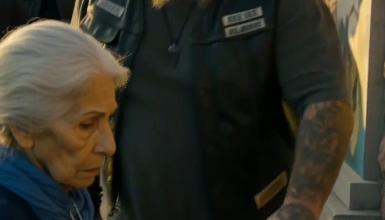
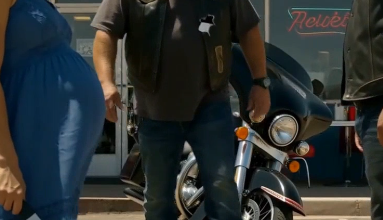
The first time I saw him, he was outside a diner off Volunteer Parkway in Bristol, holding a paper cup of coffee in one hand and fixing an old woman’s flat tire with the other. His Harley sat near the curb, black and dusty, cooling in the afternoon heat. Leather. Gasoline. Burnt coffee. Road dust. That was the smell around him.
I noticed his hands first.
Huge hands. Tattooed fingers. Skull rings. Knuckles scarred from years of work and bad choices he never bragged about.
But he touched that old woman’s tire like he was handling glass.
Lily was six then.
She stayed behind my leg, hair covering the left side of her face.
Wade saw her hiding.
He did not stare.
That mattered.
Most adults stared and then pretended they hadn’t. Kids stared honestly. Adults stared politely, which somehow felt worse.
Wade just looked at her shoes and said, “Those laces are trying to escape.”
Lily looked down.
One lace had come undone.
She did not answer.
Wade crouched, slow enough for me to stop him if I wanted to, and tied it without touching her ankle.
“Boots are easier,” he said.
That was all.
No question about the scar.
No sad voice.
No “what happened to her?”
Just boots are easier.
A month later, he came into the diner again with two Iron Order brothers. One was a Black American biker named Bishop, late fifties, gray goatee, soft voice. The other was a white American woman named Kat, forty-something, short silver hair, tattooed shoulders, laugh like gravel in a tin cup.
They looked like trouble.
They tipped twenty-five percent, stacked their plates, and thanked the busboy by name.
That was Wade’s world. Rough edges. Quiet rules. Men and women who smelled like leather, oil, rain, and old cigarettes, but showed up when they said they would.
He started walking me to my car after late shifts.
Not because I asked.
Because he noticed the lot was dark behind the diner.
“Don’t like dark corners,” he said.
“You scared of them?”
“No,” he said. “I respect what they hide.”
Wade never pushed into our life. He stood near it until Lily stopped moving away.
At first, she would not sit in the same booth. Then she sat at the end. Then across from him. Then beside him if he was drawing motorcycles on napkins.
One night he let her color his tattoos with washable markers while he drank coffee.
Bishop laughed and said, “Brother, you got a unicorn on your forearm.”
Wade looked down.
Lily had drawn a purple unicorn over a skull.
He nodded.
“Improvement.”
That was the first time she laughed around him.
Small.
Fast.
Real.
When Wade asked me to marry him two years later, he asked Lily first if it was okay for him to ask me.
She shrugged like she didn’t care.
Then she left a note in his helmet.
It said: YES BUT DON’T BE WEIRD.
He kept it tucked inside his leather cut, behind the inside pocket, where nobody could see.
That was one of Wade’s contradictions.
The outside of his vest was all patches, road names, club history, and things that made strangers step away.
Inside, he kept a child’s note folded like a holy thing.
Fourth grade changed Lily.
Not all at once.
Cruelty rarely starts loud.
At first, it was whispers. Kids looking, then laughing. A girl at recess asking if Lily’s face “felt melted.” A boy in the cafeteria pretending to cover one side of his face with a napkin.
Lily told me nothing.
She started wearing her hair down.
Then lower.
Then she stopped wanting ponytails, even on hot days.
Wade noticed before I did.
One morning, he watched her eat cereal with her head turned so her scar faced the wall.
After she left for school, he stood at the sink holding his coffee.
“Something’s wrong,” he said.
“She’s nine,” I said. “Everything is wrong when you’re nine.”
“No,” he said. “This is different.”
Two days later, her teacher called.
Mrs. Hanley was kind. Too kind. The kind of voice teachers use when they hate what they have to say.
“There was an incident at lunch,” she said.
My chest tightened.
A boy had drawn a face on his milk carton. One side normal. One side scribbled red. He showed it around the table and said it was Lily.
The principal handled it. The boy apologized. His parents were called.
All the proper things happened.
None of them fixed the look on Lily’s face when I picked her up.
She sat in the back seat with her hair covering half her cheek.
Wade was in the driveway when we got home, kneeling beside his Harley, tightening something near the exhaust. The engine ticked softly in the cooling air.
Lily walked past him without speaking.
He watched her go.
Then he looked at me.
I told him.
He did not explode.
That scared me more than if he had.
He set the wrench down carefully. Too carefully. His tattooed fingers opened and closed once. The leather of his vest creaked as he stood.
“Name?” he asked.
“No.”
“Rachel.”
“No, Wade.”
He looked toward the house. His jaw moved.
I knew what people expected from men like him. Storming into school. Scaring a child. Threats. Noise.
Wade did none of that.
He went into the garage and shut the door.
For an hour, I heard nothing but the low hum of the light and the occasional scrape of a chair.
When he came out, he was holding his phone.
“I called Kat,” he said.
“Why?”
“She knows ink.”
I thought he meant he wanted another tattoo.
I did not understand.
Not yet.
The next morning, Lily refused school.
She sat on the bathroom floor in pajamas, clutching her backpack against her chest like a shield.
“I can’t go,” she whispered.
I sat beside her.
“You can.”
“No.”
Wade stood in the doorway, boots quiet for once.
He looked too big for the hall. Too rough for that small bathroom with toothpaste on the sink and a unicorn towel on the rack.
He lowered himself until he sat on the floor across from her.
His knees nearly touched the cabinets.
“You want me to walk in with you?” he asked.
Lily shook her head.
“They’ll look at you.”
“Good.”
She peeked through her hair.
He rolled up his sleeve.
For the first time, I saw the mark.
A long red scar across his right forearm, raised-looking, angry, cutting through old tattoos like fire had dragged a finger there.
I gasped.
“When did that happen?”
He didn’t look at me.
“Long story.”
Lily stared at it.
“You got burned too?”
Wade held her eyes.
“Yeah,” he said.
That was the false climax I believed.
I thought my husband had finally shown a private wound. I thought he had hidden it under sleeves because men like Wade didn’t like being pitied.
I thought he was about to teach Lily that she wasn’t the only one.
In a way, he was.
Just not the way I thought.
Wade walked Lily into school that Friday.
I followed behind them feeling like every parent in the parking lot was watching. Maybe they were.
The Harley had barely cooled. Its pipes ticked in the morning air. His boots hit the hallway tile slow and heavy. Teachers looked up from clipboards. Kids stopped mid-sentence.
Lily’s hand stayed in his.
Mrs. Hanley met us at the classroom door. Her eyes moved from Wade’s cut to his tattoos to his face, then down to Lily.
“Mr. Carson,” she said carefully.
“Ma’am.”
He was polite. Always. That surprised people more than anything.
The principal had agreed to let Wade speak for two minutes, only because Mrs. Hanley had asked and because Wade had promised, in writing, not to identify any child, threaten anyone, or turn the class into a courtroom.
He kept that promise.
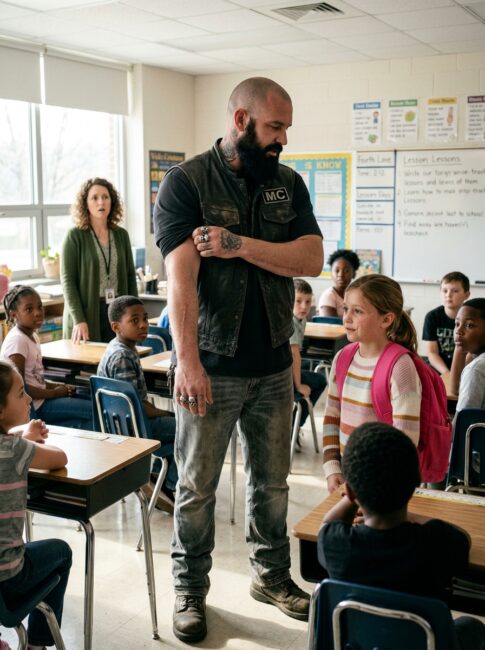
He stood in front of twenty-four fourth-graders and rolled up his sleeve.
The fake scar looked real under fluorescent lights.
I did not know it was fake then.
The children leaned forward.
Wade pointed at his arm.
“This is a map,” he said.
His voice was low. Not soft. Low.
The room went still.
“Every scar is a place where I survived. Some maps are on skin. Some maps are inside where nobody sees them.”
He looked at Lily.
“My daughter has a map on her face. It means she made it through something hard before most of you knew how to tie shoes.”
A boy lowered his eyes.
Wade kept going.
“You don’t have to like everybody. You don’t have to be friends with everybody. But you don’t get to make somebody hate the proof that they lived.”
Nobody breathed loud.
Then he stopped.
That was it.
No lecture.
No revenge.
No big heroic speech.
He walked back to Lily, touched two fingers to his own scar, then to his heart.
She copied him.
That afternoon, Lily came home and stood in front of the bathroom mirror.
She pulled her hair away from her face.
I watched from the hall.
She whispered, “This is my map.”
The words became ritual.
Every morning.
Hairbrush. Backpack. Mirror.
“This is my map.”
I thought the story ended there.
The scary biker dad defended his scarred daughter.
The bullies went quiet.
The little girl got brave.
Simple.
Then I found the receipt.
Three weeks later, while washing Wade’s jeans, I pulled a folded paper from his pocket.
Kat’s tattoo shop.
Custom scar realism.
Right forearm.
Three sessions.
My hands went cold.
That night, I waited until Lily was asleep.
Wade was in the garage, sitting on an old milk crate, cleaning tools he had already cleaned. The Harley stood beside him under the light, black tank reflecting his bowed head.
I held up the receipt.
He looked at it.
Then at the floor.
“It’s not a scar,” I said.
“No.”
“You told her you got burned.”
He rubbed both hands over his face.
“I told her I had a map.”
“Wade.”
His voice came out rough.
“I didn’t want her walking into that room alone.”
That was the twist.
The mark on his arm was not from a motorcycle accident.
Not from a fire.
Not from some hard road story.
It was ink.
Pain chosen by a grown man so a child would not feel like pain had chosen only her.
The truth about Lily’s scar was not something we gave strangers.
People asked, of course.
They always ask.
Accident?
Fire?
Dog bite?
Was she born with it?
I learned to answer with my face first. Then with a sentence.
“She survived something when she was little.”
Most decent people stopped there.
The full truth was uglier.
Lily was two when her biological father hurt her. He was not a biker. Not a rough-looking man with tattoos. He wore pressed shirts. Sold insurance. Smiled for pictures. Knew which neighbors to wave at.
He is in prison now.
That is all the space he gets in this story.
Wade knew before he married me.
I told him one night in my kitchen while Lily slept upstairs. I expected anger. Questions. Maybe that male need to promise violence after violence is already done.
Wade did not do that.
He sat still, both hands around a coffee mug he never drank from.
Then he said, “Does she know I know?”
“No.”
“Then I’ll wait till she wants me to.”
That was Wade’s way.
He did not force doors open.
He stood outside them until invited.
The scar tattoo had been Kat’s idea only after Wade asked if ink could look like burned skin.
Kat told him no at first.
Bishop told him he was out of his mind.
His club brothers argued in the back room of the tattoo shop for an hour.
“You’re putting her pain on your body like it’s yours,” Bishop said.
Wade answered, “No. I’m putting my body beside hers.”
Kat asked, “What happens when she finds out?”
Wade said, “Then I tell her the truth.”
“And if she hates it?”
He looked at the floor.
“Then I wear that too.”
Brotherhood got tested that day.
Not with fists.
With honesty.
Nobody in that room wanted Wade to make a cheap gesture out of a child’s wound. Nobody wanted him to turn love into theater.
So they made him explain it.
Again and again.
Why?
For whom?
What if it backfires?
Wade listened. Took every hit. Never raised his voice.
Finally, Kat said, “If I do this, it won’t be pretty.”
“Good,” Wade said.
“It’ll hurt.”
He nodded.
“Good.”
She worked on his arm for three sessions. Red, white, brown, raised illusion, torn edges, careful shadows. He sat through it without flinching until the last ten minutes, when Bishop said Wade’s eyes went wet.
Not from the needle.
From the thought of Lily touching her own face in the mirror.
After I found the receipt, I did not tell Lily right away.
That choice belonged to Wade.
He waited three more months.
By then, the teasing had mostly stopped. Not because every child became kind. Children are not miracles. But because shame had lost its easiest target.
Lily wore ponytails again.
Sometimes braids.
Sometimes glitter clips.
One Saturday, she found Wade on the porch watching rain hit the driveway. The Harley sat under the carport. His cut hung over the chair beside him. The house smelled like coffee and wet asphalt.
She sat beside him.
“Can I ask about your scar?”
Wade nodded.
“Did it hurt?”
“Yes.”
“When it happened?”
He was quiet.
The rain ticked on the gutter.
“No,” he said. “When I chose it.”
She frowned.
“What do you mean?”
He rolled up his sleeve.
Then he told her.
Not everything. Not all at once. But enough.
He told her it was tattooed. He told her he got it before going to school with her. He told her he should have explained sooner. He told her he was sorry if it felt like a lie.
Lily stared at his arm.
I stood inside by the screen door, not breathing.
Finally, she said, “You wanted to match me?”
Wade’s voice broke around the edge.
“Yeah.”
“Why?”
His tattooed fingers flexed once.
“So when they looked at you, they had to look at me too.”
Lily’s face changed.
Not happy.
Not sad.
Something deeper.
She reached out and traced the fake scar with one finger.
Then she touched the real one on her own cheek.
“Mine isn’t fake,” she said.
“No,” Wade said.
“Mine hurt first.”
“I know.”
“You didn’t have to.”
“I know.”
She leaned against his shoulder.
“I’m glad you did.”
That was the first time I saw Wade Carson almost cry.
Almost.
He looked toward the road, jaw tight, eyes shining, one huge tattooed hand resting carefully on my daughter’s hair like he was afraid love could break if held wrong.
After that, the map became ours.
Not a slogan.
A ritual.
Each morning, Lily stood in front of the bathroom mirror before school. Some days she said it loud. Some days barely moved her lips.
“This is my map.”
Wade would be in the hallway, pretending to look for keys he already had.
Then he would roll up his sleeve and answer, “This is mine.”
It sounds strange unless you saw it.
A little girl with a scar on her face.
A giant biker with a scar made of ink.
Two survivors of different things, choosing the same language.
The Iron Order brothers found out eventually.
Bishop saw Lily tracing Wade’s tattoo at a cookout behind the clubhouse.
He looked at Wade, then at her, then said, “That map got room for ice cream?”
Lily grinned.
“Chocolate.”
“Smart kid.”
Kat touched up the tattoo once a year, though she never charged. Wade tried to pay anyway. She always took the cash, then slipped it into Lily’s backpack for school supplies.
Nobody mentioned it.
That was biker kindness.
Rough. Hidden. Almost annoyed with itself.
On the anniversary of the classroom visit, Wade and Lily rode the Harley only three blocks to the diner where I first met him. Slow. Careful. Lily wearing a bright pink helmet and a denim jacket with a small patch on the inside.
Not outside.
Inside.
Kat had sewn it there.
A tiny embroidered road map with one word under it.
LIVED.
Lily loved that patch.
She said it was secret armor.
Every year, she added something to it. A star for the first day she wore her hair up. A blue thread for the day she gave a class presentation. A yellow bead for the day a younger girl with a birthmark asked if Lily was scared to show her face.
Lily had said, “Sometimes. But scared doesn’t get to drive.”
That line was pure Wade.
He denied it.
We all heard it.
By sixth grade, she no longer said “This is my map” every morning.
She didn’t need to.
But sometimes, when a hard day waited, I would pass the bathroom and hear her whisper it.
Then, from the hallway, Wade’s boots would stop.
His sleeve would rustle.
And his low voice would answer, “Mine too.”
Years later, Valley Creek Elementary invited Lily back to speak at a kindness assembly.
She was fourteen.
Tall. Brown hair pulled back. Scar uncovered. Voice steady enough to scare me and make me proud at the same time.
Wade stood in the back of the gym with Bishop, Kat, and half the club, all leather and tattoos and folded arms. The little kids stared at them until one kindergartner waved.
Wade waved back with two fingers.
Lily told the students about maps.
Not the whole story.
Enough.
She said some marks show where people have been hurt, and some marks show where people chose to stand beside them.
Then she looked at Wade.
“Some maps are drawn in ink,” she said.
Wade looked down at his boots.
Kat wiped her eye and blamed allergies.
Afterward, in the parking lot, the Harley started with that deep familiar rumble. Parents no longer pulled their children away when Wade walked past. Some still looked twice.
That was fine.
People can look twice.
Sometimes the second look is where the truth begins.
Lily climbed onto the bike behind him, pink helmet now replaced with matte black, her arms around his waist. Wade rolled up his sleeve before pulling on his glove.
The fake scar caught the afternoon sun.
Lily touched her cheek once.
Then tapped his arm.
Two maps.
One road home.
The Harley pulled out toward Highway 11W, leather creaking, engine low, father and daughter shrinking into the Tennessee light.
Neither one hid.
Follow the page for more biker stories about rough-looking people who love louder than they speak.