The Christmas Knock Nobody Wanted — Until the Boy Opened the Door
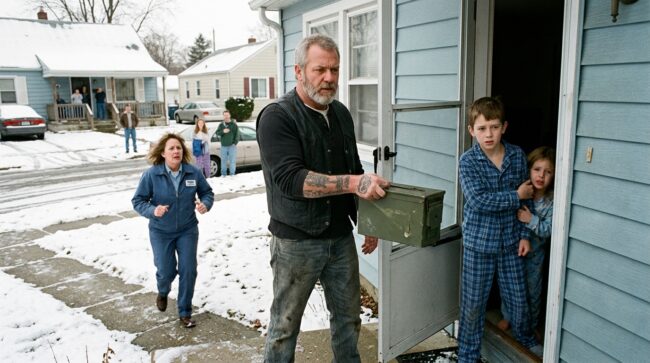
“Open the door, kid—your mother lied to you,” the biker said, standing on a snow-choked porch with a black helmet under one arm and a dented metal box in his hand.
By the time anyone on Willow Street saw him clearly, three curtains had already twitched open, one porch light had snapped on across the road, and old Mrs. Halpern next door was whispering into her cordless phone like she had been waiting all winter for trouble to finally wear boots and leather.
It was Christmas Eve, 8:17 p.m., in a tired little neighborhood on the south side of Akron, Ohio, where the snow never looked clean for long and every house seemed to lean slightly into the wind.
The biker looked wrong for the street. Wrong for the night. Wrong for Christmas.
He was broad-shouldered, gray at the temples, thick in the chest, wearing a worn black riding vest over a thermal shirt despite the cold, his beard rough with flecks of snow. His motorcycle idled at the curb like a dark animal that hadn’t been invited. Saddlebags hung low on both sides. One headlight glowed weakly through the blowing white.
Inside the small rental house at 114 Willow, ten-year-old Eli Mercer stood frozen in the hallway, his socked feet on peeling linoleum, his hand still on the edge of the wall where the paint had bubbled from years of bad heat and worse money. He had been told not to answer the door after dark. Especially not for strangers. Especially not now.
His mother, Dana, had said it twice before leaving for her second shift at St. Luke’s Laundry Services.
“No matter who it is, you call me first.”
But the man outside had said something that made Eli’s stomach turn.
Your mother lied to you.
Eli looked toward the living room, where the Christmas tree stood in the corner with only half its lights working, blinking out of rhythm like it was too tired to celebrate. There were no presents under it. Not even wrapped socks. Just the old plaid tree skirt his mother kept smoothing flat as if that might magically fill the empty space.
His little sister, Molly, sat cross-legged on the floor in flannel pajamas, coloring on the back of a grocery receipt. She was six and still believed people could fix things just by arriving in time.
“Who is it?” she whispered.
Eli didn’t answer.
Another knock hit the door. Harder this time. Not wild. Not drunken. Controlled. Which somehow felt worse.
Across the street, a front door opened. Mr. Keegan stepped onto his porch in house slippers and a Navy sweatshirt, squinting into the snow. He was one of those men who always appeared when something bad seemed likely, usually too late and too loud. He spotted the motorcycle first, then the vest, then the boy-shaped shadow inside the Mercer house window.
“Hey!” he shouted. “You got business there?”
The biker didn’t even turn around.
He just kept his eyes on the door and said, low and flat, “Yeah.”
That was enough to make everything tighten.
Mrs. Halpern was still on the phone. A teenage girl two houses down had her cell up already, recording through the glass. Someone farther off yelled, “Call the cops.”
Inside, Eli felt Molly tug at the back of his shirt.
“Is Santa late?” she asked.
It was such a small, hopeful thing to say that it made him feel angry all at once. Angry at the empty tree. Angry at the cold. Angry at every adult who had learned how to sound tired before they learned how to sound kind.
“No,” he muttered. “Just stay back.”
The biker lifted the dented metal box slightly, as if to show he had brought something. It was old, army green maybe, with scratches all over the lid and one corner bent inward. Not gift-wrapped. Not festive. It looked like something that belonged in a garage or under a soldier’s bed, not on a porch on Christmas Eve.
Then the man spoke again.
“You ask your mother about Michael Mercer,” he said. “Then you decide whether I leave.”
The name hit Eli like cold water.
Michael Mercer was his father.
Or at least the name of his father. The real thing existed only in fragments: one picture in an envelope, a folded flag in a closet box, one old story his mother almost never told all the way through. Eli knew his father had died before Molly was born. He knew there had been a war. He knew his mother stopped talking whenever his name came up long enough to matter.
No one ever came to the door because of Michael Mercer.
No one.
Eli stepped closer before he could stop himself.
“Who are you?” he called through the wood.
A pause.
Then: “Someone who owes him.”
The whole street seemed to lean in.
And when Eli reached for the deadbolt, voices exploded outside at once.
“Don’t you open that door!”
“Kid, stay inside!”
“Police are coming!”
The biker finally turned, just slightly, enough for the neighbors to see the scar along his jaw and the look in his face that made people decide things about him in a hurry. He did not shout back. He did not explain. He just stood there in the snow like a man who had come too far to leave because strangers got nervous.
That calm scared them more than rage would have.
Inside, Eli’s hand stayed on the lock.
Because for the first time all December, something had arrived for this house.
And he had no idea whether it was a gift, a threat, or the beginning of something his mother had spent years trying to keep buried.
By 8:21 p.m., Willow Street looked less like Christmas Eve and more like the first minute of a disaster everyone wanted to witness from a safe distance.
Doors opened up and down the block. Porch lights burned yellow through the snow. People came outside half-dressed in sweaters, boots unlaced, coats thrown over pajamas. Nobody wanted to be the one who did nothing if something happened to the Mercer kids, but nobody seemed eager to get close enough to learn what was actually happening either.
That was the way fear worked in neighborhoods like this. It traveled faster than truth and wore a righteous face.
Mr. Keegan crossed the street first, his phone in one hand, shoulders squared with borrowed courage.
“I said step back from that house.”
The biker looked at him once, measured him, then glanced back at the door. “Not your call.”
Keegan puffed up instantly. “There are children in there.”
“I know.”
The answer was simple, but it landed wrong. Too flat. Too certain. Like he knew more than he should. Like he had come specifically for them.
That was when Dana Mercer’s landlord, Mrs. Alvarez, appeared from the duplex at the corner, wrapped in a heavy robe with a little white dog barking hysterically under one arm. Her eyes went straight to the motorcycle, then the vest, then the metal box.
“Oh no,” she said. “No, no, not here. Not tonight.”
“What do you want?” Keegan demanded.
The biker shifted the box from one gloved hand to the other. “Five minutes.”
“You’re not getting five seconds.”
Inside the house, Molly had started crying—not loudly, not dramatically, just with the soft frightened leaking sound children make when they understand danger without understanding language. Eli knelt beside her and told her to breathe. He kept one ear on the porch, one eye on the window, and one hand on the cheap prepaid phone their mother had left charging in the kitchen.
He had already called Dana twice. No answer.
He tried again. Straight to voicemail.
“Mom,” he said after the beep, forcing steadiness he did not feel, “there’s a man here. On a motorcycle. He says he knows Dad. Please call me back.”
His voice cracked on the last word.
He hated that.
A sharp rap hit the door again, not violent but final.
“Eli.” The biker used his name now.
That changed everything.
From outside came Mrs. Halpern’s voice, shrill with outrage. “How does he know the boy’s name?”
Molly clutched Eli’s sleeve. “Don’t let him in.”
“I’m not.”
But he no longer believed the situation was simple enough for that promise.
He rose and moved to the side window, just enough to look through the edge of the curtain. Up close, the biker looked older than he had from the hallway. Mid-fifties maybe. Weathered. Exhausted in a way that had nothing to do with the cold. Snow clung to his shoulders and beard. His face wasn’t wild. It was set. Disciplined. Like every movement had been thought through before he ever turned onto Willow Street.
On the road behind him sat the motorcycle—an old Harley, dark blue under salt and slush—with a small red ribbon tied awkwardly around one saddlebag.
That detail made no sense at all.
A second vehicle turned onto the street, tires crunching over packed snow. Not a police car. A delivery van from Hanley’s Grocery. It slowed, got trapped behind the bike, and stopped. The driver leaned out, swore under his breath, then saw the crowd and stayed exactly where he was. Trouble had become public now. Public trouble always expanded.
Mr. Keegan stepped onto the first porch stair.
“Leave. Now.”
The biker’s jaw tightened. “I’m not here for you.”
Keegan reached for him.
It happened fast enough that later three different people told three different versions of it.
The biker caught Keegan’s wrist, turned him just off balance, and pushed him backward down one step. Not a punch. Not a throw. Just efficient force applied by someone who had done harder things before and knew precisely how little strength to use. Keegan stumbled, slipped on the wet edge, and smacked into the porch railing with a curse loud enough to make Molly gasp inside.
And that was all the crowd needed.
“Oh my God!”
“He put his hands on him!”
“Police! Where are the police?”
Mrs. Alvarez screamed at the biker in rapid-fire Spanish. The little dog went berserk. The teenager filming moved closer, thrilled now, narrating under her breath as if disaster improved when captured in portrait mode.
The biker did not advance. Did not posture. Did not raise his voice.
He only said, “Told you to stay back.”
That restraint made him look more dangerous, not less.
Because now everyone could imagine what he was choosing not to do.
A siren sounded in the distance, faint but getting closer.
Inside the house, Eli felt something ugly begin to build in his chest. Not just fear. Shame. That specific kind children feel when adults turn their lives into a scene. Their poor house. Their empty tree. Their dead father. Their overworked mother not answering. Their Christmas now spreading across the street like gossip with flashing lights on the way.
Then the biker did something stranger.
He bent down, set the metal box carefully on the porch, and from inside his vest pocket took out a folded piece of paper sealed in a clear plastic sleeve. He slid it under the door.
Every sound on the porch seemed to stop for a second.
Eli stared at the paper on the floorboards.
Molly whispered, “What is that?”
He didn’t know.
But the biker stepped back after doing it, which was the first thing he’d done all night that suggested he might not be trying to get in at all.
Keegan, red-faced and humiliated, pointed a shaking finger. “Don’t touch anything he leaves. It could be anything.”
The biker gave him a look so tired it almost resembled pity.
“It’s a letter.”
“How do we know that?”
“You don’t.”
The siren was close now.
A cruiser turned onto Willow Street, lights washing red and blue across the snowbanks, the Mercer house, the crowd, the motorcycle, the old man standing on the porch like he had dragged half his past through a storm and arrived exactly where he had promised himself he would.
Officer Lila Grant stepped out first, one hand up, voice sharp and practiced.
“Everybody back. Sir, step away from the residence and keep your hands where I can see them.”
The biker obeyed immediately. Slow hands. Open palms. No argument.
That should have made him seem less threatening.
Instead it made Eli’s pulse beat harder.
Because guilty men sometimes argued. Drunk men always did. But this man moved like someone who expected authority, respected procedure, and still had no intention of leaving.
Officer Grant’s partner came around the cruiser door. Younger, broader, already tense. Both officers took in the scene quickly: the crowd, Keegan rubbing his wrist, the crying child visible through the side window, the biker, the bike, the box.
Officer Grant nodded toward the porch. “What’s in that container?”
“Personal property,” the biker said.
“From where?”
A beat passed.
“From Fallujah.”
The street went still in a different way.
Not calmer. Just deeper.
Eli reached down and picked up the plastic-covered letter with suddenly numb fingers.
On the front, in thick black ink faded by time and weather, were four words:
For Dana Mercer Only.
And beneath them, in smaller writing that looked shakier, almost unwilling—
If I’m too late, then Eli.
Officer Grant saw Eli through the narrow gap in the curtain and changed her voice at once.
“Buddy,” she called, softer now, “keep that door closed, okay? You’re doing fine.”
But Eli was no longer sure what fine meant.
His mother’s name was on the letter. His name too. Not as a guess. Not by accident. Someone had written it years ago or yesterday—he couldn’t tell which—and that terrified him more than the shouting had. Because shouting was easy. Shouting meant people had already chosen a side. This was worse. This meant there was a story underneath the noise.
He turned the letter over. The plastic sleeve crackled in his hands. Molly peered up from beside his elbow, her tear-wet face reflected faintly in the window.
“Is it from Mom?”
“No.”
“Then from who?”
He looked at the ink again and said the first honest thing he had.
“I think from before.”
Outside, Officer Grant moved up the walkway alone while her partner held the crowd back. She kept her body angled, cautious but not theatrical, one of those officers who understood that panic was contagious if you fed it.
“Sir,” she said, “I’m going to ask again. State your name.”
The biker’s eyes shifted once to the door, then back to her.
“Jonah Reddick.”
“Do you know the family inside?”
A pause. Snow hissed against the porch rail. Somewhere down the block, somebody’s inflatable snowman buzzed and flapped against a frozen lawn.
“I knew the father,” he said.
“Knew him how?”
Reddick looked past her, over the crowd, over the street, like the answer lived somewhere farther back than Akron, farther back than Christmas, buried under heat and dust and years no one on Willow Street had paid for.
“Over there,” he said. “Long time ago.”
Keegan barked from the sidewalk, eager to recover his courage now that uniforms had arrived. “He assaulted me.”
Reddick didn’t even glance at him. “You grabbed first.”
“That’s not what I saw,” the teenager filming said.
“That’s because you started recording late,” Mrs. Alvarez snapped.
Everyone wanted ownership of the truth now.
Officer Grant held up one hand without looking away from Reddick. Silence rippled outward. Barely.
“You have identification?”
He nodded toward his back pocket. “Wallet.”
“Slowly.”
He moved with the same controlled precision as before, producing a worn leather wallet and handing it over without comment. Grant checked the ID, looked at him, then back at the card.
No warrants, apparently. No instant victory for the crowd.
Her partner, Officer Beasley, had already circled toward the motorcycle. “There are bags on the bike,” he called.
“They’re tied shut,” Reddick said.
“What’s in them?”
“Food. Two toys. A coat. Boots.”
The words landed awkwardly in the cold air.
Nobody said anything for a second.
Then Keegan laughed once, harsh and disbelieving. “Sure.”
Reddick finally looked at him then, and Eli could see the man’s face clearly through the side glass. It wasn’t the face of someone enjoying this. It wasn’t smug, or angry, or theatrical. It was the face of a man who had rehearsed one difficult thing for a long time and found out too late that real life would make it uglier.
Officer Grant crouched and examined the metal box without opening it.
“Why not bring this during the day?” she asked.
“Got delayed.”
“By what?”
“Snow in Pennsylvania. Then a flat outside Youngstown.”
Grant straightened. “You came from Pennsylvania?”
Reddick nodded once.
That detail bothered Eli for reasons he couldn’t name. People did not drive through a storm from another state to stand on a poor family’s porch unless something had held them upright for a very long time.
Inside, Molly wiped her face with both fists. “Why would he bring boots?”
Eli didn’t answer because he had already noticed his own winter shoes drying by the radiator with cardboard pressed inside the toes where the soles had split.
He gripped the letter harder.
Outside, Officer Beasley unfastened one saddlebag despite Reddick’s silence. Grant gave no sign to stop him. The younger officer pulled out a grocery sack first. Canned soup. Pasta. Peanut butter. Boxed stuffing mix. Then a second bag. A child’s puffy red coat with the store tag still on. Boots, small. Wrapped rectangle. Another wrapped shape, lopsided, done in plain brown paper and taped more heavily on one side as if the person who had wrapped it was better with hands than ribbons.
The crowd shifted.
The shift was small, but Eli felt it even through the door.
Not forgiveness. Not yet.
But the first hairline crack in certainty.
Mrs. Halpern lowered her phone.
The teenager stopped narrating.
Mr. Keegan’s expression turned defensive, as if generosity itself were suspicious if it arrived wearing the wrong clothes.
Officer Beasley held up the paper-wrapped items. “These for the kids?”
Reddick said nothing for a moment.
Then, “Yeah.”
“From you?”
Another pause.
“Not exactly.”
Grant’s gaze sharpened. “Explain.”
Reddick looked toward the door again, and when he spoke, his voice was quieter than before. Eli had to move closer to hear it.
“From somebody who should’ve been here.”
That sentence moved through the porch, through the officers, through the people in the snow, and settled like a weight inside Eli’s ribs.
Molly whispered, “Does he mean Dad?”
He wanted to say no. He wanted to say obviously not. He wanted to stay ten years old and irritated and certain that adults either showed up or they didn’t.
But he could not stop looking at the letter.
Officer Grant noticed.
“Eli,” she called gently, “do not open that yet.”
Too late.
Not fully. But too late to stop his eyes from catching the corner of what had slipped loose where the plastic sleeve had split along one edge.
A photograph.
Old. Glossy. Bent.
He pulled it halfway free before he even knew he’d done it.
Three men in desert uniforms stood beside a military vehicle under a white-hot sky. One was young, thinner, smiling the way people smile before they understand what a photograph will outlive. Eli knew that face instantly despite having seen it only once before in a worn envelope in his mother’s dresser.
Michael Mercer.
His father.
Beside him stood a younger version of Jonah Reddick, leaner then but unmistakable—the same eyes, same jaw, same stillness even in a snapshot. On the back of the photo, visible for only a second as Eli turned it over, there was handwriting.
You get home first, you check on them.
You hear me?
Eli forgot every warning his mother had ever given him.
He unlocked the deadbolt.
The sound was tiny.
But on that porch it was louder than the siren had been.
Officer Grant turned instantly. “Eli, no.”
Molly grabbed the back of his shirt. “Don’t.”
The crowd inhaled as one body.
Eli opened the door three inches.
Wind pushed snowdust across the threshold. Cold needled into the hallway. From that close, Jonah Reddick seemed even larger, but not in the monstrous way the neighbors had made him. Just solid. Worn. Human. His beard had more gray in it than black. His knuckles were scarred. His left glove had been stitched twice at the thumb.
Eli held up the photo with a trembling hand.
“You knew him,” he said.
Reddick looked at the photograph, and something shifted in his face so quietly it was worse than tears. It was the look of a man who had carried one order for too many years and no longer believed he deserved to be the one delivering it.
“Yeah,” he said.
Officer Grant stepped forward. “Door stays mostly closed. Understood?”
Eli barely nodded.
Reddick didn’t move closer.
He didn’t ask to come in.
Didn’t push the box forward. Didn’t explain the whole thing away like a movie would. He only stood in the wash of red-and-blue lights, snow gathering on his shoulders again, and looked at the boy the way men sometimes look at promises they failed to keep on time.
“Your mother,” Eli said, his throat tightening, “why did you say she lied?”
Reddick lowered his eyes for one brief second, then met the boy’s gaze again.
“Because,” he said, “she told you no one was coming.”
The street went silent.
Not noisy-silent. Not angry-silent.
The kind that comes right before a truth either heals something or tears it wider open.
And then, from somewhere behind Eli, in the dark hallway of the little house with the half-lit tree and the empty floor beneath it, Molly said in her small, shaking voice—
“Then why are you so late?”