Part 2: Mother Was Mocked by Relatives for Working in a School Cafeteria — Her Son’s Graduation Speech Left the Entire Family in Tears
Maria crouched beside the freshman near the hallway door.
His name was Micah Reynolds.
He was fourteen, thin, and still wearing his school backpack despite the late hour. Beside him stood his eight-year-old sister, Chloe, holding a stuffed rabbit beneath one arm.
Their mother worked evenings at a nursing home and had expected to collect them before graduation began.
Her shift ran late.
Micah insisted they could wait outside.
Maria knew better.
She opened her purse and handed him two sandwiches.
“The third one is for your mother,” she said.
Micah lowered his voice.
“We can pay you back next week.”
Maria shook her head.
“You can return the lunch bag on Monday.”
He recognized the answer.
Students at Cedar Grove often did.
Maria never called it charity. She never asked questions in front of other children. She simply placed food inside a plain paper bag and asked students to return the bag whenever they remembered.
From the podium, Andrew watched his mother hand Chloe a small carton of milk.
Denise watched too.
Her expression had changed slightly, but Rachel still looked uncomfortable.
“She should have handled that earlier,” Rachel whispered. “This is her son’s graduation.”
Denise did not respond.
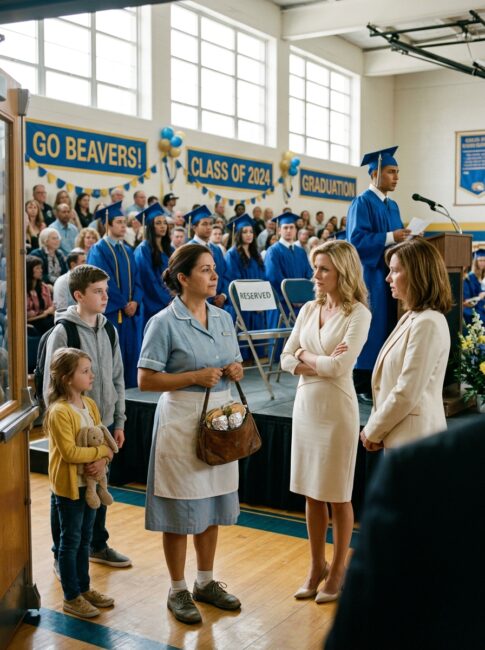
Maria entered the gym after Micah and Chloe settled near the hallway with their food.
She slipped into the reserved chair while Andrew waited at the microphone.
“I apologize,” she mouthed.
Andrew smiled.
Then he looked down at the speech in his hands.
“For most of my childhood,” he began, “I thought my mother worked in the cafeteria because life had given her no other choices.”
Maria’s smile faded.
The relatives in the front row exchanged quiet glances.
Everyone knew part of Maria’s story.
Her husband, Thomas, had died in a construction accident when Andrew was seven. Maria had taken every job available after that.
She cleaned motel rooms before sunrise. She folded laundry at a nursing facility on weekends. She delivered grocery orders in the evenings when Andrew was old enough to stay home alone.
Eventually, she accepted a position in the school cafeteria.
Some relatives considered that the end of her ambitions.
At family gatherings, Denise suggested office-training programs. Rachel once asked whether Maria planned to “move into a real career” after Andrew left home.
Maria usually smiled and changed the subject.
Andrew continued.
“Last month, I learned that my mother was offered a different job six years ago.”
Maria looked down at her hands.
The school district had offered her an administrative position at its central office. The job came with better hours, a quieter workspace, and a higher salary.
She declined it.
Nobody in the family knew why.
Andrew glanced toward the cafeteria doors.
“To understand her answer,” he said, “you need to know about the blue tray.”
Near the rear bleachers, one graduating student lifted her head.
Then another did the same.
The blue tray sat at the far end of the cafeteria counter.
It looked ordinary.
Most lunch trays were beige. A few were green. Only one was blue.
Students who needed a meal but had no money on their accounts could quietly ask Maria whether the blue tray was available.
She never required an explanation.
Sometimes a parent had lost a job. Sometimes paperwork for meal assistance had not been processed. Sometimes a student simply arrived at school hungry after a difficult night at home.
Maria placed food on the tray and handed it across the counter exactly as she served every other lunch.
No separate line.
No announcement.
No expression that made a child feel watched.
Andrew had not known about the arrangement until he returned to school one afternoon to retrieve a forgotten notebook.
He found his mother sitting alone in the cafeteria with a stack of index cards spread across a table.
Each card contained only a first name and a small mark beside a date.
Andrew recognized several names.
Some belonged to students in his graduating class.
“What are those?” he asked.
Maria quickly gathered the cards.
“Kitchen notes.”
Andrew noticed an envelope beside them.
Across the front, Maria had written:
Blue Tray Fund.
Inside were small bills and coins.
Several weeks later, he asked the cafeteria manager, Mrs. Holloway, what the blue tray meant.
Mrs. Holloway hesitated.
Then she told him the truth.
Maria had started the system after noticing a sixth-grade boy pretending to forget his lunch every day.
His father was between jobs. The boy refused free food because he did not want his friends to know.
Maria placed his meal on a blue tray and told him she needed help testing a new serving system.
The explanation protected his pride.
The arrangement continued after his family recovered.
Other students quietly learned the phrase.
The fund grew slowly.
Maria placed a few dollars inside whenever she could. Teachers occasionally added money. The cafeteria staff contributed coins after long shifts.
Sometimes the account ran low.
When that happened, Maria stayed late preparing food for school events. She accepted extra weekend hours. She used the money to cover meals until donations returned.
“That is why she declined the office job,” Andrew said from the podium. “She told Mrs. Holloway that someone needed to remain where students could find the blue tray without asking a stranger.”
Maria shook her head slightly, as if asking him not to continue.
Andrew looked toward her.
“I know you did not want anyone to know,” he said. “But there is something you never told me either.”
The gym grew quieter.
Andrew folded his speech pages and set them aside.
“The first child my mother ever fed at Cedar Grove was not the boy Mrs. Holloway mentioned.”
Maria stared at him.
Andrew reached inside his graduation gown and removed an old paper lunch bag.
Its edges were worn. A faded blue star had been drawn near the bottom corner.
“The first child was me.”
A murmur moved across the gym.
Andrew explained that before Maria worked at the school, she sometimes struggled to stretch groceries through the final days before payday.
One Monday morning, when Andrew was nine, he arrived without lunch money.
He said nothing.
At noon, the cafeteria manager at the time noticed him sitting alone with a cup of water.
She handed him food inside a paper bag and drew a blue star on the corner.
“No questions today,” she told him. “You can bring the bag back whenever life gets easier.”
Andrew carried the bag home.
Maria found it inside his backpack.
The following morning, she returned to the school with five dollars and a handwritten thank-you note.
Two months later, when a cafeteria position opened, Maria applied.
She kept the original bag.
Years later, she began drawing the same blue star on bags for students who needed something extra after school.
Andrew lifted the worn bag slightly.
“My mother did not stay in the cafeteria because she had nowhere else to go,” he said. “She stayed because she remembered what it felt like when one lunch allowed a child to walk back into class without feeling smaller.”
Near the middle rows, a graduating senior named Kayla stood.
She wore honor cords across her gown.
“My dad was out of work sophomore year,” she said softly. “Mrs. Bennett gave me the blue tray.”
A boy near the aisle stood next.
“My mother was in the hospital for three months,” he said. “She packed breakfast for me too.”
Another student rose behind him.
Then another.
Within seconds, more than twenty graduating seniors were standing throughout the gym.
Some looked toward Maria.
Others stared at the floor, wiping their eyes.
Denise covered her mouth.
Rachel lowered her phone.
Beside her sat Rachel’s son, Tyler, who had graduated from Cedar Grove two years earlier.
He leaned toward his mother.
“She helped me too,” he whispered.
Rachel turned toward him.
“When?”
“During your divorce,” Tyler said. “I did not want Dad to know I forgot lunch money. Mrs. Bennett never asked me to explain.”
Rachel looked toward Maria.
For the first time that evening, she seemed unable to speak.
Andrew continued.
“My relatives sometimes asked my mother when she planned to find a better job.”
The sentence landed gently.
He did not sound angry.
He looked at Maria with the same quiet expression he had worn since childhood whenever she returned home tired.
“I used to wonder that too,” he said. “Tonight, I finally understand that the job was never small. We were simply standing too far away to see it clearly.”
Maria lowered her head.
Denise began crying.
Not loudly.
She reached for her sister’s hand.
Maria allowed her to hold it.
After the ceremony, families gathered near the gym doors for photographs.
Students approached Maria one by one.
Some hugged her.
Some simply said thank you.
Micah remained near the hallway with Chloe and the third sandwich reserved for their mother.
When Andrew finally reached Maria, he wrapped both arms around her.
“You kept the bag,” she whispered.
“You kept everything else,” he replied.
The following Monday, Cedar Grove felt unusually quiet.
Graduation banners still hung near the entrance. Empty classrooms waited for summer cleaning. Lockers stood open while staff collected forgotten notebooks and jackets.
Maria arrived before seven.
She tied her apron, washed her hands, and began preparing breakfast bags for the students enrolled in summer programs.
The blue tray remained at the far end of the counter.
Its surface had faded from years of use. A shallow scratch ran along one side. Someone had drawn a tiny star beneath the rim with permanent marker.
Maria placed a breakfast sandwich, an apple, and a carton of milk on top.
Then she added a plain paper bag.
She did not notice Andrew enter the cafeteria until he set a small cardboard box beside the register.
“What is this?” she asked.
“Graduation gifts,” he said.
Inside were envelopes.
Some contained five dollars. Others held twenty. One included only a handful of coins and a folded note from a student.
For the next person who needs the blue tray.
Andrew had asked relatives to contribute to the cafeteria fund instead of purchasing gifts for his graduation party.
Denise added an envelope of her own.
Rachel contributed too.
She arrived later that morning carrying a case of paper lunch bags and two boxes of shelf-stable snacks.
She looked uncertain as she placed them on the counter.
“I did not know what would be useful,” she said.
Maria opened one box.
“These will help.”
Rachel glanced toward the blue tray.
“I am sorry about what I said at graduation.”
Maria studied her cousin’s face for a moment.
Then she handed her a marker.
“Would you draw stars on the bags?”
Rachel nodded.
They sat together at a cafeteria table beneath the quiet fluorescent lights.
One by one, Rachel drew small blue stars near the bottom corners.
Her lines were uneven.
Maria did not correct them.
Before leaving for college in the fall, Andrew visited the cafeteria one final time.
Students moved through the lunch line while Maria stood behind the counter wearing the same pale blue uniform.
She served pasta, fruit, and milk with practiced movements.
A nervous seventh-grade boy reached the register and lowered his voice.
“Is the blue tray available today?”
Maria smiled gently.
“It is always available.”
She handed him the tray without asking another question.
The boy carried it toward a table beside his friends.
Nobody looked twice.
Andrew watched from near the doorway.
His mother noticed him and raised one hand.
He waved back.
Above the cafeteria counter, graduation photographs had been taped beside the weekly menu.
Near the bottom was a picture of Andrew holding his diploma with Maria beside him.
She was still wearing her cafeteria uniform.
This time, nobody had asked her to change.
Follow this page for more heartfelt stories about the ordinary people whose quiet work touches more lives than anyone realizes.