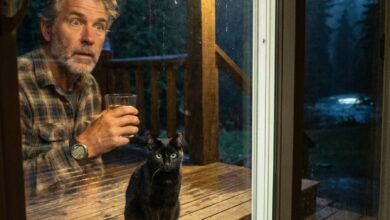
My Cat Stared at an Empty Corner Every Night — Then I Found My Husband’s Last Six Minutes in Hospital
Every night at 3:12, my cat sat beside my bed and stared at the empty corner until 3:18.
I thought grief had finally made me strange enough to notice patterns where there were none.
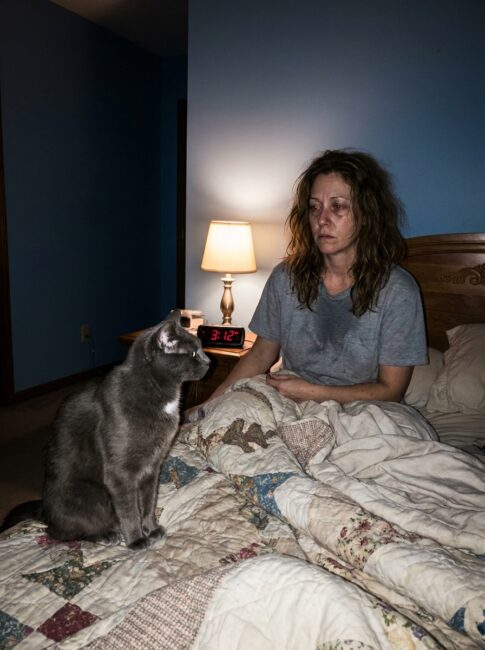
But the cat noticed first.
Her name was Juniper, though she had not come with a name, a collar, or the soft manners of an animal raised indoors. She was a thin gray cat with one torn ear, a white patch under her chin shaped like a spill of milk, and eyes the color of old green glass left in the desert sun.
She arrived in Marfa, Texas, three weeks after my husband, Daniel, was transferred to a hospital in Odessa.
Not died.
Transferred.
That was the word everyone used because it sounded temporary, as if a person could be moved ninety miles away and still remain part of the house.
I was forty-one years old then, working three days a week at a small frame shop near Highland Avenue, mounting other people’s wedding photographs behind clean glass while my own marriage folded into hospital receipts and night phone calls.
Juniper appeared under my porch one evening in July.
I heard the screen door rattle, looked down, and saw her sitting on the second step like she had an appointment. Her ribs showed when she breathed. A scratch crossed her nose. Her left pupil stayed wider than the right, as if one eye had seen something the other had refused to remember.
I put out a shallow bowl of water.
She looked at it.
Then she looked at me.
That was the first thing I learned about Juniper.
She did not rush.
She decided.
For two days, she slept under the porch and came out only when I sat on the steps without speaking. On the third morning, she walked past my ankles, entered my house, and sat in the doorway of the bedroom Daniel and I had painted blue ten years earlier.
She had never met him.
That matters.
By then Daniel had been gone from the house for nearly a month, first to Alpine, then Odessa, where the doctors said the infection had turned complicated, then dangerous, then “not responding the way we’d hoped.”
Juniper never saw his boots by the back door.
She never heard him whistle badly while making coffee.
She never sat on his chest while he read the paper.
Still, every night, at exactly 3:12, she walked into my room, sat beside the bed, and watched the same empty corner.
Six minutes.
Not five.
Not seven.
At 3:18, she blinked once and left.
The first week it happened, I blamed the plumbing.
Old houses in Marfa make noises that sound like people remembering things. Pipes knocked behind walls. Wind pushed dust under the doors. The floorboards cooled after midnight and gave off small wooden sighs.
I told myself Juniper heard a mouse.
Then I borrowed a trap from my neighbor, Mrs. Calder, who lived across the alley and knew everyone’s business before they did. No mouse came. No droppings appeared. Nothing chewed through the pantry bags.
Still, Juniper returned to the corner.
3:12.
3:18.
I started sleeping with my phone on my chest because Daniel’s hospital called at strange hours. Sometimes it was a nurse explaining a medication change. Sometimes it was a resident whose voice sounded too young to carry bad news. Sometimes it was Daniel himself, breathing hard but trying to make jokes.
“Tell the house I’m coming back,” he said once.
“The house is ignoring me,” I told him.
“Then tell it I know where the shutoff valve is.”
That made him laugh, then cough, then hand the phone to someone else.
After calls like that, I would lie awake until dawn.
Juniper would not climb into bed. She did not curl against my grief like a movie cat with perfect timing. She stayed near the dresser, tail wrapped around her feet, eyes fixed on the corner where the wall met the old cedar chest.
Only when I stopped crying would she cross the room.
She would place one paw on the quilt.
Then another.
Not close enough to comfort.
Close enough to witness.
That became our arrangement.
She did not ask for much. A scoop of Purina One in the blue ceramic bowl. A sunny strip on the kitchen floor. The right to sit on top of the washing machine when it shook during the spin cycle.
She hated closed doors.
She loved the smell of Daniel’s old flannel shirts, though she had no reason to know they were his. I kept them in the cedar chest because the closet still smelled like hospital sanitizer in my mind. Some afternoons, I would find her sleeping on the folded shirts after somehow lifting the chest lid with her head.
I thought she liked the softness.
Now I am not sure.
In August, Daniel got worse.
The calls became shorter, then stopped being his voice at all. His sister drove in from Lubbock. My mother offered to stay, but I said no because the house already felt crowded with things no one could fix.
Juniper watched everyone from under the dining table.
She did not like strangers touching her.
But on the afternoon I came home after signing another consent form, I found Daniel’s sister sitting on the kitchen floor, crying into both hands.
Juniper was beside her.
Not touching.
Just sitting close enough that her tail rested against the woman’s shoe.
That was how Juniper loved.
She put herself near the wound and waited to see whether you would survive it.
Daniel died on September 4th.
I was not in the room.
That sentence still sits inside me like a stone I swallowed by accident.
The hospital had called at 2:40 that morning, saying his blood pressure had dropped and I should come if I could. I threw on jeans, grabbed my keys, and drove into a black Texas road with nothing but my headlights, jackrabbits, and the long empty stretch toward Odessa.
Halfway there, outside a gas station that had not opened yet, the phone rang again.
A nurse said they were doing everything they could.
Her voice had changed.
There are sounds people make when hope leaves before the words do.
I pulled over near a barbed-wire fence and listened to her breathe.
“Please keep driving,” she said gently.
So I did.
By the time I reached the hospital, Daniel was gone.
I remember the fluorescent lights more than his face.
I remember the paper cup of water someone placed in my hand.
I remember a doctor with tired eyes saying they had fought for several minutes, that he had not been alone, that they were sorry.
Several minutes.
That was all he said.
After the funeral, people came to the house with casseroles, banana bread, envelopes, and sentences that began with “At least.” At least he is not suffering. At least you had ten years. At least you got to say goodbye.
But I had not.
Not the way I wanted.
I had said goodbye to a body in a hospital bed after everyone else had already finished fighting for him.
Juniper disappeared for two days after the funeral.
I searched the alley.
I shook the food bag.
I checked under the porch, behind the shed, inside Daniel’s truck, which still sat in the gravel drive with a sun-cracked receipt from Dairy Queen in the cup holder.
On the second night, I sat on the back steps and said, “Fine. Leave, then.”
My voice sounded cruel.
It was not meant for her.
At 3:12 that morning, I woke to the soft click of claws on wood.
Juniper entered the bedroom, thinner than before, dust on her whiskers. She did not look at me. She crossed to the side of the bed, sat down, and stared at the corner.
At 3:18, she left.
Then she jumped onto the cedar chest and slept on Daniel’s flannel shirts until morning.
That should have been the end of the story.
A grieving widow. A strange cat. A house full of silence.
But grief has a way of turning ordinary things into clocks.
And Juniper had become one.
By October, I had stopped sleeping through the hour.
I did not need an alarm. My body learned it the way it had learned Daniel’s old work schedule, the sound of his truck at six-thirty, the way he cleared his throat before saying something serious.
At 3:10, I would wake.
At 3:12, Juniper would enter.
Some nights the moon put a pale rectangle across the floor. Some nights the room stayed black except for the little red numbers on the digital clock. I bought that clock from a Walmart in Fort Stockton because Daniel hated using phones beside the bed.
The red numbers glowed.
3:12.
Juniper stared.
Her ears did not twitch like she heard insects in the wall. Her whiskers did not move. Even her tail stayed still, curved neatly around her feet.
Only her eyes changed.
They widened until the green almost vanished.
At first, I whispered her name.
She ignored me.
Then I waved my hand in front of her face.
Nothing.
One night I stood in the corner myself, barefoot on cold boards, my back against the wall, asking a stray cat what she could see that I could not.
Her gaze moved through me.
Not at me.
Through me.
I told Mrs. Calder about it on a Tuesday while she watered her brittle little rosemary plant beside the alley.
She was seventy-eight, wore turquoise rings on four fingers, and had buried two husbands with the same calm expression she used for bad weather.
“Cats keep appointments,” she said.
“With ghosts?” I asked, half joking.
“With what we miss,” she answered.
I laughed because I needed to.
But I did not tell her the strangest part.
Juniper only did it on my side of the bed.
Daniel’s side stayed untouched.
His pillow remained in the closet because I could not stand seeing the empty dip where his head used to rest. His boots were still by the back door. His coffee mug still sat upside down in the dish rack, though I had washed it twelve times.
Juniper never slept there.
She never crossed the invisible line where he used to be.
Except during those six minutes.
At 3:12, she sat between both sides of the bed, as if holding the room together.
At 3:18, she released it.
November came cold and dry.
The tourists thinned. The sky looked closer. At the frame shop, people brought in desert photographs and old ranch deeds and one enormous portrait of a blue heeler named Agnes wearing a bandana.
I worked with my hands because my mind was unreliable.
Measure.
Cut.
Mount.
Smooth the corners.
Glass can make anything look preserved if you clean it well enough.
One afternoon, while sorting bills at the kitchen table, I opened a hospital envelope I had avoided for weeks. Most of the papers were explanations of charges, medication lists, signatures, coding language that made death sound like an administrative problem.
Then I found the timeline.
It had been included with the final records I requested for insurance.
I almost threw it away.
The paper was thin, printed in black ink, with Daniel’s name at the top and a list of times down the left side.
2:57 AM — blood pressure falling.
3:04 AM — oxygen saturation dropping.
3:10 AM — rapid response team called.
Then my hand stopped.
3:12 AM — patient stopped breathing.
I read the line once.
Then again.
The kitchen went quiet in a way I had never heard before, though nothing had changed. The refrigerator hummed. A truck passed outside. Juniper drank from her bowl in the corner, pink tongue touching water without sound.
My eyes moved down the page.
3:18 AM — resuscitation unsuccessful, time of death confirmed.
Six minutes.
I sat there with the paper in my hand until my fingers left damp marks in the margins.
3:12.
3:18.
For four months, my cat had sat in my bedroom and watched the exact length of Daniel’s final fight.
A cat who had never met him.
A cat who had arrived after he left the house.
A cat who should have known nothing.
I took the paper to Mrs. Calder because I was afraid to be alone with it.
She did not say “I told you so.” Old women who have buried enough people know better than to make mysteries smaller.
She read the timeline, folded it once, and handed it back.
“Some animals hear storms before they arrive,” she said. “Maybe some hear people leaving after they’ve gone.”
“That sounds impossible.”
“So does loving someone after their body quits,” she said.
I wanted to dismiss it.
I wanted a better explanation. Wiring. Light. Coincidence. The digital clock training my imagination. Some tiny vibration in the wall that happened at the same time every night because of a water heater or a neighbor’s generator.
But nothing in my house turned on at 3:12.
Nothing stopped at 3:18.
Only Juniper.
That night, I searched online until the screen hurt my eyes.
I found grief forums, pet forums, arguments, stories about dogs refusing to leave hospital beds, cats sleeping beside sick owners, horses becoming restless before their riders died.
Most of it was comfort dressed as certainty.
Then I found an essay by a physician from New Mexico, a palliative care doctor who wrote about the final minutes before death.
He did not say animals saw spirits.
He did not make promises.
He wrote carefully, almost reluctantly, about how the body changes at the edge of death. The shifts in breath. The chemistry. The electrical storms in the brain. The way some animals, especially those tuned to silence, seem to respond to changes humans cannot read.
One line stayed with me.
He said the last minutes of consciousness may not disappear all at once.
They may scatter.
Like light leaving a room in layers.
I closed the laptop.
Juniper was sitting in the bedroom doorway.
She was not watching the corner yet.
She was watching me.
For the first time, I wondered whether Daniel’s last six minutes had not ended in that hospital room.
Maybe something of them had traveled home.
Maybe not a ghost.
Not a message.
Just a piece of unfinished leaving, moving through whatever roads grief uses when the body cannot follow.
And maybe Juniper, who had chosen my porch for reasons I would never understand, had been sitting with those six minutes every night because I could not.
After that, the ritual changed.
Not Juniper’s part.
Mine.
At 3:10, I would wake and sit up slowly.
At 3:12, when she entered, I no longer whispered her name or tried to stop her. I pulled the quilt to my waist and watched with her.
Sometimes I spoke to Daniel in a voice barely louder than breath.
I told him the water heater was leaking again.
I told him Mrs. Calder still overwatered the rosemary and blamed the sun.
I told him his sister had finally taken his fishing rods back to Lubbock.
I told him I was angry he had left his good boots where I had to see them every morning.
Juniper never reacted.
She sat beside the bed, facing the corner, carrying her small gray body like a witness under oath.
At 3:18, she blinked.
Then the room belonged to the living again.
This went on through Thanksgiving, through the first cold snap, through the night someone set off fireworks early and Juniper hid under the sofa for an hour but still came to my room at 3:12.
On Christmas Eve, I placed Daniel’s flannel shirt on the cedar chest instead of inside it.
Juniper stepped onto it, turned twice, and lowered herself with a small groan that made her sound older than she was.
For the first time in weeks, she purred.
It was not a sweet sound.
It was rough and uneven, like an old engine trying after winter.
I put my hand near her, not on her.
She stretched one paw until it touched my wrist.
That was all.
I slept on the floor beside the chest until morning.
By January, I had begun to count the nights.
Not at first. At first counting felt like a betrayal, as if I were measuring Daniel’s absence instead of living inside it.
But after the hospital records, after the essay, after the hours of sitting awake with a cat and an empty corner, I wrote a small mark on the calendar each morning.
A pencil line.
Nothing dramatic.
One line for each night Juniper kept watch.
Night 97.
Night 104.
Night 113.
On night 120, I woke before the clock again.
The house was still.
Outside, a freight train groaned somewhere beyond town, low and distant enough to feel more like memory than sound.
Juniper came in at 3:12.
She sat.
She watched.
At 3:18, she looked away.
Then she did something she had never done.
She climbed onto Daniel’s side of the bed.
I stopped breathing for a second.
She walked across the quilt slowly, as if stepping over water. She circled once where his knees used to be, then lay down near the empty pillow I had finally returned two days before.
Her body was small against the wide mattress.
Her eyes stayed open.
I did not move.
In the morning, she was back on the cedar chest, washing one paw like nothing had happened.
I thought that was the end of the strange part.
I was wrong.
Night 121 came with hard wind.
The kind that throws dust against windows and makes every old board speak. I had worked late at the frame shop, came home with cracked hands, ate toast over the sink, and forgot to mark the calendar.
At 3:10, I woke.
The red clock watched me.
3:11.
I turned toward the doorway.
No Juniper.
At 3:12, the room stayed empty.
I waited.
3:13.
The wind pressed against the screen door.
3:14.
I sat up and called her name.
Nothing.
By 3:18, I was out of bed, moving through the house with my heart beating too hard.
I found her in the living room.
She was sleeping in the old leather chair Daniel used to claim every Sunday afternoon, though she had avoided it since the day she arrived. One paw hung over the edge. Her torn ear twitched once in a dream.
The corner had been abandoned.
The six minutes had ended.
I stood there in the dark, angry in a way that surprised me.
Not because she stopped.
Because I had not known I needed it to continue.
For four months, I had believed Juniper was keeping watch for Daniel.
Only then did I understand she had been keeping watch for me.
I went back to bed with the house still shifting in the wind.
For the first time since the hospital call, I dreamed of Daniel.
Not sick.
Not young either.
Just Daniel as he had been in ordinary life, standing in the kitchen in his faded green T-shirt, one hand on the coffee mug he always forgot to put away.
He did not glow.
He did not say anything grand.
He looked toward the bedroom doorway, smiled a little, and said, “She stayed until you could.”
In the dream, I looked down.
Juniper sat beside his boot.
Not touching him.
Just close enough to witness.
When I woke, sunlight had turned the curtains pale.
For several seconds I did not remember.
Then I did, but the remembering did not crush me the same way.
Juniper was on the bed.
Daniel’s side.
Her eyes were half closed, and the morning light made the green look almost gold. When I touched the quilt beside her, she opened one eye, judged me, and began to purr.
Rough.
Uneven.
Alive.
I never found a clean answer.
People like clean answers because they can be placed on shelves. They can be dusted, repeated, argued over, used to make the world feel less wild.
Juniper did not give me one.
She gave me 121 nights.
She gave me six minutes at a time.
She gave me a place to put the goodbye I had missed.
Later, I moved Daniel’s boots from the back door to the closet.
Not because I was done missing him.
Because I no longer needed to trip over proof that he had lived there.
I kept the cedar chest in the bedroom. Juniper still sleeps on it most afternoons, though she no longer forces the lid open. Sometimes she kneads the folded flannel through the wood, claws clicking softly, as if checking whether memory still has a pulse.
Mrs. Calder says cats leave when their work is finished.
I disagree.
Cats leave when they choose.
Juniper stayed.
She stayed through February dust, spring tourists, the first year anniversary, and the day I finally drove to Odessa without pulling over at the gas station fence.
I sat in the hospital parking lot for twenty minutes.
Then I went inside and thanked the nurse whose name I had found in the records.
She cried before I did.
When I came home, Juniper was waiting in the hallway, tail straight, eyes narrowed like I had broken some household rule by surviving outside her supervision.
I laughed.
It startled both of us.
That became our new ritual.
Not 3:12.
Not the corner.
Now, every morning, Juniper sits on the kitchen table where she is not allowed and watches me make coffee in Daniel’s old mug. I tell her to get down. She refuses. I tap the table. She blinks once, slowly, and stays.
Some mornings, I swear she looks past me.
Toward the blue bedroom.
Toward the cedar chest.
Toward whatever remains after love changes shape but does not vanish.
I do not ask what she sees.
I have learned that some animals do not explain their mercy.
They just arrive.
They sit still.
They keep watch until the living can breathe again.
And then, one morning, they let the room go quiet.
Juniper is asleep now in the chair Daniel loved, her gray body curled into the worn leather hollow he left behind. The house is full of small sounds again.
The refrigerator hums.
The wind moves dust along the porch.
A cat dreams in the chair.
Nothing is empty anymore.
If a cat ever stayed with you through grief, share their name below.