The Black Cat Came to My Back Porch at 11:47 Every Night for Six Weeks — Then I Found My Grandfather’s Journal
The first night the black cat showed up, I checked my watch out of habit. 11:47 PM. I thought nothing of it.
The second night, same minute. Same step. Same tail curled around the same paws.
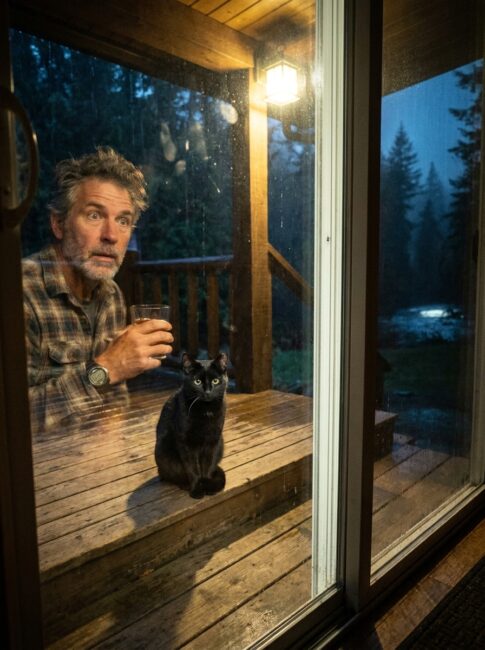
By the sixth night I started looking at the clock before he arrived, just to see if I was imagining it.
I wasn’t.
My name is Daniel Vesper. I’m fifty-eight years old, freshly divorced, and as of October I live alone in the cedar cabin my grandfather built in 1962 on the Wisconsin side of the St. Croix River, just outside Stillwater, Minnesota. My grandfather, Henrik, left it to me when he died in 2003. My ex-wife always hated the place. Too quiet, she said. It feels like the house is listening to us.
I let her have the brownstone in St. Paul. I took the cabin and the canoe and the chipped enamel coffee pot.
I had never owned a cat. Never wanted one. My mother kept dogs — golden retrievers with names like Buddy and Major, dogs that ran in circles and shed on everything. Cats, to me, were what other people had. Quiet women. Men in cardigans who read poetry. Not a man who used to manage a hardware distribution warehouse for thirty-one years.
The cat was small. Not a kitten — but not full-grown either. Adolescent, maybe. Black, except for a single white whisker on the left side of his face that caught the porch light like a thread of frost. His left ear was notched, an old scar healed clean. His eyes were the color of pond water in late October — green, but with something gold drowned underneath.
He didn’t meow. Not once.
He just sat. Six feet from the back door, on the second step down. Spine straight. Tail wrapped around his front paws like a scarf. Looking at me through the glass.
By the eighth night, I put out a bowl of milk.
He didn’t touch it.
By the fifteenth night I tried tuna, then plain water, then a piece of grocery-store rotisserie chicken. He didn’t move toward any of it. He sat. He watched. At 12:14 AM, give or take a minute, he stood up and walked off into the pines toward the riverbank, and I wouldn’t see him again until 11:47 the next night.
I started timing my evenings around him. I’d pour a bourbon at 11:30. Sit in the leather chair facing the back door. Wait.
It became the part of my day I looked forward to. Which is a strange thing to admit about a man and a cat that wouldn’t come inside.
If a cat ever chose you for a reason you didn’t understand, tell me below.
By the third week, I had stopped pretending I wasn’t waiting for him.
I’d quit my job in August — a clean buyout, enough to live on if I was careful. I told myself the cabin would be a project. I’d patch the roof, replace the dock, finally read the books I’d been collecting since the nineties. Instead I drank coffee in the mornings and watched the river move and tried not to think about my marriage, which had ended not in any single fight but in twenty-six years of slow erosion, the way water carves a canyon out of stone by simply refusing to stop.
My daughter Hannah called once a week. She’s thirty-one, an architect in Minneapolis. She’d ask if I was eating. If I was sleeping. If I was doing okay, Dad, really. I told her about the cat in the fourth week.
“That’s so weird,” she said. “Maybe he belonged to the previous owner?”
“Grandpa Henrik was the previous owner. He died when you were nine.”
A pause. “Oh. Right.”
I didn’t know how to explain to her that the cat felt less like a stray and more like an appointment. That I had started leaving the porch light on a few minutes before 11:47 because it felt rude not to. That on the night I had to drive to Hudson for a late dinner with an old colleague, I had cut the evening short and sped home in the rain because I didn’t want him to arrive at an empty step.
He was there when I pulled in. Sitting in the downpour. Soaked through. Watching the back door from the same spot, as though he had agreed to meet someone and would not leave until the meeting happened.
I noticed other things, too.
He always looked past me. Not at me — through me, toward the inside of the house. Toward the living room. Specifically, I came to realize, toward the old oak writing desk in the corner by the bookshelf. The one my grandfather had built himself out of barn wood in the early seventies. The one I had never fully unpacked into, because the drawers were stiff with age and I kept telling myself I’d get around to it.
The cat would arrive, settle, and stare at that desk through the glass for twenty-seven minutes.
Then he would leave.
In week five, I started talking to him.
“You know I’m not letting you in until you eat something,” I’d say through the door. “That’s the deal.”
He wouldn’t even blink.
“My wife always said animals don’t trust me,” I told him one night. “I think she meant I don’t trust them. Same thing, maybe.”
The rain came and went. The first frost arrived. I bought a small heated pad meant for outdoor cats and put it on the step, and he sat on it the very next night without acknowledging that anything had changed. As though he had been expecting it for some time.
I started thinking about my grandfather again. Things I hadn’t thought about in twenty years.
How Henrik used to sit on this same back porch in his last years, every night after dinner, and stay out there until late. My grandmother would call him in. He’d say just a few more minutes, Margie. He’d stay another hour. Sometimes two.
She told my mother once, near the end of his life, that she didn’t know what he was waiting for out there.
I had forgotten that until the cat made me remember.
The night I let him in was a Thursday in mid-November. The temperature had dropped to nineteen degrees and the wind was coming straight across the river out of Minnesota, and the cat arrived at 11:47 the way he always did, and sat on the heated pad, and watched the door.
I don’t know what changed in me. Only that I stood up, walked to the back door, and opened it.
I didn’t say anything. I didn’t coax him. I just opened the door and stepped back.
He looked at me — really looked at me, for the first time in six weeks — and I saw something in those green-gold eyes that I am still not sure how to describe. Not gratitude. Not relief. Something closer to recognition. The look you give an old friend you weren’t sure was going to show up.
Then he walked past me.
He didn’t pause to sniff anything. Didn’t investigate the kitchen. Didn’t do any of the things I’d read that cats do in new spaces. He walked, with the calm directness of someone who had been here before, straight down the hallway and into the living room.
He went to the oak desk.
He jumped up onto it — silently, the way only cats can — and lay down on its surface, on top of the closed leather blotter, and tucked his paws beneath him.
And he closed his eyes.
I stood in the doorway for a long time. Maybe ten minutes. The fire crackled. The cat slept. He looked, on that desk, like he was home. Like he had been gone a long time and had finally been let back in.
I walked over and sat in the chair beside the desk. I didn’t touch him. I just watched him sleep. And for the first time in maybe a year — maybe longer — I felt something inside my chest unclench.
He purred then. Low and rough. Like an old engine turning over after a hard winter.
I cried a little. I won’t pretend I didn’t.
I might have left it there. The cat had come in. He had chosen a spot. The story, as I understood it, had ended.
But around two in the morning, sitting beside that desk while the cat slept on it, I noticed that the bottom drawer was slightly ajar. Not much — half an inch. As though someone had pulled it open and not quite closed it again.
I had never opened that drawer. In all the years I had visited this cabin, in the months I had lived here since the divorce, I had never once opened the bottom drawer of my grandfather’s desk.
I slid it open.
Inside was a single object: a leather-bound journal, the color of old saddle, its pages yellowed at the edges. My grandfather’s handwriting on the cover, in the same blue fountain pen ink I remembered from birthday cards as a child. H. Vesper. Stillwater.
I lifted it out carefully. The cat didn’t stir.
I opened to a random page somewhere in the middle. It was a Tuesday in 1987. Margie made venison stew. The dock needs new boards before spring. Charlie sat with me on the porch tonight until almost midnight. He doesn’t like the cold but he sat anyway.
Charlie.
I read on. Slowly at first. Then faster. Charlie was a black cat. Charlie had a notch in his left ear from a fight with a raccoon in the summer of 1986. Charlie didn’t meow — he never has, in eleven years — but he purred like an outboard motor when he was content. Charlie sat on the back porch with my grandfather every night, no matter the weather. Charlie slept on the oak desk. Charlie was, my grandfather wrote, the most patient creature I have ever known.
I turned the pages. The handwriting changed over the years — got shakier, then stopped using cursive, then went to block letters near the end.
The last entry was dated April 11, 1999. Four years before my grandfather died.
I read it three times before I understood what it said.
Charlie died today. 11:47 PM, in my lap, on the back porch. I don’t know how he held on as long as he did. The vet said two weeks ago he had days. He had four months.
I am going to wait for him. I don’t care if it sounds foolish. I will sit on this porch every night at this hour for as long as my legs will hold me. In this life or the next one, he will come back to me at the back step. Charlie has never broken a promise to me, and he never left me, and he will not leave me now.
I will be waiting.
I looked up at the cat asleep on the desk.
He had opened his eyes.
He was watching me. Calm. Steady. Green and gold.
And I understood, suddenly and completely, what had been happening on this porch every night at 11:47 for six weeks.
The cat had come back. Exactly when he had promised. To exactly the right house.
He had only — by some quiet miscalculation of time, or fate, or the way love folds across the years — arrived one generation late.
My grandmother told me, the year before she died, that Henrik used to sit on that back porch every single night for the last four years of his life. She thought he was watching the river. She thought he was thinking about the war. She thought he was getting forgetful — sundowning, the doctors called it.
He was waiting for a cat.
He never told her. He never told my mother. He wrote it only in a journal and locked it in a drawer in a desk and died with the secret in his chest.
And the cat had kept the appointment. Twenty-two years late. To a man Charlie had never met.
I pieced it together slowly, over the next few days, while the black cat — who I didn’t yet feel right calling Charlie, but who I also didn’t feel right calling anything else — slept on the oak desk and ate, finally, from a bowl of plain chicken I set in the kitchen.
The notch in his ear. Same as the journal said. Left side.
The single white whisker. His left whisker is white as bone, the only white on him, my grandfather had written in 1992.
The silence. He has not made a sound in his entire life that I have heard. He purrs. He does not meow. He does not yowl. He is the quietest creature God ever made.
The way he sat with his tail wrapped around his paws. The way he came at exactly 11:47 — the minute Charlie had died on my grandfather’s lap.
The way he stared, every night, through the glass, toward the desk. Toward the drawer. Toward the journal that was waiting for someone to find.
I had told myself, at fifty-eight, that I had stopped believing in things. The marriage had ended. The career had ended. My grandfather had been gone for two decades. I had moved into his cabin to be alone, and the loneliness had felt earned, and I had not expected it to be interrupted.
But the cat had been waiting longer than I had.
And cats, it turns out, don’t break appointments.
He sleeps on the oak desk during the day. I haven’t moved the journal. I keep it open to the last page — Henrik’s last entry — and the cat lies on top of it the way he must have lain on top of grocery lists and tax returns and crossword puzzles in another life, in 1987, in 1992, in 1998.
I leave the back porch light on every night, even though he no longer goes outside.
He found a spot, in the second week, on the foot of my bed. Right side. The side I used to think was empty.
He sleeps there now.
He still doesn’t meow. Sometimes, when I come home from the grocery store, I’ll find him sitting in the front window, watching the road. He doesn’t run to greet me. He just notes my arrival, blinks slowly, and goes back to whatever he was thinking about.
Once, in December, I sat down on the porch at 11:47 PM with a glass of bourbon, the way Henrik used to. I just wanted to know what he had been waiting for, all those nights, in the cold.
The cat came out and sat beside me. Not in my lap. Just next to my left foot, looking out at the river.
He stayed for twenty-seven minutes.
Then he went back inside.
I called my daughter on Christmas Eve and told her the whole story. The cat. The journal. The appointment kept across two decades. I expected her to laugh, gently, the way she does when I get sentimental. She didn’t.
She was quiet for a long time on the phone.
Then she said, “Dad. Grandpa used to tell me a story when I was little. About a black cat named Charlie. He said Charlie went away but was going to come back someday. I thought he was making it up.”
I didn’t know what to say.
“He told me,” she added, “that when Charlie came back, he’d be looking for the right person. And we’d know him because he wouldn’t say a word.”
I think about that often.
I think about my grandfather, alone on this porch, every night for four years, in the rain and the snow and the mosquitoes of Minnesota summers, keeping a promise to an animal that the rest of the world thought was just a cat.
I think about how love is mostly waiting. How most of what we call devotion is simply showing up at the same time, again and again, for someone who may or may not show up back.
I think about the fact that I came to this cabin to be alone.
And I wasn’t.
His name is Charlie now. I started using it in January. He answers to it — not by coming, but by looking up, slowly, the way cats do, as if to confirm that he has heard you and decided not to argue.
He is fourteen pounds. He eats Fancy Feast Tender Beef. He hates the vacuum.
The journal sits open on the desk under his belly most afternoons.
The bowl of milk I set out, that first night six weeks in, is still in the kitchen cabinet. I never threw it away.
Some nights, around 11:47, I look up from whatever I’m reading and find him watching me from across the room.
His eyes — green pond water, with gold drowned underneath.
I think he’s checking that I’m still here.
I think, sometimes, that someone else is checking too.
If a cat ever found you across years you didn’t know were lost, share their name below.