MY NEIGHBOR FILMED ME AND CALLED ME A DISGRACE AFTER MY 11-YEAR-OLD SET MY MOTORCYCLE ON FIRE—THEN MY DAUGHTER LOOKED AT THE CROWD AND SAID, “I DON’T WANT HIM TO DIE LIKE MOM.”
Part 2
The key was still warm from her pocket.
Boone turned it over in his fingers. It was a plain steel blade on a little brass ring, the ring Rachel had bought him at a gas station in Asheville the summer before Josie was born. He had been through every drawer in the kitchen for that key. He’d checked his jacket twice and cursed at the couch cushions.
And all that time it had been in the hoodie pocket of an eleven-year-old girl.
“How long have you had this?” he asked.
“Since lunch.” Josie kept her eyes on the bike. “You were watching the game. You had two beers. Then you got your jacket.”
Boone opened his mouth and closed it again.
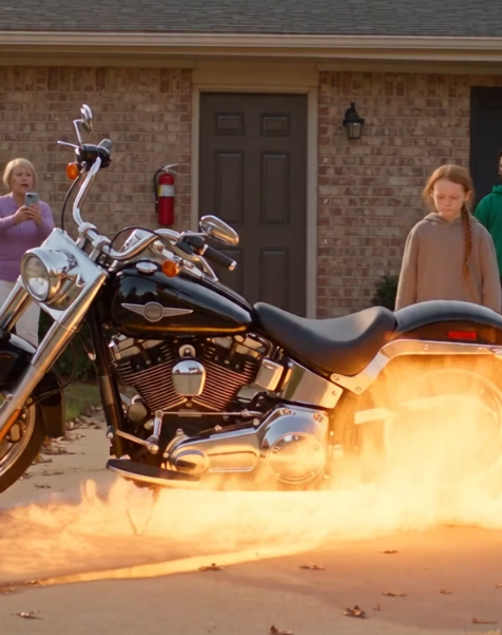
He had been going to ride to the clubhouse. It was twelve miles, all back roads. He’d done it a thousand times.
“Two beers is nothing, Jo.”
“That’s what you said Friday too,” she said quietly. “Except Friday it was four.”
He felt that one land somewhere under his ribs.
Last Friday had been the shop’s end-of-season cookout. Burgers on the grill and coolers on the tailgates. Josie had been there doing homework on an upturned bucket by the bay door, and he’d figured she wasn’t paying attention.
She had been counting.
“I took your key Saturday night,” Josie went on, still in that flat, careful voice. “You yelled at me. Then I hid it in my sock drawer on Tuesday, and you found it and yelled again. You said I was being dramatic.”
“Josie—”
“So I knew you’d just find it again.” She finally looked at him. Her eyes were dry, and that scared him most of all. “You can’t find a fire, Daddy. You can’t take a fire back.”
Somewhere down the street a siren was climbing.
To understand what happened on Willow Bend Court that afternoon, you need to know what happened on Highway 70 three years earlier.
Rachel McCready had been an ICU nurse at Harlan Creek Regional. She worked nights for eleven years. On a wet February morning she was driving home at 7:20 a.m. when a pickup crossed the center line at sixty-one miles an hour. The driver had been drinking since the bar closed. Rachel died before the ambulance arrived.
Josie was eight.
She went to the funeral in a navy dress and held her father’s hand and did not cry. She went to a grief counselor for two years and colored quietly while the woman asked gentle questions. She never once said out loud how her mother died. Not to the counselor, not to her teachers, and not to Boone.
He had taken that as a mercy. He told himself she was too young to really know.
Now, sitting on the concrete next to a smoking bike, he understood she had known every single thing.
The fire engine swung into the cul-de-sac with its lights going, and two firefighters jumped down to check a fire that was already out. Behind them came a county cruiser.
Boone saw Denise Pruitt start across the lawn before the deputy’s door was even open, phone held up like a badge.
“Officer,” she called. “I want this on the record. Every word of it.”
Part 3
Deputy Ray Okafor was a broad, unhurried man in his fifties with reading glasses tucked in his uniform pocket. He looked at the bike, then at the girl, then at the big man sitting next to her. He seemed to take his time deciding which of them to talk to first.
Denise decided for him.
“This child just set a fire in a residential neighborhood,” she said. “She could have burned down three houses. And frankly, it doesn’t surprise me one bit. You should see the people that come and go from this place. Motorcycles at all hours, loud music, men in those jackets. I’ve filed complaints with the HOA for two years.”
“Ma’am,” Okafor said. “Was anybody hurt?”
“That’s not the point.”
“It’s my first question, so it’s sort of the point.”
A couple of neighbors snorted. Denise’s face pinched. She turned the phone around and held it out.
“I recorded everything. You can see exactly how he reacts. That girl is out of control, and this is the man raising her. Somebody needs to call Child Protective Services today.”
Okafor didn’t take the phone. He crouched down in front of Josie, knees popping.
“Hey there. You want to tell me what happened?”
Josie looked at her father. Boone gave the smallest nod.
“I burned my dad’s motorcycle,” she said.
“Okay. Why’d you do that?”
Boone answered before she could.
“Because I rode it drunk.”
The words came out rough and too loud. A woman on the sidewalk put her hand to her mouth. Denise actually smiled, a quick tight flicker she couldn’t quite hide.
“There,” she said. “He admitted it. You heard him.”
“I heard him,” Okafor said, never taking his eyes off Boone. “Go on.”
So Boone told it, right there on the driveway, in front of half the street. He told them about the four beers last Friday and the ride home. He told them about the key his daughter hid twice and how he yelled at her both times. He told them about the two beers today and the jacket already on his shoulders when he heard the screaming.
“She’s not out of control,” he said. “I was. She’s the only one in this house who’s been thinking straight.”
Then Josie spoke, very quietly, and everyone on Willow Bend Court heard it.
“My mom died because a man drank and drove.”
Boone turned his head slowly.
It was three years and eight months since the crash. That was the first time he had ever heard her say it.
“I don’t want to have no mom and no dad,” Josie said. Her chin finally trembled, just once, and she clamped it still. “So I burned it.”
Nobody moved. Even Denise lowered her phone.
Deputy Okafor stayed crouched for a long moment. Then he took off his hat and turned it in his hands, and when he looked up at Boone his expression had changed.
“Mr. McCready,” he said. “I don’t expect you remember me. That February morning, out on 70…”
He swallowed.
“I was the one who knocked on your door.”
Part 4
Boone remembered the knock. He just hadn’t remembered the face.
He remembered gray light and a uniform, and the deputy’s hat held in front of his chest exactly the way Okafor was holding it now. He remembered Josie in her pajamas at the end of the hallway, and the deputy asking very gently if there was somewhere she could go play for a few minutes.
“I’ve done about forty of those knocks,” Okafor said, standing up. “You don’t forget the kids.” He looked down at Josie. “You were holding a stuffed giraffe.”
“His name was Gerald,” Josie whispered.
“Gerald,” Okafor agreed.
He turned to Denise. “Ma’am, there’s no report to write here. A property owner’s vehicle was damaged on his own property, and nobody’s pressing charges. If you want to call CPS, that’s your right.” He put his hat back on. “But I’ve been doing this a long time, and I’ll tell you what I just saw. A father getting told the truth and actually listening. That doesn’t happen as often as you’d think.”
Denise’s mouth went thin. She turned and walked back across the lawn without another word.
That night the house was very quiet.
Boone sat at the kitchen table with the key on the placemat in front of him. Josie came in around nine in her pajamas, carrying a spiral notebook with a cartoon cat on the cover. She set it in front of him without a word.
He opened it.
The first page was dated in March. The handwriting was careful and round.
Daddy had 3 beers at Uncle Walt’s. Rode home. 11:40.
The next page was May.
Daddy had beer at the lake. Rode. I counted 5.
There were six entries in all, going back eight months. Each one had the number of drinks, the time he left, and the time he came home. Next to the last one, Friday’s, there was a small drawing of a motorcycle with a big X over it.
At the bottom of the page she had written something smaller, pressed so hard the pen had nearly gone through the paper.
I wait up every time. I listen for the bike.
Boone put his hand flat over the page. He couldn’t look at it anymore, and he couldn’t look away from it.
“You’ve been waiting up,” he said.
“Every time.”
“For eight months.”
“I wasn’t going to tell you,” Josie said. “But then you yelled about the key. And I thought, if he gets hit, the last thing he ever said to me was that I was being dramatic.”
Boone got up from the table. He went to the cabinet over the refrigerator and took down the bottle of bourbon and the half-empty bottle of rum. Then he took the twelve cans out of the garage fridge. He poured every drop down the kitchen sink while his daughter watched from her chair, holding the cartoon-cat notebook against her chest.
When the last can was empty he rinsed the sink out and dried his hands.
“I’m not going to fix that bike,” he said.
Josie blinked. “You’re not?”
“No, baby.” He looked out the window at the black shape in the driveway. “I’m going to take it somewhere and let people look at it.”
He went to bed that night thinking the worst was over.
At 8:15 the next morning, the doorbell rang. A woman stood on the porch with a county ID badge on a lanyard and a clipboard under her arm.
“Mr. McCready? I’m Monica Hale with the Department of Children’s Services. We received a report about your daughter.”
Part 5
Monica Hale was polite and tired and did not smile. She sat on the edge of the living room couch and asked her questions in a voice that gave nothing away.
Had there been a fire on the property yesterday? Yes. Had the child set it? Yes. Was there alcohol in the home? Not anymore. Had he operated a motor vehicle while intoxicated?
Boone sat with his huge hands folded between his knees.
“Yes, ma’am.”
She wrote it down.
“The report also says,” she continued, flipping a page, “that the home has frequent visitors associated with a motorcycle gang. That there’s loud partying, possible drug activity, and that the child has a history of disturbing behavior.”
Boone looked up. “Drug activity?”
“That’s what was reported.”
“I run a diesel repair shop on Route 9. The guys who come by are mechanics and roofers and two retired schoolteachers. Our club does a toy run every December.” He shook his head slowly. “Somebody wrote you a story.”
“Somebody also posted a video,” Hale said.
She turned her tablet around.
It was in the Willow Bend Neighbors group on Facebook, posted the night before by Denise Pruitt. It showed the flames, the screaming, and Boone charging out of the house. It showed him running for the garage, looking frantic and huge. Then it showed him kneeling over his daughter.
And it cut off right there.
There was no “Why, baby?” and no answer from Josie. It ended with a big tattooed man looming over a small girl in the smoke. The caption underneath read: Biker’s kid burns his motorcycle. Makes you wonder what goes on in that house when nobody’s watching. Praying for that little girl.
It had 214 comments. Boone read a few before he made himself stop. One wanted the child removed. One said people like him shouldn’t be allowed to have kids. Someone had already shared it to a county-wide page.
For one long, ugly moment, the old Boone came back. He thought about walking across that lawn and saying things that couldn’t be unsaid. He felt it in his shoulders and in his jaw.
Then Josie came down the hallway, holding the notebook.
“Can I talk to her?” she asked.
Hale looked at Boone. He nodded.
They talked for forty minutes at the kitchen table while Boone sat on the back steps with his elbows on his knees. When Hale finally came outside, she sat down on the step beside him, which surprised him.
“I’ve been doing this nineteen years,” she said. “I see a lot of fathers who lie to me about drinking. I’ve almost never had one tell me before I asked.” She looked out at the yard. “Your daughter showed me her notebook. And the drawing.”
“She shouldn’t have had to write any of it.”
“No,” Hale agreed. “But she wrote it to someone she believed would eventually listen. That tells me a lot about this house.”
She stood up and smoothed her slacks.
“I’ll be making some recommendations. Counseling for both of you, and an alcohol assessment for you. I’ll do a follow-up visit. But Mr. McCready, I don’t see an unsafe child here.” She paused. “I see a child who just saved her father’s life. Possibly somebody else’s too.”
“And the report?”
Hale’s face did something careful. “I can’t tell you who filed it. But I’ll say this much. It had a lot of details about your HOA violations and your property line. More than I usually see in a child welfare call.”
After she left, Boone stood in the yard a long time looking at the burned bike.
Then he took out his phone and called Walt Dunbar, the man everybody in the club called Preacher.
“Walt. I need church called. Sunday. Everybody.”
“Everybody? Boone, what’s going on?”
“I’m bringing something you all need to see.”
Part 6
The Lantern Riders’ clubhouse sat on four acres off Old Mill Road. It was a converted feed store with a gravel lot, a fire pit, and a flagpole. On Sunday afternoon, forty-one bikes were lined up along the fence.
Boone came in on a flatbed tow truck.
He’d borrowed it from his shop. Strapped to the bed was the cruiser, still black and blistered, the seat melted down to springs, the tank scorched and buckled. White powder still caked the engine fins. He had not wiped a single inch of it.
Josie rode in the passenger seat.
Men set down their coffee cups. Conversations died one at a time. Danny “Sparks” Ruiz, the youngest member at twenty-six, walked up to the flatbed and reached toward the tank like he wanted to touch it, then pulled his hand back.
“Boone,” Walt said. He was sixty-seven, with a white beard and a voice like gravel in a bucket. “What happened to your bike?”
They backed the flatbed into the middle of the yard and unloaded the bike with straps and a come-along. When it was standing on its kickstand in the gravel, Boone climbed up on the empty trailer bed so everybody could see him.
He told them everything.
He told them about Rachel, which most of them knew, and the notebook, which none of them did. He told them about the four beers at the cookout, the key in the sock drawer, the gas can, and the fire. He told them about Deputy Okafor’s hat in his hands, and about the woman from DCS sitting on his back step. He didn’t soften any of it.
“My kid sat up eight months listening for this bike,” he said. “Eight months. And every one of you was at least one of those nights. You saw me leave. I saw some of you leave too.”
The yard was silent except for the flag rope tapping against the pole.
“So I’m asking,” Boone said. “Not judging. Asking. Who else?”
For a long moment nobody moved.
Then Walt Dunbar put his coffee down on the picnic table and stood up.
“I have,” he said. “More than I’d like to count. Since before half of you were born.”
A heavyset roofer named Hank stood up next. Then Curtis, the retired shop teacher. Then two brothers who did drywall. Then Mike Toller, who had a granddaughter Josie’s age.
Six men were standing. Boone waited.
Danny Ruiz stood up last, his face bright red.
“Friday,” he said. “The cookout. I followed you out, Boone. I’d had more than you.” He looked at the ground. “I remember thinking, if Boone’s fine to ride, I’m fine.”
Boone felt Josie’s hand slip into his from where she stood beside the trailer.
Seven out of forty-one.
Walt turned to face the whole club. “We’ve been wearing that lantern on our backs for thirty-one years,” he said. “Y’all know what it means. A light in the window for whoever’s still out on the road. We started this club after my brother didn’t make it home from a ride.” He pointed at the burned bike. “And we’ve been riding home drunk under that patch like it couldn’t happen to us.”
He looked around at all of them.
“I’m calling a vote. Anybody drinks at a club event, a ride, or a cookout, their key goes in a bowl at the door. You get it back sober or you get a ride home. No exceptions. Not for me, not for anybody.”
The hands went up all at once. It was forty-one for and none against.
Josie squeezed Boone’s fingers.
Then Walt held up one more finger, and the yard went quiet again.
“One more thing,” he said. “That bike doesn’t get fixed. And it doesn’t leave.”
Part 7
They poured a concrete pad for it the next Saturday, right beside the flagpole where everybody coming into the lot would see it first.
Curtis welded a frame to hold the cruiser upright. Hank built a cedar post. The two drywall brothers sanded down a slab of white oak, and Walt burned the words into it himself with a soldering iron, one letter at a time, while Josie stood beside him and spelled them out.
I DON’T WANT YOU TO RIDE ANYMORE.
— Josie, age 11
Beside the clubhouse door they hung a steel bowl Boone had cut from an old brake drum. The first night, eleven keys went into it.
Back on Willow Bend Court, things were going the other way.
Denise Pruitt’s video had passed four thousand shares. Strangers were writing to the HOA demanding the “biker house” be investigated. A man Boone had never met spray-painted a word on the end of his driveway that Josie had to step over on her way to the bus. Denise had also called a special HOA meeting for the following Thursday. The agenda had two items: a ban on “loud motorcycles” in the subdivision and a formal complaint about “an unsafe household.”
“You don’t have to go,” Boone told Josie.
“Yes, I do,” she said.
Thirty-some neighbors packed the community room at the clubhouse pool. Denise stood at the front with a folder an inch thick. She had two years of noise complaints, photos of motorcycles parked on the street, and a printout of a property survey. There was a highlighted strip along the McCready fence line where her garden ran four feet onto his lot, which she apparently hoped would become hers if he was forced out.
Then she played her video on the big screen. It was the same cut, ending with the big man looming over the little girl.
“That,” she said, “is who lives on our street.”
A hand went up in the back row.
It was Marcus Bell, sixteen, from the house between theirs, still in his green hoodie.
“Ms. Pruitt,” he said. “That’s not the whole video.”
Denise’s face went still.
“I filmed it too. From my window.” He held up his phone. “Can I plug it in?”
The board president hesitated, then nodded. Marcus walked to the front and connected his phone to the screen.
Same flames, same screaming, but a different angle and no cuts. You could hear Denise shouting about “a man like that.” You could see Boone kneel down slowly.
“Why, baby?”
“I don’t want you to ride anymore.”
The room heard everything that came after. Boone sat down on the concrete. Josie pressed the key into his hand. Then, a full minute later, Denise Pruitt could be seen on her own lawn, stopping her recording and saying to the woman beside her: “I’ll cut it before that part.”
Nobody in the room said anything for a few seconds.
Then the board president, a quiet retired accountant named Gloria Hensley, closed Denise’s folder and slid it back across the table.
“Denise,” she said. “I’m going to ask you to step down from this board tonight.”
The motorcycle ban was voted down 31 to 2. The “unsafe household” complaint was withdrawn on the spot. By morning, Denise’s post was gone from the neighborhood page. Marcus’s version had been shared nine thousand times, mostly by people saying they’d hugged their kids a little longer that night. Two weeks later, Monica Hale mailed Boone a letter that the DCS case was closed as unfounded.
Denise never knocked on his door. But one morning that winter, Boone found the four feet of garden along his fence dug up and replanted on her side of the line.
He figured that was as close to an apology as she was ever going to get. He decided it was enough.
What he didn’t know yet was that Josie had a gift of her own planned. It would take her two full years to give it to him.
Part 8
Boone McCready didn’t ride for two years.
He took a ride to the clubhouse every Sunday with Walt and sat by the fire pit drinking black coffee. He went to his meetings on Tuesday nights in the basement of the Methodist church. He and Josie saw a counselor together once a week for the first year, then once a month. Some of those sessions were mostly silence, and some of them were Josie finally talking about the morning the deputy knocked. After those, they would stop for milkshakes on the way home and not say much at all.
On the night he got his two-year chip, Josie, thirteen now and nearly as tall as his shoulder, handed him a small box wrapped in newspaper.
Inside was the key.
It was the same steel blade on the same little brass ring. She had kept it in her sock drawer for two years. Now it hung from a leather cord she had braided herself.
“You can ride now,” she said. “Just come home.”
He couldn’t answer her. He just pulled her into his chest and held on.
He built a new bike that spring in the back bay of his shop, a plain black bagger, nothing fancy. On his first ride, Josie followed in Walt’s truck the whole twelve miles to the clubhouse. When they pulled into the lot, Boone parked the new bike beside the burned one.
Then he walked to the brake-drum bowl at the door and dropped the old brass-ringed key into it.
“First key in, last key out,” Walt said. “It stays there.”
It is still there.
The Lantern Riders kept the rule. In the six years since that October afternoon, the club hasn’t had a single alcohol-related crash or DUI arrest. Three other clubs in the county now have a key bowl by their door. A chapter in Kentucky sent Boone a photo of theirs last year. It was made from an old brake drum, too.
Deputy Ray Okafor retired in the spring. At his party, he told the story about the cul-de-sac fire to a room full of officers and said it was the only call in thirty years where he got to watch somebody choose not to become a knock on the door.
And Josie is seventeen now.
Every year on October 24th, she drives out to the clubhouse on Old Mill Road in her secondhand Corolla. She doesn’t drink, and she never has. She says she never needed to learn that lesson the hard way. She walks across the gravel to the burned bike on its concrete pad, takes her mother’s old red bandana out of her back pocket, and wipes it down. She does the tank, the bubbled fenders, and the melted springs where the seat used to be.
She does it once and slowly, and she doesn’t let anybody help.
Last year, when she finished, she asked Walt for the soldering iron.
Underneath the words she had spelled out at eleven, she burned a second line into the white oak in her own handwriting.
THANK YOU FOR STOPPING, DADDY.
Boone stood behind her and read it three times.
People still sometimes look at Boone McCready and see exactly what Denise Pruitt saw that day: the size of him, the beard, the ink, and the leather jacket with the lantern on the back. They cross the street when he walks by.
He doesn’t mind as much as he used to.
“My eleven-year-old burned my own bike because she watched me drink and climb on it,” he says, when people ask about the black wreck by the flagpole. “Her mom was killed by a drunk driver. I put what was left of that bike in the middle of the clubhouse yard, and I’m never going to fix it. It’s the best thing anybody ever did for me.”
The jacket and the tattoos were never the danger in that house, and the loud bike in the driveway wasn’t either. The danger was a good man who believed he had it under control. The bravest person on that street was the smallest one, standing ten feet from a fire, waiting for her father to finally listen.
If this story stayed with you, follow our page for more true-hearted stories from the road. Somebody out there might need one tonight.