Part 2: My Rescue Dog Reacted to Exactly One Name — and Only That Name. When I Learned Who She Had Been, I Understood Why He Chose My Wife Over Me.
Part 2
I want to tell you exactly how I discovered it, because it took me a while to even believe it was real.
I live alone, or I did then, and a man who lives alone with a dog talks to the dog, and talks to himself, and talks on the phone, and the house is full, all day, of one man’s voice. And somewhere in the first couple of weeks, I started to notice that every so often, in the middle of all that ordinary talking, Echo would get up and go to the front door.
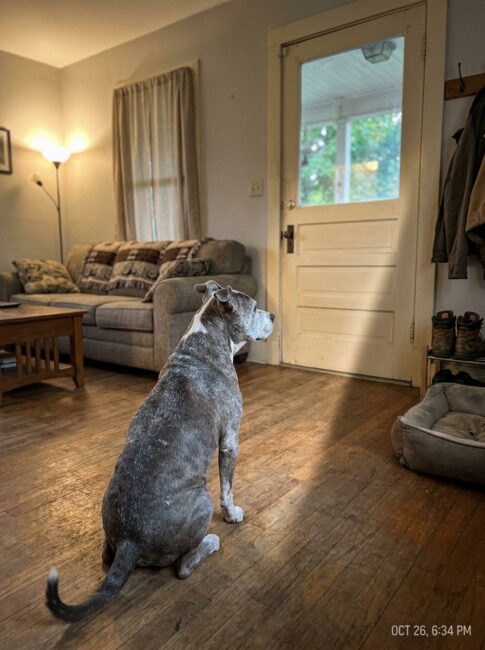
Not in distress. Not whining, not scratching. He would simply rise, walk to the door, and sit down facing it — and sit there, expectant, the specific way a dog sits when it has heard a car in the driveway and knows its person is about to walk in.
And then, after a while, when nobody came, he would sigh — an old dog’s heavy sigh — and get up and come back and lie down.
It took me longer than it should have to figure out the trigger, because the trigger was buried in normal conversation. But I am a methodical man — you do not last thirty years as an electrician being careless — and once I suspected there was a pattern, I started paying attention, and then I started, frankly, testing it.
The trigger was a name.
The name was Mary.
Every time I said the word “Mary” — and it does come up; it is a common name; it was in news stories and phone calls and things I read out loud — Echo went to the door. Every time. Without fail. It did not matter how I said it, loud or soft, to him or not to him. The sound of that name, in that house, sent that dog to the front door to wait.
I want to tell you that I tested it properly, because I did. I sat down one evening and I said dozens of names, deliberately, spaced out, watching him. Susan. Linda. Patricia. Karen. Barbara. Names of the right generation, names of every kind. Nothing. He did not lift his head.
Then I said “Mary,” and he stood up and walked to the door.
I did it again a few minutes later, after he had settled. “Mary.” Up. To the door.
I sat in my living room that night and I felt the hair stand up on my arms, because I understood that I was living with a dog who was, every single time he heard that one name, certain that a specific person was about to come home — and I did not know a single soul named Mary, and I had no idea who it was that Echo was still, after God knew how long, waiting for.
Part 3
I want to tell you about going to the shelter, because the shelter is where the first piece of it came clear.
A few weeks after I worked out the pattern, I drove back to the county shelter where I had adopted Echo. I had a specific question, and I felt a little foolish carrying it in, the way you feel foolish asking a serious question about a dog. But it had been gnawing at me, and I am not a man who can leave a thing gnawing.
I asked them about Echo’s history. I asked them who his previous owner had been, and what had happened, and whether — and I felt the foolishness most here — whether his previous owner had been named Mary.
The woman at the shelter who helped me had been there a long time, and she remembered Echo, because the old ones who sit a long time get remembered. She pulled his file.
And she told me that yes. Echo’s owner — the only owner he had ever had, the person who had raised him from a puppy — had been a woman.
Her name had been Mary.
The shelter woman told me what she could, which was not a great deal and which I am going to keep brief, because it belongs to a person I never met. Mary had been an older woman. She had had Echo for all of his life — seven years, at that point. And Mary had died. It had been about two years before I adopted him — which meant Echo had been in that shelter, or in the shuffle of foster placements that precedes the shelter, for the better part of two years before I ever walked down that row of kennels.
Mary had died, and Echo had been a seven-year-old Pit Bull with a dead owner, which is one of the hardest things to be in the entire architecture of animal rescue, and he had waited out those two years, and then a quiet electrician had picked him.
I drove home from the shelter and I looked at my dog, asleep on the floor of my quiet house, and I understood, finally, what the front door meant.
For two years in a shelter, and now however many months in my home, Echo had been waiting for Mary.
He had heard her name in my house — by pure accident, in the random traffic of one man’s talking — and every time he heard it, some deep and faithful and unkillable part of him had stood up and gone to the door, because the name meant Mary, and Mary meant home, and Echo had simply never been told, in any way he could understand, that Mary was not coming.
I did not have a way to tell him. There is no way to tell a dog that. You cannot explain death to an animal who has spent two years declining to believe in it.
So I did the only thing I could think to do, which was to stop saying the name. I started, deliberately, avoiding the word Mary in my house, the way you step around a sore spot, so that I would stop sending my old dog to the door to wait for a ghost.
And that worked. For about a year, that worked.
And then I met the woman I was going to marry.
Part 4
I want to tell you how I met her, and I want you to brace, just slightly, because you have probably already guessed, and you are right, and it is still worth telling.
I met her through ordinary life — through a friend, at the kind of low-key gathering that a fifty-five-year-old goes to without expecting anything. She was fifty-one. She was a retired bookkeeper. She was kind in a quiet, unshowy way, and she laughed at the things I said, which at fifty-five a man notices, and we started, cautiously, the way two people our age start, to see each other.
Her name was Mary.
I want to be honest about the moment I learned her name, because I had a strange, superstitious flinch when I heard it, and then I was a little ashamed of the flinch. It is a common name. It means nothing that a woman I liked was named Mary. I told myself that, and it was true, and I let it go.
But here is the small thing I did, and I did it without ever fully admitting to myself why I was doing it: I never called her Mary in my house.
It was easy not to. We were courting, and courting people use the soft names anyway — I called her “honey,” I had called her “honey” almost from the start, the way it happens. So when she began, eventually, to come to my house, and then to spend more and more of her time in it, I simply never said her actual name there. Not from any clear plan. Just a quiet, half-conscious carefulness, a man stepping around a sore spot in his own floor, keeping the word Mary out of the house so the old dog would not be sent to the door.
And for a while, that worked too.
Mary — my Mary — and Echo got along beautifully from the first. She was a dog person, and he was an easy dog, and she fussed over his gray muzzle and his old joints, and he accepted her the way an easy old dog accepts a kind new person, and I thought nothing was strange, because I had taken care that nothing would be.
We got married. Mary moved in properly. The quiet house got less quiet, in the good way, and I was happier at fifty-five than I had been at thirty-five, and Echo was an old dog dozing in the warm middle of a house that finally had two people in it again.
And then Echo started getting up.
Part 5
I want to tell you what I noticed, because I noticed it slowly, the way you notice a thing you are not looking for.
Echo started standing up when my wife walked through the room.
Not at a name — I was still careful with the name; I had never stopped being careful. He started doing it at her. At the sight of her, the sound of her step, the simple fact of Mary moving through the house. He would lift his head, and rise, and his whole old body would orient toward her — and it was not the ordinary friendly attention of a dog who likes someone. It was the other thing. It was the door thing. It was the posture of a dog whose person had just come home.
He started following her. Room to room. Not me — her. When Mary went to the kitchen, Echo went to the kitchen. When Mary settled in a chair, Echo lay down at her feet. When my wife and I went to bed, Echo — who had slept on the floor of my room for two years before she came, who was, by every right of seniority, my dog — Echo got up on the bed on her side, against her, and that became where he slept, and it stayed where he slept.
I told her about it eventually. I told her the whole thing — the name, the door, the trip to the shelter, the woman named Mary who had owned him and died, the careful year I had spent keeping her name out of the house.
My wife was quiet for a long moment when I finished.
And then she said the thing that reframed all of it, the thing I have thought about every day since.
She said: “Walter. I always assumed Echo was so gentle and so devoted because he was old. Old dogs are like that. That’s what I told myself.”
She said: “But that’s not it. Listen to what you just told me. You kept the name out of the house — but he found me anyway. Without the word. He didn’t need the word. He looked at me, and he listened to me move around, and he decided.”
She said: “He didn’t recognize me as your dog recognizing the lady of the house. Walter — he recognized me as Mary. He thinks I am her. Or — no. I don’t think it’s even that simple. I don’t think he thinks I am literally the same woman. I think it’s that everything Echo knew about being loved, about having a person, about the shape of home — all of it was built around a woman named Mary, and when a woman moved into this house, something in him recognized the shape, and he filled it in with me.”
She said: “I am not the new dog-owner to him. I am the return of the only thing he ever lost.”
Part 6
I want to be honest about how I felt, hearing that, because I think the honest version is the one worth having.
A smaller man, or a younger one, might have felt jealous. I want to admit that the thought brushed past me — that this dog I had chosen, this dog I had driven to a shelter and picked off a row of kennels and brought to my quiet house, had looked at my wife and given her the deepest devotion he had, and given me the lesser thing, the “owner” thing, the man-who-runs-the-house thing.
But I did not stay there, and I want to tell you why, because the why is the heart of this whole story.
I understood what Echo was doing, and once I understood it, there was no room left for jealousy. There was only something closer to awe.
Echo had spent the last two years of his life — his old years, the years a dog has the least left to give — in a shelter, waiting for a woman who was never going to walk through any door again. He had not been bitter about it. He had not given up. He had simply kept the faith, in the patient unreasoning way of a good dog, and every time the name surfaced, he had gone to the door and offered, one more time, to begin again.
And then a woman named Mary had moved into the house.
And Echo had not, I came to believe, mistaken my wife for his old owner. I think my wife was right that it was deeper and stranger than a mistake. I think what happened is that Echo had a whole capacity for love — a Mary-shaped capacity, built across seven years and held intact through two years of grief — and that capacity had been sitting in him, full and unspent and with nowhere to go, and then my wife walked into the house, and Echo recognized, not her face, but the shape of the thing he was for. And he poured all of it into her.
He had not loved her instead of me out of fickleness. He had loved her that way because she was, to him, the answer to the longest question of his life. She was the door finally opening. She was Mary coming home.
And the love he gave her was not a counterfeit. That is the thing I came to be most sure of. It was not a confusion, not a sad case of an old dog getting it wrong. It was the realest love that animal had — it was the entire reserve of devotion he had carried, faithfully, through abandonment and a shelter and old age, and he was spending all of it, at last, on a living woman who could feel it and hold it and love him back.
I had a dog who recognized my wife as someone he had lost.
I decided, and I have never once regretted deciding, that this was not a thing to grieve.
It was a thing to be grateful for. For her. And for him.
Part 7
Echo lived two more years after that conversation.
They were good years. He was old, and then he was very old, and toward the end his back legs were not reliable and the gray had spread up his whole face, and we did the things you do for an old dog you love — the ramp by the bed, the medication, the shorter walks, the patience.
And through all of it, he was my wife’s. Openly, completely, and with my full blessing. He slept against her every night. He followed her through every room of the house. When she sat down, he found her feet. She would talk to him — long, soft, ordinary conversations, the kind you have with a dog who has decided you are the center of the world — and Echo would lie there and receive it, an old gray Pit Bull who had finally, after everything, gotten back the only thing he had ever truly wanted.
My wife, for her part, fell entirely in love with that dog. Of course she did. It is an extraordinary thing, I think, to be on the receiving end of a love that was that hard-won and that faithful and that complete. She knew the whole story — the first Mary, the shelter, the two years of waiting — and she did not find it strange to be loved as the answer to it. She found it, she told me, like being handed something sacred and being asked to carry it the rest of the way.
Echo died at home, on the bed, on my wife’s side, with her hand on him. He was about thirteen. He went quietly, the way the very old ones sometimes get to.
And I want to tell you who cried hardest, because it is the truest thing in this whole story.
It was my wife.
I cried — he had been my dog, I had chosen him, I loved him. But I have never seen anything like the way my wife grieved that dog, and I understood it, and I did not for one second feel it as a thing that left me out.
She had been loved, for two years, with the entire faithful reserve of a creature who did not give that love lightly. She had been the homecoming at the end of his long wait. You do not lose that and cry a small amount.
Part 8
A while after Echo died, my wife said something to me, in the quiet, about what he had been.
She said: “I had a dog who recognized me as someone who had died.”
She said: “He gave me a love that, when it started, was meant for somebody else. It began as someone else’s. I know that. He was looking for his Mary, and he found a Mary, and he gave me what he had been keeping for her.”
And then she said the part that I have kept, the part that I think is the whole reason this story is worth telling at all.
She said: “But it stopped being borrowed. Somewhere in those years, it stopped being a love meant for someone else and became a love that was just — mine. He knew me. He knew my voice and my step and my hands and my moods. By the end he was not loving a memory through me. He was loving me.”
She said: “It started as somebody else’s love. It ended as real love, all the way real, just for me. And I think that is allowed. I think love is allowed to start as one thing and become another. I think most love does.”
I have thought about that more than I have thought about almost anything.
I adopted an old gray Pit Bull off a shelter row because nobody else was going to, and I brought him to my quiet house, and it turned out he was carrying a love so large and so faithful that two years of grief had not been able to empty it.
He spent it on my wife.
He was waiting, the whole time I knew him, for Mary to come home.
And then, in the strange and roundabout and merciful way these things sometimes happen, she did.
Good boy, Echo.
You waited so long.
She came home.
You were right to keep believing she would.
Follow this page for more stories about the love that was kept faithfully, through everything, until it finally found somewhere to go.