Part 2: The Trailer Park Student Was Mocked by a Rich Classmate — Then an Ivy League Letter Left the Room Silent
For most of senior year, Caleb Morris had been easy for Westbridge High to misunderstand.
He came late often enough to make teachers sigh before he even reached the door. His homework was usually done, but the pages were wrinkled, sometimes smelling faintly of fryer oil or rain. He never raised his hand unless called on, and even then his answers came quietly, like he did not want to spend too much of the room’s air.
To students like Preston Harlow, Caleb was already a finished story.
Poor.
Quiet.
Angry.
Probably lucky to graduate.
Preston said those things with a smile, because in Westbridge, cruelty dressed better than honesty. He wore pressed button-down shirts, drove a black SUV, and carried himself like the hallways belonged to his family.
In a way, they did.
His father had donated money for the new athletic wing. His mother, Diane Harlow, sat on the district foundation board. When Preston forgot assignments, teachers reminded him warmly. When Caleb forgot one, they marked it.
Mrs. Bennett noticed that difference before she wanted to admit it.
She taught AP English and had the tired eyes of someone who still believed teenagers could surprise her. Caleb had surprised her on the first week of school, when she assigned a short essay about home.
Most students wrote about kitchens, backyards, old pets, and holiday noise.
Caleb wrote about listening to rain hit a metal roof while his little sister counted seconds between thunder.
He never once used the word poor.
He never asked to be pitied.
But there was one line Mrs. Bennett copied into her notebook and could not stop thinking about:
A small home can still hold a person’s whole future, if nobody laughs loud enough to scare it away.
After that, she watched him more carefully.
She noticed the grease burns near his wrist. She noticed the way he checked his phone at 2:45 every afternoon, always with the same flash of worry. She noticed that he never bought lunch, but always sat with his sister Lily in the elementary wing when volunteers hosted the tutoring program.
Lily was six, with red hair Caleb tried to brush neatly. It never worked. She adored him anyway.
One October afternoon, Mrs. Bennett found Caleb in the library, not studying, but sewing the strap of Lily’s backpack with black thread.
“Didn’t know you were taking home economics,” she said gently.
Caleb looked up, embarrassed.
“She needs it tomorrow.”
“You could ask the office for a replacement.”
He tied the thread with careful fingers. “She likes this one.”
There was something in the way he said it that ended the conversation.
The first small twist came in November.
Westbridge held its annual scholarship prep meeting in the auditorium. Students with strong grades were invited, though some invitations seemed to travel along family lines more than transcripts.
Caleb stood at the back with his hands in his hoodie pocket.
Preston saw him and laughed.
“You lost, Morris? The maintenance meeting is down the hall.”
Caleb turned as if to leave.
Mrs. Bennett, walking in behind him, said, “Actually, Caleb has the highest practice score in the senior class.”
The sentence landed hard.
Preston’s smile flickered.
Only for a second.
Then he recovered. “Practice is not the real thing.”
Caleb said nothing.
That was the pattern. Someone threw a stone. Caleb let it hit. Everyone mistook silence for weakness.
In December, the second twist arrived in a manila envelope.
Mrs. Bennett had nominated Caleb for a private college access program. It covered application fees, interview coaching, travel costs, and test prep. Caleb returned the form unsigned.
At the bottom, in small writing, he had written:
Thank you, but I can’t leave Lily.
Mrs. Bennett read it twice.
That afternoon, she caught him near the vending machines.
“What does this mean?”
His face closed. “It means thank you.”
“It means you are turning down help.”
“It means help usually comes with people asking questions.”
“Sometimes questions are how people know what you need.”
Caleb looked toward the exit, where winter light made the floor shine.
“My mom works nights at the nursing home. My stepdad left in March. Lily thinks he is coming back because nobody told her men can leave twice.”
Mrs. Bennett said nothing.
Caleb continued, not looking at her.
“I get her from aftercare. I cook. I work at Ray’s Diner Friday through Sunday. If I go away, she gets raised by whoever is least tired.”
Then he gave a short laugh.
“Not exactly an Ivy League essay, right?”
Mrs. Bennett looked at him for a long moment.
“No,” she said. “It might be the first honest one they read.”
He almost smiled.
Almost.
By February, the rumors began.
Someone said Caleb had cheated on the SAT because no one from Briarwood Estates scored that high. Someone else claimed Mrs. Bennett wrote his essays for him. Preston did not say it directly, but he fed it carefully.
“That kind of improvement is interesting,” he told a group near the lockers.
Caleb heard.
Everyone knew he heard.
He kept walking.
What nobody knew was that Caleb had started waking at 4:40 every morning to study before Lily got up. He studied vocabulary words while oatmeal boiled. He edited essays at the diner after closing, sitting in a booth beneath a broken neon sign while Ray counted cash at the register.
Ray, who owned the diner, let him stay because Caleb never asked for anything.
One night, Ray found him asleep over a stack of scholarship forms.
The old man draped a clean apron over Caleb’s shoulders and turned off the back lights one by one.
He never mentioned it.
In March, Ivy League decisions came closer. Preston spoke about them like weather he could control. His parents had hired consultants. He had toured campuses. His application had been polished until it shone.
Caleb had submitted his from a library computer while Lily colored beside him.
The night decisions came out, Mrs. Bennett waited for an email.
None came.
The next morning, Caleb arrived late with mud on his shoes and a bruise on one cheek.
Mrs. Bennett saw it immediately.
“What happened?”
“Door.”
“Caleb.”
He met her eyes, and for once, she saw fear there.
Not of pain.
Of being stopped.
“I’m fine.”
At lunch, he sat alone behind the gym and tore something white into pieces.
Mrs. Bennett found one scrap later near the fence.
It had part of a sentence on it.
We are pleased to—
She stared at those four words until the bell rang.
Something was not right.
Not even close.
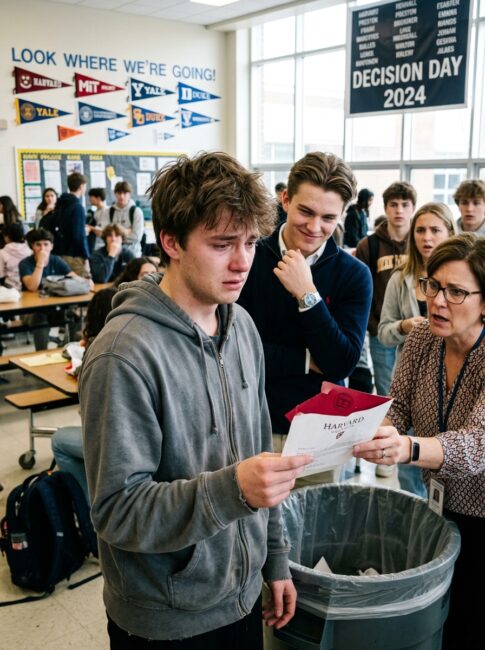
Decision Day should have been joyful.
At Westbridge High, it was treated almost like a parade. The cafeteria was decorated with blue and gold streamers. A huge bulletin board read: Look Where We’re Going.
Students pinned letters and posed for pictures.
Some were proud. Some were relieved. Some looked afraid to disappoint their parents.
Caleb stood near the back, carrying that thin envelope as if it weighed more than paper.
Mrs. Bennett watched him from beside the punch table.
She had spent the morning trying not to stare at his bruised cheek. He had covered most of it with the hood of his sweatshirt, but the shadow remained.
Preston noticed too.
He noticed everything that could be turned into a weapon.
“Rough night at the estate?” he asked.
Caleb did not respond.
Preston stepped closer.
“My parents said Harvard decisions were brutal this year. Don’t take it personally if they wanted someone with an actual driveway.”
A few students laughed.
Not all.
By then, some had begun to sense that laughing at Caleb did not feel as harmless as Preston wanted it to feel.
Still, nobody stopped him.
That was how rooms became guilty.
One small silence at a time.
When Mrs. Bennett called for students to share their news, Preston went first. He had been accepted to two excellent schools and waitlisted at one Ivy League university. His parents clapped from the front row, proud and polished.
Diane Harlow dabbed her eyes with a tissue.
Then Preston pinned his letter to the board and turned toward Caleb.
“Your turn, Morris.”
Caleb’s jaw tightened.
He walked forward slowly.
For one strange second, Mrs. Bennett thought he might pin the letter up and end months of humiliation with a quiet victory.
Instead, Caleb stopped at the trash can.
He looked at the celebration board, the cameras, the parents, the students waiting for a performance.
Then he dropped the envelope into the trash.
The room reacted exactly the way he expected.
Laughter.
Whispers.
Pity.
Preston’s voice rose above it.
“Maybe Harvard doesn’t accept trailer addresses.”
Mrs. Bennett moved before she thought.
She pulled the envelope from the trash and turned it over.
Crimson seal.
Harvard College.
The laughter weakened.
She opened it only enough to see the first line, then stopped, because it was not hers to read.
But she had already seen what mattered.
“Caleb,” she whispered, “why would you hide this?”
Preston’s face changed first.
Then Diane Harlow stood from the front row.
“Surely that’s not appropriate,” she said, her voice sharp. “Private admissions letters should not be displayed without context.”
Mrs. Bennett looked at her.
“Context?”
Diane smiled, but it had edges. “Well, extraordinary claims deserve clarity. Caleb is a bright boy, I’m sure, but there are processes.”
Caleb reached for the envelope.
“Give it back.”
Mrs. Bennett held it out.
He took it with hands that shook, and everyone finally saw what she had seen all year.
Not arrogance.
Not laziness.
Exhaustion.
Principal Marlow stepped forward. “Caleb, would you like to share your news?”
“No.”
“Are you sure?”
Caleb looked at Preston, then at the parents near the punch table.
“I said no.”
That should have been the end.
But Preston, unable to survive a silence that did not favor him, laughed once.
“Come on. Read it. Unless there’s something you don’t want us to know.”
Caleb turned.
For the first time all year, he did not look away.
“You want to know what I don’t want people to know?”
The room quieted.
“My mother cleaned your house last winter.”
Preston blinked.
Diane Harlow went pale.
Caleb continued, voice low but steady.
“She came home with leftover party food wrapped in foil because your family threw away more dinner than Lily and I had eaten that week.”
Nobody moved.
Caleb looked at Diane.
“You gave her a coat you said was ‘too worn for donation.’ My sister wore it to school for two months.”
A chair creaked.
Preston’s mouth opened, then closed.
Caleb held up the Harvard envelope.
“I didn’t want to pin this up because I knew exactly what would happen. People like you would turn it into a miracle, or a mistake, or a fraud. Anything except what it is.”
Mrs. Bennett’s eyes filled.
“What is it?” someone asked softly.
Caleb swallowed.
“It’s every morning I studied before the bus came. It’s my mom sleeping in her car between shifts so Lily wouldn’t see her cry. It’s Ray at the diner pretending not to notice I was doing essays after midnight. It’s Mrs. Bennett putting application deadlines on sticky notes because our Wi-Fi got shut off twice.”
He looked down at the letter.
“It’s not charity. It’s not luck. It’s not a trailer park kid sneaking through the wrong door.”
His voice broke slightly.
“It’s work.”
The cafeteria stayed silent.
Then the back door opened.
Caleb’s mother, Denise Morris, stepped in wearing her nursing home uniform. She was a white woman in her early forties with tired eyes, hair pulled into a messy bun, and a name badge still clipped to her pocket.
Beside her stood Lily, holding a paper cup of juice with both hands.
Denise had clearly come straight from work. There was a stain on one sleeve. Her shoes were worn flat.
She looked around, confused by the silence.
“Caleb?” she asked.
He looked like a boy again when he saw her.
Not the boy Westbridge had invented.
The real one.
The one carrying too much.
Lily ran to him first.
“Did you tell them?” she asked.
Caleb knelt and brushed her hair out of her face.
“Tell them what?”
“That you got into the red school.”
A few people laughed through tears.
Denise covered her mouth.
Caleb stared at her. “You knew?”
Denise nodded, crying now. “The library printed a copy. I saw it in your backpack.”
“Why didn’t you say anything?”
“Because you looked scared of it.”
That was the final twist.
Caleb had not thrown the letter away because he was ashamed of where he lived.
He had thrown it away because success felt like leaving.
Because the same letter that opened a door for him looked, from his small kitchen table, like a door closing on his mother and sister.
Denise crossed the room and touched his cheek, careful near the bruise.
“I slipped on the porch,” he whispered, before she could ask.
“I know when you’re lying,” she said.
Caleb looked away.
Preston looked down.
For the first time, his expensive shoes seemed to interest him very much.
Principal Marlow cleared his throat.
“Caleb, we will make sure your family has support through this transition.”
Caleb gave a tired smile.
“With respect, sir, that sentence is about nine months late.”
It was not cruel.
That made it worse.
Mrs. Bennett stepped beside him.
“You’re right,” she said.
Then she turned to the room.
“Before we applaud Caleb, we should understand something. He should not have had to prove his worth by surviving what would have broken many adults.”
No one clapped yet.
Good.
This was not the kind of moment that needed noise.
Diane Harlow walked toward Denise, face trembling with embarrassment.
“Mrs. Morris, I had no idea—”
Denise lifted one hand gently.
“No,” she said. “You didn’t.”
Two words.
Soft.
Final.
Preston remained where he was.
Caleb looked at him, waiting.
For what, even Caleb did not know.
An apology would not undo the hallway jokes. It would not erase the way teachers had doubted him or the way students had laughed at his address.
But Preston whispered, “I’m sorry.”
Caleb nodded once.
He did not forgive him out loud.
He did not need to make the room feel better.
Instead, he walked to the celebration board, unfolded the Harvard letter, and pinned it at the very bottom.
Not above anyone else’s.
Not in the center.
At the bottom, where Lily could reach it.
She touched the crimson seal with one finger.
“Is it far?” she asked.
Caleb looked at his mother.
Then at Mrs. Bennett.
Then at the room that had finally stopped laughing.
“Yeah,” he said. “But I’ll come back.”
After Decision Day, Westbridge High changed in small, uncomfortable ways.
The kind that happen when people cannot forget what they witnessed.
Teachers began looking more carefully at late assignments. The guidance office started holding evening sessions for students who worked after school. The foundation board quietly added emergency funds for application fees, transportation, and internet access.
Nobody called it the Caleb Morris Fund.
Caleb would have hated that.
He did not want to become a symbol people could praise instead of changing.
Preston stopped making jokes about Briarwood Estates. For a while, he stopped making jokes at all. In May, he approached Caleb near the parking lot and held out a paper bag.
“My mom said your sister might like these books.”
Caleb looked inside.
Children’s chapter books.
Clean. Almost new.
He looked back at Preston.
“Did your mom say to give them to me, or are you giving them to me?”
Preston’s face reddened.
“I am.”
Caleb took the bag.
“Then thanks.”
It was not friendship.
But it was something less ugly than before.
Graduation came under a sky full of heavy clouds. Caleb wore his cap and gown over the same gray hoodie, though Mrs. Bennett suspected it was no longer because he had nothing else. Maybe he wore it because he wanted people to remember the boy they had ignored.
Denise sat in the bleachers with Lily on her lap.
Ray from the diner sat two rows behind them, wearing a tie no one believed he owned.
When Caleb’s name was called, the applause rose quickly. Too quickly, maybe. Guilt often has loud hands.
Caleb crossed the stage, shook Principal Marlow’s hand, and found his mother in the crowd.
Denise pressed her fingers to her lips.
Lily waved both arms.
After the ceremony, families took photos on the football field. Preston posed with his parents near the goalpost. Mrs. Bennett hugged students until her mascara gave up.
Caleb stood apart for a moment, holding his diploma and watching Lily chase dandelion fluff through the grass.
Mrs. Bennett came beside him.
“Have you decided?” she asked.
He knew what she meant.
Harvard had offered enough aid to make the impossible almost practical. A local church had arranged rides for Denise. Ray had promised Lily free pancakes on Saturdays if she missed her brother too much.
The door was open.
Still, Caleb looked afraid of walking through it.
“My mom says I have to go,” he said.
“She’s right.”
“Lily cried last night.”
“She’ll cry again.”
“That doesn’t help.”
Mrs. Bennett smiled sadly. “No. But it is true.”
Caleb looked toward the parking lot, where Denise was kneeling to tie Lily’s shoe. His mother’s work badge was still in her purse, because she had to go in at six.
“I used to think leaving meant proving everyone right,” he said. “Like I thought I was better than where I came from.”
Mrs. Bennett shook her head.
“Leaving can be a way of carrying it differently.”
That August, Caleb packed two suitcases and one cardboard box. Lily taped a drawing to the inside lid. It showed their trailer with a bright red building beside it, as if Harvard had moved next door.
On the morning he left, Briarwood Estates was quiet. Denise stood beside the old sedan, trying not to cry and failing.
Caleb hugged Lily first.
She whispered something in his ear.
He laughed, then wiped his face before anyone could comment.
When he hugged his mother, Denise held him for a long time.
“I’m proud of you,” she said.
“I know.”
“No, you don’t,” she whispered. “But you will someday.”
Before he got into the car, Caleb walked to the row of leaning mailboxes near the entrance. He opened theirs and taped something inside the metal door.
A copy of the crimson Harvard letter.
Not to show off.
Not for the neighbors.
For the little girl who would check the mail after school and remember that far away did not mean gone.
Months later, Lily would open that mailbox on rainy afternoons just to look at it.
And sometimes, when thunder rolled over the trailer roof, she would count the seconds between the flashes and imagine her brother under a different sky, studying beside a window, carrying all of them forward without ever letting go.
If this story stayed with you, follow the page for more heartfelt stories about the people we almost misunderstand.