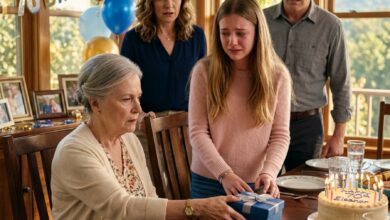
Part 2: An Old Woman Shoved a Young Woman’s Cart in a Supermarket — The Camera Showed Why Everyone Lowered Their Heads
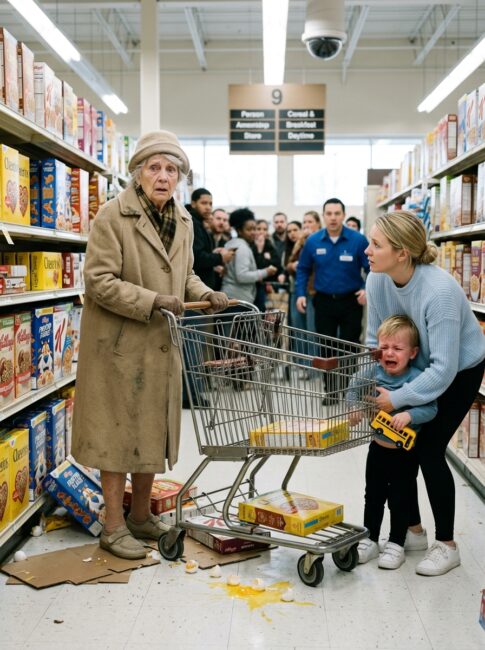
The store manager, Daniel Reed, arrived before the eggs stopped spreading across the tile.
He was thirty-nine, broad-shouldered, and usually calm in the way people become calm after years of handling broken scanners, angry customers, and teenagers stealing candy. But even he looked shaken when he saw Eleanor standing over spilled groceries while Claire tried to comfort her crying toddler.
“Mrs. Hayes,” Daniel said carefully, “you need to step back.”
Eleanor did not move.
Her eyes stayed on the cart.
Not Claire.
Not the toddler.
The cart.
That was the first thing that did not fit.
People expected rage from her, or confusion, or the vacant look they sometimes unfairly placed on anyone old enough to move slowly. But Eleanor’s face was focused. Almost alert. Her mouth trembled, yet her eyes kept tracking the front wheel of the cart as if it were alive.
Claire hugged her son close.
“He could have been hurt,” she said, her voice cracking. “You shoved my baby’s cart.”
“I moved it,” Eleanor whispered.
The words were not an apology, but they were not cruel either.
A few shoppers scoffed.
Daniel glanced at the broken eggs, the cereal boxes, the startled child, and the old woman whose hands now gripped the strap of her handbag like she was holding herself together.
“Mrs. Hayes,” he said, softer this time, “why did you do that?”
Eleanor opened her mouth.
Nothing came out.
Then she looked past Daniel toward the frozen food aisle, where the overhead lights flickered against the chrome edges of the freezer doors.
Her face changed.
For one breath, she seemed less like a rude old woman and more like someone listening to a sound no one else could hear.
Claire noticed it too.
“Is she confused?” someone whispered behind the bread rack.
“She shouldn’t be shopping alone,” another voice said.
Eleanor heard them.
Her shoulders dropped, but she still did not defend herself.
Instead, she bent slowly, despite the stiffness in her knees, and picked up one of Claire’s fallen grocery bags. A tomato had rolled underneath the cereal display, and Eleanor reached for it with a shaking hand.
Claire stepped back.
“Don’t touch our things.”
Eleanor froze.
Her face flushed, and the tomato slipped from her fingers.
Daniel lifted one hand toward the crowd.
“Everyone, please give us room.”
Nobody really did.
They stayed close enough to judge.
That was how public embarrassment worked. People pretended to be concerned while watching every second.
Claire’s toddler, Noah, had stopped crying, but his cheeks were wet. He was two years old, with sandy hair and round brown eyes. He clutched a small yellow toy school bus against his chest.
Eleanor saw the toy.
Her breath caught.
She pressed one gloved hand to her chest, not dramatically, just hard enough that Daniel noticed.
“Mrs. Hayes?” he asked.
“I had one,” she whispered.
Claire frowned.
“What?”
Eleanor looked at the child’s toy, then at the floor.
“A yellow bus,” she said. “Years ago.”
The crowd grew quieter, but only because the old woman now seemed stranger.
Daniel knew Eleanor a little. She came every Saturday between noon and one. She bought oatmeal, canned peaches, tea bags, and one small bouquet of white daisies when they were on sale.
Sometimes she paid with coins.
Sometimes she forgot her shopping list and stood in the same aisle for a long time, touching her coat pocket.
But she had never caused trouble.
Not once.
Then the second odd thing happened.
Eleanor turned toward Claire, slowly raised both hands, and said, “Check the camera.”
Claire blinked.
“What?”
“The camera,” Eleanor repeated. Her voice was weak, but clear. “Please.”
Daniel looked up.
A black security camera dome hung above aisle seven, angled toward the endcap displays, the dairy section, and the entrance to frozen foods.
Claire wiped her son’s cheek.
“You want us to check the camera after you shoved my cart?”
Eleanor nodded.
A man nearby laughed once, bitterly.
“Great. Now she wants a replay.”
But Eleanor did not look embarrassed anymore.
She looked terrified that no one would believe her in time.
Daniel had seen enough shoplifting claims to know footage could settle arguments. He also knew it could make them worse. Still, there was something in Eleanor’s eyes that pulled at him.
“Come with me,” he said.
Claire shook her head.
“I’m calling the police.”
Daniel did not argue.
“That’s your right,” he said. “But before anyone leaves, I’m checking the footage.”
Eleanor looked relieved for only half a second.
Then she turned toward Claire’s cart again.
The front right wheel spun slowly.
A thin strip of plastic, almost invisible against the metal frame, dangled near it.
Daniel followed her gaze.
He knelt.
On the floor, partly hidden under broken cereal boxes, lay a small round object no bigger than a grape.
A blue bead.
It had not come from Claire’s groceries.
It had rolled from the frozen food aisle.
Eleanor stared at it as if it had returned from the past.
“Not again,” she whispered once more.
This time, Claire heard the grief inside it.
The security office was barely bigger than a pantry.
It had two chairs, six monitors, a filing cabinet, and a coffee mug that said World’s Okayest Boss. Daniel brought Claire, Eleanor, and one cashier named Tanya inside while another employee stood near the aisle to keep shoppers from slipping on the egg spill.
Claire held Noah on her hip.
The boy had calmed, but he still watched Eleanor with uncertain eyes.
Eleanor sat in the corner chair, her hands folded tightly over her purse. She did not ask for water. She did not complain. She looked smaller under the fluorescent office light, as if the store had spent all her strength in one sudden push.
Daniel rewound the camera footage.
The screen showed aisle seven from above.
Claire entered the frame first, pushing her cart toward the cereal display. Noah sat in the child seat, holding his yellow toy bus. Claire glanced down at her phone, then put it in her purse. She did nothing careless. Nothing wrong.
Behind her, Eleanor appeared near the canned soup.
She moved slowly, one hand on the shelf.
Then the footage showed what nobody in the aisle had seen.
Near the frozen food section, a teenage stock clerk pushed a dolly stacked with cases of bottled sparkling water. He stopped to avoid a child running past, and one case shifted. A single bottle slipped out of the torn plastic wrap and fell.
It hit the floor softly.
It rolled.
At first, it moved behind the endcap, hidden from everyone standing at eye level.
On the overhead camera, it was clear.
The bottle rolled toward the aisle, struck the small blue bead, and changed direction. The bead rolled ahead of it like a marble. The bottle followed slowly, then faster, curving toward the front wheel of Claire’s cart.
At the same moment, Noah leaned forward.
His yellow toy bus slipped from his hand and fell toward the floor.
Claire bent slightly to catch it.
Her cart began to drift.
Only inches.
But those inches mattered.
The blue bead reached the front wheel first.
The wheel lifted and jerked.
The heavy cart tilted toward the side where Noah leaned forward.
Daniel stopped the footage.
Nobody spoke.
Claire’s face changed slowly.
“No,” she whispered.
Daniel replayed it.
This time, they saw Eleanor.
The old woman had been looking at a can of soup. Then she heard the bottle. Her head turned sharply. Her body stiffened before anyone else noticed anything.
She saw the bead.
She saw the wheel.
She saw Noah leaning.
Then Eleanor moved faster than anyone thought she could.
She crossed the aisle, grabbed the cart, and shoved it sideways into the cereal display. The impact looked harsh from the floor. From the camera, it looked precise.
The cart did not fall.
Noah did not fall.
The cereal boxes absorbed the force.
The bottle rolled harmlessly past the spot where the cart would have tipped.
Daniel replayed the three seconds again.
Eleanor’s hands shook the entire time.
Claire covered her mouth.
Tanya, the cashier, whispered, “She stopped it.”
Eleanor stared at the monitor without blinking.
Her face was not proud.
It was haunted.
Daniel turned to her.
“How did you see that so fast?”
Eleanor swallowed.
For several moments, she did not answer.
Then she opened her purse and pulled out a small, worn photograph in a plastic sleeve. The edges were cloudy from years of being touched.
In the picture stood a little boy about Noah’s age, smiling beside a yellow toy school bus. He had dark curls, chubby cheeks, and one hand wrapped around Eleanor’s finger.
“My grandson,” Eleanor said.
Her voice was thin.
“His name was Matthew.”
Claire looked at the photograph, then at Noah’s toy.
The resemblance was not exact, but the shape of the moment was.
A little boy.
A yellow bus.
A shopping cart.
Eleanor continued, though every word seemed to cost her.
“Thirty-one years ago, my daughter brought Matthew to a store two towns over. I was with them. I was supposed to be watching him while she checked the price on diapers.”
Her gloved thumb brushed the photograph.
“There was a spill near the dairy case. Nobody had cleaned it yet. A cart wheel caught, and the cart tipped. He hit his head on the corner of a display.”
Claire closed her eyes.
Eleanor looked down.
“He lived for two days.”
The office became unbearably still.
Even the monitors seemed too bright.
Eleanor did not cry loudly. Her grief had aged past sound.
“My daughter never blamed me,” she said. “That was almost worse. She said accidents happen. She said I should stop punishing myself.”
Her mouth trembled.
“But every time I hear a cart wheel catch, I am back in that aisle.”
Daniel lowered his eyes.
Claire shifted Noah against her shoulder, suddenly holding him tighter.
“Mrs. Hayes,” Claire said, barely above a whisper, “I didn’t know.”
Eleanor gave a small nod.
“You couldn’t.”
That was the center of it.
Nobody could have known.
All they had seen was an old woman shoving a young mother’s cart. They had seen cracked eggs, a crying toddler, and a startled crowd. They had placed a story around Eleanor before she could speak.
Mean old woman.
Confused old woman.
Dangerous old woman.
But on the camera, she was something else entirely.
A grandmother who had spent thirty-one years listening for the sound that once ruined her life.
A woman who had trained her grief into reflex.
A stranger willing to be hated for three seconds if it meant a child stayed safe.
Daniel rubbed his forehead.
“I need to show this to the officers when they arrive,” he said.
Claire flinched.
“I called them.”
“I know,” Daniel said gently.
Eleanor nodded without resentment.
“I understand.”
Claire stared at her.
“You understand?”
Eleanor looked at Noah.
“He cried because of me.”
Claire’s eyes filled.
“He cried because he was scared,” she said. “But he’s here.”
Eleanor’s face crumpled at that.
It was not relief exactly.
It was the pain of being forgiven for something she had not done wrong, mixed with the ache of not being able to forgive herself for something that had happened decades ago.
A knock came at the office door.
The two police officers entered quietly, already briefed by Daniel’s employee that the situation had changed. Daniel played the footage for them.
Once.
Then again.
The younger officer looked toward Eleanor.
“Ma’am,” he said, “you probably saved that child from a serious injury.”
Eleanor shook her head immediately.
“No. I scared him.”
Claire stepped forward before anyone else could speak.
“You saved him,” she said.
Her voice broke on the second word.
Then she did something nobody expected.
She walked to Eleanor and lowered Noah gently to the floor.
The toddler stood uncertainly, clutching his yellow bus. Claire knelt beside him.
“Noah,” she said softly, “can you say thank you?”
Noah looked up at the old woman.
Eleanor leaned back slightly, as if afraid of touching the moment.
The little boy held out the yellow bus.
Eleanor’s gloved hands rose to her mouth.
She did not take it at first.
Claire nodded.
“It’s okay.”
Eleanor accepted the toy with both hands, like it was made of glass.
For the first time since the shove, her tears came.
Not many.
Just enough to cross the lines in her face.
“I’m sorry I frightened you,” she whispered to Noah.
Noah, being two, did not understand the weight of the sentence.
He only pointed at the bus and said, “Beep.”
A sound escaped Daniel that was almost a laugh, almost a sob.
Outside the office, the store had gone quieter. Word had spread that the camera showed something different from what people had assumed. The same shoppers who had whispered earlier now avoided each other’s eyes.
When Eleanor came out, leaning on the wall for balance, the man in the football hoodie was standing near the cereal display.
He removed his cap.
“I’m sorry,” he said.
Eleanor looked at him, surprised.
Then a woman in pearls who had judged her minutes earlier stepped forward.
“I am too.”
One apology became another.
Not dramatic. Not clean. Some were awkward. Some were too late.
But they came.
Eleanor seemed unsure what to do with them.
She had been living with blame for so long that kindness felt almost suspicious.
Claire walked beside her through aisle seven while an employee finished mopping the floor. The cereal boxes had been restacked. The broken eggs were gone. Only a faint shine on the tile showed where the mess had been.
Claire stopped at the spot where Noah’s cart would have tipped.
She looked at the display corner.
Then at her son.
Then at Eleanor.
Her face folded with the realization of how close ordinary life had come to changing forever.
Eleanor did not say, “I told you.”
She did not ask for thanks.
She only reached down and picked up the small blue bead from the edge of the aisle.
She placed it in Daniel’s hand.
“Tiny things,” she said quietly, “can turn everything.”
Daniel looked at the bead in his palm and had no answer.
The police left without filing a complaint.
Daniel wrote an incident report anyway, but not the kind he had expected. He included the footage, the rolling bottle, the bead, the tilted wheel, and Eleanor’s movement toward the cart.
At the bottom, under customer action, he wrote one sentence.
Intervened to prevent possible injury to child.
He printed a copy for Eleanor.
She folded it carefully and placed it in her purse beside Matthew’s photograph.
Claire offered to drive her home, but Eleanor refused at first. Pride is sometimes the last furniture left standing in a lonely life.
Then Noah reached for Eleanor’s hand.
That changed it.
Claire drove a quiet brown sedan with a car seat in the back and cracker crumbs tucked into the seams. Eleanor sat in the passenger seat, holding her purse on her lap with both hands.
For a while, nobody spoke.
Sunlight moved across the windshield. Neighborhood lawns passed in soft green blurs. Noah hummed to his yellow bus in the back seat.
At a red light, Claire glanced over.
“Do you have family nearby?” she asked.
Eleanor looked out the window.
“My daughter lives in Oregon,” she said. “We talk on birthdays.”
Claire understood that sentence had rooms inside it.
She did not push.
When they reached Eleanor’s small house, the porch light was still on from the night before. A wind chime hung near the door, though there was almost no wind.
Claire carried Eleanor’s two grocery bags to the porch. Oatmeal. Tea. Canned peaches. A small bouquet of white daisies.
Eleanor noticed Claire looking at the flowers.
“For Matthew,” she said.
Claire nodded.
Noah toddled up the walkway holding his yellow bus. He stopped in front of Eleanor and lifted it toward her again.
This time, she did not take it.
She bent slowly, her knees stiff, and touched the top of the toy with one gloved finger.
“You keep it,” she said. “Drive it safe.”
Noah smiled.
Before Claire left, she asked if she could come by next Saturday.
“Just to check in,” she added quickly. “Or bring groceries. Only if you want.”
Eleanor looked at the young mother, then at the little boy in the car seat.
For thirty-one years, she had remembered one aisle as the place where everything ended.
Now another aisle had given her a different memory.
Not enough to erase the first.
Nothing could.
But enough to stand beside it.
“That would be nice,” she said.
The next Saturday, Claire returned.
Then the next.
Sometimes she brought Noah. Sometimes she brought soup. Sometimes she brought nothing but twenty minutes of conversation on the porch.
At Green Valley Market, Daniel kept the blue bead in a small clear box by the office monitor. Not as decoration. As a reminder to slow down before deciding what a person’s worst moment meant.
Eleanor still shopped on Saturdays.
People no longer moved away when she counted coupons. The cashier at lane four started saving white daisies when they went on sale. The man in the football hoodie once helped her reach a jar of peaches from the top shelf and did not make a speech about it.
One afternoon, Claire saw Eleanor standing near aisle seven again.
For a second, the old woman’s face tightened at the sound of a cart wheel squeaking.
Then Noah ran to her carefully, holding up his yellow bus.
“Beep,” he said.
Eleanor smiled.
It was small, but real.
She took his hand, not to pull him away, not to stop danger, but simply because he had offered it.
Across the aisle, the security camera watched without judgment.
It recorded cereal boxes, grocery carts, tired mothers, lonely widows, and all the quiet things people did before anyone understood them.
Eleanor and Noah walked slowly toward the daisies.
His little hand rested inside her gloved one.
And if this story stayed with you, follow this page for more heartfelt stories about the quiet truths people carry.