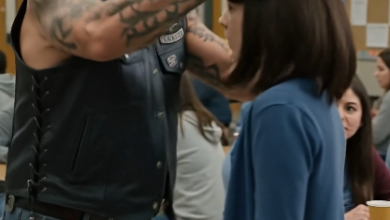
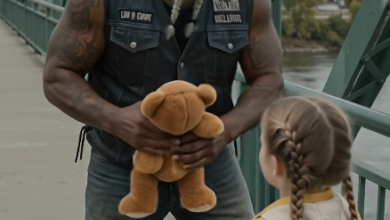
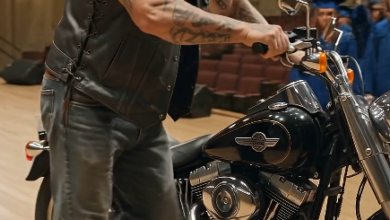
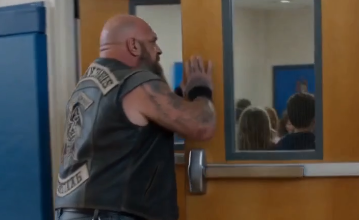
Part 2: The Newspaper Boy Was Knocked Down Outside the Train Station While Adults Walked Past, Until a Tattooed Biker Rode Ten Seconds Away, Turned Around, and Changed What Everyone Thought They Saw
I was standing outside Union Station that day because my train was late.
My name is Helen Morris, and I had been a station volunteer for eleven years, which means I had seen every kind of person pass through those doors: soldiers coming home, mothers carrying sleeping toddlers, businessmen angry at weather, college kids lost in their own earbuds, tourists photographing ceilings they forgot were built by people who never got rich enough to ride trains for fun.
Micah Reed was part of the station too.
Not officially.
He did not have a badge or a counter or a desk. He had a bundle of papers, a careful voice, and a spot near the old stone pillar where the wind did not hit quite as hard in winter. He started selling newspapers after school when he was eleven, because his grandmother, Alberta Reed, cleaned rooms at a hotel downtown and could not always stretch her paycheck across medicine, rent, and groceries.
Micah told people he was saving for a bicycle.
That was partly true.
He was saving for a used red Schwinn he had seen in the window of a repair shop on Southwest Boulevard.
But he also bought milk on Tuesdays.
Bread when his grandmother’s hours got cut.
Cough drops when she pretended she did not need them.
He kept a little notebook in his backpack where he wrote every dollar earned and every dollar spent, because Alberta had taught him that poor people survived by knowing exactly where money went, even when there was not enough of it.
Most commuters did not know any of that.
They saw a boy selling papers and either bought one, ignored him, or judged him in that quick way adults judge children who work where children should not have to.
Gravel saw him differently.
Though I did not know that yet.
Raymond Knox had been coming through the station area for years, usually on Thursdays, because his road crew worked near the rail yards and there was a diner two blocks over that served meatloaf the way his mother used to make it. He never bought a paper at first. He would ride past, engine low, eyes forward, looking like the kind of man who preferred not to be spoken to unless something was on fire.
Then one rainy afternoon, Micah stepped toward him at a red light and said, “Paper, sir?”
Gravel looked down from the Harley.
“No.”
Micah nodded politely. “Have a good ride.”
The light turned green.
Gravel rode off.
The next Thursday, Micah said the same thing.
“Paper, sir?”
“No.”
“Have a good ride.”
It happened for six weeks.
On the seventh, Gravel pulled a dollar from his vest pocket and bought one.
He did not read it.
He folded it into his saddlebag and rode away.
That became their ritual.
Every Thursday.
One paper.
One dollar.
One nod.
No extra talk.
That was how some men become kind without making anyone uncomfortable by admitting it.
The first seed was the brass compass tied to Gravel’s handlebar.
Small. Old. Scratched. Not fancy enough to be decorative. It hung from red cord and tapped lightly against the metal whenever the bike idled.
The second seed was the way Micah always looked at it.
Not greedily.
Curiously.
Like the compass had a story he wanted but was too polite to ask for.
The third seed came the week before the incident, when Gravel bought his usual paper and Micah finally said, “Does that thing really tell direction?”
Gravel looked at the compass.
“Used to.”
“What happened?”
“Got old.”
Micah nodded, serious as a judge.
“Old things can still know where home is.”
Gravel stared at him for a second too long.
Then the light changed.
He rode away without answering.
That sentence followed him all week.
Because the compass had belonged to his younger brother, Danny, and Danny had been dead for thirty-nine years.
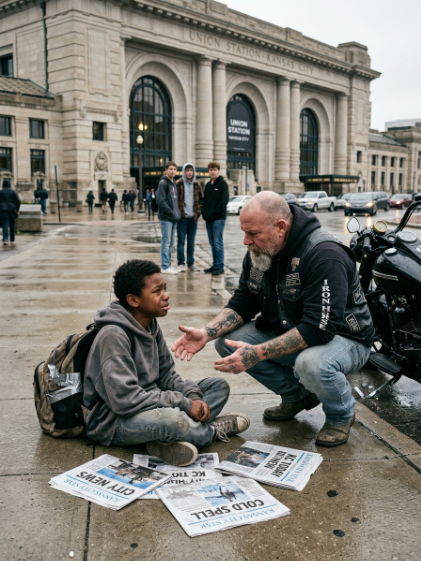
The day Micah got shoved was wet, cold, and ordinary in the way bad days often are before they become memories.
A light rain had turned the sidewalk dark. Cars hissed along Pershing Road. Commuters crowded under awnings, impatient with delays and weather, shoulders hunched, eyes on phones. Micah had tucked most of his newspapers under the dry side of the pillar, keeping only five in his arm so they would not get ruined.
He had sold nine papers by 4:20.
I know because he told me later.
Nine meant milk, bread, and maybe two dollars toward the bicycle.
At 4:27, the three older boys came around the side entrance.
I had seen them before.
Not often.
Enough.
They were the kind who moved through public spaces looking for someone smaller to turn into entertainment. One was white American, tall, sandy-haired, maybe seventeen, wearing a varsity jacket though I never learned from which school. One was Latino American, shorter, heavyset, with a red backpack slung over one shoulder. The third was Black American, thin, nervous-looking, following more than leading, laughing a half-second late.
That last part mattered later.
The tall one took a paper from Micah’s stack.
Micah said, “That’s a dollar.”
The boy held it above his head.
“What you gonna do, paperboy?”
Micah reached, not aggressively, just trying to get back what he owed someone else if he lost it. The second boy bumped him with a shoulder. The papers slipped. The third boy laughed, then stopped when Micah hit the ground harder than anyone expected.
It was not cinematic.
No slow motion.
No dramatic scream.
Just a child falling on wet stone while adults nearby calculated whether getting involved would make them late.
Micah’s coin pouch snapped open.
Quarters rolled under the bench.
Newspapers slid into a puddle.
The tall boy said, “Should’ve held on.”
A commuter stepped around the papers.
That is the sentence I still hate remembering.
Not what the boys said.
What the adults did with their feet.
I started toward Micah, but I am seventy-two and move slower than I used to. The station security guard began walking too, one hand on his radio, but he hesitated because the boys were already backing away and nobody wants paperwork if a thing can pretend to be over.
Then came the sound.
The Harley returning.
Not screaming.
Not roaring.
Returning.
Gravel had turned back.
His black Road King rolled to the curb, hazard lights blinking against the rain. The engine stopped, and the sudden absence of sound made people look up. Gravel stepped off the bike and moved with a calm that was worse than anger.
The three teenagers stopped smiling.
A man that size does not have to threaten anyone to change the temperature.
Gravel walked past them and crouched beside Micah.
“You hurt?”
Micah shook his head too quickly.
Gravel looked at the way the boy held his ribs.
“You sure?”
Micah swallowed.
“My papers got wet.”
That nearly broke me.
Not “I’m hurt.”
Not “they pushed me.”
My papers got wet.
Gravel picked up one paper from the puddle, water running off the folded edge.
The tall teenager muttered, “It was just a joke.”
Gravel did not look at him.
He said, “Jokes don’t leave kids on pavement.”
The security guard arrived then, finally, and the three boys began explaining over each other. The nervous one kept looking at Micah, his face changing from bravado to something that looked like fear of himself.
Someone called the police.
Someone else found the scattered quarters.
I thought the biker had simply come back because he saw a boy being hurt.
That would have been enough.
But when Micah reached for his backpack, a small brass compass fell from the front pocket and landed near Gravel’s boot.
Gravel went very still.
It looked almost exactly like the one on his Harley.
Micah saw Gravel staring at the compass and tried to grab it quickly, as if he had been caught with something he should not have.
“It’s mine,” he said.
Gravel’s eyes moved to his face.
“I didn’t say it wasn’t.”
“My grandma gave it to me.”
The police had not arrived yet, but the security guard had the older boys near the station wall. People had finally gathered, now that the hardest part was already done. Everyone wanted to witness the ending, fewer had wanted to interrupt the beginning.
Gravel picked up the compass and turned it over.
His hands, those huge scarred hands, became careful.
On the back were three scratched letters.
D.K.R.
Gravel’s breath caught.
“Where’d your grandma get this?”
Micah looked uncertain.
“She said it was my grandpa’s. But I never knew him.”
Gravel looked toward the Harley, where his own brass compass hung from the handlebar, weathered and nearly identical.
For a moment, he was no longer the biggest man on that sidewalk.
He was a seventeen-year-old boy again, standing beside train tracks with his little brother’s coat in his hands.
That was the twist.
Gravel had not turned around only because a child was in trouble.
He had turned around because, ten seconds after passing the station, the scene in his mirror looked exactly like the worst day of his life.
When Raymond Knox was eighteen, his younger brother Danny was thirteen and sold newspapers outside a bus depot in St. Louis. Their mother was sick. Their father was gone. Danny worked corners with a canvas bag and a smile too big for his face because he believed every stranger might be decent if you gave them a chance.
One evening, three older boys cornered Danny.
Not for much.
Coins.
Papers.
The small brass compass their grandfather had given him.
Raymond had been across the street, late coming back from a mechanic job. He saw the shove. Saw Danny fall. Saw papers scatter. Saw people keep walking.
Raymond ran.
But not fast enough to stop the fall that cracked Danny’s skull against the curb.
Danny lived for two days.
Before he died, he asked where his compass was.
Nobody knew.
Raymond carried the guilt like a second spine for the rest of his life. Years later, he found a similar compass at a flea market and tied it to his Harley, not because it worked, but because punishment sometimes takes the shape of a memorial only the guilty understand.
And now, outside Union Station, a boy selling newspapers had the original compass.
Danny’s compass.
Gravel looked at Micah with something like fear.
“What’s your grandma’s name?”
“Alberta.”
“Alberta Reed?”
Micah frowned.
“You know her?”
Gravel sat back on his heels.
The rain kept falling.
The station noise blurred.
“Yeah,” he said. “I knew her.”
Alberta had been Danny’s friend.
More than that, maybe.
A girl from the neighborhood who used to buy papers from him with pennies and sit beside him after school. After Danny died, Raymond had left St. Louis, then the family scattered, and the past became something he visited only in nightmares and engine noise.
Micah held out his hand for the compass.
Gravel returned it.
Not because he wanted to.
Because it was not his.
Micah closed his fingers around it.
“My grandma says it belonged to a boy who was kind to her when everybody else was mean,” he said.
Gravel looked away.
Danny.
Still kind in someone else’s story after all those years.
The police handled the older boys.
Not perfectly.
Nothing involving teenagers, shame, parents, and consequences is ever clean.
The tall one tried to call it messing around until the security camera footage showed enough truth to make his father stop defending him out loud. The second boy cried when his mother arrived, though whether from guilt or fear of punishment, I could not say. The third boy, the nervous one, told the officer, “I told them to stop,” then admitted he had not said it loudly enough for anyone to hear.
That sentence mattered too.
Because silence can be honest and still useless.
Micah was checked by paramedics. Bruised ribs. Scraped elbow. No hospital needed, though I saw Gravel watching closely enough to argue if the boy had winced differently.
When Alberta arrived, she came as fast as arthritic knees allowed, wrapped in a purple coat, hair tucked under a scarf, face fierce with worry. She reached Micah and held him so tightly the boy finally cried.
Then she saw Gravel.
The years between them were so many they almost failed at recognition.
Almost.
“Raymond Knox,” she said.
Gravel stood.
“Alberta.”
She looked at the compass tied to his Harley, then at the one in Micah’s hand, and the whole story crossed her face before either of them explained.
“You still carry him,” she said.
Gravel nodded once.
“Badly.”
Alberta stepped closer.
“No. You carry him loudly. There’s a difference.”
He did not know what to do with that.
She asked Micah to show her where he hurt, fussed over his jacket, cursed the wet newspapers, then turned back to Gravel.
“You turned around.”
His jaw tightened.
“Should’ve been faster.”
“Today?”
He did not answer.
“Or then?”
The question landed soft and devastating.
Gravel looked toward the station entrance, where people were still pretending not to listen.
“I saw it happen to Danny,” he said.
“I know.”
“I was there.”
“I know.”
“I didn’t stop it.”
Alberta’s eyes filled, but her voice stayed steady.
“You were eighteen. You ran across traffic. You held his head till the ambulance came.”
“I was late.”
“You were his brother, not God.”
That was the revelation Gravel had never allowed himself to believe.
For thirty-nine years, he had built his life around the ten seconds he thought had killed Danny: the hesitation, the distance, the breath before motion. He had become a man who fixed roads because broken pavement had taken his brother. He had become a biker who watched mirrors because a mirror had shown him a child falling. He had bought papers from Micah because some part of him still believed every newspaper boy was a debt waiting to be paid.
But Danny’s compass had not been lost to cruelty forever.
Alberta had found it under a bench the day after the incident, kept it through marriages, moves, grief, and old age, then given it to her grandson because she wanted Micah to carry something that pointed home.
She did not know Gravel was still alive.
Gravel did not know Alberta had remembered Danny as kind, not broken.
The two compasses lay on the station bench between them.
One real.
One replacement.
Both worn.
Both pointing nowhere useful unless you believed memory could still be a map.
Micah looked from his grandmother to Gravel.
“Was Danny like me?”
Gravel took a long breath.
“Yeah.”
“Did he sell papers good?”
A faint smile moved under Gravel’s beard.
“He could sell rain to a fish.”
Micah smiled then, despite the bruise blooming near his elbow.
Alberta laughed through tears.
And for the first time since I had known him, Gravel looked less like a man guarding a grave and more like a brother allowed to remember a boy alive.
After that day, Gravel changed his Thursday route.
He still bought a paper from Micah, but he no longer rode away immediately.
Sometimes he parked the Harley by the curb and drank coffee from the station kiosk while Micah worked. He never hovered too close, never made the boy look helpless, never turned kindness into a cage. He simply became part of the corner, a large tattooed man with a leather vest, a black Harley, and a presence that made cruelty think twice before choosing that sidewalk.
Micah’s sales improved.
Not because people suddenly loved newspapers.
Because some bought from guilt.
Some from curiosity.
Some because Gravel stared at them until generosity seemed easier.
Alberta scolded him for that.
“You can’t bully people into local journalism.”
Gravel said, “Looks like I can.”
She rolled her eyes.
The nervous teenager came back two weeks later.
His name was Andre. Black American. Sixteen. Thin, restless, ashamed in the way boys are when they want forgiveness but do not yet know whether they deserve it. He approached Micah with his mother standing behind him and apologized without looking at the ground.
Micah listened.
Alberta listened harder.
Gravel stood fifteen feet away, arms folded, saying nothing.
Andre offered to pay for the damaged papers.
Micah accepted.
Then Andre asked if he could help sell for an hour on Saturdays as part of the community service his mother had invented before the court could.
Micah looked at Gravel.
Gravel shook his head slightly.
Not his choice.
Micah looked at Alberta.
She said, “Forgiveness doesn’t mean free labor, baby. Decide what helps you.”
Micah thought about it.
Then said, “You can carry the wet stack.”
Andre did.
It was awkward.
Good.
Some repairs should be.
By December, Micah had saved enough for the red Schwinn.
The day he bought it, Gravel rode behind him from the bike shop to Alberta’s apartment, hazard lights blinking, taking up the lane so cars could not crowd the boy. Micah pedaled carefully, newspapers strapped to the rear rack, brass compass in his jacket pocket.
At the apartment building, Alberta came outside and clapped like he had won a race.
Gravel pretended to check his phone.
Micah rode in a slow circle.
“Looks good?” he asked.
Gravel nodded.
“Chain’s a little loose.”
“It’s brand new.”
“Still loose.”
Alberta smacked his arm with a newspaper.
“Let the child enjoy things.”
Gravel adjusted the chain anyway.
That winter, Alberta invited him for supper.
He refused twice.
On the third invitation, she said, “Raymond Knox, I knew you when you had hair and bad shoes. Sit down.”
He sat.
Micah asked about Danny.
Gravel talked.
Not all at once.
Not easily.
But enough.
He told him Danny liked grape soda, hated math, made up headlines for fun, and once convinced three commuters that a pigeon on the depot roof was trained by the government. Micah laughed so hard he nearly spilled tea.
Gravel realized then that grief loosens when it is allowed to tell funny stories.
The next spring, Union Station started a youth vendor program.
Not because of one incident, officially.
Because Helen Morris, which is to say me, bothered the station board until they chose peace over hearing my voice again.
The program gave young sellers ID badges, safe locations, adult check-ins, and a small scholarship fund sponsored quietly by the Red Road Riders, Gravel’s club. No cameras. No speeches. No using children as proof of biker goodness.
Just structure.
Just safety.
Just adults doing what should have been done before a boy hit wet pavement.
On the first day of the program, Micah stood outside the station wearing a clean navy jacket, his vendor badge clipped straight, newspapers stacked dry inside a rolling cart. The red Schwinn leaned against the pillar behind him.
Gravel arrived at 4:15.
Same black Harley.
Same leather vest.
Same heavy boots.
But now there were two brass compasses tied to the handlebar.
His replacement.
And a second one Micah had found at an antique shop, paid for with his own money, and given to Gravel with a note that said:
For Danny’s brother. So both roads know home.
Gravel had not cried when he got it.
At least not where anyone saw.
He bought his Thursday paper, folded it, and tucked it into his saddlebag.
Micah looked at him.
“You gonna read it this time?”
Gravel grunted.
“Maybe.”
“You always say that.”
“Maybe keeps a man mysterious.”
Micah smiled.
A train horn sounded beyond the station roof.
Commuters moved around them.
The city kept being busy.
But fewer people walked past the boy without seeing him now.
Gravel started the Harley.
The twin compasses swung together from the handlebar, tapping lightly against the metal as the engine settled into its low, steady rumble.
Micah lifted one hand.
Gravel lifted two fingers from the grip.
Then he rode away, not fast, not far from memory, carrying two boys with him: the one he lost, and the one he turned back for.
This time, ten seconds was enough.
Follow the page for more stories about the people you almost judged before you knew which moment made them turn around.