A Biker Found an Abandoned Dog With a Note From a Sick Boy’s Mother—Then the Child Recognized the Tattoo His Grandmother Said Belonged to a Dead Man
Claire pulled Owen against her before I could answer him.
“Inside, honey.”
“But that’s him.”
“I know.”
The dog went through the doorway first, nails clicking over the metal threshold. Owen followed with one hand buried in his coat. I stayed outside beside a bucket filled with cigarette ends.
My daughter looked smaller than the woman I’d imagined arguing with for eleven years.
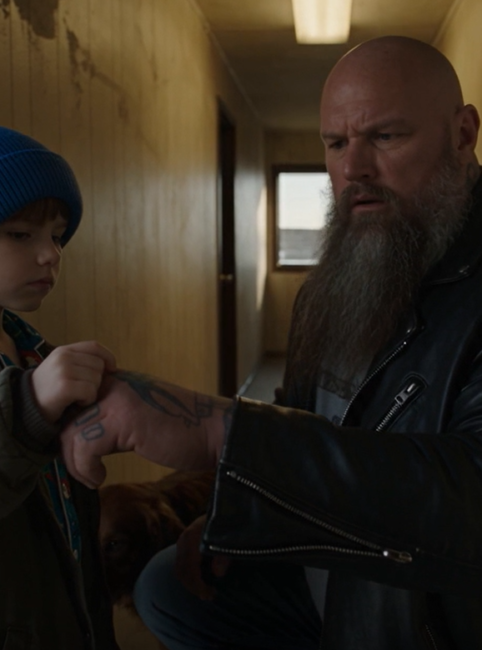
“You told him I was dead?”
“No.”
“Your mother-in-law did?”
Claire watched somebody carrying an ice bucket past the stairwell.
“Not here.”
Inside, two beds had been pushed together. Prescription bags sat beside a grocery sack of clean socks. Owen lowered himself onto a mattress, and the dog climbed up carefully, as though this were a job he remembered.
“His name’s Murphy,” Owen told me.
“I figured that from the tag.”
“Then why were you calling him Buddy?”
“Temporary arrangement.”
He almost smiled.
Claire filled a paper cup at the sink. Her hand shook enough to spill water on the dresser.
I wanted to demand eleven years back. Instead, I asked whether Owen had eaten.
“Half a sandwich,” she said.
“The good half,” Owen added.
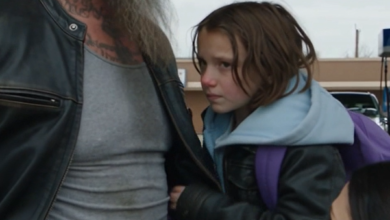
He was pale, with a scattering of freckles across his nose and a knit cap pulled down to his eyebrows. Nothing about him suggested the rushing emergency my frightened mind had already invented. He was tired. He wanted his dog.
Claire said he was being treated for leukemia. She said it quietly, while helping him untangle the leash from his blanket.
I sat on the chair nearest the door.
Owen studied my vest.
“Mom said you fix things.”
“Some things.”
“Motorcycles?”
“Mostly.”
“People?”
Claire turned toward the sink.
I rubbed my thumb over a split in the chair’s plastic arm.
“Not by myself.”
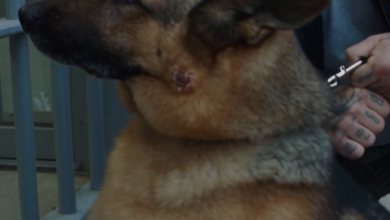
Murphy rested his chin on Owen’s ankle. The dog had a thin patch of hair beneath his collar and a dull coat, but the veterinarian who’d checked him that afternoon had found no immediate emergency. Food, flea treatment, follow-up. Ordinary things I could manage.
This room was different.
On the dresser lay an envelope bearing the name of a family assistance fund. Beneath it was a school worksheet.
People in my family.
Owen had drawn his mother, his father, Murphy, and an older woman with a purple purse.
There was no grandfather.
Claire saw me looking.
“He asked about your tattoo when he was little. I showed him a photograph.”
“And Ruth told him I was dead?”
“She said you were gone. Later, he asked if that meant dead.”
“You let him believe it?”
Her mouth tightened.
“Yes.”
That answer hurt more than an excuse would have.
For years I’d told myself that every returned birthday card proved somebody else was keeping her away. Now my daughter stood in front of me admitting she had helped close the door.
Then I remembered something I’d done that afternoon.
I took the note from my vest.
“You wrote this?”
She nodded.
“The garage closes at six. I found Murphy at five-forty.”
Her eyes lifted sharply.
I’d nearly left early.
Had she known how close her plan came to sending that dog home with somebody else?
Before Claire answered, Owen asked to see the bird again.
I pushed back my watch.
He touched the faded swallow with one careful fingertip.
“Why’s that wing funny?”
“Your mom moved my arm when the fellow was drawing it.”
“I was four,” Claire said.
“You were helping.”
For the first time, she looked directly at me.
When Claire was eight, she used to sit on a milk crate in my garage while I rebuilt carburetors. Her mother brought sandwiches wrapped in wax paper. On Sundays, we ate them behind the shop, where the traffic sounded like rain.
Claire called the swallow my home bird.
Before I rode anywhere, she tapped the motorcycle’s tank three times. I tapped back. It meant I’d heard her asking me to return.
Her mother died when Claire was nineteen. Afterward, the garage became quieter, and I mistook providing money for knowing how to speak.
Years later, when Claire married David, Ruth Mercer handled the reception receipts. She carried a numbered carbon-copy book and a violet stamp with a damaged letter R. Claire teased her about it. Ruth said replacing something that still worked was wasteful.
Those were the things I remembered: three taps, violet ink, my daughter laughing over a crooked letter.
Then Owen coughed, and the motel room returned.
Claire checked the time for his next medication. I went outside while she settled him.
My phone showed two messages from Leon, who rented the neighboring repair bay.
Dog okay?
Then:
You okay?
I typed that I’d found my daughter.
The phone rang immediately.
I silenced it.
Claire joined me with her coat unbuttoned. She had left the room door open a few inches.
“David made us leave,” she said.
“When?”
“Tuesday.”
It was Friday.
“Why?”
“He said he couldn’t keep living with me making every decision about Owen. We’d been separated in the same house for months.”
“And Ruth?”
“It’s her house.”
I waited.
“She changed the lock after we left.”
A car rolled slowly through the lot. Claire watched until it passed.
I asked why she hadn’t called me.
“Would you have answered?”
“Yes.”
“You don’t know that.”
I started to argue, then remembered the last thing I had said to her before her wedding.
Marry into that family, don’t expect me to stand around watching.
I had meant David’s habit of answering questions directed at her. She had heard a condition attached to being my daughter.
I’d spent eleven years pretending my meaning mattered more than what she’d heard.
“I would have answered,” I said again. “But I should’ve made that easier to believe.”
She leaned against the brick wall.
That was when the gray SUV pulled in.
David got out carrying a plastic storage bin.
Not a weapon. Not a court order.
Owen’s clean clothes.
He set the bin at Claire’s feet.
“You didn’t answer your phone.”
Then he looked at me, and the concern on his face hardened.
Why would a man who had thrown them out bring pajamas folded around a child’s favorite pillow?
David didn’t reach for Owen.
That surprised me.
He stayed outside while Claire checked the bin. There were socks, two books, a game controller, and a blue pillowcase embroidered with a crooked moon.
“You forgot his charger,” she said.
“Side pocket.”
She found it.
These were two people who still knew where the other put things. Somehow that made the motel worse.
David looked toward the room.
“How was his appointment?”
“Unchanged.”
“What does that mean?”
“It means you can call the clinic with the access you already have.”
He lowered his eyes.
I had been ready for somebody easy to hate. A man who didn’t ask. A man who arrived angry and gave me permission to become angry back.
Instead, David took out his phone and showed Claire a payment confirmation.
“I covered through Monday.”
The motel.
My certainty shifted.
“You put them out,” I said.
David’s jaw worked.
“I told her we couldn’t keep doing what we were doing.”
“In your mother’s house.”
“Yes.”
“With a sick kid.”
He looked at me.
“Yes.”
Claire closed the storage bin.
“Paying for this room doesn’t change Tuesday.”
“I know.”
He said it without much strength. I couldn’t tell whether he believed it or had learned that arguing made him look worse.
Then he noticed Murphy through the doorway.
“You found him?”
“I did,” I said.
David looked from the dog to Claire.
“How?”
I told him about the service road.
He took another breath, slower this time.
“Claire.”
“Don’t.”
He turned his phone toward me.
The photograph was taken from a vehicle. Murphy sat beside the red personnel door of my garage. His leash was attached to the outside bench. The highway service road ran beyond the gravel entrance.
I had found him after he’d slipped that leash.
“She sent me this yesterday,” David said. “Said she was taking him somewhere he’d be safe.”
Claire reached for the phone.
He moved it away.
“She knew exactly whose garage that was.”
The motel sign buzzed above us.
I looked at my daughter.
“You watched?”
Her eyes filled, but she didn’t answer.
David put the phone away.
For a moment he appeared to be the only person present telling the whole truth.
Then he said, “Mom told you the fund was empty. I didn’t.”
Claire stopped wiping her face.
“What?”
“She said the donations had been returned after you refused the family arrangement.”
“What arrangement?” I asked.
David looked uncomfortable.
“Claire and Owen staying with her. Me handling transportation. Less confusion.”
Claire gave a short, dry laugh.
“Me moving out of my son’s room so your mother could manage everything.”
“That isn’t how she explained it.”
“No,” Claire said. “It wouldn’t be.”
I asked how much money had been raised.
Neither answered.
David opened the fundraiser page on his phone. The total was still visible beneath a photograph of Owen holding Murphy.
Forty-one thousand, eight hundred and sixty dollars.
Claire gripped the doorframe.
“Then why did she tell me there was nothing left?”
David stared at the number as though somebody had changed it while he slept.
Which of them had ever actually looked at the bank account?
We didn’t solve forty-one thousand dollars in a motel parking lot.
We argued about where Owen would sleep.
Claire refused David’s offer to return to the house. She also refused my first suggestion, which was to move into the room above my garage.
“No stairs,” she said. “Not on the bad days.”
Leon answered when I finally called him. His wife, Denise, knew a woman who rented a furnished ground-floor duplex. It was available for three weeks between tenants.
By the next afternoon, Claire had a key.
She insisted on signing the short lease herself.
I paid the deposit. She wrote the amount on the back of an envelope.
“Dad.”
“Write it down if you need to.”
She did.
Murphy explored the kitchen, then positioned himself where he could see Owen’s bed and the front door.
The dog’s behavior around my motorcycle finally made sense when Owen showed me a notebook.
On the first page was a drawing of a large black bike. On the back sat a stick figure in a helmet. Murphy occupied an enormous sidecar.
“Mine’s not equipped for that,” I said.
“I know. Mom told me.”
Claire leaned against the counter.
During the early months of treatment, she had shown Owen an old video of me arriving home. The engine, the three taps, her young voice asking for a turn on the seat.
He had watched it repeatedly with Murphy beside him.
“Whenever he got to the motorcycle part, he called the dog over,” she said.
Owen demonstrated, tapping his notebook three times.
Murphy stood.
He went straight to the door.
I looked away until I could trust my face.
That evening, David brought printed fundraiser records. He had requested them from Ruth and received six pages of summaries.
No bank statements.
The summaries listed motel assistance, fuel, household expenses, and a payment to a roofing contractor.
Claire pointed at that line.
“Whose roof?”
David said nothing.
His mother’s house had been reroofed in August.
Ruth’s explanation, delivered through a speakerphone, was calm.
“The house was being maintained for Owen. He lived here.”
“Did donors know they were buying your roof?” Claire asked.
“It wasn’t buying me anything.”
“Then send the actual invoices.”
Ruth ended the call.
The next morning, Claire contacted a lawyer recommended by the hospital social worker. I drove her there and waited beside a coffee machine that accepted my dollar and delivered hot water.
The lawyer, Elaine Porter, didn’t promise arrests or instant refunds.
She asked who controlled the account, what donors had been told, and what Claire had signed.
Then she asked for originals.
At the duplex, we emptied Claire’s document bag across the kitchen table.
There were appointment slips, mileage notes, insurance letters, and a violet-stamped receipt from the first benefit dinner.
Number 814.
It recorded an anonymous cash gift of three thousand dollars, restricted to Owen’s treatment travel and temporary lodging.
Claire touched the damaged R in the stamp.
“This was Mrs. Alvarez’s money. She sold her husband’s fishing boat.”
David examined the summary.
There was no corresponding gift listed.
Only a handwritten deduction for “returned donor funds.”
Claire looked at him.
“Did Mrs. Alvarez get her money back?”
For once, David reached for his phone before calling his mother.
Mrs. Alvarez had received a thank-you card.
No refund.
By Monday, Elaine had copies of the receipt, fundraiser page, contractor invoice, and David’s messages with Ruth. She told us to preserve everything and stop conducting investigations through arguments.
I managed that for almost a day.
Then Leon showed me the post.
It had a photograph of my garage, cropped so the service road looked like the entrance to some abandoned building.
A vulnerable child should not be exposed to an unstable stranger while his family is trying to help.
My name wasn’t written.
It didn’t need to be.
Underneath, somebody had supplied an old newspaper clipping about a fight outside a bar seventeen years earlier. I had pleaded guilty to disorderly conduct. My wife had still been alive to collect me.
I’d told Claire about the charge.
I had never told her I’d started the fight.
By noon, one customer had canceled a repair. Another asked whether children were staying at the shop.
Leon wanted to answer the post.
“Don’t,” I said.
Then I wrote three paragraphs on my phone and nearly sent them.
Claire took it from my hand.
“Please don’t make Owen searchable.”
That stopped me.
Elaine documented the post. The hospital social worker helped Claire review who could receive updates and how to manage unwanted visits.
A staff member later asked Claire privately whether she felt safe staying at the duplex.
Claire told me because she didn’t want me hearing it from someone else.
“They have to ask,” she said.
“I know.”
I knew after she explained it.
Before that, I felt accused.
Ruth called me that night.
Her voice was softer than it had been on speakerphone.
“You think arriving on a motorcycle makes you a father again?”
“No.”
“You frightened her when she needed you.”
“I know.”
“You don’t know what this has cost us.”
“Send the statements.”
She breathed into the receiver.
“There are things Claire hasn’t told you.”
“Then she can tell me.”
I hung up with my hand shaking.
The next day brought a different loss.
The informal riding group I met on Sundays had been invited to help with Ruth’s next benefit dinner. Their organizer asked whether I could stay away until the family dispute was sorted out.
“People are uncomfortable, Jack.”
“Which people?”
He didn’t answer.
Leon canceled his participation. Two others did too. The rest decided they had already committed.
I couldn’t blame all of them. I still wanted to.
That afternoon I found Claire sitting in the duplex kitchen with Murphy’s old leash across her knees.
The empty collar loop at one end looked absurdly small.
She had heard about the riders.
“I can explain the photograph,” she said.
“You already said you knew the garage.”
“Not just that.”
Owen was asleep in the next room. The refrigerator hummed against a loose panel.
Claire pressed the leash flat with her palm.
“I told the woman at the motel he’d run away.”
I waited.
“And when you called the number on his tag, I almost didn’t answer.”
What had my daughter been trying to make happen without ever having to ask me?
Claire spoke with her eyes on the leash.
“I wanted you to find him.”
I sat down.
She had driven past the garage twice the previous week. Once she’d seen me carrying a transmission casing. Once I was sitting on the bench eating something from foil.
She could have stopped.
She didn’t.
“I kept hearing what you said before the wedding.”
“I’m sorry.”
“Let me finish.”
So I did.
Ruth had told her I refused every message. That I sent back photographs. That I wanted nothing to do with David’s family, which meant Owen too.
Some of it had been true at the beginning.
I had refused one invitation to dinner.
I had returned a package addressed in David’s handwriting without opening it.
I couldn’t put all eleven years in Ruth’s hands.
Claire had eventually stopped trying. She had also stopped checking what Ruth said.
“When Owen asked if you were dead, I let it stand,” she said. “Explaining that my father didn’t want us felt worse.”
“I wanted you.”
“You wanted me to admit you’d been right.”
I opened my mouth.
Closed it.
She nodded once, as though I had finally answered.
When David ordered her out and Ruth changed the lock, Claire’s motel had allowed Murphy for two nights. After that, a different room was available, but pets weren’t permitted.
There were other options she hadn’t called.
She knew that now.
At the time, she had pictured my garage, my bench, the dog I’d kept when she was young.
She tied Murphy where I would see him before closing. She left water. She parked across the service road.
“I watched you come out.”
“And if somebody else had taken him?”
“I would’ve stopped them.”
“The leash came loose.”
“I know.”
I had walked around the building to bring in a delivery. Murphy slipped the loop from the bench leg and followed the sound of a motorcycle passing on the road.
Claire saw me catch him near the gravel entrance.
She watched me carry him back.
Then she drove away.
“Why?”
“Because if you kept him, I knew he’d be okay.”
“And Owen?”
Her face folded.
“I thought maybe you’d call. Maybe I wouldn’t have to say it first.”
There it was.
Not a master plan.
A frightened woman using a dog to knock on a door she was afraid to approach.
It had worked.
That didn’t make it fair.
“Murphy didn’t deserve that,” I said.
“No.”
“Neither did Owen.”
“I know.”
She cried without covering her face.
I stayed in the chair.
After a while, I asked her to tell the lawyer the same story. To correct the motel account. To stop making the next lie carry the last one.
She agreed.
Then I took out the note.
Please take care of my son’s dog.
“You could’ve written six words.”
She looked at me.
“Dad, I need somewhere to go.”
From the bedroom came three soft taps against the wall.
We both turned.
Owen stood in the doorway holding his notebook.
“Are you going away because of me?”
Claire reached him first.
“No, honey.”
He looked past her.
At me.
How many grown-up mistakes had he already decided were his fault?
I knelt so Owen didn’t have to look up.
“No,” I said. “I’m staying.”
He watched me for a moment.
“People say that.”
“I’ll be here tomorrow.”
That was a promise small enough to keep.
By Thursday, Elaine had helped Claire assemble a written request for a complete accounting. David signed it too.
He did one more thing.
He moved out of Ruth’s house.
Not into Claire’s duplex. She wouldn’t consider that.
He rented a room near his work and began arranging his own visits with Owen instead of asking his mother when he should come.
None of it made Tuesday disappear.
It gave him somewhere to start.
Ruth’s benefit dinner went ahead Saturday evening in a rented community hall. Claire asked that Owen’s photograph be removed from the promotional page and that no further donations be accepted in his name without an agreed arrangement.
The dinner had already been paid for.
The organizers changed it to a donor meeting.
Ruth called that humiliating.
Mrs. Alvarez called it overdue.
I drove Claire there. Owen stayed at the duplex with Denise and Murphy, assembling a model truck at the kitchen table.
There were thirty-two people in the hall.
I counted because I needed something to do with my eyes.
Two riders sat near the back. One nodded at me. I nodded back.
Elaine attended with Claire. She wasn’t there to run a trial. She had told us that twice.
Ruth stood beside a folding table with a pitcher of water and her violet receipt book.
She looked tired.
Older than I remembered.
For a moment I saw somebody who had spent months answering questions she didn’t know how to answer, then discovered that controlling the questions felt better.
That didn’t change the invoices.
Claire read a short statement.
She thanked the donors. She corrected the claim that assistance had been refused. She said she had received no refunded donor money and had not agreed to spending restricted travel gifts on home improvements.
Ruth interrupted at “restricted.”
“The house was his home.”
Mrs. Alvarez stood slowly.
“My receipt says travel and lodging.”
Ruth reached for her water.
“That was one receipt.”
Elaine placed a copy on the table.
“Number 814,” she said.
Ruth didn’t touch it.
“That receipt was voided.”
Claire looked at her.
“You told David you’d never seen it.”
“I meant I didn’t remember the donation.”
Mrs. Alvarez opened her purse and produced a bank withdrawal slip. David supplied the message in which Ruth had described the gift as refunded.
A man near the back asked where the refund check was.
Ruth said she had dealt in cash.
“Then show us the signed return,” Mrs. Alvarez said.
Ruth looked down at the violet book.
“You won’t find a carbon for eight-fourteen. Claire tore it out.”
The room became still.
Claire’s copy had been photographed alone. The book had not been discussed.
“You said you never handled it,” David said.
Ruth’s fingers closed around the cover.
“I handled everything.”
She said it sharply.
Then, perhaps because she had finally said something true, she kept going.
Who took the calls? Who booked the hall? Who stayed up reconciling payments? Who was supposed to maintain a house everybody expected Owen to return to?
“I wasn’t going to lose my home after everything I did.”
Claire sat down.
There was no applause.
Only someone setting a cup onto a table too hard.
Ruth stared at the book in her hands.
How much of Owen’s help had she begun to believe belonged to her?
The meeting didn’t end with handcuffs.
It ended with the hall manager asking who was taking the leftover food.
Ruth left with David. He carried the receipt book in a paper grocery bag after she agreed to turn over the records through the lawyers.
Claire stood beside my motorcycle in the parking lot.
“You didn’t say anything.”
“Wasn’t my money.”
She looked toward the hall.
“Wasn’t just money.”
“No.”
Over the following months, the documents did what our anger couldn’t.
Statements were obtained. Donors provided receipts. Some household expenses had been described accurately; others had been placed under categories that hid what they bought. The roof payment was the largest problem, but it wasn’t the only one.
Claire received a negotiated repayment arrangement for money intended for her and Owen’s expenses. Some donors pursued their own complaints. Other questions remained with people whose job was to investigate them.
Ruth had to sell investments and make payments.
She also lost control of every decision concerning Owen.
That consequence reached her before the financial ones did.
Claire didn’t agree to unsupervised visits. She didn’t promise she eventually would.
David kept visiting.
Sometimes Owen wanted him there. Sometimes he stayed beside his mother for the first twenty minutes. David learned to sit through that without asking the child to reassure him.
I learned something similar.
Being invited back wasn’t ownership.
I knocked.
I called before bringing groceries.
When Claire said she needed a quiet afternoon, I went home instead of deciding she really needed me.
Murphy’s coat improved. The thin patch beneath his collar filled in slowly. He developed a habit of sleeping across my boots whenever I visited, making departure an awkward business.
Owen’s treatment continued.
There were better weeks and worse ones. Nobody in our family got to turn one encouraging appointment into a guarantee.
His motorcycle wish changed too.
At first he wanted a ride.
Then he wanted to know how a bike stayed upright, whether engines got lonely in winter, and why I owned seven different tools that all looked like crooked spoons.
On a mild afternoon, with Claire’s permission and the bike secured in the garage, I helped him sit on the stationary passenger seat.
Engine off.
Helmet fitted.
Murphy lay beside the workbench, offended that his drawing’s sidecar had still not appeared.
Owen tapped the tank three times.
I tapped back.
He grinned through the open visor.
Claire took one photograph.
She kept it for herself.
A week later, she brought me an envelope. Inside were the birthday cards Ruth had stored without delivering, along with two I had sent to an old address.
Not every missing year had the same cause.
We sorted them at the kitchen table.
Owen asked why there were so many.
“Mail trouble,” I said.
Claire shook her head.
“People trouble.”
He accepted that more readily.
By spring, the note from Murphy’s collar lived in a frame above my workbench. I hadn’t displayed it to shame Claire. She was the one who brought the frame.
On the back, she wrote a different sentence.
Dad, I need somewhere to go.
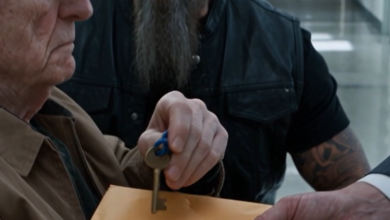
One evening, Owen found me hanging a spare key beside the garage door.
“Who’s that for?”
“Your mom.”
He considered the second empty hook.
“What about mine?”
I handed him the small brass key I’d had cut that morning.
Murphy lifted his head.
Outside, Claire waited beside the car, holding Owen’s coat open.
He put the key carefully into his pocket, then turned back toward me.
“Can we come tomorrow?”