His Dog Followed Every Motorcycle Convoy After the Funeral—Then a Prison Gate Exposed the Biker Who Was Still Alive and the Brother Selling His Family’s Shop
Ben Rourke kept one hand through Boone’s harness.
The dog was sitting now, pressed against his boot, staring through the service fence. Beyond it, the man in gray had been guided back inside.
“Say that again,” Ben asked.
The officer didn’t.
He looked toward the security camera above the entrance, then asked Ben to move away from the gate.
Ben obeyed.
He had spent five months helping people explain Boone’s behavior. The dog followed the rumble of touring motorcycles because Ethan had ridden one. He waited outside the repair shop because Ethan had worked there. He refused the blanket Grant brought from Ethan’s house because grief could make an animal strange.
There had always been an explanation.
Now a man behind a prison fence had used Ethan’s words.
Boone, clock out.
Then he had said his brother had visited and left him there.
Ben could still hear the voice.
It was rougher than Ethan’s. Slower.
That mattered.
Two weeks earlier, Boone had strained toward a delivery driver wearing a leather jacket. Ben had wanted it to mean something then, too.
Dogs made mistakes.
So did men who missed their friends.
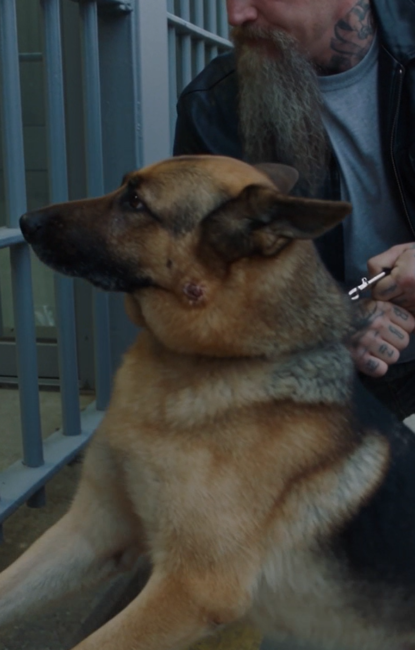
He crouched and checked Boone’s paws. The shepherd’s black saddle was sprinkled with gray near the shoulders, and one ear carried a small notch from an old encounter with a fence.
“Stay with me,” Ben said.
Boone leaned against him without looking away from the building.
The motorcycle ride had started outside Marietta, Ohio. It was supposed to end across the West Virginia line, with donated paperbacks delivered to a detention center’s education program.
Boone had slipped through the shop gate and followed the motorcycles along two slow blocks before Ben caught him.
They hadn’t let him run the route.
Luis, driving the support pickup, had secured him in a familiar harness on the back seat.
At their last stop, Boone had refused to move toward the grass. Instead, he pulled toward the fenced service yard.
That was where everything changed.
The officer returned with a woman from the administrative office. She asked for Ben’s name and phone number, then asked him to wait.
“Is he Ethan Cole?” Ben said.
“We have a disputed identity. I can’t resolve that here.”
“Does he have a lawyer?”
“Yes.”
“Then please give the lawyer my number.”
She wrote it down.
Ben called Grant.
His friend’s younger brother answered from the shop.
“Did you make the delivery?”
“Boone found somebody.”
A pause.
“What do you mean?”
“A man. Here.”
The silence lengthened.
Ben looked down at the dog.
“Grant. Have you been here?”
“Who told you that?”
Not no.
Not what are you talking about.
Ben closed his eyes.
Grant began explaining before Ben asked another question.
There had been a call. An impersonator. Somebody trying to reach Ethan’s accounts.
“People do ugly things after a death,” Grant said.
Ben looked through the fence at the empty yard.
He had helped Grant carry Ethan’s memorial photograph into the church.
Grant had ordered the memorial cards, arranged the food afterward, and answered the questions Ben could not bear to ask. There was a photograph of them standing beside the casket. Ben had once thought it showed what brothers were for.
He had trusted the hand gripping his shoulder beside the grave.
Now that same man was asking him to leave before the lawyer called.
What, exactly, had Grant seen when he came through those doors?
Ben remembered a Saturday behind the shop the previous summer.
Ethan was grilling sausages beside a motorcycle with its seat removed. Boone waited beneath the picnic table, watching every falling crumb as though he had a written contract.
Ethan tapped his belt buckle twice.
“Clock out.”
Boone came around to his left boot and sat. Ethan slipped him one small piece of sausage.
Grant complained that his brother was teaching the dog to beg.
“Teaching him when to stop,” Ethan said.
Later, Grant showed Ben a replacement brass key tag for the shop’s old parts cabinet.
Three shallow punch marks ran along one edge.
“So I can find it in the dark,” Grant said.
Ethan laughed.
“The cabinet’s red. Turn on a light.”
Grant tucked the tag into his pocket.
Ben remembered the laughter, the smell of browned onions, Boone’s chin resting on Ethan’s boot.
Nothing had seemed worth remembering carefully.
Now he sat in the visitor parking lot, pulling that afternoon apart.
The phrase mattered.
The belt taps mattered.
The key tag did not seem to matter yet.
He called Mara, who handled the shop’s accounts and had been caring for Boone above the garage.
She listened without interrupting.
Then she asked where the dog was.
“Beside me.”
“Water?”
“Yes.”
“Good. Now tell me what you actually saw.”
It was the question Ben needed.
A man behind a fence.
A familiar way of standing, favoring the right leg.
A voice using a private command.
The dog responding.
And an accusation.
Mara wrote each item down.
She didn’t say Ethan was alive.
She didn’t say Ben had lost his mind.
“Stay where they told you to stay,” she said. “I’ll find somebody who knows what questions to ask.”
The callback came less than an hour later.
The lawyer introduced herself as Tessa Warren. Her client had authorized her to speak with Ben.
Her client was being held under the name Logan Price.
He had repeatedly said his real name was Ethan Cole.
Ben stood up so quickly Boone rose with him.
“Then why is he still there?”
“Because the identification error has spread through several records, and the evidence we’ve been given conflicts. I’m working to untangle it.”
“What evidence?”
“Some of that I can discuss when we meet.”
Ben heard caution, not indifference.
He made himself respect it.
Tessa asked for photographs, anything documenting Ethan’s physical features before the crash, and the names of people who had known him for years.
Ben had all three.
He also had a funeral program in his wallet, worn along the fold. He almost mentioned it, then realized how little it proved. It documented what they had believed. It could not tell the lawyer whether that belief had ever been checked.
Then she asked about Grant’s visit.
“He told me an impersonator called.”
“He told investigators the same thing.”
Ben looked at his motorcycle.
Grant had spent the winter keeping the shop open, paying bills, and answering condolences. He had arranged Boone’s food delivery without being asked.
A cruel misunderstanding was still possible.
Ben needed it to be possible.
Tessa’s next question made that hope harder to hold.
“Do you know why your friend’s brother was the person who identified the deceased man in the first place?”
Grant met Ben that evening in the shop office.
He had printed documents and lined them across the desk. There was a crash report, correspondence about the body’s identification, and paperwork concerning Ethan’s estate.
He looked exhausted.
Ben had seen that exhaustion for months.
“I didn’t invent a death,” Grant said.
“I didn’t say you did.”
“You’re thinking it.”
Ben sat down.
Boone remained with Mara upstairs. Grant had suggested bringing him into the office, but Ben wanted one conversation without the dog becoming an argument.
Grant described the call after the crash.
Ethan’s pickup had been found with a motorcycle on its trailer. Two men had been inside the truck.
One had died.
One had been taken to a hospital.
The surviving patient’s paperwork carried the name Logan Price, a man being sought in connection with a stolen-vehicle investigation.
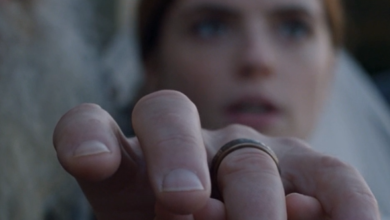
The deceased man had Ethan’s jacket.
His wedding ring was in a zipped pocket.
Grant had identified those belongings, then signed a statement identifying the body as his brother.
Ben remembered the closed casket.
He remembered being told there was no reason to look.
“I recognized the ring,” Grant said.
“So did you see his face?”
Grant pressed his fingers against his eyes.
“I saw enough to believe what they told me.”
For the first time, Ben understood how a terrible mistake could begin.
A jacket.
A ring.
A name attached to the other patient.
Grief filling the spaces nobody checked.
Grant showed him a letter from Tessa asking for help confirming her client’s identity.
He had answered it.
His reply described Ethan’s death, enclosed supporting papers, and said the caller was exploiting a bereaved family.
“I thought I was protecting what was left,” Grant said.
Ben hated how reasonable that sounded.
“What about visiting?”
“Through glass. He’d been hurt. He looked different.”
“And the voice?”
“He knew things. That scared me.”
Grant lowered his head.
Ben could almost believe him.
Grant pushed the folder across the desk. Nothing was hidden, he seemed to be saying. Ben understood the invitation to stop. He also noticed that every page Grant offered supported the original conclusion. There was nothing showing anyone had tested the later contradiction.
Then Mara knocked.
She held the old shop computer’s backup drive.
“I found the messages you asked about.”
Grant looked up.
“I didn’t ask you to look through anything.”
“Ben did. For photographs.”
Her voice stayed level.
The photographs were there, along with copies of purchase records and messages Ethan had sent before the crash.
One message mentioned Logan Price.
Ethan had known the other man.
That changed the accident again.
Ben read the line twice.
Bringing Logan back tonight. We need to settle this before the lender gets another inventory list.
Grant’s hand moved toward the paper.
Mara kept hold of it.
Ben looked at the estate documents on the desk.
After Ethan’s wife died, Ethan had named his brother as the beneficiary of his estate. The shop their father left them had become the largest thing either man owned.
Grant was now administering Ethan’s share.
He had already begun negotiating its sale.
If he had believed an honest mistake, why had he never mentioned knowing the other man in the truck?
Tessa asked them to stop confronting Grant.
“Preserve what you have,” she said. “Let people with authority obtain the rest.”
Ben wanted to drag the whole town into the office.
Instead, he copied photographs.
It felt absurdly small.
It was also useful.
A photograph from the summer picnic showed Ethan’s right wrist clearly. An old surgical scar curved beneath a tattoo of a compass.
Mara found the clinic information in an employee emergency folder Ethan had maintained for years.
Tessa contacted the people who could request the relevant records.
Ben did not receive a dramatic answer that night.
He received a list of appointments.
Over the next week, investigators began comparing information that should have been reconciled earlier.
The wallet and an ambulance transfer record had pointed to Logan Price. The crash paperwork had repeated that name. Confusion and difficulty speaking after the injury had delayed Ethan’s account.
When he became clearer, his insistence on another name had been treated as another conflicting statement.
Grant’s death identification had made that conflict look settled.
It had not been settled.
The fingerprints taken at booking had never established that he was Logan. The name had traveled farther than the evidence supporting it. A review of the hospital transfer records also exposed an early mix-up in the belongings information.
Tessa did not describe one clerk making one mistake. She described several people accepting a conclusion they should have questioned, even after her client challenged it. She was gathering the documents that showed when each warning had reached them.
Booking photographs, medical records, and independent witnesses now gave Tessa a way to challenge it with more than a grieving friend’s certainty.
Ben met Ethan in a controlled visit.
Without Boone.
He had imagined knowing immediately.
Instead, seeing the thinner face and the unfamiliar clothes hurt enough to make him hesitate.
Ethan noticed.
“Left drawer,” he said.
Ben stared.
“What?”
“The wrench you broke. You hid it under the old seat covers.”
Ben sat down.
Ethan’s mouth trembled.
“I wasn’t mad about the wrench.”
Ben pressed both palms against his knees.
For several minutes they discussed nothing useful.
A leaking roof.
Mara’s coffee.
Whether Boone still slept against the bedroom door.
Then Ethan asked about Grant.
Ben told him what he knew.
Ethan lowered his eyes.
“Don’t let him sell the building.”
The money trail took longer.
Their father’s shop had owned motorcycles, parts, and equipment used to support business borrowing. Investigators found inventory claims that listed items the shop no longer possessed.
The same assets appeared in more than one set of paperwork.
Some funds had moved into an account Grant controlled.
Other documents carried Ethan’s signature.
Mara stared at those pages when Tessa explained what could be shared.
“He signed them?”
“We need his account of that.”
Ben thought about the message concerning Logan.
He thought about Grant’s brass key tag with three punch marks.
The parts cabinet held older sales records. The cabinet had been emptied shortly after the funeral.
Grant had called it organizing.
Then Mara found a recent storage receipt among the shop’s expenses.
It concerned a unit across town, opened before the crash.
What had Grant moved there before anyone believed Ethan was dead?
Grant changed the office password on Thursday.
By Friday, Ben’s standing repair appointments had disappeared from the shared calendar.
He wasn’t an owner. He had worked alongside Ethan for years, but loyalty did not give him access Grant could not revoke.
Grant sent him a polite email stating that their working arrangement had ended.
Then he asked for Boone.
The dog belonged to Ethan’s estate, he wrote.
Ben read the sentence three times.
Mara sat beside him on the upstairs couch. Boone’s head rested between her feet, one ear turning at the sound of every motorcycle below.
“He’s not taking him,” Ben said.
“Call Tessa.”
Ben did.
She helped them find appropriate advice about Boone’s care and the dispute over the shop. Mara documented where he had been living, who had paid his expenses, and the arrangements made after the funeral.
They did the dull work before the argument became another emergency.
Grant tried the town next.
He described Ben as a man unable to accept his friend’s death. He suggested Mara had taken advantage of the confusion to obtain confidential business records.
Some people listened.
One rider called Ben and asked whether he was certain the prisoner wasn’t using information found online.
Ben nearly shouted.
Then he remembered how badly he had wanted Grant’s explanation to be true.
“Come meet the lawyer,” he said.
The rider did.
Not everyone did.
A parts supplier paused deliveries while ownership questions were being examined. The proposed buyer wanted reassurance. Grant blamed Ben for threatening everyone’s jobs.
That accusation reached people faster than the truth about the invoices.
Mara began receiving messages asking why she was helping a man accused of stealing vehicles.
She showed Ben one, then put the phone facedown.
“Twenty-three years balancing their books,” she said.
Ben had no sentence that could make that fair.
Boone rose slowly from the floor and pressed his nose beneath her hand.
She scratched behind his notched ear.
“Still got one customer.”
The dog leaned harder.
Mara kept his routines steady. The same walks, the same bowl, the same place to sleep. Ben wanted to return to the detention center every day, but he stopped treating Boone as a test they could keep repeating until somebody listened.
Tessa called that afternoon.
Investigators had located records from the storage unit. Among them were older sales documents and copies of correspondence concerning inventory discrepancies.
The records connected Grant to transactions he had denied handling.
But there was also something Ethan needed to explain.
A payment to Logan Price.
Made before the crash.
Ben looked toward the folded memorial program still tucked beside the television.
He had built Ethan into someone who needed rescuing.
There had been comfort in that.
It let every difficult question belong to somebody else.
Now Tessa asked whether he would come to another visit.
“Ethan wants you there when he explains.”
Ben agreed.
That evening, Grant sent one last message.
Ask him why he was driving a wanted man out of town.
Ben turned the phone over before Mara could see his face.
What had his friend been trying to save besides himself?
Ethan did not ask whether Ben believed him.
He began with the signatures.
“I signed things I didn’t read closely enough.”
Ben sat still.
Grant had managed the financing. Ethan handled customers, repairs, and the machines their father had taught him to understand.
When money became tight, Ethan accepted explanations he should have checked.
He liked being the brother who kept the doors open.
He didn’t like paperwork that made the shop look less successful.
“So you looked away,” Ben said.
“Yes.”
The answer was immediate.
That made it harder to dislike him and impossible to excuse him.
Logan Price had worked occasionally moving motorcycles and equipment. He knew which items had been sold and which were still being claimed as inventory.
He was also wanted in a separate stolen-vehicle case.
Ethan had given him cash and offered a ride out of town before finally deciding they needed to confront the shop’s records.
“I told myself I was helping him get straight,” Ethan said.
“Were you?”
“Some of it.”
“And the rest?”
“I didn’t want him talking before I knew how much trouble I was in.”
Ben looked at the table between them.
There was no dog here to make the right answer simple.
Ethan had given Logan his jacket when the heater failed. He had taken off his wedding ring earlier while working and put it in the zipped pocket.
After the crash, those belongings stayed with the wrong man.
The mistake had not required Grant to arrange an accident.
It required him to accept a death that benefited him, then protect it when evidence began contradicting it.
Ethan remembered his brother’s visit.
He remembered placing his scarred wrist against the glass.
He remembered Grant seeing it.
“He said I should stop,” Ethan told them.
“Stop what?”
“Making this harder on the family.”
Ben felt his jaw tighten.
Tessa let the silence settle.
Then she asked about Ethan’s early reluctance to contact Grant.
“I knew about the inventory by then. Not all of it. Enough.”
He had asked his lawyer not to use Grant as his only family contact. That warning had not kept Grant’s earlier identification from being treated as reliable.
Ethan had also withheld details about Logan from his first conversations with counsel because he feared what those details meant for him.
“I made it harder to help me,” he said.
“Yes,” Tessa answered.
She did not add comfort.
Ben was grateful for that.
He had mistaken loyalty for protecting his friend from every uncomfortable fact. Sitting there, he understood that Ethan needed something harder from him. He could bring photographs, answer questions honestly, and still say the money and the signatures mattered. None of those acts canceled the others.
Before the visit ended, Ethan asked about Boone.
“He still waits by the shop door.”
Ethan looked down.
“Anna used to say that dog knew when I was lying.”
“Dogs don’t sort out accounts.”
“No.”
“People have to.”
Ethan nodded.
Later, independent comparisons confirmed his identity. Work also continued to identify the deceased man correctly and notify the people who belonged to him.
There would be no quiet exchange of one name for another.
Two families had been given false answers.
Tessa warned Ethan that establishing who he was would not erase what he had done.
He said he understood.
Ben wondered whether Grant would understand the same distinction when both brothers finally had to answer in one room.
The first public confrontation happened during proceedings over control of the shop.
By then, Ethan’s identity had been formally corrected, and the legal basis for holding him as Logan Price had been challenged successfully.
His own conduct remained under investigation.
Ben understood that difference.
He wished the people posting online understood it too.
Boone stayed with Mara that morning. Nobody brought him into a hearing as though a dog could replace records.
Ben sat behind Ethan.
Grant arrived with an attorney and the same leather document case he had carried to the funeral home.
The room was smaller than Ben expected.
No grand staircase.
No crowd waiting to cheer.
Just people turning pages while the clerk checked names.
Grant’s account was careful.
He had acted in good faith.
He had kept employees paid.
He had believed a body identification made during a terrible week.
The later claims had looked like fraud.
Ethan listened with both hands folded.
Then the questions turned to the visit.
Grant said he had not recognized the man.
He described a brief encounter with someone injured, confused, and insistent on information an impostor might have obtained.
Records contradicted the brevity.
Correspondence contradicted the claim that he had done nothing afterward.
He had actively urged people to stop contacting the shop about the prisoner.
Then came the proposed sale.
The buyer had received assurances that no living co-owner could challenge the transaction.
Grant said he believed that.
An attorney placed a storage-unit inventory beside him.
Older sales records had been kept there, including documents that showed the same assets being used in inconsistent claims.
Grant denied removing them personally.
“The staff had access to the parts cabinet.”
Ben felt Ethan shift in front of him.
The attorney asked about the brass key tag recorded among the storage unit’s contents.
Grant said it was an ordinary shop key.
There were several.
“Did yours have identifying marks?”
“I don’t remember.”
Ben remembered the summer picnic.
Three shallow punch marks.
Grant searching for it in the dark.
A photograph showed the tag beside the recovered records.
Grant leaned forward.
“Those marks are on the wrong edge in that picture.”
He stopped.
The attorney waited.
Grant looked toward his own lawyer.
The correction did not prove every transaction.
It did identify something he had just claimed not to remember.
Further records showed the unit had been opened and paid for by Grant. Messages connected him to the removal of the cabinet’s contents.
The little brass tag fitted into evidence much larger than itself.
Then Ethan spoke when asked about his brother’s visit.
“He saw my wrist. I held it up.”
Grant shook his head.
“You kept saying things only—”
He broke off again.
Only who would know?
Nobody completed the sentence for him.
Ethan looked at his brother.
“You knew enough to ask me to stay dead.”
Grant’s attorney objected. The discussion returned to dates, documents, and what could be established.
Ben was glad.
He wanted a result that would survive the room.
There had been enough people deciding who Ethan was from a jacket, a document, or the way he looked. Ben would not ask anyone to make the opposite mistake merely because the dog had brought them to the right door.
When they stepped outside, Mara was waiting across the street with Boone on his red leash.
Ethan stopped on the courthouse steps.
After months of calling the wrong name, what would happen when someone finally let him answer the right one?
Ethan tapped his belt twice.
Boone rose so quickly Mara had to gather the leash.
“Clock out,” Ethan said.
She crossed with him when the traffic signal changed.
There was no leap into Ethan’s arms.
Boone reached his left boot and stopped.
He pressed his nose against the denim, breathed in, then pushed his whole shoulder against Ethan’s leg.
Ethan lowered himself carefully onto a bench.
The dog climbed halfway across his knees.
For a long time, Ethan did nothing but hold the harness.
Ben stood nearby with the spare leash looped around his hand.
A bus pulled away.
Someone carried coffee past them.
Mara wiped her face and complained about the wind.
Boone did not look up.
What followed was slower.
The shop’s proposed sale was halted while ownership and estate records were corrected. Grant was removed from the position he had used to control Ethan’s affairs.
The financial investigation continued into charges, testimony, and consequences.
Ethan had to answer for the documents he signed and the help he gave Logan. He did so with counsel, without pretending the wrong done to him had made every earlier choice disappear.
Logan’s family received the truth about the crash and the man they had lost.
Ben went with Ethan when he met one of Logan’s sisters.
He waited outside.
That conversation did not belong to him.
The failures that had kept Ethan under another man’s name were reviewed separately. Tessa kept copies of every request that had gone unanswered and every contradiction that had been treated as resolved.
Ben learned that a corrected record was a beginning.
It was not repayment.
Ethan returned to a small apartment above the shop.
He did not take charge of everything on the first morning.
Mara set the books on his kitchen table.
“You want to run a business,” she said, “you read these.”
He read.
Sometimes he needed help.
He asked.
Some evenings he stood outside the apartment door longer than he needed to, keys resting in his palm. Mara never hurried him. Ben learned not to fill those moments with cheerful talk. Boone waited too, then followed when Ethan was ready.
Boone’s bed went beside the bedroom door, where it had always been. His familiar blanket smelled faintly of Mara’s laundry soap now.
Ethan left it that way.
On Saturdays, Ben came early with coffee.
They repaired what could be repaired, argued about estimates, and took turns walking Boone around the block.
The dog still lifted his head when motorcycles passed.
Sometimes he went to the window.
Then he looked back at Ethan.
The first time he did that without getting up, Ben set down his cup.
Ethan noticed too.
Neither man said anything.
A month later, they joined a short memorial ride.
Ethan chose the route. He included a quiet stop for Logan, whose name had been missing from every early account.
Boone traveled in the support pickup, secured comfortably beside Mara.
Afterward, back at the shop, engines cooled in the yard.
Ethan stood in the doorway with the dog’s red leash.
Boone came to his left boot before the buckle taps.
Ethan rubbed the notch in his ear.
“No more looking,” he whispered. “I’m here.”
Boone leaned against him.
Could an ordinary evening finally be enough?
Follow this page for more stories about loyal animals, complicated families, and the quiet moments when someone who has been missing finally finds a way home.