An Eighty-Five-Year-Old Biker Rode Five Hundred Miles to a Wedding He Wasn’t Invited To—Then the Bride Saw His Ring and Stopped Her Grandfather at the Door
Hannah let go of the iron gate.
Behind her, the church doors opened, releasing organ music and the smell of lilies. Richard called her name in the voice he used when a problem needed to disappear before guests noticed.
The old man stepped backward.
“I shouldn’t have said it like that.”
Hannah looked at the ring again. Up close, its silver face held the same crooked sunburst as hers. One ray ended short. Her grandmother used to rub that unfinished point while listening to the radio.
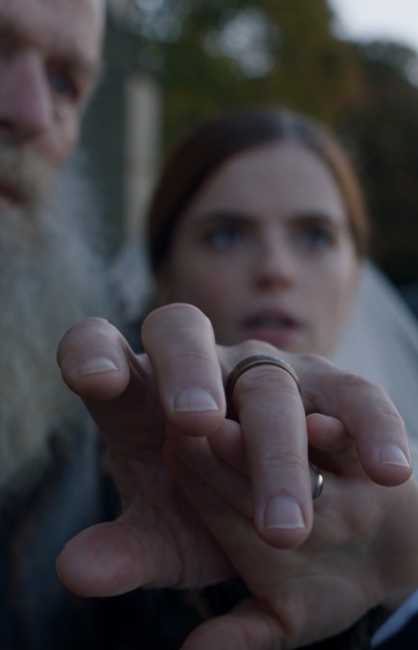
“What’s your name?”
“Walter Hayes. Walt.”
Richard stopped on the church steps.
Hannah saw it. Not surprise exactly. Something smaller and faster.
Then her grandfather came down smiling.
“Walter. Good Lord. It’s been years.”
The familiarity unsettled her more than a denial would have.
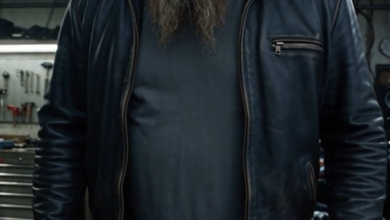
Walt’s shoulders sagged beneath his riding jacket. He had been tall once; he was still broad, but age had bent him forward. Faded tattoos disappeared beneath wool cuffs. His white beard moved against the collar when he swallowed.
Richard reached for Hannah’s elbow.
“This is old family business.”
“He says you know why he never came home.”
“Your grandmother had a life before me.”
Walt nodded, almost apologetically.
“She did.”
A bridesmaid appeared carrying Hannah’s shoes. Hannah had come outside in stocking feet, lifting her wedding dress above the damp path.
“Five minutes,” the bridesmaid whispered.
“Tell Ben I need longer.”
Richard’s fingers tightened once, then released.
Walt looked toward his motorcycle, parked beyond the gate. An old touring machine, clean but worn, with a folded road map tucked beneath a clear cover.
“You rode here?”
“Over four days.”
“From where?”
“Indiana.”
“How old are you?”
“Eighty-five.”
Richard exhaled. “You see? He’s exhausted. Let’s get him somewhere quiet.”
It sounded sensible.
That frightened Hannah.
At twenty-five, she had already asked Richard to fill the places death left empty. He would walk her down the aisle because her own father couldn’t. Until this morning, that choice had felt simple.
She had spent her childhood trusting Richard to supply the sensible explanation. When her father died, Richard handled the bills. When her mother couldn’t get out of bed, he bought groceries and made sure Hannah reached school.
This stranger had arrived with a ring and an accusation.
For an instant she wanted to surrender him to the explanation.
Then Walt took an envelope from inside his jacket.
“Your grandmother’s name was Clara. I’m not asking you to believe anything else yet.”
Hannah recognized the handwriting on the front.
Or thought she did.
Clara’s name slanted right, the final letter trailing below the others. Hannah had birthday cards signed that way.
Inside was a typed letter.
Walt didn’t offer it immediately.
“There are things in this that hurt. You don’t owe me your wedding day.”
Richard held out his hand.
“I can take care of that.”
Walt folded the envelope against his chest.
“No.”
The word was quiet. It changed Richard’s face.
Hannah asked to see the letter herself.
Its first lines described a lost pregnancy and asked Walt never to return. Near the bottom, Clara supposedly wrote that Richard had stayed when Walt could not.
Hannah’s mother was fifty-eight.
The date was almost fifty-nine years old.
She read it again, searching for some other pregnancy, some ordinary explanation.
Then she looked toward the bridal-room window, where her mother stood watching.
If the baby in the letter had died, who had Hannah’s mother been?
Walt remembered Clara in a yellow kitchen with one drawer that never closed properly.
It was 1967. They were engaged, and she had just told him about the baby. He had found a temporary maintenance job two states away, enough money to rent a better apartment before the birth.
She made him practice holding a rolled towel.
“Support the head, Walter.”
“It hasn’t got one.”
“Use your imagination.”
Their matching rings came from a neighborhood silversmith. Neither could afford wedding bands yet. Clara asked for a sunburst because Walt left for work before dawn.
One ray on each ring came out short.
“Don’t fix it,” she told the jeweler. “That’s ours.”
Richard, who worked in his father’s printing business, brought over engagement announcements.
His typewriter made a small e jump above the other letters.
Walt pointed it out.
Richard shrugged. “It’s got ambition.”
Later, Clara tied Walt’s lunch in a blue dish towel and said she would leave the kitchen light on until he came home.
He remembered the towel more clearly than the last kiss.
That was all the happy memory would give him.
At the church gate, Hannah watched him press the envelope flat with both hands.
Ben found a cushion for Walt’s chair and set it down without making a ceremony of it. Hannah noticed the old man’s relief, and the small effort he made to hide it.
She asked whether he had known her grandmother was pregnant.
“Yes.”
“Then you thought my mother—”
“Yes.”
His voice stopped there.
Hannah’s mother reached them before Hannah could finish.
Beth Morgan wore a pale green dress and the expression she got when someone mentioned a hospital bill.
“Dad? What’s happening?”
She meant Richard.
Walt looked away.
Hannah wished she hadn’t seen that.
She handed her mother the letter. Beth read the opening, then checked the date.
“No.”
Richard put a hand on her shoulder.
“Your mother lost a pregnancy before you.”
Beth shook her head.
“She told me I was her first.”
“People don’t tell children everything.”
“I’m fifty-eight.”
The organ stopped inside.
Without music, Hannah could hear traffic beyond the church grounds and somebody moving chairs in the entrance hall.
Walt took off his gloves. His knuckles were swollen, and a dark seam of road dirt marked one cuff.
Beth looked at the old ring.
“My mother kept hers in a little green box.”
“I gave her that.”
Hannah’s bridesmaid returned with Ben, who had loosened his tie and left his boutonniere crooked.
He didn’t ask whether the wedding was still happening.
“Do you want a room?” he asked Hannah.
“Yes.”
The church coordinator offered an unused meeting room beside the office. Walt said he would stay outside.
Hannah held the door open.
“You came five hundred miles. You can have a chair.”
Richard followed them in.
He was the only person who seemed irritated by that.
Inside, Beth asked Walt why he had never checked what happened.
He looked at the floor.
“I wrote. I called her parents. They said she’d gone. Then I got another letter saying she’d married Richard.”
“And you stopped?”
“Eventually.”
He didn’t make it sound noble.
Hannah noticed something on the old page beneath her mother’s fingers.
Every small e sat slightly higher than the letters beside it.
Where had she seen that same uneven line before?
Hannah remembered the uneven letters on recipe cards Richard had typed for her mother years earlier. The same machine, perhaps. A shared machine did not mean a shared lie.
Richard noticed her looking.
“Clara’s father had the office typewriter at home for years,” he said.
Walt lifted his head.
Richard pulled out a chair and sat carefully. He was eighty-six, only a year older than Walt, but his suit and polished shoes had protected him from looking fragile until that moment.
“Edgar didn’t approve of Walter. Nobody here needs to pretend otherwise.”
Beth stared at him.
“My grandfather?”
Richard nodded.
“He thought Clara would end up raising a child alone. Walter had debts. A motorcycle. Plans that changed every week.”
Walt rubbed one thumb over the other.
“I had debts.”
Hannah waited for him to add an excuse.
He didn’t.
Richard continued.
“Edgar could be cruel. He handled the mail. He told me Walter had left.”
For the first time, Richard sounded shaken.
Hannah wanted to believe him.
He had repaired her bicycle, sat through terrible school concerts, and learned how she liked her pancakes after her father died. She could not place that man neatly beside the one Walt’s letter suggested.
Beth turned the page over.
“Then maybe Grandpa Edgar wrote it.”
“Maybe,” Richard said.
Walt’s ring clicked softly against the table.
For several minutes, suspicion moved away from the living man toward a dead one who could not answer.
Then Hannah remembered the green box.
Beth had brought it to the church with Clara’s lace handkerchief and several old family papers. It was upstairs in the bridal room.
“I want the box.”
Richard looked toward the door.
“Not now.”
Hannah stood.
“Especially now.”
Ben went with her. On the stairs, she stopped and pressed both hands against the wall.
“I don’t know what I’m doing.”
“You’re checking.”
“What if I ruin everything?”
He looked down at her bare feet.
“We can be late.”
Upstairs, the box sat beside a curling iron and three half-empty bottles of water. Hannah had removed the ring that morning without disturbing the envelopes underneath.
Now she brought all of it downstairs.
Beth spread the contents on the table.
Photographs. A receipt from the silversmith. Clara’s old address book. A small bundle of letters tied with faded ribbon.
Richard sat very still.
Beneath the photograph lay another typed page, apparently from Walt to Clara. It said he would not raise her baby. Walt read it once, then pushed it away.
“I never wrote that.”
The receipt listed two silver rings and Clara’s name. The date matched Walt’s account.
One photograph showed Clara leaning against a motorcycle beside a young man whose shoulders Hannah recognized before she recognized his face.
Walt touched the corner without lifting it.
Beth whispered, “She told me that was a cousin.”
Richard reached for the photograph.
Beth moved it away.
There were other papers: wedding expenses from Clara’s marriage to Richard, an old bank notice, and a folded carbon copy of a letter addressed to Walt.
This one announced that Clara had married and did not want further contact.
Beneath the typed text was a short handwritten instruction.
Use the Ohio address. He still collects there.
Richard said Edgar had directed everything.
Then Beth found a business receipt dated the same day as the first letter.
It placed Edgar in a hospital in another state.
Could a man recovering there have prepared a letter mailed from Richard’s shop?
The receipt did not prove who wrote anything.
Hannah said that before Richard could.
She worked as a payroll clerk. Dates and names had taught her how easy it was to make an incomplete record look conclusive.
Edgar could have dictated a letter.
Somebody could have mailed it for him.
The typewriter could have moved.
She wanted answers that survived those possibilities.
Beth read the handwritten instruction again.
“Is this yours?”
Richard leaned forward.
“I handled correspondence for the business.”
“Is it yours?”
“Yes. But that doesn’t mean I wrote the letter.”
Walt closed his eyes.
Hannah put a glass of water near his hand.
“How did you find me?”
“A wedding announcement.”
He explained that a friend’s daughter had been researching local family history. She found a photograph of Clara in a newspaper archive under her married name. Walt asked for help finding out what had happened to her.
That led to Beth.
Then Hannah’s public wedding announcement.
He had learned about his daughter and granddaughter less than a month earlier.
“Why didn’t you call?”
“I did.”
Beth looked up.
“The number listed for the family business,” Walt said. “Richard answered.”
Nobody spoke.
Walt reached into his envelope for a newer sheet of paper. It was an email printed by the friend who had helped him.
Richard had written that Beth knew the old story, wanted no contact, and would consider his presence at the wedding harassment.
Beth read it.
“I never said that.”
Richard’s expression hardened.
“I was protecting you.”
“From what?”
“From this.”
He gestured at the table, the wedding dress, the room holding more than anyone wanted.
Hannah felt something settle inside her.
Beth turned the two old messages toward each other: one telling Clara that Walt rejected the baby, the other telling Walt there was no baby left to come home to.
The old letters could still require careful checking.
The new one did not.
Richard had spoken for her mother without asking her.
Walt had come anyway, but he had stopped outside the gate.
“I wasn’t going in,” he said. “I wanted to see her arrive. Then I thought I’d go.”
His riding companion, Luis Ortega, had followed in a pickup carrying tools and spare clothes. Walt had ridden short daylight stretches, stopping often, with rooms booked along the way.
The trip had cost him time, fuel, and most of what he could comfortably spare.
He hadn’t brought a claim on anyone.
He had brought a clean shirt folded in his saddlebag.
Beth covered her mouth.
Richard pushed back his chair.
“This is being made into something ugly.”
Hannah looked at him.
“You told her father she didn’t want him.”
“I raised her.”
Walt nodded once.
“You did.”
That answer seemed to anger Richard more than an argument.
Ben picked up the newer email.
“Who else received this?”
Richard stood.
The church coordinator appeared in the doorway and asked quietly whether Hannah had authorized a request to remove an unwanted guest.
Hannah looked from the coordinator to Richard.
Outside the meeting-room window, Luis was helping Walt’s motorcycle into a safer parking space.
Who had decided the old man was leaving before Hannah had finished asking him to stay?
Richard had spoken to the coordinator while Hannah was upstairs.
He had described Walt as an elderly stranger experiencing confusion. He said the family wanted him escorted away before the ceremony.
The coordinator looked mortified.
“I’m sorry. I should have checked with you.”
“You’re checking now,” Hannah said.
Richard reached for his phone.
“If this continues, the reception arrangements may need to change.”
Beth stared at him.
He had contributed money toward the reception. Some payments were complete; others had been promised. Hannah had always understood the help as a gift.
Now he was holding it like a handle.
Ben stepped into the hall with the coordinator to call the venue.
Hannah remained beside the table.
“We can eat sandwiches.”
Richard gave her a weary look.
“You don’t understand what you’re doing.”
“I understand that sentence.”
Walt rose slowly.
His right knee resisted. He caught the chair back, then steadied himself before anyone could reach him.
“I’ve stayed too long.”
Beth stood in front of the door.
Not dramatically. She simply put herself there.
“You haven’t.”
He looked at her as though the words were in a language he had forgotten.
Richard turned toward Beth.
“I was there every time you needed a father.”
“Yes,” she said.
“And this is what I get?”
Beth flinched.
Hannah had seen her mother apologize for smaller things all her life: being late, needing help, choosing something Richard hadn’t suggested.
This time she held the door.
Walt sat again.
Hannah moved the water closer. His hands trembled from fatigue, not uncertainty. She asked whether he needed a break, and he said yes. For two minutes, nobody asked him to remember anything.
The guests had begun asking questions. A bridesmaid told them there was a family delay and offered coffee. Some accepted. Others checked watches. One aunt complained about the caterer.
The world did not stop neatly for the truth.
Hannah was grateful for that.
She could hear someone laughing near the kitchen. A baby protested a diaper change. Life continued beyond the room where her family was coming apart.
Ben returned.
The venue could hold the food. They could reduce the final extras. A friend had offered to cover a payment if necessary, but Ben and Hannah would decide that later.
Nobody needed to accept Richard’s terms to have dinner.
Then Richard said something worse than the threat.
“Ask Walter how many times he came back for Clara.”
Walt stared at his hands.
Hannah waited.
“Not enough,” he said.
“Did you ever come?”
“Once. Her parents’ place. Nobody would tell me where she was.”
“And afterward?”
“I believed the letter.”
Richard spread his hands.
“There.”
But Walt continued.
“I should’ve done more. That’s mine.”
He looked at Beth.
“I won’t pretend somebody else made every choice for me.”
The room became quiet.
Richard had wanted a confession that would end the conversation. Instead, Walt had given one that made the conversation possible.
Beth sat beside him.
Hannah gathered the remaining letters, intending to put them safely away.
At the bottom of the box lay an envelope in Clara’s unmistakable later handwriting.
It was addressed to Beth.
The date was eleven years earlier.
Why had Clara written her daughter a letter and never given it to her?
Beth opened the envelope herself.
Hannah watched her read the first paragraph twice.
Then her mother lowered the page.
“She knew.”
Richard looked toward the window.
Walt did not move.
Clara had written the letter in 2015, three years before she died. It was not a complete account. There were crossed-out sentences, a place where the pen had stopped long enough to stain the paper, and an unfinished paragraph near the end.
But its meaning was plain.
She had discovered a draft among Richard’s old business papers.
A draft of the letter that told Walt the pregnancy had ended.
Clara had never written it.
She had also never lost that baby.
Beth pressed the paper flat against the table.
Hannah read over her shoulder, then asked permission to continue.
Clara described confronting Richard.
He said Edgar had wanted the separation. He said he had only helped. He reminded her of the life they had built and the years that could not be returned.
Then Clara admitted what she had done.
She found Walt’s address.
She traveled to Indiana with a friend.
She saw him outside a small house beside a younger woman and a little boy. She assumed he had another family.
She went home without speaking to him.
Walt lifted his head.
“My niece. Her son.”
Beth closed her eyes.
There were no words in the room for the size of that mistake.
Clara’s letter did not ask to be excused.
She had gathered the drafts and carbon copies into the green box, intending to show Beth exactly what had been done. The papers were there because she had begun telling the truth, then stopped.
It said she was ashamed of having accepted the easier explanation twice: once when she was young and frightened, and again when she was old and afraid of destroying her daughter’s understanding of home.
She had planned to tell Beth.
Then postponed it.
Then become ill.
The letter ended mid-sentence.
Hannah set it down.
She wanted to protect her grandmother from the page.
She could almost hear Clara telling her to bring a sweater, reminding her that rice doubled, asking whether she had enough money for gas.
Those memories were true.
So was this.
Walt took a long breath.
“She came all that way.”
Nobody answered.
He rubbed the short ray on his ring.
For a moment Hannah was angry with him for hearing longing before betrayal.
Then she realized he had room for both.
Beth turned to Richard.
“You knew she went?”
“No.”
“You knew she found the draft?”
He looked at the letter.
“Yes.”
“And you let her keep believing those people were his wife and child?”
“I didn’t know who they were.”
“You didn’t ask.”
Richard’s face tightened.
“I was her husband.”
Walt looked at him.
“I know.”
Two words. No challenge in them.
Richard seemed unable to bear that either.
A knock came at the door.
The church coordinator asked whether Hannah wanted the guests told the ceremony would be postponed.
Hannah looked at her mother, at the man who raised her, and at the stranger whose ring had brought her outside.
“No,” she said.
She still wanted to marry Ben.
But she would not let Richard take her arm and present the family story as if nothing had changed.
If he wanted everyone to hear his version, would he say it with the letters on the table?
Hannah asked the pastor to bring the immediate family into the fellowship room.
No cameras.
No announcement to the congregation.
About twenty people gathered among stacked chairs and trays of untouched cookies. They were the people Richard had asked to trust him for decades.
Hannah stood beside Ben.
Her mother sat near Walt.
Richard remained by the doorway, one hand on the back of a chair.
“I’m changing who walks with me,” Hannah said. “Before rumors start, I want you to know why.”
Richard interrupted.
“This is private.”
“Yes,” Beth said. “And you’ve already been telling people he’s confused.”
Nobody looked at Walt.
That small courtesy nearly undid Hannah.
She described only what they could show: the matching rings, the family photographs, the letters, Richard’s recent email, and his admission that Beth had never requested the refusal he sent in her name.
She did not announce that every old question was solved.
Her aunt asked about the typewriter.
Richard answered quickly.
“Edgar used it. Half the town used that machine.”
Walt lifted the first letter.
“It was yours when you brought the engagement announcements.”
Richard’s mouth tightened.
“It belonged to the business.”
“The raised e,” Walt said. “You said it had ambition.”
Someone gave a nervous little laugh, then stopped.
Hannah placed the carbon copy beside the first letter. She pointed to Richard’s handwritten instruction about the Ohio address.
He had already admitted writing that.
Richard looked around the room.
“Her father wanted him gone.”
“Did he ask you to tell Walter the baby died?” Beth asked.
Richard did not answer.
“Did my mother ask you?”
“No.”
The word came out sharply.
Then he seemed to realize how much it contained.
Beth gripped the edge of her chair.
Walt lowered the letter.
Richard began speaking faster.
“Clara was alone. She was pregnant. He was chasing work and riding around with people who couldn’t keep a job. I stayed.”
“You stayed,” Beth said.
“I gave you a father.”
“You told mine I was dead.”
Richard looked toward Hannah.
She waited.
He pointed at the paper in Walt’s hand.
“If I hadn’t written it, Edgar would have found another way.”
Nobody moved.
The room held the sentence long after he stopped saying it.
There was no cheer, no sudden rush toward Walt. One cousin sat down. Another looked at Richard as if trying to place an unfamiliar man inside a familiar suit.
Hannah felt no victory.
She felt tired.
Richard started toward Beth.
She lifted one hand.
“Not now.”
He stopped.
Walt was crying quietly. He hadn’t covered his face. Tears had caught in his beard, and he seemed unaware of them.
Beth took a tissue from the box on the table.
Then another.
She offered one to him.
Hannah turned to Ben.
“I still want today.”
“Me too.”
She asked her mother to walk with her.
Then she looked at Walt.
“Would you come on the other side?”
He glanced toward Richard, then down at his old boots.
“I don’t want to take anything.”
Hannah held out her hand.
“You’re being invited.”
As he reached for it, she wondered whether one walk could begin a relationship without pretending to repay a lifetime.
They walked slowly.
Beth held Hannah’s left arm. Walt held her right, careful not to step on the dress. Halfway down the aisle, his knee stiffened.
Hannah shortened her stride.
Nobody needed to know why.
At the front, she kissed her mother, then turned to Walt. He smelled faintly of leather, cold air, and the peppermint he had accepted from the church coordinator.
“Thank you for coming,” she whispered.
He nodded because his mouth would not cooperate.
The ceremony happened.
Ben misplaced one line. Hannah laughed before she cried. Someone’s phone rang in a coat pocket despite three reminders.
It was still their wedding.
Richard left before the reception.
Beth did not chase him.
The following weeks brought harder conversations than the one in the fellowship room. Old records were requested. Family photographs were relabeled. Beth and Walt agreed to verify their relationship privately rather than leave Hannah carrying the proof.
The result confirmed what the dates and letters had already led them to believe.
Beth was his daughter.
Neither of them knew what to do with that on the first phone call afterward.
Walt asked whether she had eaten.
She laughed.
Then cried.
Then answered.
Richard sent explanations before he sent an apology. Beth returned the explanations unopened after the first two. She told him any future conversation would have to begin with what he had done, without Edgar’s name attached to it.
He had raised her.
That remained part of her life.
She was not ready to decide what contact could mean, and nobody was permitted to decide for her.
Hannah stopped calling him every Sunday.
She began calling Walt on Wednesdays.
The calls were awkward at first. He didn’t know what questions were too personal. She didn’t know whether asking about his childhood would sound like an assignment.
Eventually, they discussed a leaking faucet for twenty minutes.
She loved that conversation.
Walt returned to Indiana with Luis driving the pickup and the motorcycle secured behind them. He had made the journey he came to make. He did not need to prove anything on the return.
In spring, Hannah and Ben visited his house.
Beth came too.
They brought copies of photographs and a framed wedding picture. Walt had cleared a place on the mantel, then worried aloud that the room was too dusty.
Beth picked up a cloth.
“Where do you keep the polish?”
He showed her.
Hannah stood in the doorway watching her mother dust her father’s mantel for the first time at fifty-eight.
Later, Walt brought out the green ring box.
Beth had given it to him after choosing the papers she wanted to keep. Inside lay the silversmith’s receipt and a photograph of Clara laughing beside the old motorcycle.
Hannah slipped off her ring.
For a moment, the two crooked sunbursts lay together in Walt’s palm.
“Do you want hers back?” she asked.
He shook his head.
“She gave it to you.”
He closed Hannah’s fingers around it.
That evening, as they prepared to leave, Walt followed them to the porch. He watched Beth reach the car, then called her name.
She turned.
“I’ll leave the kitchen light on.”
Beth put her hand on the open car door.
Hannah looked back at the little kitchen window, where a light had begun to glow.
How soon could they come home again?
Follow this page for more stories about families finding their way back, the people we misunderstand, and the small acts that make room for another beginning.