The Mother Was Shamed for Not Contributing to the Class Fund — At the End of the Year, the Teacher Revealed the Truth
By the next morning, Sarah’s empty envelope had become a story.
Nobody said anything directly to her daughter, Lily, but nine-year-old children were skilled at noticing the silences adults believed they concealed.
Two mothers discussed the spring celebration beside the school entrance.
One lowered her voice when Sarah approached.
The other glanced at Sarah’s grocery-store uniform and smiled too brightly.
Lauren updated the class-fund spreadsheet every Friday. Her emails remained cheerful, but one sentence began appearing in bold letters.
A few families have not yet contributed. Please remember that fairness matters.
Sarah read every message.
She never replied.
At pickup, she stood slightly apart from the other parents, usually holding a paper grocery bag against her hip. She left quickly because her evening shift began before dinner.
Mrs. Carter watched her with growing concern.
She also began noticing strange things.
When Marcus Bell could not attend the science museum field trip because his mother had lost her job, an envelope appeared inside Mrs. Carter’s desk drawer.
It contained thirty dollars and a handwritten note.
Please tell him the school covered it.
There was no signature.
A week later, a new pair of black concert shoes appeared in the nurse’s office for Elena Ramirez, whose old shoes had split along one side.
The nurse assumed they came from a donation closet.
Mrs. Carter knew the closet had been empty since January.
Then came the coldest morning of the year.
A boy named Tyler arrived without gloves. His father had dropped him off early and driven away before anyone noticed.
Sarah was leaving the grocery store after a night inventory shift when she saw him standing near the school doors, rubbing his hands together.
She removed her own gloves and gave them to him.
“They are too big,” Tyler said.
Sarah smiled.
“That means they will still fit next winter.”
She waited until the school secretary unlocked the door.
Then she walked back toward the bus stop with both hands tucked inside her coat pockets.
Mrs. Carter saw everything from her car.
That afternoon, she asked Sarah to stay for a moment after pickup.
“Are the envelopes from you?” the teacher asked.
Sarah looked tired.
The skin beneath her eyes had darkened since the beginning of the year.
“I do not know what you mean.”
Mrs. Carter opened her desk drawer and placed the museum note between them.
Sarah recognized her own handwriting.
She exhaled slowly.
“Please do not mention it,” she said.
“You have been helping other children?”
“Only when I can.”
Mrs. Carter looked at Sarah’s worn cardigan.
“But you could not contribute to the class fund.”
Sarah smiled without bitterness.
“I had to choose.”
The answer stayed with Mrs. Carter long after Sarah left.
She expected the mystery to end there.
It did not.
During the winter concert, Lily wore a red dress that had clearly been altered by hand. The hem was slightly uneven, but the careful stitching held.
Three other girls wore dresses with the same kind of repaired seams.
One boy’s shirt had a button that did not quite match the others.
After the concert, Mrs. Carter found Sarah in the cafeteria gathering loose programs from beneath the chairs.
“You repaired the costumes,” she said.
Sarah shrugged.
“Some parents were busy.”
Mrs. Carter looked toward the stage, where children posed for photographs beneath paper snowflakes.
“How many?”
Sarah folded one program carefully.
“Enough.”
She picked up her tote bag and left before Mrs. Carter could ask anything else.
PART 3 — REDEMPTION
By spring, the class fund had paid for bright matching shirts, a catered teacher-appreciation lunch, decorative banners, and a photo booth for the end-of-year picnic.
Lauren sent frequent updates.
She thanked the “generous families who made the magic possible.”
Sarah’s name never appeared.
Lily noticed.
One afternoon, she came home with the class shirt folded inside her backpack.
“I do not want to wear it,” she said.
Sarah stood at the kitchen counter, slicing bruised apples into a bowl. The grocery store allowed employees to take home produce that could no longer be displayed.
“Why not?”
Lily traced the printed school logo with one finger.
“Madison said her mom paid for mine.”
Sarah set down the knife.
“Your shirt belongs to you.”
“She said we get things because other people pay.”
The apartment became quiet.
Sarah wiped her hands on a dish towel and sat beside her daughter.
There were bills stacked beneath a refrigerator magnet shaped like a strawberry. The heating bill was overdue. A laundromat receipt rested beside a pharmacy coupon.
Sarah did not tell Lily that she had already worked three double shifts that month.
She did not tell her that the white envelopes came from tips, returned bottles, and the small amount she earned mending clothes after midnight.
She did not tell her that some weeks she ate dinner during her break so Lily would not notice how little remained in the kitchen.
Instead, Sarah straightened the folded shirt.
“Sometimes people talk before they understand,” she said. “You do not have to carry their words for them.”
The following week, Mrs. Carter asked Sarah to meet after school.
The teacher had found another envelope beneath the attendance folder.
This one was labeled for Grace Holloway, a quiet student whose mother had recently entered a treatment program.
Inside was enough money for the year-end picnic and a small grocery-store gift card.
Mrs. Carter placed it on the desk.
“You cannot keep doing this alone.”
Sarah looked toward the classroom door.
“Grace has been taking crackers home from lunch.”
“I know.”
“She thinks nobody notices.”
Mrs. Carter felt her throat tighten.
“Where did the gift card come from?”
Sarah hesitated.
“My employee discount helps.”
“That is not what I asked.”
Sarah rested both hands on the back of a chair.
For the first time, she seemed close to tears.
“When Lily was in first grade, I was between apartments,” she said. “We stayed in a motel for six weeks.”
Mrs. Carter said nothing.
“Somebody left a grocery card in Lily’s backpack. No name. No note. Just enough for cereal, milk, and a birthday cake mix.”
Sarah looked down.
“I still do not know who did it.”
The teacher understood then.
Sarah was not trying to repay a person.
She was keeping a small kindness alive long enough for it to reach another child.
At the end of May, the fourth-grade families gathered in the school cafeteria for the final celebration.
Paper lanterns hung from the ceiling. Children ran between tables in their matching shirts while parents arranged trays of food beneath a banner that read WHAT A YEAR TO REMEMBER.
Sarah arrived late from work.
She had changed out of her uniform, but the faint grocery-store name-tag outline remained visible against her navy blouse.
Lily ran toward her and wrapped both arms around her waist.
Lauren stood near the microphone with a clipboard.
Before the awards began, she tapped the microphone twice.
“We want to recognize the families who made this year possible,” Lauren said. “This class raised more than any other fourth-grade class in the school.”
Several parents applauded.
Lauren began reading names.
Each family received a small printed certificate.
Sarah stepped toward the back wall, as though trying to make room for everyone else.
Mrs. Carter watched her.
Then the teacher approached the microphone.
“I would like to recognize one more parent,” she said.
Sarah immediately shook her head.
Mrs. Carter saw the warning in her eyes.
She also saw Lily standing beside her mother, still holding the class shirt against her chest.
The teacher chose her words carefully.
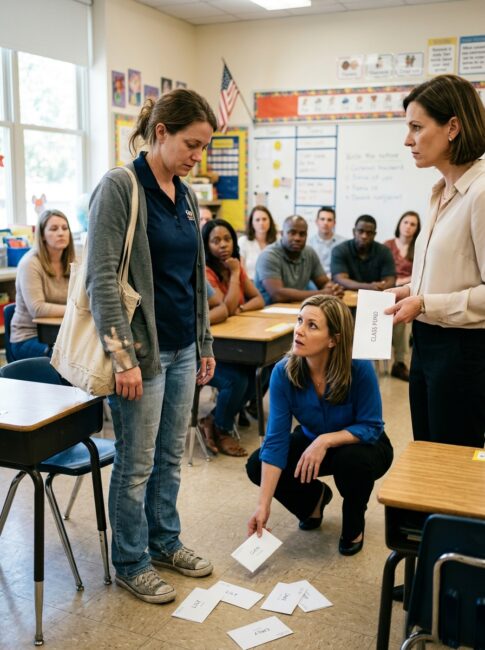
“This parent did not contribute to the fund,” Mrs. Carter said.
The room shifted.
Lauren lowered her clipboard.
A few parents looked toward Sarah.
Mrs. Carter continued.
“She could not.”
Sarah closed her eyes.
“But throughout this year, several children attended field trips because someone quietly paid the difference. Children received concert clothes that had been repaired late at night. A child arrived at school without gloves and left wearing a warm pair.”
The cafeteria became silent.
Mrs. Carter’s voice softened.
“Grocery cards appeared when families needed food. Lunch bags appeared when children tried to hide that they were hungry. Nobody was told where those things came from.”
Lauren looked down at the certificates in her hand.
Mrs. Carter glanced toward Sarah.
“The parent who could not give one hundred and fifty dollars to our class fund gave whatever she had directly to children who needed it most.”
A mother near the dessert table pressed one hand against her mouth.
Mrs. Carter did not list every detail.
She did not mention the motel.
She did not mention the overdue bills.
Some parts of a person’s life did not belong to a room simply because the room had finally become curious.
She said only one more thing.
“Sarah asked for no recognition. She asked that the children never feel embarrassed.”
Lauren’s expression changed.
She set the clipboard on the table and walked slowly toward Sarah.
“I am sorry,” she said.
Sarah looked uncomfortable with the attention.
“You did not know.”
Lauren swallowed.
“I did not ask.”
Sarah did not answer.
Lily reached for her mother’s hand.
Across the room, parents who had once avoided Sarah’s eyes now looked down at the floor, at their paper plates, or at the envelopes they had praised themselves for filling months earlier.
Mrs. Carter stepped away from the microphone.
There was no applause at first.
The silence felt more honest.
Then Tyler, still wearing Sarah’s oversized gloves despite the warm weather, walked across the cafeteria and hugged her around the waist.
PART 4 — ENDING
The celebration continued more quietly after that.
Children returned to the cookie table. Someone restarted the music. The paper lanterns moved gently whenever the cafeteria doors opened.
Sarah stayed near the back wall.
She accepted a cup of lemonade from Grace’s mother and listened when the woman whispered thank you without explaining for what.
Lauren approached again later.
This time, she carried no clipboard.
“I thought fairness meant everyone putting in the same amount,” she said.
Sarah looked toward the children.
Lily and Grace were sharing a plate of strawberries near the window.
“I understand why,” Sarah replied.
Lauren waited, perhaps expecting more.
Sarah simply took a sip of lemonade.
The next school year, the class-fund form changed.
The suggested contribution remained, but the bold reminders disappeared.
Beneath the amount was a new sentence.
Families may contribute money, supplies, time, or nothing at all. Participation is always private.
A second envelope appeared beside the first.
Quiet Help Fund — For students who need a little extra support. No names required.
Mrs. Carter kept the envelope inside her desk drawer.
Sometimes it held twenty dollars.
Sometimes it held a grocery card, a bus pass, or a handwritten offer to mend a jacket.
Once, it contained nothing except a note.
I cannot help this month, but please keep the envelope here. I may be able to next month.
Sarah never asked who wrote it.
During the summer, she continued working at the grocery store.
She also kept a small sewing basket beneath her kitchen table. Buttons, thread, and fabric scraps filled an old cookie tin that had belonged to her mother.
One evening, Lily found Sarah repairing a backpack with a broken zipper.
It was not Lily’s backpack.
“Who is that for?” she asked.
Sarah guided the needle through the thick fabric.
“A child who needs it.”
“Do they know you fixed it?”
Sarah smiled.
“They will know it works.”
Lily sat beside her and picked up a loose button from the table.
For several minutes, neither of them spoke.
Outside the apartment window, the streetlights flickered on one by one. A bus stopped at the corner and continued down the road with a tired mechanical sigh.
At the beginning of fifth grade, Lily brought home a new class-fund envelope.
Sarah opened it at the kitchen table.
She counted the money inside her wallet, paused, and placed five dollars into the envelope.
Then she added a folded note.
I can also repair winter coats. Please ask privately.
Lily watched her seal the flap.
“Is five dollars enough?” she asked.
Sarah handed her the envelope.
“It is what we have today.”
The next morning, Lily carried it to school in the front pocket of her backpack.
She walked carefully, as though the small envelope contained something far heavier than five dollars.
At the classroom door, Mrs. Carter accepted it without opening the flap.
She recognized Sarah’s handwriting.
The teacher placed it quietly inside the desk drawer beside the other envelopes, where nobody’s name appeared on a public list and nobody’s kindness needed an audience.
Follow our page for more heartfelt stories about the quiet sacrifices people make when nobody is watching.