Part 2: The Grandmother Who Refused Her Granddaughter’s Birthday Gift — The Secret Behind It Left the Family Speechless
At first, everyone thought Eleanor Miller had become cruel with age.
That was the easiest answer.
She had always been difficult in small ways. She folded napkins twice before dinner. She corrected the way people held knives. She could turn a warm conversation cold by noticing a stain on someone’s sleeve.
But this was different.
This was Lily.
The granddaughter who called every Wednesday after school. The girl who still kissed Eleanor’s cheek, even when cousins teased her for acting like a little kid. The one who sat with Eleanor during storms because she knew thunder made the old woman nervous.
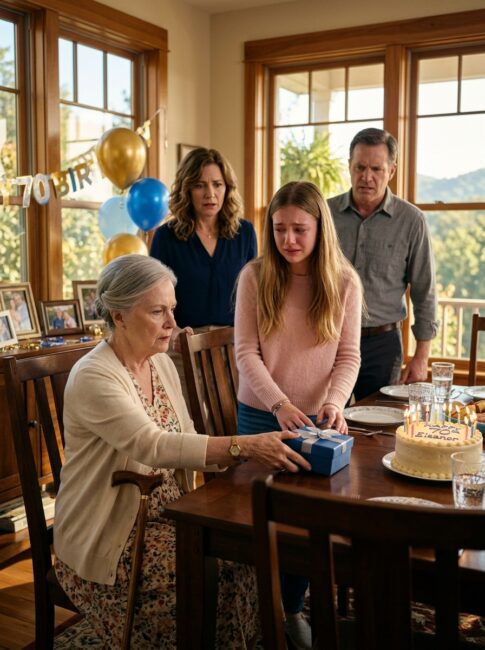
Lily stood by the birthday table with the blue box pressed against her chest.
Her lips trembled.
Rachel stepped in front of her daughter. “Mom, apologize.”
Eleanor tightened both hands around her cane. Her knuckles looked pale under thin skin.
“I will not,” she said.
Mark shook his head. “It’s a gift from a child.”
“She is not a child,” Eleanor said.
The words landed strangely.
Lily looked up.
There was no anger in Eleanor’s voice now. Only something dry and frightened.
“Grandma?” Lily whispered.
Eleanor did not answer.
She turned toward the hallway, moving slowly, one careful step at a time. Everyone watched her leave the room, shoulders stiff, gray hair pinned neatly at the back of her head.
The party stayed frozen behind her.
Then Lily did something no one expected.
She followed.
Rachel reached for her. “Honey, don’t.”
But Lily slipped past her mother and walked down the hallway, still carrying the rejected gift.
The door to Eleanor’s bedroom was almost closed.
Inside, the old woman stood beside her dresser, breathing hard. Her hand was pressed flat against the wood, near a small framed photograph of Lily at age six, missing both front teeth and wearing a crooked paper crown.
Lily stopped in the doorway.
“I’m sorry,” she said.
Eleanor turned too quickly.
“You should not be the one apologizing.”
That was the first thing that did not fit.
Lily hugged the box tighter. “Then why did you say that?”
Eleanor’s eyes moved to the ribbon.
For a moment, she looked almost sick.
“Where did you buy it?” she asked.
“The antique store near the bus station.”
Eleanor closed her eyes.
The air shifted.
Lily frowned. “Grandma?”
Eleanor reached for the dresser drawer, opened it, then stopped. Her fingers hovered over something inside.
She shut it again.
“Go back to the party,” she said.
“No.”
The firmness in Lily’s voice surprised both of them.
From the hallway, Rachel, Mark, and two cousins had gathered silently. Nobody came in. Nobody wanted to admit they were listening.
Lily stepped closer and placed the blue box on the dresser.
“I worked all summer for it,” she said. “Mrs. Alvarez at the antique store said it was old, but special. She said it looked like something someone loved.”
Eleanor’s face changed.
Not at the word old.
At the word loved.
She opened the box with trembling fingers.
Inside lay a delicate silver locket on a thin chain. It was oval-shaped, slightly tarnished around the edges, with a tiny engraved vine curling across the front.
Lily had polished it badly. Little dark lines remained in the grooves, but the metal still caught the afternoon light.
The hallway went quiet.
Eleanor did not touch the necklace.
She stared at it.
Then her hand rose to her throat, where no jewelry had rested for more than forty years.
Rachel whispered from the doorway, “Mom?”
Eleanor flinched.
She snapped the box shut.
“Take it away.”
Mark stepped into the room. “Enough. She deserves an explanation.”
Eleanor looked at her son with a pain so sudden he stopped moving.
“You always wanted explanations after the damage was done,” she said.
Mark’s mouth opened, then closed.
That was the second thing that did not fit.
Eleanor turned back to Lily.
“You bought this with your own money?”
Lily nodded.
“Every dollar?”
“Yes.”
Eleanor sat slowly on the edge of the bed.
Her knees seemed to give up before her pride did.
The cane slipped from her hand and hit the carpet with a soft thud.
A small sound came from the doorway.
Rachel had seen something on the dresser.
The closed blue box sat beside Eleanor’s old Bible, and beneath the Bible was the corner of a faded newspaper clipping.
Rachel reached for it.
Eleanor’s voice cut through the room.
“Don’t.”
But Rachel had already lifted it.
The clipping was yellowed and fragile, folded so many times the paper had begun to split. The headline was from 1981.
LOCAL WOMAN’S JEWELRY STOLEN AFTER BUS STATION FIRE
Lily stared at the words.
Then she looked at the locket.
Eleanor lowered her face into both hands.
And suddenly, the gift did not look like a gift anymore.
It looked like something that had found its way home.
The story came out in pieces.
Not because Eleanor wanted to tell it.
Because Lily sat beside her on the bed and waited without reaching for the locket again.
That patience broke what anger had never touched.
Eleanor was twenty-eight when she owned the necklace.
Her husband, Thomas, had bought it for her one week after Lily’s mother was born. He was not rich. He fixed washing machines, repaired heaters, and came home with oil under his nails no matter how hard he scrubbed.
But he had saved for six months.
Inside the locket, he placed a tiny photo of himself holding their baby daughter, Rachel, wrapped in a yellow blanket.
On the back, he had engraved one sentence.
For every hard day we survived.
Eleanor wore it through everything.
She wore it when the rent was late. She wore it when Thomas came home limping after a job injury. She wore it when doctors said Rachel’s lungs were weak and nights became a long chain of prayers beside a hospital crib.
Then came the fire.
It started near the bus station on a cold October evening.
Eleanor had taken Rachel, then three years old, to meet Thomas after work. A faulty heater in the waiting room sparked near a stack of old flyers. Smoke filled the building before anyone understood what was happening.
People pushed for the doors.
Someone knocked Eleanor down.
Rachel slipped from her arms.
That was the part Eleanor never told at Sunday dinners.
For forty-three years, the family had believed the fire was just an accident from the past, a story Grandma mentioned only when warning children not to stand too close to heaters.
They never knew Rachel had disappeared in the smoke for almost three minutes.
Eleanor found her under a row of metal seats, coughing, crying, alive.
The locket was gone.
So was Eleanor’s coat.
In the chaos, someone had stolen both.
“The newspaper made it sound like I cared about the jewelry,” Eleanor said. “I cared because your father’s picture was inside it. I cared because your grandfather’s promise was inside it.”
Rachel sat down slowly on the chair beside the dresser.
Her eyes had gone wet.
“You never told me.”
Eleanor looked at her daughter. “You were little. Then you were alive. After that, telling the story felt greedy.”
Mark leaned against the doorframe, ashamed of his own impatience.
For years, he had mocked Eleanor’s fear of crowds. He had rolled his eyes when she checked exits in restaurants. He had called her dramatic when she refused to attend indoor concerts.
He had not known that every crowded room still carried the sound of people pushing past her child.
Lily picked up the newspaper clipping with careful fingers.
“Mrs. Alvarez sold it to me for sixty dollars,” she said. “She said it came from an estate box.”
Eleanor nodded, but her eyes remained on the blue box.
“It may not be mine,” she whispered.
Lily opened the locket.
The hinge resisted at first, then gave with a soft click.
Inside was not a photograph.
There was only a dark, empty oval where a picture had once been. The other side held a thin scrap of paper so faded it looked nearly blank.
Mark took out his phone for light.
Rachel leaned closer.
The handwriting was small, slanted, and familiar only to one person in the room.
Eleanor’s hand flew to her mouth.
The sentence was still there.
For every hard day we survived.
No one moved.
Lily started crying first.
“I thought I was giving you something pretty,” she said.
Eleanor reached for her then, but stopped halfway, as if she did not believe she still had the right.
Lily closed the space and folded herself into her grandmother’s arms.
The blue box slid onto the bedspread between them.
Eleanor held her granddaughter with one hand and covered the locket with the other.
“I refused it because I thought you had bought someone else’s pain,” she whispered. “Then I saw it was mine, and I was afraid of wanting it back too much.”
That was the third twist no one expected.
Her rejection had not come from contempt.
It had come from fear.
Fear that Lily had spent months of labor on a stolen memory. Fear that accepting it would make the girl feel responsible for a wound older than her mother. Fear that one small necklace might bring back a version of Eleanor she had spent forty years burying.
Rachel stood and walked to the bed.
For years, she had mistaken her mother’s strictness for coldness. She had taken every correction personally, every warning as criticism.
Now she remembered something.
Eleanor never let Lily leave the house without checking the latch on her backpack.
She always made children hold hands in parking lots.
She never sat with her back to a doorway.
Rachel had called those habits control.
They were survival, dressed as routine.
“I used to think you didn’t trust us,” Rachel said.
Eleanor shook her head. “I trusted you. I never trusted the world to be gentle.”
Mark wiped his face with the heel of his hand.
He had brought an expensive bracelet for Eleanor’s birthday, still wrapped in silver paper downstairs. He had chosen it in ten minutes from a department store case.
Lily had worked all summer and accidentally brought home the only gift that could return a missing chapter of their family.
Eleanor opened the locket again.
Her thumb moved over the faded words.
“Your grandfather stood in that smoke for an hour after they carried us out,” she said. “He searched under benches, in trash cans, between burned seats. He came home with black hands and no necklace.”
Rachel whispered, “Dad never told me that either.”
“He said losing it meant we were alive to miss it.”
The room fell apart quietly.
Not with shouting.
Not with dramatic apologies.
Just with breathing that no one could keep steady.
Then Lily pulled something from her pocket.
It was a small folded receipt from the antique store.
“I kept this because I was proud,” she said. “But maybe we can ask where it came from.”
Eleanor looked at the receipt.
For the first time that day, she smiled.
It was small and broken, but real.
The family drove to Mrs. Alvarez’s antique store before the sun went down.
Eleanor did not want to go at first. She said she was tired. She said the past had already taken enough of the day.
But Lily held the cane out to her.
“Then let’s take one piece back,” she said.
Mrs. Alvarez remembered the locket immediately.
She was a seventy-year-old Puerto Rican American woman with warm brown eyes, silver curls, and a habit of calling every customer honey. When she saw Eleanor holding the necklace, her expression softened.
“I wondered who it belonged to,” she said.
The estate box had come from a storage unit bought after an old boardinghouse closed near the bus depot. Inside were postcards, broken watches, keys without locks, and the locket wrapped in a stained handkerchief.
No name.
No photo.
Only the words inside.
Eleanor listened without speaking.
Then Mrs. Alvarez opened a drawer beneath the counter.
“There was one more thing in that box,” she said. “I didn’t put it out for sale because it looked personal.”
She placed a tiny, smoke-stained photograph on the glass counter.
The edges were curled.
The image was faded.
But there was Thomas Miller, young and smiling, holding baby Rachel in a yellow blanket.
Eleanor touched the counter as if the floor had moved beneath her.
Rachel covered her mouth.
Mark turned away.
Lily looked from the photo to her grandmother, understanding at fifteen what some adults spend a lifetime avoiding.
The gift had not been rejected because it was worthless.
It had been rejected because it was too valuable to touch in front of people who did not know what it had cost.
Eleanor finally lifted the photograph.
Her hands shook, but this time she did not hide them.
The birthday cake was still on the dining room table when they returned home.
The candles had melted into crooked little towers. The balloons had drifted lower. Someone had turned off the music, but nobody had cleaned the plates.
It looked less like a ruined party now and more like a room waiting for the right ending.
Eleanor sat in her chair again.
This time, Lily stood beside her without the blue box.
The locket was already around Eleanor’s neck.
Rachel had fastened the clasp because Eleanor’s fingers could not manage it. Mark had found an old magnifying glass so they could see the inscription again. The younger cousins, who had been laughing earlier, now stood quietly near the hallway.
Nobody knew exactly what to say.
So Eleanor saved them.
“I owe this young lady a birthday wish,” she said.
Lily laughed through tears. “It’s your birthday, Grandma.”
Eleanor touched the locket at her throat.
“Not anymore.”
Rachel brought the cake closer.
Eleanor looked at the seventy candles, then at Lily.
“I do not need all that fire,” she said, and everyone laughed gently because now they understood the tremor beneath the joke.
They lit only one candle.
The small flame flickered in the center of the cake, bright but harmless. Eleanor watched it for a long moment, not afraid exactly, but respectful of what even small flames can carry.
Then she closed her eyes.
No one asked what she wished for.
When she blew out the candle, Lily held the locket steady against Eleanor’s chest so it would not swing forward.
After cake, Rachel found an old photo album from the closet. For the first time in years, Eleanor let them sit around her and ask questions about Thomas.
She told them how he sang badly while fixing sinks. How he cried when Rachel first said Daddy. How he once walked four miles in the rain because the family car would not start and Eleanor had asked for peaches.
The stories did not make him return.
But they made the room feel less empty around his absence.
Later, when guests began leaving, Mark paused beside his mother’s chair.
“I thought you were being cruel,” he said.
Eleanor looked at him.
“I know.”
He swallowed. “I’m sorry I learned so late.”
She patted his hand once.
“Late is still a kind of arrival.”
That was all she said.
Near sunset, Lily helped Eleanor onto the porch. The neighborhood was quiet. The sky had turned soft orange behind the trees, and the little silver locket rested against Eleanor’s cardigan, catching light whenever she breathed.
Lily sat beside her on the wooden step.
“I almost hated you for a minute,” she admitted.
Eleanor smiled without looking away from the yard.
“That means you are honest.”
“I’m glad I followed you.”
Eleanor took her granddaughter’s hand.
“I am too.”
For a while, they said nothing.
Inside the house, the family cleared dishes, folded napkins, and moved more gently around one another than they had that morning.
On the porch, Eleanor opened the locket and looked at the tiny photograph finally returned to its place.
Then she closed it carefully and pressed it into Lily’s palm.
“Someday,” she said, “when a gift feels heavy, open it slowly.”
Lily nodded, and the old woman leaned back in her chair while the evening settled around them like a blanket.
Follow the page for more heartfelt stories about family secrets, quiet sacrifices, and the moments that change how we see the people we love.