Part 2: A Student Was Shunned Because His Brother Was in Prison — His Graduation Speech Left the Entire Auditorium in Tears
For four years, Evan Miller had walked through Brookhaven High like someone trying not to leave fingerprints.
He kept his head down. He ate lunch in the far corner of the courtyard, where the old brick wall blocked the wind. He never joined clubs, never went to games, and never raised his hand unless a teacher called on him twice.
People thought that meant he was ashamed.
They were only partly right.
The story everyone knew was simple enough to repeat.
Caleb Miller, nineteen years old, had beaten a local man outside a gas station and put him in the hospital. The man was Daniel Keene, father of one of Brookhaven’s most popular students. The arrest had made the county paper. Caleb’s mugshot was passed around on phones before the first bell.
By Monday, Evan was no longer Evan.
He was Caleb’s brother.
When lockers slammed near him, he flinched. When teachers paused too long while reading his last name, he stared at his desk. When boys in football jackets joked about hiding their wallets, he pretended not to hear.
His mother, Ruth, tried to make him change schools.
Evan refused.
“Caleb graduated from Brookhaven,” he said.
Ruth looked at him across the kitchen table. “That is exactly why I’m asking.”
But Evan stayed.
Not because he was brave. He did not feel brave. Most mornings, he felt like a bruise wearing clothes.
He stayed because every Friday after school, he took the city bus two towns over to visit Caleb at North Ridge Correctional Facility. Caleb always sat on the other side of the glass with his hands folded neatly in front of him, like he was trying to look smaller than the orange uniform allowed.
“How’s school?” Caleb would ask.
“Fine.”
“Liar.”
Evan would shrug.
Caleb would smile, but his eyes always searched Evan’s face for new damage.
On the first visit after sentencing, Caleb had leaned close to the phone and said, “Don’t you dare let what I did become your whole life.”
Evan had nodded.
Then he went back to school Monday and found the word “felon” written on his biology notebook.
He never told Caleb.
That became the first rule between them.
Evan did not tell Caleb about the jokes. Caleb did not tell Evan how often he woke up shaking. Their mother pretended not to notice that both of her sons had become experts at protecting each other with silence.
Still, small cracks appeared.
During sophomore year, Evan began carrying a worn navy-blue notebook that had once belonged to Caleb. It had math formulas on the first pages, song lyrics in the middle, and a folded newspaper clipping tucked inside the back cover.
Whenever someone got too close to the notebook, Evan snapped it shut.
That only made people talk more.
In junior year, a teacher asked students to write an essay about someone who inspired them. Evan wrote about his brother.
The paper came back with a red circle around the title.
Choose a more appropriate role model.
Evan folded the essay into quarters and put it inside Caleb’s notebook.
That afternoon, he skipped detention for the first time in his life and went to the prison instead.
Caleb noticed his face immediately.
“Who was it?”
“No one.”
“Evan.”
“It’s not important.”
Caleb looked down at his hands. His knuckles were scarred, but not from the night people talked about. They were older scars, from warehouse work, car repairs, and once, from punching through a kitchen window when he was sixteen because their father had locked Ruth outside in December.
Nobody at Brookhaven remembered that part.
They remembered Caleb’s mugshot.
That was easier.
The first person to make Evan wonder if the town’s story had missing pieces was Mrs. Alvarez, the school librarian. She was small, silver-haired, and known for returning gossip with a blank stare.
One rainy afternoon, Evan found her standing beside him in the history aisle.
“You know,” she said quietly, “your brother used to come in here before school.”
Evan did not answer.
“He read repair manuals. HVAC. Electrical. Plumbing. Said he was going to buy your mother a house with a roof that didn’t leak.”
Evan’s throat tightened.
Mrs. Alvarez placed a book on the shelf.
“He also used to bring you here when you were little. You had a backpack shaped like a dinosaur.”
“I don’t remember.”
“He did.”
Then she lowered her voice.
“Not everyone forgets who people were before their worst day.”
After that, Evan started spending free periods in the library.
Not to read.
To breathe.
By senior year, the principal announced that Evan had earned salutatorian. There were polite claps in the assembly, but also surprised faces, as though good grades were suspicious on him.
Principal Warner shook the valedictorian’s hand.
When Evan came forward, Warner gave him a tight smile and said softly, “Keep the speech positive, son. This is not the night for family issues.”
Evan looked at him.
“Family issues?”
Warner’s smile did not move.
“You know what I mean.”
Evan did not, not fully.
Not until two weeks before graduation, when Mrs. Alvarez called him into the library after school and placed a sealed envelope on the desk.
“I should have given this to someone years ago,” she said.
Inside was a copy of an old incident report.
Not the police report.
A school report.
Caleb’s name was on the first line.
Daniel Keene’s was on the second.
And Principal Warner’s signature was at the bottom.
Evan read it once.
Then again.
His hands began to shake so badly the paper rattled.
Mrs. Alvarez touched the desk, not him.
“Your brother tried to tell them,” she whispered. “He tried before that night ever happened.”
The truth did not clear Caleb.
That was the hardest part.
Truth rarely arrives clean enough to save everyone.
Caleb had hit Daniel Keene behind the gas station. Caleb had stayed when he should have walked away. Caleb had thrown the punch that broke Daniel’s cheekbone and changed the next six years of all their lives.
But the school report told what came before.
It told of a freshman named Maya Reynolds, who had filed three complaints about Daniel Keene’s son, Trevor. It told of messages sent after midnight, hands grabbed in hallways, rumors spread when she refused him, and one afternoon by the east stairwell when Caleb found Maya crying with her sleeve torn.
Caleb had reported it.
Twice.
The second report had Principal Warner’s handwritten note at the bottom.
No actionable evidence. Possible misunderstanding between students.
Trevor Keene was a senior then. Star pitcher. Scholarship candidate. Son of Daniel Keene, who had donated money for the new athletic wing.
Caleb was nineteen, working nights, taking community classes, and picking Evan up from middle school because Ruth’s shift ended after dark.
He was also the only person Maya trusted enough to name Trevor out loud.
According to the report, Caleb had gone to Principal Warner and said, “If you don’t protect her, I will.”
Warner wrote that down too.
Three weeks later, Maya transferred schools.
One week after that, Caleb saw Daniel Keene outside the gas station.
No one knew what Daniel said to him.
Caleb never repeated it.
But a witness heard Caleb say, “You knew.”
Then came the fight.
The headlines left out Maya.
The court left out the school report because no one filed it with the police. Warner called it internal documentation. Daniel called it unrelated. Caleb’s public defender, overwhelmed and underpaid, never found it.
Caleb pleaded guilty because Daniel Keene had serious injuries, because Ruth could not afford a trial, and because Caleb thought prison would be easier than watching Evan become another target.
When Evan brought the report to North Ridge, Caleb stared at it through the glass for a long time.
“Where did you get this?”
“Mrs. Alvarez.”
Caleb closed his eyes.
“You weren’t supposed to know.”
Evan gripped the phone. “Why?”
“Because knowing doesn’t undo it.”
“It changes it.”
“No,” Caleb said, opening his eyes. “It changes how you look at me, and I didn’t want you building your life around my anger.”
Evan leaned forward, his breath fogging the glass.
“You went to prison and let everyone think you were just some violent criminal.”
Caleb’s mouth tightened.
“I was violent that night.”
“You were trying to protect someone.”
“I lost control.”
“You were nineteen.”
“That doesn’t give Daniel Keene his face back.”
Evan had no answer for that.
Caleb looked past him toward the visiting room, where other families were speaking into phones, crying softly, pretending walls did not exist.
Then he said, “Listen to me. I made a mistake. Don’t turn me into a saint because people turned me into a monster.”
That was Caleb.
Even behind glass, even in prison, he refused the easy version of himself.
Evan wanted to hate him for it.
It would have been easier if Caleb had wanted revenge. Easier if he had asked Evan to expose everyone, to burn down names and offices and reputations. But Caleb only asked one thing.
“Graduate,” he said. “Walk across that stage. Shake the man’s hand if you have to. Then leave this town better than I did.”
Evan laughed once, bitterly.
“You expect me to shake Principal Warner’s hand?”
“I expect you not to let him own your face.”
But Evan could not stop thinking about the report.
He could not stop thinking about Maya Reynolds, whose name had been buried because a powerful family needed clean headlines. He could not stop thinking about Ruth crying in the laundry room when she thought both sons were asleep.
Most of all, he could not stop thinking about the empty chair.
Caleb had applied for permission to attend graduation under supervised release. Ruth had helped him fill out the form. Evan had written a letter. Mrs. Alvarez had written one too.
The request was denied.
No security availability, the letter said.
Evan read those words in the kitchen while Ruth pressed his graduation gown with careful hands.
“He won’t be there,” Ruth said softly.
Evan nodded.
“He wanted to be.”
“I know.”
Ruth’s iron stopped moving.
“I wish people knew him before.”
Evan looked at his mother.
She seemed smaller than she had when he was little, but not weaker. Ruth Miller had worked double shifts, visited prison every Sunday, and still left porch lights on for both sons, one who came home and one who could not.
“Mom,” Evan said, “did you know?”
She did not ask what he meant.
Her eyes filled slowly.
“I knew there was more.”
“Why didn’t you say anything?”
“To who?” she asked. “The newspaper? The court? The parents who crossed the street when I walked by?”
Evan looked away.
Ruth folded the gown over the chair.
“Your brother begged me not to drag Maya’s name into it. He said she had already lost enough.”
Another twist.
Another silence Caleb had carried alone.
On graduation morning, Evan went to the library before the ceremony.
Mrs. Alvarez was packing returned books into a cart. When she saw him in his gown, she smiled, then began crying immediately, which made him look at the floor.
“I need to ask you something,” Evan said.
She nodded.
“Was Maya okay?”
Mrs. Alvarez took off her glasses.
“She became a nurse,” she said. “She sent me a Christmas card last year.”
Evan swallowed.
“Does she know about tonight?”
“She does.”
He looked up.
Mrs. Alvarez reached into a drawer and pulled out a small cream envelope.
On the front, in careful handwriting, was Evan’s name.
Inside was a note.
Your brother was the first person who believed me. I heard you’re graduating. Stand tall for yourself, not for the people who failed us. — Maya
Evan folded the note and slipped it into Caleb’s old notebook.
At the ceremony, he sat on stage behind the valedictorian and watched families wave from the bleachers. Some students smiled at him awkwardly. Some looked through him. Trevor Keene was not there; he had moved away years ago. But Daniel Keene sat near the aisle, older now, face slightly uneven, expression hard as stone.
Principal Warner announced the awards.
Then Evan’s name.
As Evan rose, Ruth pressed both hands to her mouth.
Mrs. Alvarez stood near the back wall.
The empty chair beside Ruth remained empty.
Evan walked to the podium.
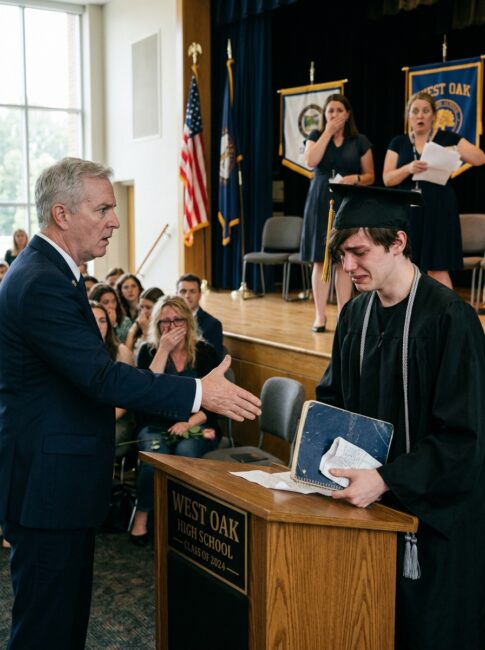
Principal Warner extended his hand.
And Evan, who had spent four years disappearing so other people could feel comfortable, left that hand hanging in the air.
The silence after Evan’s first sentence felt larger than the auditorium.
Principal Warner stepped back from the microphone, but he did not leave the stage.
Evan unfolded the paper in his hand.
“My name is Evan Miller,” he said. “Most of you know me as Caleb Miller’s brother.”
A rustle moved through the audience.
He looked at his classmates first.
“For four years, some of you called my brother a criminal when you passed me in the hall. Some of you never said it, but your parents did when they thought I couldn’t hear. And some of you were kind to me only when no one was watching.”
A few heads lowered.
Evan’s voice trembled, but it did not break.
“I used to think graduation meant leaving all of that behind. Then I realized leaving quietly would make it easy for everyone to keep the story exactly how they liked it.”
Principal Warner shifted.
Evan placed the old school report on the podium.
“My brother made a terrible mistake. He hurt a man. He pleaded guilty, and he is still paying for it. But before that night, he tried to protect someone this school refused to protect.”
A woman in the second row gasped.
Daniel Keene stood halfway, then sat when every face turned toward him.
Evan did not say Maya’s name.
He had promised himself he would not.
“A girl asked for help,” Evan said. “My brother believed her. He reported it. Twice. Adults with power decided it was easier to protect a reputation than a person.”
The auditorium seemed to stop breathing.
Mrs. Alvarez closed her eyes.
Evan looked down at Caleb’s notebook, open beside his speech. His fingers touched the worn cover.
“My brother told me not to make him a hero. He said one good thing does not erase one bad night. He is right.”
That sentence moved through the room differently than anger would have.
It made people listen.
“But one bad night should not erase every good thing he did before it. It should not erase the little brother he raised while our mom worked late. It should not erase the girl he believed when nobody wanted the trouble. And it should not teach a town to punish a child for sharing a last name.”
Ruth began to cry into both hands.
Evan finally looked at the empty chair beside her.
“My brother asked permission to be here tonight. He was denied. So that chair is for him.”
His lips pressed together for a moment.
“And it is also for every person who was missing from the room because someone decided their pain was inconvenient.”
No one clapped.
Not yet.
They were too busy feeling the weight of what they had accepted without asking.
Evan turned his head slightly toward Principal Warner.
“I won’t shake your hand tonight,” he said, quieter now. “Not because I hate you. Because my hand belongs first to the people who held me when this place let me fall.”
Then he stepped away from the podium.
For one suspended second, nothing happened.
Then Ruth stood.
Her chair scraped loudly against the floor. She clapped once, then again, crying so hard she could barely see her son.
Mrs. Alvarez stood next.
Then a few students.
Then more.
The applause did not arrive like thunder. It came unevenly, painfully, as if people were learning how to use their hands for something other than judgment.
Evan walked down from the stage without looking back.
At the bottom of the steps, his mother reached for him.
He folded into her arms, cap crooked, gown wrinkled, face finally young again.
“I’m sorry,” she whispered.
“For what?”
“For all the days I couldn’t make it stop.”
Evan held her tighter.
From across the aisle, Daniel Keene remained seated. His face was unreadable. But after a long moment, he looked at the empty chair beside Ruth, then down at his own hands.
No speech fixed the past that night.
Principal Warner did not confess from the stage. The town did not become kinder before sunset. Caleb did not walk through the auditorium doors in a pressed shirt, smiling like the years had been returned.
But something shifted.
Small things.
Classmates who had avoided Evan stood in the lobby, unsure how to apologize. A mother who had once pulled her daughter away from Ruth touched Ruth’s shoulder and said only, “I didn’t know.”
Ruth nodded, not forgiving, not refusing.
Just hearing.
Later that evening, Evan and his mother drove to North Ridge. Visiting hours were over, but they parked outside the fence anyway.
The sky was turning lavender.
Evan still wore his graduation gown.
Ruth handed him his diploma.
Through the distant windows, no one could see Caleb. Still, Evan stood beside the car and lifted the diploma with both hands, facing the prison like a boy showing his brother a sunrise.
His phone buzzed a minute later.
A message from an unknown number appeared.
He saw you from the rec room window. He’s crying, but he told me to say he’s proud.
Evan read it twice.
Then he sat on the hood of the car, opened Caleb’s old notebook, and tucked his diploma inside the back cover with Maya’s note and the essay his teacher had once marked inappropriate.
Ruth sat beside him.
For a while, neither of them spoke.
The prison lights flickered on one by one across the field.
Evan looked at them and imagined his brother somewhere behind the glass, still asking him to live bigger than the story people had handed him.
When Ruth finally reached for his hand, Evan let her take it.
He did not feel healed.
He felt seen.
And sometimes, after years of being mistaken for someone else’s worst day, being seen is where a life begins again.
For more heartfelt stories about family, justice, and the quiet courage people carry unseen, follow this page and keep reading with us.